
Tag Archives: Socialism

Jay Richards: eight common myths about wealth, poverty and the free market

Have you read Jay Richards’ book “Money, Greed and God?” Because if you haven’t, he’s written a series of articles that summarize the main points of the book.

The index post is here.

Here are the posts in the series:

  • Part 1: The Eight Most Common Myths about Wealth, Poverty, and Free Enterprise
  • Part 2: Can’t We Build A Just Society?
  • Part 3: The Piety Myth
  • Part 4: The Myth of the Zero Sum Game
  • Part 5: Is Wealth Created or Transferred?
  • Part 6: Is Free Enterprise Based on Greed?
  • Part 7: Hasn’t Christianity Always Opposed Free Enterprise?
  • Part 8: Does Free Enterprise Lead to An Ugly Consumerist Culture?
  • Part 9: Will We Use Up All Our Resources?
  • Part 10: Are Markets An Example of Providence?

Parts 4 and 5 are my favorites. It’s so hard to choose one to excerpt, but I must. I will choose… Part 4.

Here’s the problem:

Myth #3: The Zero Sum Game Myth – believing that trade requires a winner and a loser. 

One reason people believe this myth is because they misunderstand how economic value is determined. Economic thinkers with views as diverse as Adam Smith and Karl Marx believed economic value was determined by the labor theory of value. This theory stipulates that the cost to produce an object determines its economic value.

According to this theory, if you build a house that costs you $500,000 to build, that house is worth $500,000. But what if no one can or wants to buy the house? Then what is it worth?

Medieval church scholars put forth a very different theory, one derived from human nature: economic value is in the eye of the beholder. The economic value of an object is determined by how much someone is willing to give up to get that object. This is the subjective theory of value.

And here’s an example of how to avoid the problem:

How you determine economic value affects whether you view free enterprise as a zero-sum game, or a win-win game in which both participants benefit.

Let’s return to the example of the $500,000 house. As the developer of the house, you hire workers to build the house. You then sell it for more than $500,000. According to the labor theory of value, you have taken more than the good is actually worth. You’ve exploited the buyer and your workers by taking this surplus value. You win, they lose.

Yet this situation looks different according to the subjective theory of value. Here, everybody wins. You market and sell the house for more than it cost to produce, but not more than customers will freely pay. The buyer is not forced to pay a cost he doesn’t agree to. You are rewarded for your entrepreneurial effort. Your workers benefit, because you paid them the wages they agreed to when you hired them.

This illustration brings up a couple important points about free enterprise that are often overlooked:

1. Free exchange is a win-win game.

In win-win games, some players may end up better off than others, but everyone ends up better off than they were at the beginning. As the developer, you might make more than your workers. Yet the workers determined they would be better off by freely exchanging their labor for wages, than if they didn’t have the job at all.

A free market doesn’t guarantee that everyone wins in every competition. Rather, it allows many more win-win encounters than any other alternative.

2. The game is win-win because of rules set-up beforehand. 

A free market is not a free-for-all in which everybody can do what they want. Any exchange must be free on both sides. Rule of law, contracts, and property rights are needed to ensure exchanges are conducted rightly. As the developer of the house, you’d be held accountable if you broke your contract and failed to pay workers what you promised.

An exchange that is free on both sides, in which no one is forced or tricked into participating, is a win-win game.

On this view, what you really need to fear as a consumer is government intervention that restricts your choices in the marketplace.

Economists agree on the benefits of free trade

Who could possibly disagree with free trade? Well, many people on the left do. They favor imposing restrictions on free trade. For example, people on the left favor making those who import goods pay tariffs, which makes it harder to trade with other nations. People on the left want to pass rent control laws to block landlords and tenants from trading more freely. People on the left want to pass minimum wage laws that block employers and workers from trading wages for labor more freely. But economists generally don’t agree with any of restrictions on free trade. In fact, even across the ideological spectrum, the majority of economists view free trade as a wealth creating policy, and restrictions on free trade as a wealth destroying policy.

Harvard economist Greg Mankiw explains what most professional economists agree on.

Excerpt:

Here is the list, together with the percentage of economists who agree:

  1. A ceiling on rents reduces the quantity and quality of housing available. (93%)
  2. Tariffs and import quotas usually reduce general economic welfare. (93%)
  3. Flexible and floating exchange rates offer an effective international monetary arrangement. (90%)
  4. Fiscal policy (e.g., tax cut and/or government expenditure increase) has a significant stimulative impact on a less than fully employed economy. (90%)
  5. The United States should not restrict employers from outsourcing work to foreign countries. (90%)
  6. The United States should eliminate agricultural subsidies. (85%)
  7. Local and state governments should eliminate subsidies to professional sports franchises. (85%)
  8. If the federal budget is to be balanced, it should be done over the business cycle rather than yearly. (85%)
  9. The gap between Social Security funds and expenditures will become unsustainably large within the next fifty years if current policies remain unchanged. (85%)
  10. Cash payments increase the welfare of recipients to a greater degree than do transfers-in-kind of equal cash value. (84%)
  11. A large federal budget deficit has an adverse effect on the economy. (83%)
  12. A minimum wage increases unemployment among young and unskilled workers. (79%)
  13. The government should restructure the welfare system along the lines of a “negative income tax.” (79%)
  14. Effluent taxes and marketable pollution permits represent a better approach to pollution control than imposition of pollution ceilings. (78%)

Now when you are talking to a Democrat, you are talking to someone who disagrees with most or all of those common sense economic policies. For example, Obama’s backers in the labor movement inevitably endorse higher import tariffs, which discourage free trade between countries. No economist supports these tariffs on imports, because history has shown (e.g. – Smoot-Hawley Act) that tariffs destroy economic growth and reduce wealth creation. And that’s what I mean when I talk about economic illiteracy – I mean ignoring what we know from economics and our past experience with bad policies.

Democrat economic policies don’t work because they are making policies that are based on economic myths. We know that these myths are myths because of economics is a mathematical science, and because we have tried good and bad policies in different times and places. We have calculations and we have experience to know what works and what doesn’t work. If you want to help the poor, you have to respect what economists know about how wealth is created. The solution is not to “spread the wealth around”, it’s to encourage people to create more wealth by inventing things that people freely choose to buy.
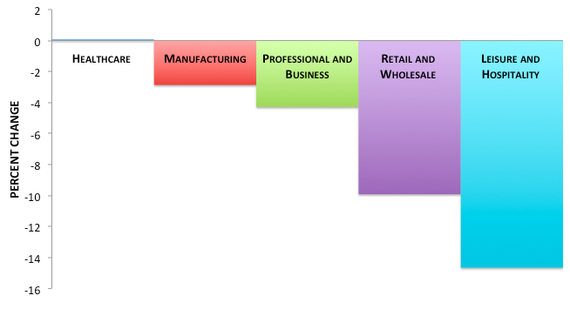
Should young Americans feel confident about their economic prospects?

Wages of Young Americans (Source: The Atlantic)

Graph: Young People’s Wages Have Fallen Across Industries Between 2007 and 2013.

Young Americans are taking longer to graduate and graduating with more debt, but that’s not all – they aren’t find jobs, and the jobs they do find typically don’t allow them to pay back their loans.

Here’s an article from The Atlantic, which leans left.

Excerpt:

American families are grappling with stagnant wage growth, as the costs of health care, education, and housing continue to climb. But for many of America’s younger workers, “stagnant” wages shouldn’t sound so bad. In fact, they might sound like a massive raise.

Since the Great Recession struck in 2007, the median wage for people between the ages of 25 and 34, adjusted for inflation, has fallen in every major industry except for health care.

These numbers come from an analysis of the Census Current Population Surveyby Konrad Mugglestone, an economist with Young Invincibles.

In retail, wholesale, leisure, and hospitality—which together employ more than one quarter of this age group—real wages have fallen more than 10 percent since 2007. To be clear, this doesn’t mean that most of this cohort are seeing their pay slashed, year after year. Instead it suggests that wage growth is failing to keep up with inflation, and that, as twentysomethings pass into their thirties, they are earning less than their older peers did before the recession.

The picture isn’t much better for the youngest group of workers between 18 and 24. Besides health care, the industries employing the vast majority of part-time students and recent graduates are also watching wages fall behind inflation. (40 percent of this group is enrolled in college.)

It’s not just that – the Democrats are doing a pretty good job of wrecking other parts of the economy, from energy development to health care to entitlement programs to college tuition, which rises higher as government throws more money into the system. They are doing everything they can to wreck the economy with higher taxes and burdensome regulations.

As a result of our headlong rush towards socialism, the U.S. economy has now fallen to number 2 in the worldbehind China.

Look:

We’re no longer No. 1. Today, we’re No. 2. Yes, it’s official. The Chinese economy just overtook the United States economy to become the largest in the world. For the first time since Ulysses S. Grant was president, America is not the leading economic power on the planet.

It just happened — and almost nobody noticed.

The International Monetary Fund recently released the latest numbers for the world economy. And when you measure national economic output in “real” terms of goods and services, China will this year produce $17.6 trillion — compared with $17.4 trillion for the U.S.A.

As recently as 2000, we produced nearly three times as much as the Chinese.

To put the numbers slightly differently, China now accounts for 16.5% of the global economy when measured in real purchasing-power terms, compared with 16.3% for the U.S.

This latest economic earthquake follows the development last year when China surpassed the U.S. for the first time in terms of global trade.

So things are bad for young people, and it’s going to get worse.

It’s important to check what major you are studying to make sure you get a return on your investment, and don’t be scared to study something you hate if it means that you can make your career work. Your education and career choices are not about fulfillment and thrills. You have to make hard choices in order to make ends meet so that you have freedom to do the things you ought to do, especially if you want to get married and start a family. Those marriage and family plans start the day you step into high school, in my opinion.

UPDATE: 17.7% Teen Unemployment in America – Still Above Rate of 6 Years Ago and Labor Force Participation Remains at 36-Year Low.

New study: stronger net neutrality laws are a tax on Internet use

The leftist Washington Post reports on a new study which counts the cost of the Obama administration’s proposed “net neutrality” policies.

Excerpt:

[A] new study suggests that strong controls on Internet providers might force Americans to pay more for their Internet, anyway.

Internet service providers would be subject to more than $15 billion a year in new fees if the Federal Communications Commission decides to start regulating them with Title II of the Communications Act — the same tool the agency uses to police telephone service, according to Hal Singer and Robert Litan, two economists who support less-aggressive net neutrality rules. And those charges, they say, would inevitably be passed along to you.

Regulating broadband under Title II would allow federal, state and local governments to collect the same fees from ISPs that they already levy on phone companies. Among these are a “universal service” fee that was established decades ago to help ensure everyone in the country had access to telephone service.

In a paper published by the Progressive Policy Institute, Singer and Litan argue that these and other charges stemming from various state and local rules could add $84 or more to a U.S. household’s yearly Internet bill.

“Although the state and federal governments collect these fees from broadband providers,” Singer and Litan write, “history shows — and economic models of competitive markets predict — that the fees are passed along to customers, just as they are now on telecommunication services. So consumers’ Internet bills will soon have all those random charges tacked on at the end, much like they see on their phone bills.”

The study is the latest effort by opponents of strong net neutrality rules to describe the potential economic fallout of regulating ISPs under Title II. Last month, telecom lobbyists argued to the FCC that aggressive regulation would slow down the pace of industry investment in network upgrades, to the tune of $45 billion over the next five years.

And there is this from the Heartland Institute, a free-market think tank:

On June 17, FCC Chairman Julius Genachowski pushed through a 3-2 vote along party lines to begin his agency’s process of reclassifying broadband Internet access under a more restrictive regulatory regime known as Title II. Once the Internet is reclassified as a telecommunications service rather than an information service under Title I, the FCC will have seized the power necessary to micromanage the vibrant medium we take for granted.

Numerous studies have found FCC enforcement of net neutrality rules would harm the digital economy and consumers. The research on net neutrality points out regulation would stifle innovation and impose costs that would be passed on to consumers. Study after study finds net neutrality is an attempt to fix a “market failure” that doesn’t exist.

A recent study from New York University concluded net neutrality would cost Americans 500,000 jobs and $62 billion over the next five years. The international market research firm Frost & Sullivan found net neutrality regulations would likely pass on to the consumer up to $55 per month in additional costs. These and other studies show a hands-off approach to Internet regulation maximizes social and economic welfare.

The rest of the Heartland post links to studies that discuss the impact to the economy and to consumers of these net neutrality laws.