Tag Archives: Socialism

Democrat debate: spend more money, raise taxes, ban guns and fossil fuels

It's almost Hallowe'en, and this debate scared me
It’s almost Hallowe’en, and this debate scared me

Here’s Bernie Sanders explaining what the number 1 foreign policy threat to the United States is:

It’s not Iran getting a nuclear weapon. It’s not Russian aggression in the Ukraine. It’s not the Middle East on fire after we retreated from Iraq. It’s not China militarizing and stealing our military secrets by hacking our computers. Forget all that. The really big threat is the over 18 years of no warming that we’ve had, which is (to them) a sure sign that we’re all going to die a fiery death.

Here’s a review of the debate from National Review.

Excerpt:

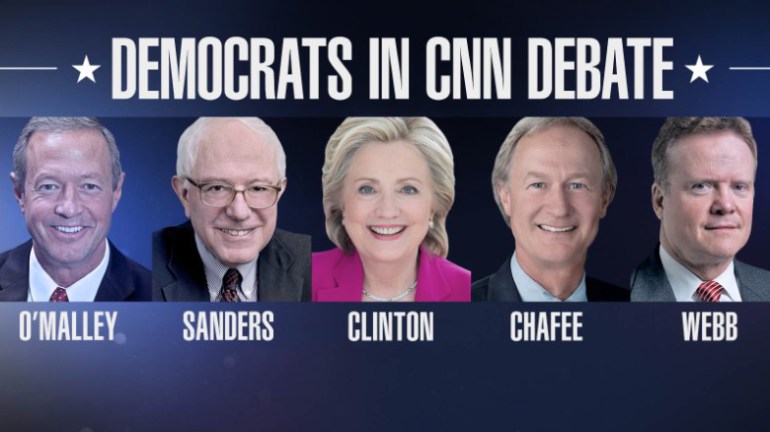
In one of the few surprises of the night, Bernie Sanders did his best to try to save her on her troubles with her personal e-mail server. He’s an old fool if he thinks Hillary will return the favor when he needs it. Martin O’Malley, who sounded tough in cable-news interviews, wimped out in the end once he saw the audience’s roaring applause to Sanders’s declaration that the issue was settled and nobody needed to hear any more about “her damn e-mails.”

Sanders may rock the arenas when they’re filled with progressive grassroots activists, but his style doesn’t transfer well to a broader audience. He’s the party guest whom you instinctively don’t want to talk to, who begins shouting immediately, who grabs your lapel and spits a bit as he jabs his finger into your chest for emphasis. He’s Senator Larry David. You want to get away from his perpetually irritated (and irritating) ranting, but he just won’t stop talking, and he won’t let you gently back away or escape the conversation. Every two-minute answer felt like ten minutes of shouting — and he had the audacity to give Hillary grief about shouting.

Beyond his giant wimp-out on Hillary’s e-mails, O’Malley was more pleasant to listen to but is ultimately going to be a non-factor in this race. When Sanders finished his call for a revolution, O’Malley turned to the camera and said with a big smile, “What we need is a green-energy revolution!” And for a moment, he waited for applause that didn’t come. The Democratic audience wasn’t in a mood for innovation. They are in a mood for populist revenge against people who have more than they do. Sanders shouts, O’Malley whispers.

Jim Webb pointed out how affirmative action disadvantages poor whites, the need to respect the rights of gun owners, the seriousness of foreign-policy threats that Democrats rarely acknowledge — like cyber threats, hacking (ahem), and China. He was the lone voice of reality saying,“With all due respect to Senator Sanders, I don’t think the revolution is going to come, and I don’t think the Congress is going to pay for all this.”

Webb has a good chance of winning the Democratic nomination in 1948. You almost have to wonder how Webb would be doing in the GOP presidential primary, but at a key moment, Webb flinched, saying he wouldn’t have a problem with extending Obamacare benefits to illegal immigrants.

So all the candidates on the stage proposed a lot of spending (e.g. – free college tuition) and paying for it by taxing the rich. As if the rich are going to stand there and take it, and not simply respond by laying off workers, outsourcing, and even moving their operations out of the country entirely. Should we really be giving free college degrees in English to people, and paying for it by taxing entrepreneurs and job creators? Can no one see the negative consequences of taxing the people who invent products, run companies and create jobs? Do people really continue to work as hard when you take more and more of their money, or do they not scale back their work or stop working entirely?

Should we really go “well beyond” what Obama did with his executive order amnesty? Should we really be covering illegal immigrants under Obamacare? All the candidates seemed to be fine with amnesty for millions of unskilled immigrants. Again, no worry about how to pay for a whole bunch of people who use more in government programs than they pay for in taxes. Where will the money come from? Will “the rich” just lie down and hand over their money and keep working like before as more and more of their money is taken from them and their families, and given to others? How did the Democrat candidates respond to the problem of illegal immigrants who are convicted of crimes being released to murder ordinary citizens? Their answer: disarm the ordinary citizens. Take their guns. And release the drug criminals from the jails.

New regulations were proposed. Glass-Steagall and restrictions on energy development. Only Webb had a sensible view of energy development, including nuclear power. The rest turned a blind eye to the massive pollution caused by India and China and promised to stop the global warming with expensive wind and solar power.

And what about all the wars created by our weakness with Russia, China, Iran, Islamic State? Well, except for Webb, the candidates promised to end these wars, apparently unilaterally, and with a magic wand. Whoosh! There, all the wars are ended. Because that’s what the Democrat voters want to hear. They want simplistic solutions, and they can’t comprehend the motivations of other parties: job creators, banks, Russia, China, Iran, and so on. They just want what they want, and they have no idea what comes next as the other people in the room respond to the new rules.

Jim Webb

Webb was the only grown-up on the stage, and he is more like the old-style Democrat who actually was competent, and actually loved his country:

When asked whether only black lives matter, or whether all lives matter, Webb was the ONLY one to say that all lives matter. He was the only one was serious about foreign policy. And the only one who was serious about what all this spending would cost.

God help us all if anyone other than Webb is the nominee. I really was scared for my country listening to the other candidates pander to their clueless base.

To get another reaction to the first CNN debate, you can listen to the latest episode of the Weekly Standard podcast.

New study: negative effects of day care on children not caused by quality of day care

Does government provide incentives for people to get married?
Mom is staying home because Dad can afford to let her: do kids benefit?

New study using National Institute of Child Health and Human Development data is discussed on the Family Studies web site.

First, let’s get the two views:

Parents, policymakers, and academics interested in how day care and preschool affect child development often embrace one of two competing—and exaggerated—claims about the childrearing circumstances that are now normative in America: that of non-family care being initiated early in a child’s first year of life on a full-time or near-full-time basis and continuing, in one form or another (e.g., family day care, center care, preschool), until the start of formal schooling.

Critics of such arrangements highlight the fact that developmental risks, like increased rates of insecure attachment and elevated levels of aggressive behavior, have been found to be associated with the extensive use of non-family care in America. Advocates, in contrast, stipulate, usually without qualification, that if the quality of care is good, then children benefit; and, indeed, that it is the limited quality of care available to too many parents in the USA that is responsible for any negative effects on children that emerge in the research literature.

All right, so the big-government, anti-family people say that day care as such isn’t bad for kids, the negative effects that are observed are not caused by too much day care, but by the low quality of the day care. The conservative, pro-family, limited-government crowd thinks that quality doesn’t matter as much as quantity – too much day care is bad for kids, regardless of quality.

The study details:

[…][T]he National Institute of Child Health and Human Development (NICHD) funded, to the tune of at least $150 million, the NICHD Study of Child Care and Youth Development. It recruited more than 1,000 children (along with their mothers) in 1991 from 10 different research sites, and followed them from the first month of life to age 15. Among other purposes, the NICHD Study was designed to investigate the claim that long hours of day care initiated very early in life posed risks to children’s social and emotional development; and, should this prove so, to evaluate the proposition that such negative effects would be due to the poor quality of care that children received, not the quantity of care they experienced across the first five years of life.

And the conclusion:

NICHD Study’s findings on the effects of day care proved more consistent than inconsistent with my “developmental risk” claim. And they provided virtually no support for the idea that it was poor quality care that accounted for the negative effects of “early, extensive, and continuous” care (initiated very early in life, for long hours, and continuing for many years).2 Specifically, our many research reports revealed that the more time children spent in any kind of non-familial child care, and sometimes specifically in centers, the more aggressive and disobedient they proved to be at two (but not three) and 4.5 years of age, as well as across their elementary school years; and the more impulsive they proved to be at age 15, at which age they also engaged in more “risky” behavior than children who experienced far less non-familial care across their first five years of life. Critically, despite spending millions to carefully measure the quality of care, using methods and measures developed by the proponents of the “it’s quality, stupid” view, the study never found that the quality of care accounted for these quantity-of-care effects. In other words, the problem behavior associated with early, extensive, and continuous care emerged irrespective of whether quality of care was good or bad.

Read the whole thing, and don’t feel guilty if you can’t do the best for your kids. I am sure that everyone reading this post is going to do the best they can for their kids. But for those who have not yet had kids, let this be a lesson to you about what you should be studying in school, where you should be working, how much you should borrow, how much you should spend. A stay-at-home mom is expensive. It cannot be finessed with feelings and following your heart to fun and thrills.

When it comes to children, money is important

I know there are lots of Christians around the world who read the Bible and understand that there are certain goals laid out in the Bible for Christian parents who are raising their kids. As far as I can tell, young Christians seem to think that these goals will sort themselves out all by themselves through God’s mysterious predestination, or some other such fideistic wishing. What it really boils down to is that young people want to do what they want to do, and they can sound pious about it by saying God will somehow make their crazy plan work out. Well, that’s not effective, and young Christians would never act so ineffectively in any other area of their lives – ignoring how things really work.

Look the Bible has information about the specification that God expects you to implement. Part of that spec involves requirements for your kids. If you decide that the Bible is not trying to give you a spec, you’ll fail to deliver. If you decide that you don’t need to read studies to know how the world works, you’ll fail to deliver. If you decide that following your heart is something that God rewards more than intelligent thought, you’ll fail to deliver. You cannot feelings your way out of this assignment, you’ve got to solve the problem, and that means reading the studies and making a plan that delivers results.

So, young people. If you want to do the best for your kids, you better stop doing what feels good, and start engaging in some serious self-denial and self-sacrifice. Fumbling around chasing happy philosophy bubbles to Europe through your teens, 20s and 30s is not the right way to prepare professionally and financially for kids. Your love for your future kids begins with your decision to grow up and do hard, boring things that need to be done. You won’t be able to fix the child care costs problem at the 11th hour if you follow your heart for the first 10 hours. Keep in mind what child care looks like in places like Ontario, and what your children would be learning, and who they would be learning it from. Make a plan now.

Obama borrowed $10 trillion and all we got was this horrible jobs report

They told me if I voted Republican, we'd lose jobs, and they were right!
What kind of economic growth can you get from a community organizer?

Wow, you would think that there would be some organic economic growth after Obama added $10 trillion to the national debt, but the September jobs report looks more like a forecast for recession than anything else.

The Daily Signal reports:

The Bureau of Labor Statistics’ September jobs report showed unexpected weakness in the labor market.

The payroll survey showed that employers created only 142,000 jobs in September. The economy created only 167,000 net new jobs a month in the 3rd quarter—a substantial drop from the 231,000 jobs a month pace in the 2nd quarter.

The numbers are even worse for private-sector job growth. Large expansions in government hiring boosted the August and September figures. Private-sector job growth dropped from 220,000 net new jobs a month in the 2nd quarter to 138,000 in the 3rd quarter.

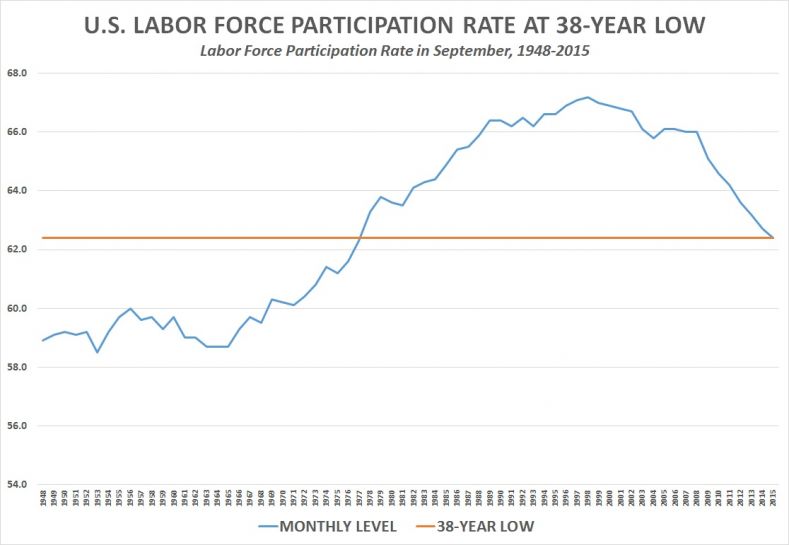
[…]The Household survey reported that the unemployment rate remained constant at 5.1 percent in September. Unfortunately, this happened only because almost 600,000 Americans left the labor force. People not looking for work do not count as unemployed, so the unemployment rate remained unchanged.

However, the labor force participation rate dropped another 0.2 percentage points to 62.4 percent—its lowest level since 1977.

[…][T]he September report follows a disappointing August report. Revisions also showed that employers created 60,000 fewer jobs in July and August than previously estimated.

CNS News says that the number of Americans not in the workforce is at 94,610,000. The Weekly Standard says we are going in reverse: ” For the last three months, average job growth comes in at 167,000. Nearly 100,000 below the average for 2014. We are going in reverse.” and “Of the 142,000 new jobs, 24,000 are in government. ”

The manufacturing sector is hardest hit, as Investors Business Daily explains:

The anemic September jobs report was bad news for anyone hoping that the economy had turned a corner. But it was even worse news for manufacturing, which is on a two-month losing streak.

Manufacturing shed 9,000 jobs last month on top of the 18,000 lost in August, completely erasing the gains made so far this year. Since January 2013, the industry has gained only 338,000.

All this flies in the face of President Obama’s repeated promise in 2012 that if reelected, he would create 1 million new manufacturing jobs by the end of his second term. Obama said that these new jobs would “put middle-class people back to work.” To make it happen, he promised to aggressively pursue corporate tax reform and unfair trade practices by China, set up new community-college/employer partnerships and create up to 20 “manufacturing innovation institutes.”

Since then, he’s done little if any of it.

The problem is big government regulations:

A study by the National Association of Manufacturers found that regulations cost the industry nearly $20,000 per worker in 2012. At smaller firms, the cost is almost $35,000 per worker.

It’s only getting worse, as new or impending regulations on CO2 emissions, smog, etc. threaten hundreds of thousands of manufacturing jobs.

Investors Business Daily says:

The biggest decline in the workforce has not been among the elderly, but the young, who just aren’t jumping into starter jobs at the normal rate.

[…]The workweek shrank again — to 34.5 hours — largely due to the rise of part-time hiring. Thank you, ObamaCare.

Obamacare forces employers to make workers part-time, or else pay more to employ them if they stay full-time. It’s a real genius-level policy.

More:

Can we finally repeal the law requiring employers to provide health benefits to workers once they log 30 hours of work in a week? Workers can’t pay their bills and feed their families with 28-hour paychecks.

Wages, which made decent gains over the previous several months, actually ticked down in September. So we are working less, for less.

This is no accident; it’s policy-induced slow growth.

It’s fitting that we get a disappointing jobs report in the very week that the administration says it will move forward with a new ozone containment rule that the National Association of Manufacturers says will be one of the biggest job-killing regulations in American history.

Obama still won’t allow the Keystone Pipeline, or the exporting of oil, which would be a major job producer. He won’t cut the corporate tax, or roll back ObamaCare rules hindering employment. His grandiose plans to save the planet come before putting Americans to work.

This is serious. I know that a lot of people in the media, in academia, in Hollywood, etc. think that you can tax and regulate your way to prosperity with laws like Obamacare, but it’s not true. Massive expansions of government and massive borrowing depress economic growth and job creation. Jobs come from entrepreneurs, and entrepreneurs do not like what they have seen from the government in the last 7 years under these Democrats.