
Tag Archives: Sexual Immorality

Study: women who have fewer premarital sex partners have lower risk of divorce

Man helping a woman with proper handgun marksmanship

Consider this article from Family Studies that talks about how the number of pre-marital sex partners that a woman has increases her risk of divorce.

It says:

American sexual behavior is much different than it used to be. Today, most Americans think premarital sex is okay, and will have three or more sexual partners before marrying. What, if anything, does premarital sex have to do with marital stability?

This research brief shows that the relationship between divorce and the number of sexual partners women have prior to marriage is complex. I explore this relationship using data from the three most recent waves of the National Survey of Family Growth (NSFG) collected in 2002, 2006-2010, and 2011-2013. For women marrying since the start of the new millennium:

  • Women with 10 or more partners were the most likely to divorce, but this only became true in recent years;
  • Women with 3-9 partners were less likely to divorce than women with 2 partners; and,
  • Women with 0-1 partners were the least likely to divorce.

Earlier research found that having multiple sex partners prior to marriage could lead to less happy marriages, and often increased the odds of divorce.

[…]Even more noteworthy has been the decline in the proportion of women who get married having had only one sex partner (in most cases, their future husbands). Forty-three percent of women had just one premarital sex partner in the 1970s.

[…]By the 2010s, only 5 percent of new brides were virgins. At the other end of the distribution, the number of future wives who had ten or more sex partners increased from 2 percent in the 1970s to 14 percent in the 2000s, and then to 18 percent in the 2010s. Overall, American women are far more likely to have had multiple premarital sex partners in recent years (unfortunately, the NSFG doesn’t have full data on men’s premarital sexual behavior, and in any event they recall their own marital histories less reliably than do women).

Here’s the change:
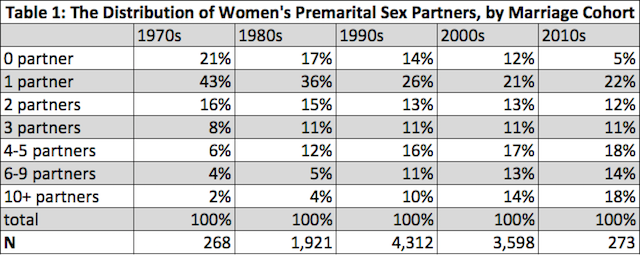
Women have freely chosen to dismiss the Bible and the moral law

And the problem with this, of course, is that more premarital sex partners means a higher risk of divorce:
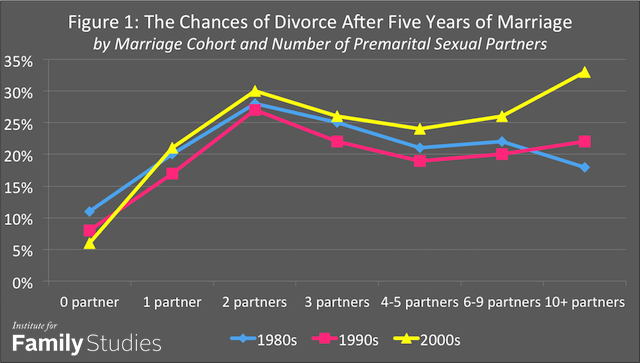
Even one non-husband premarital sex partner raises risk of divorce

Why is the 2-partner number so high?

In most cases, a woman’s two premarital sex partners include her future husband and one other man. That second sex partner is first-hand proof of a sexual alternative to one’s husband. These sexual experiences convince women that sex outside of wedlock is indeed a possibility. The man involved was likely to have become a partner in the course of a serious relationship—women inclined to hook up will have had more than two premarital partners—thereby emphasizing the seriousness of the alternative.

The Christian Post had an article about some recent numbers from the Centers for Disease Control about virgins.

Excerpt:

A new Centers for Disease Control study examines teenage health behaviors in connection to their self-reported sexual activity and shows those who remain abstinent are much healthier on many fronts than their sexually active peers.

The report, titled “Sexual Identity, Sexual Contacts, and Health-Related Behaviors Among Students in Grades 9-12, United States and Selected Sites,” showcased the results from a 2015 survey that monitored several categories of health-related behaviors like tobacco usage, drug and alcohol use, sexual habits, unhealthy dietary behaviors, and behaviors that contribute to unintentional injuries and violence.

The report concludes “that students who had no sexual contact have a much lower prevalance of most health-risk behaviors compared with students” who had sexual contact.

The article quotes Dr. Jennifer Roback Morse, who I have featured on this blog many times:

In a Monday interview with The Christian Post, Jennifer Roback Morse, founder and president of the Ruth Institute, said, “this study is remarkable because it asks questions and reports the answers, rather than avoiding questions or assuming answers.”

As Glenn Stanton noted last week in The Federalist, the results from those questions and answers are remarkable.

With regard to smoking, teenage virgins are 3,300 percent less likely to smoke daily than their peers who are sexually involved with someone of the opposite sex, Stanton computed from the report’s data. Teen virgins are 9,500 percent less likely to smoke daily than their peers who are sexually involved with someone of the same sex or in a bisexual relationship, he added. Chaste young people are also extremely less likely to use indoor tanning beds, binge drink, smoke marijuana, ride in cars as passengers with a drunk driver, and get into physical fights than their sexually active peers. Abstinent youth are also more likely to get a solid eight hours of sleep every night and eat breakfast daily.

[…]The CDC report also included findings from 25 state surveys, and 19 large, urban school district surveys conducted among students in grades 9–12 which took place between December of 2014 and September of 2015.

Now, many pro traditional marriage people will tell young men “feminism and the sexual revolution change nothing about a woman’s suitability for marriage, so go out there and get married to these women anyway”. In my experience, no one is telling women NOT to follow their hearts, and explaining to them the harm that they do by allowing their feelings to determine who they will engage in relationships.

I would like to see women make better decisions with men before they marry, rather than be influenced by their peers and culture to give themselves to men who are not marriage-minded. Maybe a little skepticism should be shown to “follow your heart”? Women need to understand what they are losing when they choose to have premarital sex.

In my group of friends, the men are aware of the Biblical prohibition on premarital sex. My friends know about the research on marriage, and what it takes to make a marriage work. We don’t follow our hearts, because we do what we know will work to achieve the results we want. We don’t listen to the culture, and we don’t listen to radical feminists. Men generally take an engineering approach to marriage – we want to know what the best practices and tradeoffs are, and then we plan and act to succeed.

Study: women who lose their virginity in their teens are more likely to divorce

College students puking in toilet

The UK Daily Mail reports on a study that shows that women who lose their virginity as teenagers are more likely to divorce.

Excerpt:

Women who lost their virginity as young teenagers are more likely to divorce – especially if it was unwanted, according to new research.

The University of Iowa study shows that 31 per cent of women who had sex for the first time as teens divorced within five years, and 47 per cent within 10 years.

Among women who delayed sex until adulthood, 15 per cent divorced at five years, compared to 27 per cent at 10 years.

The findings were published in the April issue of the Journal of Marriage and Family.

Author Anthony Paik, associate professor of sociology in the university’s College of Liberal Arts and Sciences, examined the responses of 3,793 married and divorced women to the 2002 National Survey of Family Growth.

The study showed, however, that if a young woman made the choice to lose her virginity as a teenager, there was no direct link to a marital split later in life.

If the sexual act took place before the age of 16 women were shown more likely to divorce, even if it was wanted.

Thirty-one percent of women who lost their virginity during adolescence had premarital sex with multiple partners, compared to 24 per cent of those who waited.

Twenty-nine percent experienced premarital conceptions, versus 15 percent who waited.

One in four women who had sex as a teen had a baby before they were married, compared to only one in ten who waited until adulthood.

Only one per cent of women surveyed said they chose to have sex at age 13 or younger, compared to five per cent at age 14 or 15, and 10 per cent at age 16 or 17.

Forty two per cent reported that their first sexual intercourse before age 18 that was not completely wanted.

Fifty eight per cent of the group waited until age 18 or older to have sex. Of those, 22 per cent said it was unwanted, compared to 21 per cent who said it was wanted.

Researchers concluded sex itself may not increase the probability of divorce, while factors such as a higher number of sexual partners, pregnancy, or out-of-wedlock birth increased the risk for some.

If you want a stable marriage, then you don’t have sex before you’re married. There are tons of virgins out there, and there is a huge difference in the quality of romantic relationships when both parties exercise self-control with physical touching. Don’t let it go too far – you lose some of what love and marriage can be.

Don Johnson: six reasons why people reject Christianity

Here’s a post on practical evangelism by Christian scholar Don Johnson.

His list of reasons why people often reject Christianity:

  1. Christians behaving badly
  2. Disappointment with God
  3. Weak or absent father
  4. Social pressure
  5. Cost of discipleship
  6. Immorality (especially sexual immorality)

And here’s the detail on #6:

Of all the motivations and reasons for skepticism that I encounter, immorality is easily the most common. In particular, sexual sin seems to be the largest single factor driving disbelief in our culture. Brant Hanson calls sex “The Big But” because he so often hears this from unbelievers: “’I like Jesus, BUT…’ and the ‘but’ is usually followed, one way or the other, with an objection about the Bible and… sex. People think something’s deeply messed-up with a belief system that says two consenting, unmarried adults should refrain from sex.” In other words, people simply do not want to follow the Christian teaching that sexual intercourse should take place only between and man and woman who are married, so they throw the whole religion out.

The easiest way to justify sin is to deny that there is a creator to provide reality with a nature, thereby denying that there is any inherent order and purpose in the universe.

Aldous Huxley admitted that this is a common reason for skepticism:

I had motives for not wanting the world to have a meaning; consequently I assumed that it had none and was able without any difficulty to find satisfying reasons for this assumption…. Those who detect no meaning in the world generally do so because, for one reason or another, it suits their books that the world should be meaningless. …

For myself as, no doubt, for most of my contemporaries, the philosophy of meaninglessness was essentially an instrument of liberation. The liberation we desired was …liberation from … a certain system of morality.  We objected to the morality because it interfered with our sexual freedom…. There was one admirably simple method in our political and erotic revolt: We could deny that the world had any meaning whatsoever. Similar tactics had been adopted during the eighteenth century and for the same reasons. (Ends and Means, 270-273)

Indeed, similar tactics have been used extensively up to the present day. If you are looking for two great resources that document the extent to which the work of the world’s “great” atheistic thinkers has been “calculated to justify or minimize the shame of their own debauchery,” (Spiegel, 72) I recommend Intellectuals by Paul Johnson and Degenerate Moderns: Modernity as Rationalized Sexual Misbehavior by E. Michael Jones. The bottom line is that these skeptical scholars didn’t reach their conclusions by following the evidence where it led. They didn’t “discover” that the world was meaningless and then proceed to live accordingly. They lived sinful lives (usually involving some type of sexual deviancy) and then produced theories that justified their actions.

It’s important to understand that an atheist is not identical to a Christian, except not religious. There is something else going on in their minds when they reject very obvious evidences like the origin of the universe, the cosmic fine-tuning, the origin of life, the Cambrian explosion, the habitability arguments, etc. The something else that is going on is hinted at when you look at atheist attitudes to abortion. According to a recent survey of atheists, 97% of them were pro-abortion!

What kind of person likes abortion? The kind of person who wants to be sexually active with no consequences, even if it means taking someone else’s life. The desire to do as they please and retreat from obligations to others is the key. Now dispensing with God and his obligations is not an unreasonable view if there is no evidence for God, but it does provide a motive for people to not look for that evidence if happiness is their main goal. When I discuss these issues with atheists, I find that no work has been done to read anything. Not even debates, where there are two sides. They don’t want to hear the case for Christian theism, and they work hard to avoid stumbling across it by accident, too.

God and the cosmic authority problem

Tough Questions Answered has a quote from Christian philosopher Paul Moser that I think is relevant:

It would be a strange, defective God who didn’t pose a serious cosmic authority problem for humans.  Part of the status of being God, after all, is that God has a unique authority, or lordship, over humans.  Since we humans aren’t God, the true God would have authority over us and would seek to correct our profoundly selfish ways.

So we’re not dealing with unbiased truth-seekers here. The goal might not always be sex, but let’s be honest. Who wants to have to spend time reading the Bible, praying, going to church and reading thick books by Stephen C. Meyer, Michael Licona and Hugh Ross so that we can answer questions? No one. Who wants to give up premarital sex so that we can create a stable marriage for children so they can grow up in a safe place where knowing God is natural and easy? No one. We just don’t want to have to do stuff for God, even if it’s good stuff. We don’t want to have build a life that is a testament to God’s existence and character, especially if it means that other people will think that we are weird and maybe even a bit mean. We want to do what we want to do instead, and be liked by other people.

That’s the real challenge of Christianity: setting aside what you wanted to do, and letting God be your customer, instead. You’d be surprised how many Christians aren’t comfortable with the idea of serving God and being viewed in a bad way by non-Christians. They aren’t OK with the self-sacrifice, and they are really not OK with the social disapproval. It’s hard to be chaste, and to be known to be chaste by your peers, for example. Much easier to just give in and do what everyone else is doing.

Let’s illustrate with C.S. Lewis

And here’s a relevant quote from C.S. Lewis’ “The Screwtape Letters” to illustrate:

You must have often wondered why the enemy [God] does not make more use of his power to be sensibly present to human souls in any degree he chooses and at any moment. But you now see that the irresistible and the indisputable are the two weapons which the very nature of his scheme forbids him to use. Merely to over-ride a human will (as his felt presence in any but the faintest and most mitigated degree would certainly do) would be for him useless. He cannot ravish. He can only woo. For his ignoble idea is to eat the cake and have it; the creatures are to be one with him, but yet themselves; merely to cancel them, or assimilate them, will not serve…. Sooner or later he withdraws, if not in fact, at least from their conscious experience, all supports and incentives. He leaves the creature to stand up on its own legs—to carry out from the will alone duties which have lost all relish…. He cannot “tempt” to virtue as we do to vice. He wants them to learn to walk and must therefore take away his hand…. Our cause is never more in danger than when a human, no longer desiring, but still intending, to do our enemy’s will, looks round upon a universe from which every trace of him seems to have vanished, and asks why he has been forsaken, and still obeys.

— Uncle Screwtape, in The Screwtape Letters

I’m not a big fan of Lewis, but I think he is onto something there. That’s really what the Christian life is like, and no wonder more people don’t choose it. Who wants to do your duty for God, as part of a relationship with him, in a universe that seems so unfair? It’s a tall order, and most people prefer to do their own thing instead of building something nice for God with their lives.