Tag Archives: Self-Organization

What is intelligent design? Dr. Stephen C. Meyer explains in this video

A MUST-SEE lecture based on Dr. Stephen C. Meyer’s book “Signature in the Cell“. (H/T Chris S.)

You can get an MP3 of the lecture here. (30 MB)

I highly recommend watching the lecture, and looking at the slides. The quality of the video and the content is first class. There is some Q&A (9 minutes) at the end of the lecture.

Topics:

  • intelligent design is concerned with measuring the information-creating capabilities of natural forces like mutation and selection
  • Darwinists think that random mutations and natural selection can explain the origin and diversification of living systems
  • Darwinian mechanisms are capable of explaining small-scale adaptive changes within types of organisms
  • but there is skepticism, even among naturalists, that Darwinian mechanisms can explain the origin of animal designs
  • even if you concede that Darwinism can account for all of the basic animal body plans, there is still the problem of life’s origin
  • can Darwinian mechanisms explain the origin of the first life? Is there a good naturalistic hypothesis to explain it?
  • there are at least two places in the history of life where new information is needed: origin of life, and Cambrian explosion
  • overview of the structure of DNA and protein synthesis (he has helpful pictures and he uses the snap lock blocks, too)
  • the DNA molecule is composed of a sequence of proteins, and the sequence is carefully selected to have biological function
  • meaningful sequences of things like computer code, English sentences, etc. require an adequate cause
  • it is very hard to arrive at a meaningful sequence of a non-trivial length by randomly picking symbols/letters
  • although any random sequence of letters is improbable, the vast majority of sequences are gibberish/non-compiling code
  • similarly, most random sequences of amino acids are lab-proven (Doug Axe’s work) to be non-functional gibberish
  • the research showing this was conducted at Cambridge University and published in the Journal of Molecular Biology
  • so, random mutation cannot explain the origin of the first living cell
  • however, even natural selection coupled with random mutation cannot explain the first living cell
  • there must already be replication in order for mutation and selection to work, so they can’t explain the first replicator
  • but the origin of life is the origin of the first replicator – there is no replication prior to the first replicator
  • the information in the first replicator cannot be explained by law, such as by chemical bonding affinities
  • the amino acids are attached like magnetic letters on a refrigerator
  • the magnetic force sticks the letters ON the fridge, but they don’t determine the specific sequence of the letters
  • if laws did determine the sequence of letters, then the sequences would be repetitive
  • the three materialist explanations – chance alone, chance and law, law alone – are not adequate to explain the effect
  • the best explanation is that an intelligent cause is responsible for the biological explanation in the first replicator
  • we know that intelligent causes can produce functional sequences of information, e.g. – English, Java code
  • the structure and design of DNA matches up nicely with the design patterns used by software engineers (like WK!)

There are some very good tips in this lecture so that you will be able to explain intelligent design to others in simple ways, using everyday household items and children’s toys to symbolize the amino acids, proteins, sugar phosphate backbones, etc.

Proteins are constructed from a sequence of amino acids:

A sequence of amino acids forming a protein

Proteins sticking onto the double helix structure of DNA:

Some proteins sticking onto the sugar phosphate backbone

I highly, highly recommend this lecture. You will be delighted and you will learn something.

If you want to read something more about the material that he is covering, there is a pretty good article here.

Related posts

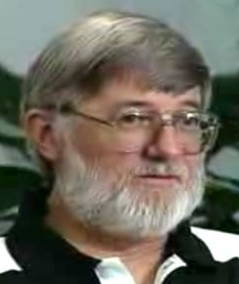
Video interview of Charles Thaxton on the origin of life

Charles Thaxton
Charles Thaxton

When I was a younger man, just starting full-time work with a hot Internet start-up in the big city, my biggest interest was in the origin of life. I liked to listen to debates about it (e.g. – Walter Bradley versus Robert Shapiro, etc.) and lectures and interviews. Two of my favorite interviews are from the University of California series on Origins, featuring Charles Thaxton and Dean Kenyon.

I found the one with Charles Thaxton in miniature form on Youtube.

About Charles Thaxton:

Charles Thaxton received his Ph.D. in physical chemistry from Iowa State University. He completed two post-doctoral programs, one in history of science at Harvard University and the second in the molecular biology laboratories of Brandeis University.

He has specialized in the origin of life and in science’s relationship with Christianity through history.

He is co-author of The Mystery of Life’s Origin and also The Soul of Science. He is Academic Editor of the high school biology book Of Pandas and People. He has contributed significant chapters to the books God and Culture and The Creation Hypothesis.

He has published technical articles in Journal of Inorganic Chemistry, Journal of Scientific Instruments, and Journal of Cell Biology.

He has lectured widely in American universities including Princeton University, Yale University, University of Michigan, University of Delaware, Rice University, Texas Universtiy, Johns Hopkins University, Vanderbilt University, and Harvard Law School.

He has lectured outside the country at the Korean Advanced Institute of Science, the Russian Academy of Science, and in various universities in Mongolia, Romania, Poland, Hungary, and the former Czechoslovakia.

He has held appointments at Slovak Technical University in Bratislava, Czechoslovakia, the Biomathematical Institute in Craiova, Romania, and at Charles University in Prague, where he was a Templeton scholar in the department of natural sciences.

He is a member of American Chemical Society, American Association for the Advancement of Science, and Fellow of American Institute of Chemistry, American Scientific Affiliation, and Discovery Institute.

He and his wife Carole homeschooled two sons, both of whom are college graduates. He is a survivor of two bouts of cancer, which left him with one leg and one lung. He and his wife reside near Atlanta, Georgia, where they teach homeschooled teens at Konos Academy. He also is writing two books, punctuated by speaking stints.

Here’s the lecture I liked so much featuring Charles Thaxton:

And here are the questions:

1. How did you first get interested in the origin of life?
2. How did you come to write The Mystery of Life’s Origin with Walter Bradley and Roger Olsen?
3. Was there an advantage to having the three of you collaborate on the project?
4. What is the primary argument of your book, The Mystery of Life’s Origin?
5. Have scientists come close to developing a plausible naturalistic explanation to the origin of life or do you still consider the origin of life to be a mystery?
6. Do you see a particular irony in the timing of Stanley Miller’s experiments and the discovery of DNA by Watson and Crick?
7. How does the emergence of modern genetics tie in with the Darwinian scenario of life going from simple to complex?
8. What are the major problems with origin of life simulation experiments?
9. Isn’t it rather impressive that amino acids were produced in the Miller experiments?
10. How close is the development of amino acids to the threshold of life?
11. What are the steps involved in producing proteins from amino acids?
12. Why are amino acids isolated during this process?
13. How can the investigator affect the outcome of a simulation experiment?
14. How did you evaluate the different chemical evolution experiments?
15. Are the initial conditions in the simulation experiments plausible?
16. What did the earth’s early atmosphere contain?
17. Will the simulation experiments work with this atmosphere?
18. There seems to be an underlying assumption that the origin of life resulted without any intelligent input whatsoever yet the simulation experiments appear to rely upon intelligent guidance. Could you comment on this irony?
19. Are there any natural processes that would have filtered out destructive ultraviolet light?
20. What additional steps beyond creating amino acids would be required to develop life?
21. What is so difficult about making proteins or nucleic acids?
22. In addition to the energy problem in protein synthesis isn’t there a sequencing problem?
23. Are DNA sequences analogous to a written language?
24. Has Hubert Yockey made similar claims?
25. In The Mystery of Life’s Origin you refer to order, randomness, and specified complexity. Could you give us an overview of these concepts?
26. What do you think the presence of specified complexity in a living system indicates about its origin?
27. In inferring the necessity of intelligence to produce life haven’t you ventured from the realm of science to religion?
28. Could you summarize the reasons why you believe intelligence was involved in the origin of life?
29. What are the major objections to your current point of view?
30. How was The Mystery of Life’s Origin received by the scientific community?
31. What was Dean Kenyon’s response to your critiques of his book, Biochemical Predestination?
32. What was Dean Kenyon’s response to The Mystery of Life’s Origin?
33. Were you a bit apprehensive about meeting Kenyon after writing a book which was quite critical of his views in Biochemical Predestination?
34. Are self-organizational theories plausible?
35. Would you comment on the work done by Prigogine and Eigen?
36. What is your assessment of RNA scenarios?
37. What other problems do you see with an RNA world?

This is an argument you never hear in William Lane Craig debates, but it’s worth knowing well.

Related posts

New paper casts doubt on Stuart Kauffman’s self-organization theory

One of the naturalistic theories for the origin of biological information in the origin of life is Stuart Kauffman’s “self-organization” theory. The theory attempts to account for the functional sequences of information in living systems by arguing that the information emerges automatically from a sufficiently diverse pre-biotic soup.

In his book, “At Home in the Universe”, Kauffman writes:

I hope to persuade you that life is a natural property of complex chemical systems, that when the number of different kinds of molecules in a chemical soup passes a certain threshold, a self-sustaining network of reactions—an autocatalytic metabolism—will suddenly appear. Life emerged, I suggest, not simple, but complex and whole, and has remained complex and whole ever since… The secret of life, the wellspring of reproduction, is not to be found in the beauty of Watson-Crick pairing, but in the achievement of catalytic closure.

Doug Axe explains the theory a bit more: (H/T Evolution News)

When chemicals react, they produce different chemicals. So the idea here—call it Kauffman’s conjecture—was that mixtures with a sufficient number of different chemicals are bound to give rise to local compositions that continually replenish themselves through a self-catalyzed network of chemical reactions.  Those special compositions would typically differ from the original mixture, but since they make more of themselves, they should be able to ‘grow’ by establishing themselves repeatedly in local pockets.  The ability to propagate in this way, if proven, would be something like reproduction, only at the low level of chemical composition rather than at the high level of organismal form.

It was clear enough to me why Kauffman and others liked this idea.  If some kind of reproduction and inheritance could conceivably be achieved in systems that are much, much simpler than anything we think of as living, then maybe scientists were making the problem of explaining life much, much harder than it really needed to be.

But now a new peer-reviewed research paper has cast doubt on this naturalistic theory.

Axe explains:

The paper’s title is a diplomatic statement of its main conclusion: Lack of evolvability in self-sustaining autocatalytic networks constrains metabolism-first scenarios for the origin of life.  It becomes clear on reading the paper that the word constrains is here being used euphemistically. After testing the effect of fitness on the evolution of their model compositional assemblies, they report that “some slight relative increases and decreases in their replication-mutation equilibrium frequencies are detected, but the effects are so minor that it is hard to think of any evolutionary relevance.”  The problem is that the behavior of the whole system is almost completely determined by the inherent chemistry, leaving no room for selection to do anything interesting.

The citation is “Lack of evolvability in self-sustaining autocatalytic networks constraints metabolism-first scenarios for the origin of life”, Proceedings of the National Academy of Sciences USA, vol. 107, no. 4, pp. 1470-1475.