
Tag Archives: Self-Control

Should Christians be motivated by the fear of missing out (FOMO)?

Bible study that hits the spot

My best friend Dina and I recently spent some time talking over some articles that we found on the culture. We specifically talked about what is motivating young people, so I wanted to write something about that.

FOMO: Fear Of Missing Out

Here’s a leftist New York Times article explaining where FOMO comes from:

It’s known as FOMO, or “fear of missing out,” and refers to the blend of anxiety, inadequacy and irritation that can flare up while skimming social media like Facebook, Twitter, Foursquare and Instagram. Billions of Twitter messages, status updates and photographs provide thrilling glimpses of the daily lives and activities of friends, “frenemies,” co-workers and peers.

[…]When we scroll through pictures and status updates, the worry that tugs at the corners of our minds is set off by the fear of regret, according to Dan Ariely, author of “Predictably Irrational” and a professor of psychology and behavioral economics at Duke University. He says we become afraid that we’ve made the wrong decision about how to spend our time.

[…]A friend who works in advertising told me that she felt fine about her life — until she opened Facebook. “Then I’m thinking, ‘I am 28, with three roommates, and oh, it looks like you have a precious baby and a mortgage,’ ” she said. “And then I wanna die.”

It’s like they want to run a race to do fun and exotic things with their peers, and not finish last.

Anyway, I want to begin this post with examples of FOMO behavior I have personally encountered.

FOMO Travel

Dina and I read and discussed this article by Alain de Botton in The European – notice the emphasis on travel and having fun, sophisticated experiences:

We’re continually being bombarded with suggestions about what we might do (go jet skiing, study in Colorado, visit the Maldives or see the Pyramids). We’re always hearing of the amazing things friends have done or are going to do: ‘there was this great bar we all went to …’; ‘she’s getting married in a little country church, then we’re having a picnic…’; ‘the sun was glinting on Sydney Harbour…’ There are endless hints of the allure of life in other places: an article about family-friendly restaurants in Brooklyn, a crime novel set in Trieste, the departure board at the airport with its list of places only a plane trip away: Moscow, Bangkok, Addis Ababa… The modern world makes sure we know at all times just how much we’re missing. It is a culture in which intense and painful doses of FOMO (Fear Of Missing Out) are almost inevitable.

What’s interesting is this – how does FOMO travel affect young, unmarried Christians?

Travel through missions work seems to be the FOMO activity of choice for at least a few young, unmarried Christians. One of my best friends who is married to another of my best friends told me about her missions trip to a European country. I asked her why she did it, since it meant lost savings, lost earnings, lost work experience, etc. (She gave up a year of earnings, and she had a great job in engineering). Her answer was that she did it for the adventure. I have a hard time hearing Jesus say that he was going to do something because he was bored and wanted an adventure. Especially when it’s $30,000 in costs, $60,000 of lost income, and lost work experience – per year. This was before the time of the Internet, though, when missionary work actually made sense. I just don’t think it’s worth spending that kind of money for the impact you make. The people I know who went on missionary trips just wanted to feel spiritual, look spiritual, and have a fun “life experience” vacation. One missionary told me that she was desperate to get away from her boring mid-Western roots.

If you really want to share Christ effectively with people in other countries, then you can start a blog and pay the tiny costs for it out of your earnings from your day job – that’s what I do. I get more people from Europe reading my blog than I could contact in a year of missionary work. I Skype with the people who are interested in Christianity from these countries (Scotland, Northern Ireland, England, Canada, etc.), as well. Meanwhile, I keep working my not-exciting job, so my savings increase, and my resume remains gap-less. This is good stewardship of finances, and self-denial prepares your character for the hard work of marriage and parenting. The Bible says that those who do not work should not eat. And Paul says that he built tents so that no one could accuse him of taking on missionary work for financial gain.

You can tell whether a person is sincere in their missionary intentions by looking at how responsible they’ve been in their decision-making. If a person has gone into debt paying for fun, thrilling activities like skydiving, ziplining, surfing, etc., then it’s FOMO travel. We must look past the spiritual smokescreen, and tell young people to grow up.

After all, if defending God’s honor was the missionary’s main goal, then the real battlefield would be the university.

Bill Craig puts it best:
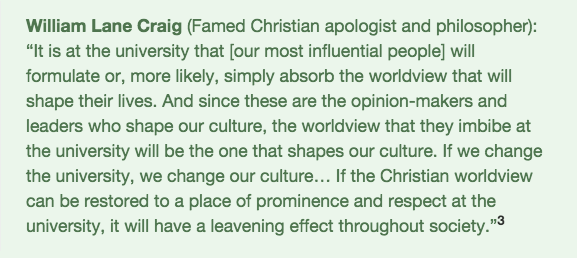
If serving God is your goal, look to the university

There is already a perfectly fine university right next door – no need to fly to Europe to find one! Remember, the university that took your faith away, or maybe the faith of someone you cared about? Yeah, it’s still sitting there in your home town! And it’s still ruining the lives of thousands of young people, by peer-pressuring them into secular, liberal views – and behaviors. It seems to me that it’s better stewardship to stay here and work, then give money to groups like Reasonable Faith. And you can start a blog, teach in church and invite scholars to the local university, too. That costs almost nothing, and it produces better results.

What about Jesus?

Sometimes, it’s a good idea to look beyond the words of the Bible and reflect on the overall message of it at a higher level. When I look in the Bible, I see that Jesus went through a lot of suffering in obedience to God in order to secure the salvation of people who did not even like him. And it’s from this sacrifice on our behalf that his claim on our obedience comes. There are things that I don’t like to do that I do anyway because they work to serve God. Jesus life’s ambition was not to do things that were easy, or that made him happy. Experienced Christians do things that are not fun, because these things are right and because they solve the real problem.

Unmarried 35-year-old woman reflects on her adventurous life of fun, travel and serial cohabitation

Telling a woman how to make wise decisions protects her

I found an interesting article featuring a 35-year-old woman who is alarmed that her approach to life has left her in debt and single, with a gap-filled resume of short-term jobs. I thought it might be useful for young women to read this, and consider whether making “rash” decisions and being “adventurous” works out.

She writes:

I feel like a ghost. I’m a 35-year-old woman, and I have nothing to show for it. My 20s and early 30s have been a twisting crisscross of moves all over the West Coast, a couple of brief stints abroad, multiple jobs in a mediocre role with no real upward track. I was also the poster child for serial monogamy. My most hopeful and longest lasting relationship (three and a half years, whoopee) ended two years ago. We moved to a new town (my fourth new city), created a home together, and then nose-dived into a traumatic breakup that launched me to my fifth and current city and who-knows-what-number job.

Rash decisions, adventure, exploring…. and lots of debt:

For all these years of quick changes and rash decisions, which I once rationalized as adventurous, exploratory, and living an “original life,” I have nothing to show for it. I have no wealth, and I’m now saddled with enough debt from all of my moves, poor decisions, and lack of career drive that I may never be able to retire. I have no career milestones and don’t care for my line of work all that much anyway, but now it’s my lifeline, as I only have enough savings to buy a hotel room for two nights.

No STEM degree, which means she doesn’t like to study hard things that can be tested against the real world for correctness:

I used to consider myself creative — a good writer, poetic, passionate, curious. Now, after many years of demanding yet uninspiring jobs, multiple heartbreaks, move after move, financial woes, I’m quite frankly exhausted.

Surprised by aging and poor health:

Also, within the past year I’ve had a breast-cancer scare and required surgery on my uterus due to a fertility issue. On top of that, I’m 35 and every gyno and women’s-health website this side of the Mississippi is telling me my fertility is dropping faster than a piano falling out of the sky. Now I’m looking into freezing my eggs, adding to my never-ending financial burden, in hopes of possibly making something of this haunted house and having a family someday with a no-named man.

She’s still trying to be the sexpot 25-year-old she used to be:

I’m dating. I’m working out and working hard. Listening to music I enjoy and loving my cat. Calling my mom…. I’m drinking too much… And with men I date, I feel pressure to make something of the relationship too soon (move in, get married, “I have to have kids in a couple of years”; fun times!). All the while still trying to be the sexpot 25-year-old I thought I was until what seemed like a moment ago.

But her plan hasn’t worked out:

I used to think I was the one who had it all figured out. Adventurous life in the city! Traveling the world! Making memories! Now I feel incredibly hollow. And foolish. How can I make a future for myself that I can get excited about out of these wasted years?  What reserves or identity can I draw from when I feel like I’ve accrued nothing up to this point with my life choices?

Well, I’ve known women like this, and I think we’re going to see more and more women like this as the society becomes more secular and feminist. I want to say something about whether she is sincere about wanting to get married and have children, and what women should do to avoid ending up like her.

Do women today understand male nature and marriage?

This woman’s demonstrated life plan is that she chose whatever made her feel good from age 18-35+, and now wants to enter into a marriage some time after age 35. And what does marriage mean to her? Has she prioritized entering the traditional roles of wife and mother? Don’t listen to her words. Look at her actions. Her actions show that marriage and children were of NO importance to her. And her current approach to getting married and having kids is the same as ever – work out in order to look hot, and try to coerce a man who signs up for recreational sex with no commitment into becoming a man who makes a life-long commitment to provide for her and her children (which is the opposite of what he signed up for). She wants marriage now for the same reason that she’s wanted anything: for fun, thrills, adventure and to keep up with her girlfriends who are already married.

What kind of man should she have been pursuing from age 18 to 35, if she really wanted marriage and children? Well, the first thing to realize is that not all men want marriage. And the next thing to realize is that women who are serious about marriage need to focus ONLY on men who want to marry. All the men that the women quoted above wanted in her youth didn’t want to marry. They wanted premarital recreational sex with her, and that was fine with her – she chose them, and disregarded the men who were interested in marriage.

A man who was interested in marrying her would have:

  • ….told her no to sex before marriage (because the more sexual partners a woman has, the less happy she will be in marriage, and the more unstable her marriage will be).
  • …led her to become better at being a wife and mother, by discouraging her thrill-seeking, traveling and wasteful spending, and instead encouraging her focus on a STEM education, career and getting debt-free.
  • …led her to develop a Christian worldview in which she would understand the importance of marriage and children, and learn to sacrifice her own interests to love and care for others.

Was she interested in getting ready for marriage? No. She never chose those marriage-minded men. She didn’t want to be a wife. The men she chose were chosen for fun, for thrills, and to show off their outward appearance to her girlfriends.

So, who are the men in this group of marriage-minded men? How do you recognize them? Marriage-minded men are interested in marriage because they want to lead a home. They will have invested a lot of time learning how to protect others, how to provide, and how to debate and lead on moral and spiritual issues. Marriage-minded men see the marriage enterprise as a way of advancing the causes that they care about most. Women who really want to get married will recognize those men, and pursue those men. And they’ll do it early, so that they can invest in their husbands early and be young enough to have children.

New study: same-sex attraction isn’t fixed

Young people seem to like gay marriage more than they like individual liberties

The Federalist reports on what researchers have found about the nature of same-sex attraction. Is it fixed? Or does it change over time? I think that gay activists would like everyone to believe that same-sex attraction is fixed, but to learn the truth, we should look at what the scientific research says.

Excerpt:

There is not only no scientific evidence that sexual orientation is immutable, there is conclusive scientific evidence that most people who experience exclusive same-sex attraction end up developing an interest in the opposite sex over time.

This is so well established by now that scholars are busy publishing methods to measure frequency of sexual orientation change in massive longitudinal studies of youth and young adults. (I.e., How many times in nine years can we expect a homosexual sexual orientation to change? Is the change associated with lifestyle habits? Who changes more frequently: males or females?)

That basic fact was already settled science when Obergefell  came before the Supreme Court. Half a dozen rigorous studies could be cited from the late 1990s and early 2000s, but the most noteworthy probably remains a Cornell-led study published in 2007.

In this study, Dr. Rich Savin-Williams examined a representative sample of more than 12,000 American youth, following each from the age of 16 to 22. Rather than rely on an individual’s reconstruction of his or her past based on current identity, researchers met with subjects three times throughout the six-year period. Each time, they asked individuals (via a computer, to protect privacy) whether they had had a romantic attraction to a member of the opposite or same sex since their last interview.

For instance, 17-year-old males were asked if, in the past year, they had had a romantic attraction to another male or female. About 1.5 percent reported only having a romantic attraction to other males. Five years later, when that 1.5 percent were asked about their romantic attractions since last interview, the overwhelming majority (70 percent) reported a 180-degree flip in their sexual orientation—they only had romantic feelings for women.

Similarly, among females, about 40 percent switched from exclusive same-sex attraction to exclusive opposite-sex attraction. Most of the rest (45 percent of the total) reported they had feelings for both men and women. Only 1 percent of women who, at 17, reported a full year of exclusive same-sex attraction reported a similar experience in the five years that followed.

This research is in agreement with previous research on identical twin studies reported by the prestigious science journal Nature:

When one identical twin is gay, there is about a 20% chance that the other will be as well. But because this rate is not 100%, it is thought that environmental factors play a role as well. One of the best characterized is the ‘older brother effect’: the chance of a man being gay increases by 33% for each older brother he has. The reason is not clear, although one hypothesis holds that the mother’s immune system begins to react against male antigens and alter the fetus’s development.

So, it turns out that homosexual behavior is a lot more related to free choices than it is to innate, fixed dispositions. That’s what the science says. It’s not what the politicians say. It’s not what the Supreme Court says. It’s not what Hollywood says. It’s not what journalists say. But it is what science has found to be true about the universe. We are in control of our behaviors, and we have to choose things that are likely to work out in the long-term – not just what feels good to us in the moment.

Whenever I hear gay activists complaining that they have no choice but to give in to their “innate, fixed, biological” sexual attractions, I always think about how I’ve never been married and have had to deal with sexual attraction to the opposite sex. As a Christian, there is simply no Biblical support for sex outside of marriage. So, that means that I’ve had to just live with not being allowed to act on my desires. In fact, this is the normal Christian life. There was a time when people had more skepticism about their feelings and desires, and they knew that self-control was a good thing. But now it seems as if everyone is so desperate to be liked that we tell everyone yes to everything that they feel like doing. We now consider every moral viewpoint as equal to any other – all the better to do what makes us feel happy. The important goal is that we all feel good right now, and who cares about the damage that our selfishness will cause down the road? We can just act surprised when that happens and pretend that there is no such thing as cause and effect. I can remember a time when Christians in particular had some suspicion about following your heart, because the heart was deceitful and selfish. I guess those days are over, and suddenly feelings are ruling over reason and self-control.

It’s pretty clear that not everything that a person feels like doing is good for them. A lot of decisions that people make to feel good right now lead to outcomes where they or the people who are depending on them will be harmed. For example, lots of people feel like staying home from a school exam, or staying home from their jobs, or drinking alcohol all night, or taking drugs. We used to have more confidence about telling people that not everything they wanted was good for them, and to have more self-control, and to think of how their decisions would harm others. Today, society has drifted away from objective moral boundaries and self-control toward subjective feelings and moral relativism, we are all finding it more difficult to tell people that they should choose to adhere to moral standards. We always seem to be looking to big government to make our irresponsible, reckless choices to be happy in the moment “work out” somehow.

Today, when people make poor decisions that wreck their families, hurt their kids, damage their health, etc. we are more likely to tax the people who haven’t been selfish and reckless in order to pay for government programs that “fix” the outcomes of the selfish, reckless people. In some countries, you can get free single mother welfare, free taxpayer-funded abortions, free sex-changes, free treatment for sexually-transmitted diseases, free rounds of IVF, and so on. Just do whatever you want and someone else who had more self-control than you did will pay for it for you. That’s why we have a twenty-trillion dollar debt, which we never had during the time when we still had the courage to tell people not to do things that were risky, and would be expensive to fix when they blew up.

When did it become normal to think that cause and effect were so unpredictable that people shouldn’t be blamed and held accountable for making bad decisions? When did it become normal to think that doing what feels good for ourselves should be rewarded with other people’s money, through big government programs? When did it become normal to take people to court to force them to celebrate your self-centeredness, just because their disagreement with what you were doing made you feel bad?