Tag Archives: Science

Walter Bradley lectures on the creation and design of the universe

Dr. Walter L. Bradley

This lecture is special to me, because I bought a VHS tape of it just after I started working full-time, and watched it a million times. It changed my life. The lecture was delivered at the University of California, Santa Barbara.

About the speaker:

Dr. Bradley received his B.S. in Engineering Science and his Ph.D. in Materials Science from the University of Texas in Austin.

Dr. Bradley taught for eight years at the Colorado School of Mines before assuming a position as Professor of Mechanical Engineering at Texas A&M University (TAMU) in 1976.

During his 24 years at Texas A&M, Dr. Bradley served as Head of the Department of Mechanical Engineering at Texas A&M University and as Director of the Polymer Technology Center, and received five College of Engineering Research Awards. He has received over $4,500,000 in research grants and has published over 140 technical articles and book chapters. He has also co-authored “The Mystery Of Life’s Origin: Reassessing Current Theories. He is a Fellow of the American Society for Materials and of the American Scientific Affiliation and serves as a consultant for many Fortune 500 companies.

He currently serves as Distinguished Professor of Engineering at Baylor University.

The lecture: (63 minutes lecture, 25 minutes audience Q&A)

Summary slide:

This slide summarizes the content of the lecture

Introduction:

  • At the beginning of the 20th century, people believed that the progress of science was pointing away from an intelligent Creator and Designer, and towards naturalism
  • A stream of new discoveries has shifted the support of science towards theism, and away from naturalism
  • Richard Dawkins, an atheist, says that nature only has the appearance of design, but that if you look closer, naturalistic mechanisms can account for the appearance of design
  • When deciding between design and apparent design (“designoid”), it matters whether you think there is an intelligence there to do the designing

Evidence #1: The Big Bang:

  • an eternal “steady state” universe is more compatible with naturalism, but a created universe is more compatible with a Creator
  • In 1929, Hubble used telescopes to observe that the light from distant galaxies was redshifted. The further away galaxies were, the faster they were moving away. Therefore, space is expanding in all directions, suggesting an explosive origin of the universe
  • In 1965, the discovery of the cosmic microwave background radiation matched a prediction of the Big Bang cosmology, and of the creation event
  • In 1992, the COBE space telescope allowed us to test four specific predictions of the Big Bang model, especially the predictions for light element abundances (hydrogen and helium), which matched the predictions of the creation model

Evidence #2: Simple mathematical structure of the physical laws

  • the simple mathematical structure of natural laws allows us to understand these laws, make discoveries, and engineer solutions to problems
  • early scientists saw the mathematical structure of the universe to mean that nature was designed by an intelligent to be understood
  • the fundamental equations of the laws of the universe can be easily written on one side of one sheet of paper
  • Eugene Wigner’s famous paper, “The Unreasonable Effectiveness of Mathematics in the Physical Sciences” makes the point that this simple structure is an unexpected gift that allows is to do science

Evidence #3: fine-tuning of the physical constants and quantities

  • in order for any kind of complex life to survive, we need stars that provide energy within specific ranges for long periods of time
  • in order for any kind of complex life to survive, we need planets with stable orbits that will not suffer from extreme temperature swings as it varies in distance from its star
  • in order for any kind of complex life to survive, we need stable atomic structure
  • in order for any kind of complex life to survive, we need to have chemical diversity and correct relative abundances of each element
  • organic life has minimum requirements: process energy, store information, replicate, and you can’t fulfill those functions if there is only one element, e.g. – hydrogen
  • the energy level from the photons from the sun have to match the energy levels of the different elements in order to drive the chemical bonding needed for life
  • These requirements for life of any imaginable type depend on the values of the constants and quantities. The constants and quantities cannot vary much from what they are, or the universe will lose the characteristics (above) that allow it to support complex life of any imaginable time
  • For example, ratio of strong force to electromagnetic force:
    – if 2% larger, then no stable hydrogen, no long-lived stars, no compounds containing hydrogen, e.g. – water
    – if 5% smaller, no stable stars, heavy hydrogen would be unstable, few elements other than hydrogen

Evidence #4: initial conditions for habitability

  • Universe: expansion rate of the universe must be fast enough to avoid a re-collapse, but slow enough to allow matter to clump together and form stars and planets for complex life to live on
  • Planet: right distance from the star to get the right climate
  • Planet: right mass to retain the right atmosphere

Evidence #5: origin of life and information theory

  • It’s possible to explain every process in an automobile engine using plain old naturalistic mechanisms – no supernatural explanation is necessary to understand the processes
  • But the existence of engine itself: engineering all the parts has to be explained by the work of an intelligence
  • Similarly, we can understand how living systems work, but the existence of the living systems requires an intelligence
  • Even the simplest living system has to perform minimal function: capture energy, store information and replicate
  • Living systems are composed of objects like proteins that are composed of sequences of components complex such that the order of the components gives the overall structure function
  • Developing the components for a simple living cell is very improbable – even given the large number of galaxies, stars and planets in the universe, it is unlikely that complex, embodied life would exist anywhere in the universe

Evidence #6: more initial conditions for habitability

  • Location within the galaxy: you need to be away from the center of the galaxy, because the explosions from dying stars, and excessive radiation will kill life
  • Location within the galaxy: you need to be close enough to the center in order catch the heavy elements you need for life from the explosions of other stars
  • Location within the galaxy: the best location is between two arms of  a spiral galaxy, where you can get the heavy elements you need from dying stars, but without being hit with explosions and harmful radiation
  • Star mass: determines rate at which the sun burns, determines the energy level of photons that are used to drive chemical bonding reactions, determines the length of time the star will be stable
  • Star mass: star mass must be the correct value in order to allow liquid water on the planet’s surface, while still preserving stable orbit

I wish there was more curiosity about science in churches, and young Christians understood how critical science is for grounding the rationality of the Christian worldview. We need to be training up more scientists who think about the big questions, like Dr. Walter Bradley.

How the discovery of the cosmic microwave background radiation falsified atheism

Apologetics and the progress of science

Prior to certain scientific discoveries, most people thought that the universe had always been here, and no need to ask who or what may have caused it. But today, that’s all changed. Today, the standard model of the origin of the universe is that all the matter and energy in the universe came into being in an event scientists call “The Big Bang”. At the creation event, space and time themselves began to exist, and there is no material reality that preceded them.

So a couple of quotes to show that.

An initial cosmological singularity… forms a past temporal extremity to the universe. We cannot continue physical reasoning, or even the concept of spacetime, through such an extremity… On this view the big bang represents the creation event; the creation not only of all the matter and energy in the universe, but also of spacetime itself.

Source: P. C. W. Davies, “Spacetime Singularities in Cosmology,” in The Study of Time III, ed. J. T. Fraser (Berlin: Springer Verlag ).

And another quote:

[A]lmost everyone now believes that the universe, and time itself, had a beginning at the big bang.

Source: Stephen Hawking and Roger Penrose, The Nature of Space and Time, The Isaac Newton Institute Series of Lectures (Princeton, N. J.: Princeton University Press, 1996), p. 20.

So, there are several scientific discoveries that led scientists to accept the creation event, and one of the most interesting and famous is the discovery of the cosmic microwave background radiation.

Here’s the history of how that discovery happened, from the American Physical Society web site:

Bell Labs radio astronomers Arno Penzias and Robert Wilson were using a large horn antenna in 1964 and 1965 to map signals from the Milky Way, when they serendipitously discovered the CMB. As written in the citation, “This unexpected discovery, offering strong evidence that the universe began with the Big Bang, ushered in experimental cosmology.” Penzias and Wilson shared the Nobel Prize in Physics in 1978 in honor of their findings.

The CMB is “noise” leftover from the creation of the Universe. The microwave radiation is only 3 degrees above Absolute Zero or -270 degrees C,1 and is uniformly perceptible from all directions. Its presence demonstrates that that our universe began in an extremely hot and violent explosion, called the Big Bang, 13.7 billion years ago.

In 1960, Bell Labs built a 20-foot horn-shaped antenna in Holmdel, NJ to be used with an early satellite system called Echo. The intention was to collect and amplify radio signals to send them across long distances, but within a few years, another satellite was launched and Echo became obsolete.2

With the antenna no longer tied to commercial applications, it was now free for research. Penzias and Wilson jumped at the chance to use it to analyze radio signals from the spaces between galaxies.3 But when they began to employ it, they encountered a persistent “noise” of microwaves that came from every direction. If they were to conduct experiments with the antenna, they would have to find a way to remove the static.

Penzias and Wilson tested everything they could think of to rule out the source of the radiation racket. They knew it wasn’t radiation from the Milky Way or extraterrestrial radio sources. They pointed the antenna towards New York City to rule out “urban interference”, and did analysis to dismiss possible military testing from their list.4

Then they found droppings of pigeons nesting in the antenna. They cleaned out the mess and tried removing the birds and discouraging them from roosting, but they kept flying back. “To get rid of them, we finally found the most humane thing was to get a shot gun…and at very close range [we] just killed them instantly. It’s not something I’m happy about, but that seemed like the only way out of our dilemma,” said Penzias.5 “And so the pigeons left with a smaller bang, but the noise remained, coming from every direction.”6

At the same time, the two astronomers learned that Princeton University physicist Robert Dicke had predicted that if the Big Bang had occurred, there would be low level radiation found throughout the universe. Dicke was about to design an experiment to test this hypothesis when he was contacted by Penzias. Upon hearing of Penzias’ and Wilson’s discovery, Dicke turned to his laboratory colleagues and said “well boys, we’ve been scooped.”7

Although both groups published their results in Astrophysical Journal Letters, only Penzias and Wilson received the Nobel Prize for the discovery of the CMB.

The horn antenna was designated a National Historic Landmark in 1990. Its significance in fostering a new appreciation for the field of cosmology and a better understanding of our origins can be summed up by the following: “Scientists have labeled the discovery [of the CMB] the greatest scientific discovery of the 20th century.”8

It’s the greatest scientific discovery of the 20th century.

In the New York Times, Arno Penzias commented on his discovery – the greatest discovery of the 20th century – so:

The best data we have [concerning the Big Bang] are exactly what I would have predicted, had I nothing to go on but the five books of Moses, the Psalms, the bible as a whole.

Just one problem with the greatest scientific discovery of the 20th century: atheists don’t accept it. Why not?

Here’s a statement from the Secular Humanist Manifesto, which explains what atheists believe about the universe:

Religious humanists regard the universe as self-existing and not created.

For a couple of examples of how atheistic scientists respond to the evidence for a cosmic beginning, you can check out this post, where we get responses from cosmologist Lawrence Krauss, and physical chemist Peter Atkins.

You cannot have the creation of the universe be true AND a self-existing, eternal universe ALSO be true. Someone has to be wrong. Either the science is wrong, or the atheist manifesto is wrong. I know where I stand.

Positive arguments for Christian theism

Robin Collins lectures on fine-tuning for discoverability from particle physics

This lecture is 29 minutes long, the Q&A is 15 minutes. I highly recommend this lecture to all audiences of all levels of ability, for the simple reasons that apart from the content, this lecture is a how-to clinic in the tone, body language, slides and so on for you to use when trying to be persuasive when making your case. Science is king in this lecture. The scientific method is defined and applied in a winsome way. Making science understandable should be the bread and butter approach to Christian apologetics, and this lecture rivals the Mike Strauss lecture at Stanford University and the Mike Strauss lecture at the University of Texas – Dallas as the ideal lectures for showing that. It’s not just the scientific material that makes this lecture by Collins work, it’s the narrative and the style that make the lecture work.

About Robin Collins:

Robin Collins (PhD, University of Notre Dame, 1993), is professor of philosophy at Messiah College, Grantham, PA specializing in the area of science and religion.  He has written over twenty-five articles and book chapters on a wide range of topics, such as the fine-tuning of the cosmos as evidence for the existence of God, evolution and original sin, the Doctrine of Atonement, Asian religions and Christianity, and Bohm’s theory of quantum mechanics.  Some of his most recent articles/book chapters are “Philosophy of Science and Religion” in The Oxford Handbook of Science and Religion, “Divine Action and Evolution” in The Oxford Handbook of Philosophical Theology (2009)  “The Multiverse Hypothesis: A Theistic Perspective,” in Universe or Multiverse? (Cambridge University Press), and “God and the Laws of Nature,” in Theism or Naturalism: New Philosophical Perspectives (Oxford University Press, forthcoming).  He recently received a grant from the John Templeton Foundation to finish a book that presents the case for design based on physics and cosmology,  tentatively entitled The Well-Tempered Universe: God, Cosmic Fine-tuning, and the Laws of Nature.

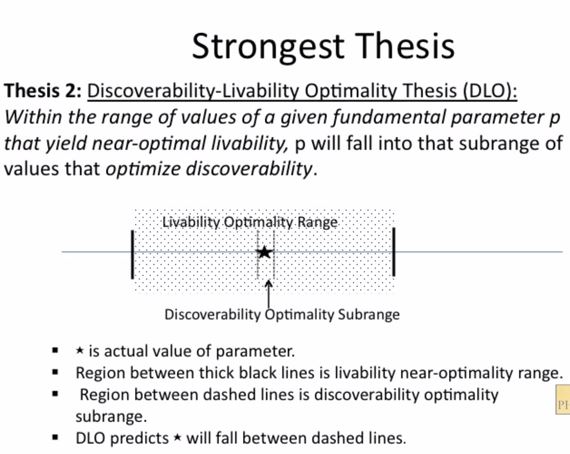
His thesis in one slide:

Fine-tuning for discoverability
Fine-tuning for discoverability – the DLO thesis

Summary:

  • Thesis: the universe is more intelligible than we would expect it by chance
  • The regular fine-tuning argument says that complex embodied observers are very rare
  • But the number of highly-discoverable universes that have complex embodied observers is rarer still
  • Why do we exist in a highly-discoverable universe?
  • Can we quantify and test discoverability?
  • Yes: by varying fundamental parameters and seeing how it affects discoverability
  • Conclusion of his calculations: The Discoverability-Liveability Optimality range is an even smaller range within the Liveablity Optimality range of the standard fine-tuning argument
  • Fine-tuning #1: the fine structure constant, governs the strength of the electro-magnetic force
  • If larger, wood-burning fire becomes impossible because fires won’t stay lit, and therefore forging metals becomes unlikely
  • If smaller, wood-burning fires won’t go out, e.g. – from lightning strikes, so that wood would be less accessible
  • Other constraints: smaller value decreases effectiveness of light microscopes, drastically lowers efficiency of transformers and motors
  • Fine-tuning #2: the cosmic microwave background radiation (CMBR), radiation left over from the Big Bang
  • humans need to discover the CMBR in order to confirm the Big Bang creation out of nothing, and it depends on baryon/pothon ratio
  • his calculations show that the actual value of CMBR is exactly at the peak for detectability by humans
  • if baryon/photon ratio larger, CMBR is less discoverable
  • if baryon/photon ratio smaller, CMBR is less discoverable
  • Fine-tuning #3: parameters related to subatomic particles are fine-tuned for their discovery and usefulness, e.g. – the bottom quark, the charm quark, the tau lepton and the Higgs Boson
  • the lifetime of the particles affects their usefulness to scientists who want to investigate the Standard Model of physics
  • decay rates of these subatomic particles are related to several of the finely-tuned parameters
  • for example, the mass of the bottom quark is finely-tuned for its discoverability by scientists
  • the tau lepton and the charm quark are similarly fine-tuned for disoverability
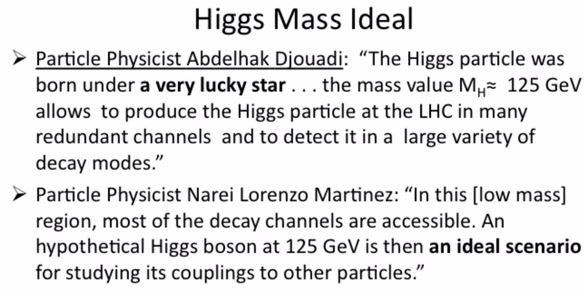
  • the mass of the Higgs boson is finely-tuned for discoverability and for making further discoveries
  • Conclusion: the DLO thesis is strongly confirmed – this is an even greater degree of fine-tuning that the already astonishing probabilities of the fine-tuning for complex, embodied intelligent beings
  • The formalized version of the philosophical argument based on this evidence is impervious with some of the traditional objections to the standard fine-tuning argument
  • #1 multiverse/selection effect: it is not subject to multiverse / observer selection objections
  • #2 normalizeability: it is not subject to the McGrew-Vestrup objection because the range of possible values is finite not infinite
  • #3 falsifiability: it makes falsifiable predictions, and in fact Collins’ earlier calculations of the CMBR discoverability contained an error that falsified the thesis – until he found the error and corrected for it
  • #4 usefulness: it gives clues about the Creator’s purpose for us, namely that the universe was created for us to be able to do science and find evidence of the Creator’s existence – there is no expectation for us to exercise blind faith, trust in God is meant to be a plausible deduction from the progress of experimental science

Sample slide:

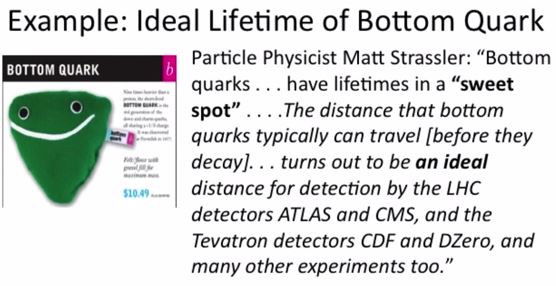
Fine-tuning of the bottom quark for discoverability
Bottom quark lifetime is finely-tuned for discoverability

And another:

Higgs boson mass is finely-tuned for discoverability

Earlier, I blogged about a Robin Collins lecture on the fine-tuning that allows complex, embodied life to exist. Another must-see lecture. If you are looking for something to study in university, and you have funding, then physics, mathematics and philosophy are the best places to be for a Christian scholar.