Tag Archives: Science

Information Enigma: 21-minute video explains intelligent design

Can random mutation and natural selection create new functional information?

The video is here:

I have read and listened and watched a lot of material on intelligent design, but I have never seen so much value packed into such a short lecture. I really hope you’ll watch this and that it’s helpful to you.

Summary:

  • the big question when discussing the origin of life: where did the information in living systems come from?
  • Until 530 million years ago, the oceans were largely devoid of life
  • In a 10 million year period, many new forms of animal life emerged
  • New biological forms of life require new information
  • the discovery of DNA shows that living systems work because cells have information that allows them to build the components of molecular machines: cell types, proteins, etc.
  • can random mutation and natural selection create new functional information?
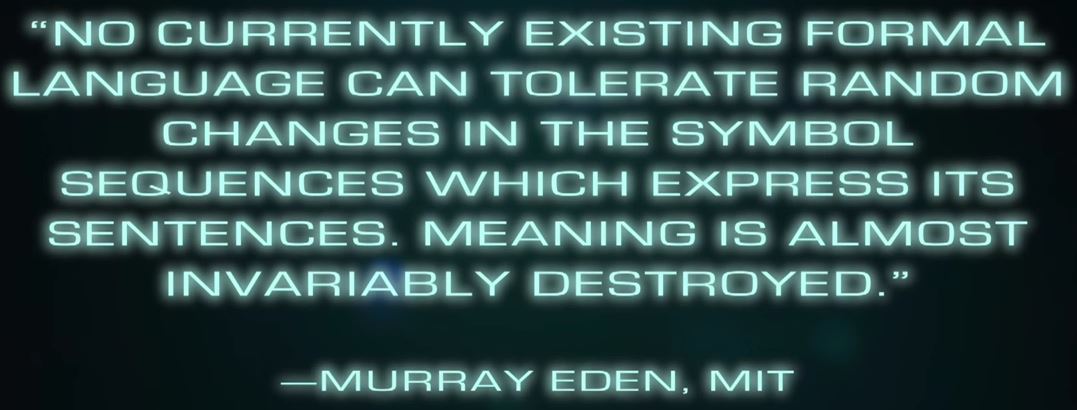
  • normally, random mutations tend to degrade the functionality of information, e.g. – randomly changing symbols in an applications code does not usually introduce useful new functions, it usually renders what is there non-functional
  • the majority of possible sequences will NOT have functions, so random mutations will more likely give you non-functional code, rather than functional code
  • example: a bicycle lock  with 4 numbers has many possible sequences for the 4 numbers, and only one of them has unlock functionality, the rest have no functionality
  • if you have lots of time, then you might be able to guess the combination, but if the lock as has 10 billion numbers, and only one combination that unlocks, you can spend your whole life trying to unlock it and won’t succeed
  • how likely is it to arrive at a functional protein or gene by chance? Is it more like the 4-dial lock (can be done with lots of time) or the 10 billion dial lock (amount of time required exceeds the time available)?
  • the probability is LOW because there is only one sequence of numbers that has unlock function
  • consider a short protein of 150 amino acids has 10 to the 195th power possible sequences
  • if many of these sequences of amino acides had biological function, then it might be easier to get to one by random mutation and selection than it is with a lock that only unlocks for ONE sequence
  • how many of the possible sequences have biological function?
  • Thanks to research done by Douglas Axe, we now know that the number of functional amino acid sequences for even a short protein is incredibly small…
  • Axe found that the odds of getting a functional sequence of amino acids that will fold and have biological function is 1 in 10 to the 77th power
  • Is that number too improbable to reach by chance? well, there are 10 to 65th atoms in the entire Milky Way galaxy… so yes, this is a very improbable outcome
  • can random genetic mutations search through all the sequences in order to find the one in 10 to the 77th power one that has biological function? It depends on how much guessers we have and how many guesses we get in the time available
  • even with the entire 3.5 billion year history of life on Earth, only about 10 to the 40th organisms have ever lived, which far smaller fraction of the 10 to the 77th total sequences
  • even with a very fast mutation rate, you would not be able to reach a functional protein even with all that time, and even with all those organisms

I was once having a discussion with a woman about the research that Axe did at the Cambridge University lab. He published four articles in the Journal of Molecular Biology. I held out one of the papers to her and showed her the numbers. She said over and over “I hate the Discovery Institute! I hate the Discovery Institute!” Well, yeah, but you can’t make the Journal of Molecular Biology go away with hating the Discovery Institute. JMB is peer-reviewed, and this was experimental evidence – not a theory, not a hypothesis.

We have been blessed by the Creator and Designer of the universe in this time and place with overwhelming evidence – an abundance of riches. For those who have an open mind, this is what you’ve been waiting for to make your decision. For the naturalists who struggle so mightily to block out the progress of experimental science, they’ll need to shout louder and shut their eyes tighter and push harder to block their ears. Maybe if they keep screaming “Star Trek” and “Star Wars” over and over to themselves, they will be able to ignore the real science a little longer.

A must-read series of posts on cosmic fine-tuning by Allen Hainline

Apologetics and the progress of science

There are four posts in the series, so far. I think Allen might be done, so I’m going to link to all four and snip something I like from each one.

The first post is on whether the fine-tuning is real, and whether a multiverse explains the fine-tuning so that there is no need for a cosmic Designer.

I just have to choose this quote from the atheist Stephen Hawking on the fine-tuning:

The remarkable fact is that the values of these numbers [i.e. the constants of physics] seem to have been very finely adjusted to make possible the development of life. For example, if the electric charge of the electron had been only slightly different, stars would have been unable to burn hydrogen and helium, or else they would not have exploded. It seems clear that there are relatively few ranges of values for the numbers [i.e. the constants of nature] that would allow for development of any form of intelligent life.

And from Luke Barnes, who I’ve mentioned before on this blog:

In my years of researching this topic, I’m amazed at how few scientists who have studied the fine-tuning details disagree with this core claim that the subset of life-permitting physics is a tiny fraction among possibilities. Since Luke Barnes is a top researcher on this topic, consider his input on the level of acceptance of the fine-tuning claim: “I’ve published a review of the scientific literature, 200+ papers, and I can only think of a handful that oppose this conclusion, and piles and piles that support it.[3]

And on the multiverse as a way to escape the fine-tuning:

The key issue though is that for the multiverse to be an adequate explanation for the fine-tuning it requires the conjunction of several hypotheses for which we lack any empirical evidence:

  1. A universe-generating mechanism that generates a plethora of universes
  2. That this mechanism doesn’t itself require fine-tuning
  3. The many-worlds interpretation of quantum physics
  4. The ability to widely vary constants in those universes. If you think that it’s a foregone conclusion that String Theory/M-Theory[8] will come to the rescue in this area, you should watch this video clip by Oxford physicist Roger Penrose where he exclaims that “it’s not even a theory … it’s a collection of hopes”.

Occam’s razor therefore does seem to favor design over the multiverse. When one accounts for the extensive problems in affirming premise 2 and how these multiverse theories make predictions incompatible with our universe, the hypothesis that God designed the physics of the universe to bring about life is more plausible.

Here’s the second post, where he explains the fine-tuning argument philosophically, and gives an example of one of the constants that has to be fine-tuned in order to support complex, embodied intelligence of any kind.

The cosmological constant:

The inference to design will be more easily recognized if we shed some light as to the specialness of the required values. Consider the size of the bull’s eye and wall based on just 1 parameter – the cosmological constant. There is a natural range for possible values for this constant because there are known contributions that are 10120times larger than the overall net value. (There is a near perfect but inexact cancellation of contributions accurate to 120 decimal places). Let’s use the most conservative numbers in the physics literature that indicate a fine-tuning to 1 part in 1053. If the cosmological constant, which governs the expansion rate of the universe, had been larger than its current value by this tiny fraction, then the universe would have expanded so fast that no stars or planets would have formed and therefore no life. If the value were smaller by this amount then the universe would have rapidly collapsed before the universe cooled sufficiently to allow for stable information storage which is required by any self-replicating system such as life.

In the third post, he responds to objections to the fine-tuning argument. One objection you hear from atheists who don’t understand the science is that any selection of constants and quantities is as likely as any other, so our life-permitting set is just random. Now, first off, there are only 10 to the 80 atoms in the visible universe, so if the cosmological constant is fine-tuned to 1 in 10 to the 120, it’s not rational to say “it just happened randomly”.

But here is Allen’s response:

However, the assumption that any set of constants is just as likely as any other is the very thing that we want to know. Starting off with that as an assumption begs the question against design. As Luke Barnes articulates in this excellent podcast dealing with responses to the fine-tuning claim, suppose we’re playing poker and every time I deal I get a royal flush. If this continues to happen, you become increasingly convinced that I’m likely to be cheating. If I responded to an accusation of cheating by just saying “well any set of 5 cards is just as likely as any other so you can’t accuse me of cheating” you would be rational to reject this explanation. The question is not “how likely is any set of 5 cards?” but rather “how likely is it I’m cheating if I just dealt myself 10 straight royal flushes?” This question accounts for the possibility that I’m cheating which would almost certainly be true in this scenario. So the right fine-question is “given the fine-tuning evidence, how likely is it that the constants were set at random?” The values for physical constants conform to a very particular pattern – that which supports life. The fact that we have so many finely-tuned constants makes it unlikely that they were all set at random (at least in the single universe scenario and I’ve already shown some of the problems/challenges in multiverse explanations.)

Every 5-card hand that you draw is equally unlikely, but the royal flush is the highest hand in the game and always wins. Every hand you draw is unlikely, but whatever you draw is overwhelmingly likely to not be a royal flush.

Finally, the fourth post deals with the objection that the constants and quantities could not have been other than they are.

He quotes physicist John Barrow giving 5 reasons why the constants can vary, and then this:

Even if the constants and laws of physics couldn’t vary, there is even more reason to think that there were many physically possible sets of initial conditions. Paul Davies states this emphatically:

“Even if the laws of physics were unique, it doesn’t follow that the physical universe itself is unique…the laws of physics must be augmented by cosmic initial conditions…there is nothing in present ideas about ‘laws of initial conditions’ remotely to suggest that their consistency with the laws of physics would imply uniqueness. Far from it…it seems, then, that the physical universe does not have to be the way it is: it could have been otherwise.[4]”

John A. Wheeler agrees: “Never has physics come up with a way to tell with what initial conditions the universe was started off. On nothing is physics clearer than what is not physics.”

The constants and quantities are not determined by physics. They were selected by whoever created nature in the first place.

So that’s the series. I noticed that he kept linking to this Common Sense Atheism podcast featuring famous cosmologist Luke Barnes. I grabbed it to listen this weekend, and you might want to get it, too. It’s over an hour. It seems like it is one stop shopping to understand common objections to the fine-tuning argument, and how strong each one is.


Stephen C. Meyer and Marcus Ross lecture on the Cambrian explosion

Cambrian Explosion
Cambrian Explosion

Access Research Network is a group that produces recordings  of lectures and debates related to intelligent design. I noticed that on their Youtube channel they are releasing some of their older lectures and debates for FREE. So I decided to write a summary of one that I really like on the Cambrian explosion. This lecture features Dr. Stephen C. Meyer and Dr. Marcus Ross.

The lecture is about two hours. There are really nice slides with lots of illustrations to help you understand what the speakers are saying, even if you are not a scientist.

Here is a summary of the lecture from ARN:

The Cambrian explosion is a term often heard in origins debates, but seldom completely understood by the non-specialist. This lecture by Meyer and Ross is one of the best overviews available on the topic and clearly presents in verbal and pictorial summary the latest fossil data (including the recent finds from Chengjiang China). This lecture is based on a paper recently published by Meyer, Ross, Nelson and Chien “The Cambrian Explosion: Biology’s Big Bang” in Darwinism, Design and Public Education(2003, Michigan State University Press). This 80-page article includes 127 references and the book includes two additional appendices with 63 references documenting the current state of knowledge on the Cambrian explosion data.

The term Cambrian explosion describes the geologically sudden appearance of animals in the fossil record during the Cambrian period of geologic time. During this event, at least nineteen, and perhaps as many as thirty-five (of forty total) phyla made their first appearance on earth. Phyla constitute the highest biological categories in the animal kingdom, with each phylum exhibiting a unique architecture, blueprint, or structural body plan. The word explosion is used to communicate that fact that these life forms appear in an exceedingly narrow window of geologic time (no more than 5 million years). If the standard earth’s history is represented as a 100 yard football field, the Cambrian explosion would represent a four inch section of that field.

For a majority of earth’s life forms to appear so abruptly is completely contrary to the predictions of Neo-Darwinian and Punctuated Equilibrium evolutionary theory, including:

  • the gradual emergence of biological complexity and the existence of numerous transitional forms leading to new phylum-level body plans;
  • small-scale morphological diversity preceding the emergence of large-scale morphological disparity; and
  • a steady increase in the morphological distance between organic forms over time and, consequently, an overall steady increase in the number of phyla over time (taking into account factors such as extinction).

After reviewing how the evidence is completely contrary to evolutionary predictions, Meyer and Ross address three common objections: 1) the artifact hypothesis: Is the Cambrian explosion real?; 2) The Vendian Radiation (a late pre-Cambrian multicellular organism); and 3) the deep divergence hypothesis.

Finally Meyer and Ross argue why design is a better scientific explanation for the Cambrian explosion. They argue that this is not an argument from ignorance, but rather the best explanation of the evidence from our knowledge base of the world. We find in the fossil record distinctive features or hallmarks of designed systems, including:

  • a quantum or discontinuous increase in specified complexity or information
  • a top-down pattern of scale diversity
  • the persistence of structural (or “morphological”) disparities between separate organizational systems; and
  • the discrete or novel organizational body plans

When we encounter objects that manifest any of these several features and we know how they arose, we invariably find that a purposeful agent or intelligent designer played a causal role in their origin.

Recorded April 24, 2004. Approximately 2 hours including audience Q&A.

You can get a DVD of the lecture and other great lectures from Access Research Network. I recommend their origin of life lectures – I have watched the ones with Dean Kenyon and Charles Thaxton probably a dozen times each. Speaking as an engineer, you never get tired of seeing engineering principles applied to questions like the origin of life.

The Cambrian explosion lecture above is a great intermediate-level lecture and will prepare you to be able to understand Dr. Meyer’s new book “Darwin’s Doubt: The Explosive Origin of Animal Life and the Case for Intelligent Design“. The Michigan State University book that Dr. Meyer mentions is called “Darwin, Design and Public Education“. That book is one of the two good collections on intelligent design published by academic university presses, the other one being from Cambridge University Press, and titled “Debating Design: From Darwin to DNA“. If you think this lecture is above your level of understanding, then be sure and check out the shorter and more up-to-date DVD “Darwin’s Dilemma“.