
Tag Archives: Science

Is the vastness of the universe evidence against God’s existence?

Apologetics and the progress of science

Physicist Hugh Ross writes about it in Salvo Magazine.

First a quick blurb about Hugh Ross:

Hugh Ross launched his career at age seven when he went to the library to find out why stars are hot. Physics and astronomy captured his curiosity and never let go. At age seventeen he became the youngest person ever to serve as director of observations for Vancouver’s Royal Astronomical Society. With the help of a provincial scholarship and a National Research Council (NRC) of Canada fellowship, he completed his undergraduate degree in physics (University of British Columbia) and graduate degrees in astronomy (University of Toronto). The NRC also sent him to the United States for postdoctoral studies. At Caltech he researched quasi-stellar objects, or “quasars,” some of the most distant and ancient objects in the universe.

Now back to the topic “Is the vastness of the universe incompatible with God’s existence?”

Here’s Ross’ introduction:

Scientists seem more difficult to please than the golden-haired girl of fairy-tale fame. While Goldilocks troubled herself over the just-right porridge, chair, and bed, astronomers appear preoccupied with the size of the universe.

In the days before telescopes, when an observer could count a few thousand stars in the night sky, many considered the universe too small and unimpressive to be the work of an almighty, all-knowing Creator. Only an infinite cosmos, they said, would befit an infinite deity. But then, others argued, an infinite cosmos might eliminate the need for a Creator.

Thanks to the Hubble space telescope, scientists now see that the universe contains roughly 200 billion large- and medium-sized galaxies and about a hundred times as many dwarf galaxies. The stars in those galaxies add up to about fifty billion trillion, and they comprise a mere one percent of the mass of the observable universe.

Because of the travel time of light, the universe humans can observe is really the universe of the past. What researchers know about the expansion and geometry of the universe informs us that the universe of today is at least several hundred times more enormous than the universe we can see. The universe is trillions of trillions of times larger and more spectacular than what the earliest astronomers presumed!

And yet, this new knowledge of the vastness of the universe has led to new complaints. In his book, God: The Failed Hypothesis, Victor Stenger says, “If God created the universe as a special place for humanity, he seems to have wasted an awfully large amount of space.” Stephen Hawking, in the best-selling science book of all time, A Brief History of Time, shares Stenger’s view: “Our solar system certainly is a prerequisite for our existence. . . . But there does not seem to be any need for all these other galaxies.” So now the universe is too big to befit the all-wise, all-powerful God of the Bible.

I like how he quotes an atheist physicist to get the challenge right. No sense in caricaturing the claim of your opponent.

I formalized Stenger’s argument like this:

  1. If all things in the universe are not done the way that Victor Stenger likes them, then there is no God.
  2. All things in the universe were not done the way Victor Stenger likes them.
  3. Therefore, there is no God.

I would deny premise 1, there, since there is no reason to believe that’s it’s true.

Anyway, let’s see what Hugh Ross says:

The hot big bang model (now firmly established by observations) tells us that at the moment of cosmic creation, the universe was infinitely or near-infinitely hot and compressed, and all the ordinary matter existed in the form of hydrogen. As the universe expanded, it cooled. The rate at which the universe expanded and cooled depended in large part on its mass—the greater the mass, the slower the expansion and cooling rate. The slower the expansion and cooling rate, the more time the universe would spend in the temperature range (13–150 million degrees Centigrade) at which nuclear fusion can occur.

Because of its mass, the universe spent about twenty seconds in the nuclear fusion temperature range when it was between three and four minutes old. As a result, 24.77 percent of the universe’s hydrogen (by mass) fused into helium. Thus, when stars began to form—about 380,000 years later—they started off composed of about 75 percent hydrogen, 25 percent helium, and trace amounts of deuterium, lithium, and beryllium.

In the nuclear furnaces of the stars themselves, more hydrogen fused into helium, and, in addition to the extra helium, all the rest of the elements that appear in the periodic table were synthesized (created). The capacity of stellar nuclear furnaces to produce an abundance of elements heavier than helium (all but two of the elements) depended critically on how much of the universe’s initial hydrogen was fused into helium and heavier elements during the first several minutes after the cosmic creation event. How much fusion of the universe’s primordial hydrogen actually occurred at this time depended, in turn, on the universe’s mass or mass density.

If the universe’s mass (or cosmic mass density) had been even the slightest bit less than a hundred times the fifty billion trillion stars occupying the observable universe, nuclear fusion during the first several minutes of its existence would have proceeded less efficiently. Thus, the cosmos would have been forever incapable of generating elements heavier than helium—elements such as carbon, nitrogen, oxygen, phosphorus, sodium, and potassium—all of which are essential for any conceivable kind of physical life.

On the other hand, if the universe’s mass had been even the slightest bit greater, nuclear fusion during the first several minutes after its beginning would have been too productive, and all the hydrogen in the universe eventually would have been fused (after just two generations of stars) into elements as heavy as iron or heavier. Again, all the most life-essential elements, including hydrogen itself, would have ceased to exist.

Basically, your body is made up of heavier elements, and if the universe was not as massive as it is (and as old as it is), then there would not be enough heavy elements to make you, or to make massive stars like our Sun which burn steady for long periods of time. We need the heavy elements and we need the steady source of heat.

Dr. Ross has another reason why God would use vast space and long periods of time, and if you want to read that, you can click here. I think that it’s important for us all to get used to the idea that we all need to understand science apologetics. God put these evidences into the universe for us to discover and use.

Ten scientific problems with global warming alarmism

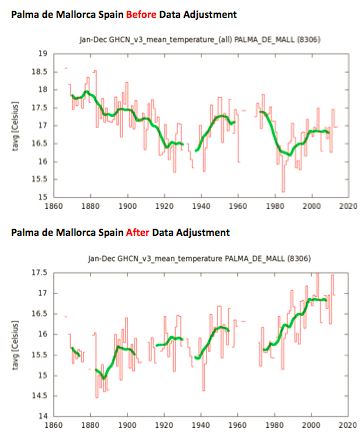
How climate scientists adjust the data to prove they need more grant money
How climate scientists adjust the data to prove they need more grant money (see #10 in the list below)

My friend Bruce posted this article from the the Daily Wire, and I think it’s a good summary of the scientific evidence against global warming alarmism. After we go over this, I’ll take a stab at explaining why so many non-scientists desperately want to believe that global warming is true, and why they try to push everyone else to believe it, too.

First, the list:

  1. Temperature records from around the world do not support the assumption that today’s temperatures are unusual.
  2. Satellite temperature data does not support the assumption that temperatures are rising rapidly
  3. Current temperatures are always compared to the temperatures of the 1980’s, but for many parts of the world the 1980’s was the coldest decade of the last 100+ years
  4. The world experienced a significant cooling trend between 1940 and 1980
  5. Urban heat island effect skews the temperature data of a significant number of weather stations
  6. There is a natural inverse relationship between global temperatures and atmospheric CO2 levels
  7. The CO2 cannot, from a scientific perspective, be the cause of significant global temperature changes
  8. There have been many periods during our recent history that a warmer climate was prevalent long before the industrial revolution
  9. Glaciers have been melting for more than 150 years
  10. “Data adjustment” is used to continue the perception of global warming

So, we can’t look at all of these in one post. Obviously, the satellite measurements are the best thing to look at, since they cannot be tampered with as easily as the ground measurements, and they show no warming for 18 years.

But let’s look at number 8 instead:

Even in the 1990 IPCC report a chart appeared that showed the medieval warm period as having had warmer temperatures than those currently being experienced.  But it is hard to convince people about global warming with that information, so five years later a new graph was presented, now known as the famous hockey stick graph, which did away with the medieval warm period.  Yet the evidence is overwhelming at so many levels that warmer periods existed on Earth during the medieval warm period as well as during Roman Times and other time periods during the last 10,000 years.  There is plenty of evidence found in the Dutch archives that shows that over the centuries, parts of the Netherlands disappeared beneath the water during these warm periods, only to appear again when the climate turned colder.  The famous Belgian city of Brugge, once known as “Venice of the North,” was a sea port during the warm period that set Europe free from the dark ages (when temperatures were much colder), but when temperatures began to drop with the onset of the little ice age, the ocean receded and now Brugge is ten miles away from the coastline.  Consequently, during the medieval warm period the Vikings settled in Iceland and Greenland and even along the coast of Canada, where they enjoyed the warmer temperatures, until the climate turned cold again, after which they perished from Greenland and Iceland became ice-locked again during the bitter cold winters.  The camps promoting global warming have been systematically erasing mention of these events in order to bolster the notion that today’s climate is unusual compared to our recent history.

That’s right, the world was much warmer than it is now during the Medieval Warming Period… so warm that you could actually farm on Greenland. But now it’s all frozen over.

Bruce also posted this article from Forbes magazine about the so-called consensus about global warming among scientists.

It says:

It is becoming clear that not only do many scientists dispute the asserted global warming crisis, but these skeptical scientists may indeed form a scientific consensus.

[…]Only 36 percent of geoscientists and engineers believe that humans are creating a global warming crisis, according to a survey reported in the peer-reviewed Organization Studies. By contrast, a strong majority of the 1,077 respondents believe that nature is the primary cause of recent global warming and/or that future global warming will not be a very serious problem.

The survey results show geoscientists (also known as earth scientists) and engineers hold similar views as meteorologists. Two recent surveys of meteorologists (summarized here and here) revealed similar skepticism of alarmist global warming claims.

According to the newly published survey of geoscientists and engineers, merely 36 percent of respondents fit the “Comply with Kyoto” model. The scientists in this group “express the strong belief that climate change is happening, that it is not a normal cycle of nature, and humans are the main or central cause.”

The authors of the survey report, however, note that the overwhelming majority of scientists fall within four other models, each of which is skeptical of alarmist global warming claims.

[…]Taken together, these four skeptical groups numerically blow away the 36 percent of scientists who believe global warming is human caused and a serious concern.

Many people listen to Obama, who never passed a science class in his life, talk about how most scientists support the idea of man-made global warming. But the truth is that his statements are just more “you can keep your health plan” and “you can keep your doctor”. He says what he wants people to believe so they will like him and rely on him to save them. But he has no knowledge of climate science any more than he has knowledge of health care policy.

Why do people believe weird things?

So why do people believe these things? People believe these things for the same reason that primitive people would sacrifice animals in order to get a bountiful harvest or be spared being struck by lightning. They fear the future, and they want to believe that they are doing something in order to save themselves from doom. There is something credulous in us that seeks to know and control the future. When we are told a noble lie by grant-seeking, attention-craving academics, we believe it because we want to believe it. We want to believe that the future is going to be OK, especially when all we have to do to make it OK is recycle cans and turn off our lights when we are not using them.

This is the real psychological motivation behind the desperate desire to believe in the global warming myth. We are scared, and we want someone to save us from the future. And we jump at the chance of controlling the future, especially when it means recycling cans, rather than having to deal with our own sinfulness. We invent a new morality that justifies us rather than having to comply with the old morality. Freedom to commit adultery, as long as we recycle cans to save the planet. Sanctification through purchasing carbon credits, instead of  sanctification through chastity, sobriety and self-control.

New study: cameras capture wild crows using tools they made to hunt for insects

Crow using a tool he made to hunt for bugs

By now regular readers know that birds are my favorite creatures of all, especially parrots. Pretty much any new study about how great birds are will be blogged about here. Partly to bolster the argument for design in nature, and partly just because I think that birds are so awesome!

Here is the latest bird news from Science Daily.

Excerpt:

Scientists have been given an extraordinary glimpse into how wild New Caledonian crows make and use ‘hooked stick tools’ to hunt for insect prey.

Dr Jolyon Troscianko, from the University of Exeter, and Dr Christian Rutz, from the University of St Andrews, have captured first video recordings documenting how these tropical corvids fashion these particularly complex tools in the wild.

The pair developed tiny video ‘spy-cameras’ which were attached to the crows, to observe their natural foraging behaviour.

They discovered two instances of hooked stick tool making on the footage they recorded, with one crow spending a minute making the tool, before using it to probe for food in tree crevices and even in leaf litter on the ground.

The findings are reported in the Royal Society’s journal Biology Letters on Wednesday, December 23.

[…]”In one scene, a crow drops its tool, and then recovers it from the ground shortly afterwards, suggesting they value their tools and don’t simply discard them after a single use.” According to Rutz, this observation agrees with recent aviary experiments conducted by his group: “Crows really hate losing their tools, and will use all sorts of tricks to keep them safe. We even observed them storing tools temporarily in tree holes, the same way a human would put a treasured pen into a pen holder.”

New Caledonian crows (Corvus moneduloides) are found on the South Pacific island of New Caledonia.

They can use their bills to whittle twigs and leaves into bug-grabbing implements; some believe their tool-use is so advanced that it rivals that of some primates.

OK, that is pretty cool, but on crows are not the most cuddly birds. However, Goffin cockatoos are pretty cuddly, and there was a related story about them.

Goffin cockatoo using a tool he made to scoop up food through cage bars

First, this one from November 2012: (Science Daily)

A cockatoo from a species not known to use tools in the wild has been observed spontaneously making and using tools for reaching food and other objects.

A Goffin’s cockatoo called ‘Figaro’, that has been reared in captivity and lives near Vienna, used his powerful beak to cut long splinters out of wooden beams in its aviary, or twigs out of a branch, to reach and rake in objects out of its reach. Researchers from the Universities of Oxford and Vienna filmed Figaro making and using these tools.

How the bird discovered how to make and use tools is unclear but shows how much we still don’t understand about the evolution of innovative behaviour and intelligence.

A report of the research is published this week in Current Biology…

And then an update to the story – a new study showing that the cockatoo is actually able to teach other birds how to make tools as well: (Science Daily)

Goffin’s cockatoos can learn how to make and use wooden tools from each other, a new study has found.

The discovery, made by scientists from Oxford University, the University of Vienna, and the Max Planck Institute at Seewiesen, is thought to be the first controlled experimental evidence for the social transmission of tool use in any bird species.

Goffin’s cockatoo (Cacatua goffini) is a curious species of Indonesian parrot not known to use tools in the wild. At a laboratory in Austria the researchers had observed a captive adult male Goffin’s cockatoo named ‘Figaro’ spontaneously start to sculpt stick tools out of wooden aviary beams to use them for raking in nuts out of his reach. To investigate if such individual invention could be passed on to other cockatoos the team used Figaro as a ‘role model’, exposing other birds to tool use demonstrations, some with Figaro as ‘teacher’ and others without his ‘students’ seeing him at work.

In the experiments one cockatoo group was allowed to observe Figaro skilfully employing a ready-made stick tool, while another could see what researchers called ‘ghost demonstrations’ — either seeing the tools displacing the nuts by themselves, while being controlled by magnets hidden under a table, or seeing the nuts moving towards Figaro without his intervention, again using magnets to displace the food. The birds were all then placed in front of an identical problem, with a ready-made tool lying on the ground nearby.

Three males and three females that saw Figaro’s complete demonstration interacted much more with potential tools and other components of the problem than those seeing ghost demos. They picked up sticks more than the ghost demo control groups and generally seemed more interested in achieving the result. Remarkably, all three males in this group acquired proficient tool use, while neither the females in the same group nor males and females in the ghost demo groups did.

A report of the research is published in the journal Proceedings of the Royal Society B.

During the Christmas holidays, I’ve been working on a technical project that is now deployed and functioning on a cloud service, backed by a data store. One of the reasons I have been able to keep at it despite all the festivities going on, is because my pet bird has been flying and landing on top the computer monitor and urging me to get cracking on the next feature in the feature list. He is very bossy.

Related posts