Tag Archives: Same-Sex Marriage

This woman’s husband left her for his business partner and took her kids

A striking story from the Public Discourse.

Excerpt:

In the fall of 2007, my husband of almost ten years told me that he was gay and that he wanted a divorce. In an instant, the world that I had known and loved—the life we had built together—was shattered.

I tried to convince him to stay, to stick it out and fight to save our marriage. But my voice, my desires, my needs—and those of our two young children—no longer mattered to him. We had become disposable, because he had embraced one tiny word that had become his entire identity. Being gay trumped commitment, vows, responsibility, faith, fatherhood, marriage, friendships, and community. All of this was thrown away for the sake of his new identity.

Try as I might to save our marriage, there was no stopping my husband. Our divorce was not settled in mediation or with lawyers. No, it went all the way to trial. My husband wanted primary custody of our children. His entire case can be summed up in one sentence: “I am gay, and I deserve my rights.” It worked: the judge gave him practically everything he wanted. At one point, he even told my husband, “If you had asked for more, I would have given it to you.”

I truly believe that judge was legislating from the bench, disregarding the facts of our particular case and simply using us—using our children— to help influence future cases. In our society, LGBT citizens are seen as marginalized victims who must be protected at all costs, even if it means stripping rights from others. By ignoring the injustice committed against me and my children, the judge seemed to think that he was correcting a larger injustice.

[…]At the time of the first ceremony, the marriage was not recognized by our state, our nation, or our church. And my ex-husband’s new marriage, like the majority of male-male relationships, is an “open,” non-exclusive relationship. This sends a clear message to our children: what you feel trumps all laws, promises, and higher authorities. You can do whatever you want, whenever you want—and it doesn’t matter who you hurt along the way.

[…]Our two young children were willfully and intentionally thrust into a world of strife and combative beliefs, lifestyles, and values, all in the name of “gay rights.” Their father moved into his new partner’s condo, which is in a complex inhabited by sixteen gay men. One of the men has a 19-year-old male prostitute who comes to service him. Another man, who functions as the father figure of this community, is in his late sixties and has a boyfriend in his twenties. My children are brought to gay parties where they are the only children and where only alcoholic beverages are served. They are taken to transgender baseball games, gay rights fundraisers, and LGBT film festivals.

Both of my children face identity issues, just like other children. Yet there are certain deep and unique problems that they will face as a direct result of my former husband’s actions. My son is now a maturing teen, and he is very interested in girls. But how will he learn how to deal with that interest when he is surrounded by men who seek sexual gratification from other men? How will he learn to treat girls with care and respect when his father has rejected them and devalues them? How will he embrace his developing masculinity without seeing his father live out authentic manhood by treating his wife and family with love, honoring his marriage vows even when it’s hard?

My daughter suffers too. She needs a dad who will encourage her to embrace her femininity and beauty, but these qualities are parodied and distorted in her father’s world. Her dad wears make-up and sex bondage straps for Halloween. She is often exposed to men dressing as women. The walls in his condo are adorned with large framed pictures of women in provocative positions. What is my little girl to believe about her own femininity and beauty? Her father should be protecting her sexuality. Instead, he is warping it.

Without the guidance of both their mother and their father, how can my children navigate their developing identities and sexuality? I ache to see my children struggle, desperately trying to make sense of their world.

When I was younger and considering marriage, I thought a lot about no-fault divorce and how I would feel about my wife leaving me because she wanted to find herself in Europe, or something. I thought about the feminist judge who would give her custody of our children, and force me to pay alimony and child support. Marriage did not seem like a good risk to me then. I guess part of me always thought that feminists would be the only bad guys in this sexual revolution, and men and children were the victims of feminist selfishness. But this woman’s story really makes me realize how women can be just as much the victims of judicial activism as any man was under no-fault divorce laws. That story she told about the activist judge just made my blood run cold. What must that have been like for her, to lose custody of her kids and have them put into the “gay lifestyle” Grindr-style environment? My heart goes out to her.

Previously, I blogged about Dawn Stefanowicz‘s story of growing up with a gay father.
How should Christians respond to the Supreme Court’s decision to redefine marriage?

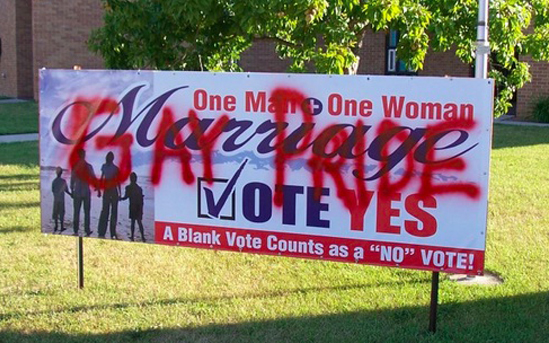
Gay activist vandalizes pro-marriage sign

In case you haven’t heard, the Supreme Court voted to redefine marriage to remove the focus on creating and raising children in stable relationships. Now marriage is just for any two or more people who have feelings for each other, and when the feelings go, so does the marriage. The commitment is gone, the child-centered focus is gone. It’s just about the needs of selfish adults.

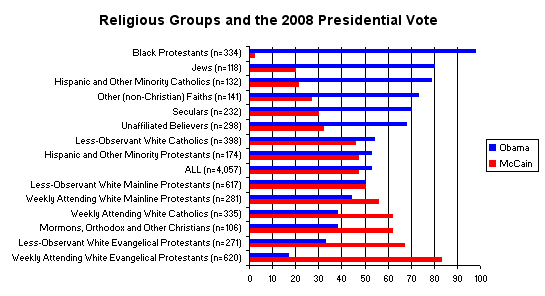
Which Religions Voted for Obama in 2008?

And more:

2008 voting broken by religious groups
2008 voting broken down by religious groups

So, remember that when you are processing today’s decision on gay marriage – not every person who calls herself a Christian actually is what she claims to be. For many of them, religion is just a custom, like the clothes they wear, or the food they eat. They don’t really believe a word of the Bible, and just want to dance and sing in church for the sake of their own happiness. There is nothing cognitive going on in some churches. No understanding, no authenticity.

You can read Justice Scalia’s dissent to the decision here.

How should Christians respond?

This post by Lenny Esposito at Come Reason made me laugh. He writes about how Christians should respond to same-sex marriage, since the Supreme Court is about to rule on it, and is guaranteed to rule against natural marriage.

Lenny has arguments against same-sex marriage that are made on the basis of logic and evidence. But not everyone is happy with his approach.

He writes:

I did receive a few responses from people who wrote something to the effect of “All we need is the Gospel. Share the Word with them.” I’ve run into such thinking before, with those who question the necessity of rigorous training in logic and apologetics. They think such things are “of men.” They admonish me and other believers to simply let loose the “the sword of the Spirit, which is the word of God” (Eph. 6:17) to fight our battles.

I think such talk is sincere but misguided. First of all, we live in a post-Christian culture. The Bible is not taken to be the final answer on issues such as same-sex marriage. That’s why if I quote the Bible to a person who supports homosexual unions, it really doesn’t sway them at all. In fact, many times it solidifies their stance since they see themselves as more modern and progressive than some 2,000 year-old book.

Anyone who has been paying attention to the changes of belief about this issue can quickly see my point. We’ve been offering Biblical admonition against homosexuality and same-sex marriage for over 30 years. Which way did the culture shift? Which way did the Church shift? According to a newly released Pew study, over 60% of Catholic and mainline Protestants support same-sex marriage.1 Even among Evangelicals, the support for same-sex marriage has DOUBLED in the last ten years.2 All this even though the scriptural admonitions against homosexuality are clear and have been discussed repeatedly, especially in churches.

In the words of Dr. Phil, “How’s that workin’ for ya?” I can answer that: it isn’t.

I’m actually not sure that any churches have talked about the Bible says about any issue in the real world. Mine certainly never does, and the pastors are all quite proud of preaching the gospel every week and never talking about current events, law or policy. It’s just Bible, Bible, Bible all the time, and never a word about how it is supported by evidence, or how it applies to real world issues. No wonder churched Christians get the idea that Christianity is just about their emotional state, and not about reality.

More from Lenny:

While I do believe that the Christians who think quoting scripture is the proper way to face these questions are sincere, they are trying to make scripture into something that it is not. They think scriptures are some kind of secret weapon that cannot be resisted. They see it as a sort of mystical summons of the Holy Spirit who will magically change those with whom they’re engaging; a few phrases that one only needs to voice in order to change people’s hearts and minds.

But “the Word” is not a magical incantation and it’s wrong to think of it that way. Such is an unbiblical view of scripture itself. Yes, the Holy Spirit is the one who transforms lives. It is he would is responsible for our understanding our sinfulness and our need for Christ. But that doesn’t mean the Spirit will reshape every unregenerate idea, even among believers. That’s why Paul didn’t quote scripture to the Athenians in Acts 17 when he witnessed to them. Instead, he used popular poets and thinkers they were familiar with to make his point. When Paul was held prisoner in Jerusalem, he didn’t quote scripture to his captors, but appealed to Roman law (Acts 22:25) in order to escape flogging.

I thought it was worth quoting what Lenny said. I think he is more familiar with the normal church  background where people rely on feelings and nudges and intuitions, and are hyper-spiritual about everything.

So what do you think? Is he right about this?

He didn’t provide a case against same-sex marriage in his post, so I’ll just link to my case against same-sex marriage, and summarize the main points below:

  1. Celebrating same-sex unions is bad for children
  2. Celebrating same-sex unions is bad for public health
  3. Celebrating same-sex unions is bad for business and religious liberty

And of course there have been more recent studies since I wrote that which are relevant, like this one that I blogged about previously. There’s much more to the case for natural marriage than my 3 points, but it’s a start.

Jennifer Roback Morse debates on marriage at Columbia University

Cloning her would solve the marriage problem
Dr. J makes marriage interesting and fun

Dr. Jennifer Roback Morse defends marriage at Columbia University in this short hour-long exchange. This is your chance to hear how anti-child advocates of same-sex marriage really are. And Dr. J links SSM to unilateral divorce at the end of the Q&A, too. Awesome! This debate really needed to go for twice the time, and I look forward to hearing MORE debates from Dr. J.

Details:

Columbia University’s Federalist Society hosts a debate between Dr J and Professor Katherine Franke based on the question “Is Marriage Equality Possible?”  About an hour of audio includes opening position (Dr J), arguments (Prof. Franke), and rebuttal (Dr J), as well as a brief question-and-answer period.

The MP3 file is here.

Dr. J’s opening speech (15 min.)

Two basic contentions:

  • 1) same-sex marriage is not the equivalent of traditional marriage
  • 2) if we legislate that they are equal, then we are really redefining marriage by changing the essential purpose of marriage

A case study from Ireland:

  • a known sperm donor for a lesbian couple was excluded from having a relationship with the child he conceived
  • after the child was born, the sperm donor wanted regular contact with the child, but the women opposed giving him access
  • same-sex marriage requires that courts are able to assign parental rights instead of having rights assigned biologically, as with traditional marriage
  • That is why SSM is different from TM

What is the purpose of marriage?

  • Marriage is about attaching mothers and fathers to children, and mothers and fathers to one another
  • Children are born helpless from two opposite-sex parents and they need parental guidance and care during development
  • In TM, there is no third party needed in order to have a child
  • In TM, the biological parents have rights and responsibilities for the child
  • TM is about providing the child with justice
  • Every child is entitled a relationship to both biological parents, and is entitled to care, protection and nourishment from both parents, and every child is entitled to a stable family environment
  • the problem is that children don’t have standing to sue for these rights in court
  • so the purpose of marriage is that we have a social construct to provide these rights to children naturally, without the state having to intervene

The purpose of marriage according to SSM?

  • In SSM, the essential child-centered  purpose marriage is replaced with new purposes like pooling resources and having same-sex couples recognized by society

SSM redefines marriage in four ways:

  • it diminishes the entitlement of children to a relationship with both biological parents
  • it diminishes the identification of parental roles with biology
  • it requires the state to determine parental relationships, instead of recognizing biological parents
  • it enshrines the idea that mothers and fathers are interchangeable, that children don’t really need mothers AND fathers

Dr. Franke’s opening speech (20 min.)

Hard cases make bad law 1: the presumption of paternity

  • consider the case where a mother is married and has an affair resulting in a child
  • the Supreme Court has ruled that the father of the child has no right of contact
  • this is a case where marriage gets in the way of biological parents having a relationship with the child
  • so it can be the case where marriage is in conflict with the relationships to biological parents

Hard cases make bad law 2: the purpose of marriage can be changed

  • marriages was used to keep peace between families and communities
  • marriage used to be about trading and trafficking of women
  • so the concern for offspring was not always the greatest concern

TM and SSM are both equally able to create stability for children:

  • same-sex unions are just as stable for children as TM marriages

Same-sex unions do provide justice for the child:

  • giving the adults in same-sex couples the social recognition that opposite sex married couples have is good for children

Children can sue in court

  • children can use guardians to sue their parents in court to get their rights

Opposing SSM is racism

  • opposing same-sex marriage is equivalent to racism
  • we could abolish marriage completely and let individuals form private contracts, then the state would really be neutral on marriage

Dr. J’s rebuttal speech (5 min.)

The state cannot be neutral on marriage

  • what the deinstutionalization of marriage means is that the private contracts are made by adults and children will have no consideration in those contracts

Regarding the adultery case

  • the presumption of paternity is there to protect the marriage
  • such borderline cases almost never happen with TM, whereas in SSM these third party problems occur in 100% of the cases

Children are not happy being separated from their biological parents

  • adults do not have a right to exclude a child’s biological parents from having a relationship with them, and children are often not happy being excluded from their biological parents