Major pro-abortion group endorses Joe Biden for President
What does Joe Biden think about Roman Catholics? He might like you to believe that he’s a great friend of Catholics, so he can get their votes. But he’s very strongly in favor of abortion and infanticide. And he’s also opposed to religious liberty for Roman Catholics. How do I know? Because he said so himself.
Biden’s record is one of attacking nuns, not defending them. Last month, he pledged to overturn a Supreme Court decision that affirmed a group of nuns’ right to deny contraceptive coverage based on their sincerely-held religious beliefs. The Little Sisters of the Poor are a Catholic order that has existed since 1839 and serves impovrished elderly in over 30 countries, including the United States. In 2013, the Little Sisters sued the Obama-Biden administration’s Health and Human Services, seeking a religious exemption to providing contraceptives and abortifacients that went against their beliefs. After three years of litigation, the Supreme Court ruled in the Little Sisters’ favor in 2016.
When the Trump administration issued a new rule that expanded religious exemptions to include the Little Sisters, the state of Pennsylvania interfered, suing the administration to take protections away from the nuns. That case also made it to the Supreme Court, which again decided in favor of the Little Sisters in July 2020.
But the day the Supreme Court issued its ruling, Biden promised to take away the nuns’ hard-fought exemption if elected president.
“I am disappointed in today’s U.S. Supreme Court decision,” Biden said in response. “If I am elected I will restore the Obama-Biden policy.”
So, not good on religious liberty, especially for Roman Catholics.
And here’s an interesting article from Life News, about Biden’s support for abortion. Is he a moderate?
NARAL, the pro-abortion political and lobbying organization, yesterday announced its endorsement of pro-abortion former vice president Joe Biden, the presumptive Democrat nominee, for president.
If elected, Biden has promised to:
enshrine Roe v. Wade in federal law;
appoint justices who will uphold abortion on demand;
reverse the Trump Administration’s pro-life policies;
reverse President Trump’s Title X rule that prevents pro-abortion groups from promoting or referring for abortions;
promote abortion around the world by reversing the Protecting Life in Global Health Assistance program which prevents federal taxpayer dollars from being used by abortion groups to perform or promote abortion overseas;
abolish the Hyde Amendment which prevents federal tax dollars from being used to pay for abortions except in cases of rape, incest, or to save the life of the mother.
Joe Biden isn’t a Roman Catholic. Like all other Democrats, he’s an atheist. He doesn’t think that the Bible is an authority on truth or morality. I know, because I looked at his actions. His actions declare that he’s a pro-abortion, anti-Christian bigot.
Reformed Baptist theologian Wayne Grudem speaks on the Bible and capital punishment.
About Wayne Grudem:
Grudem holds a BA from Harvard University, a Master of Divinity from Westminster Theological Seminary, and a PhD from the University of Cambridge. In 2001, Grudem became Research Professor of Bible and Theology at Phoenix Seminary. Prior to that, he had taught for 20 years at Trinity Evangelical Divinity School, where he was chairman of the department of Biblical and Systematic Theology.
Grudem served on the committee overseeing the English Standard Version translation of the Bible, and in 1999 he was the president of the Evangelical Theological Society. He is a co-founder and past president of the Council on Biblical Manhood and Womanhood. He is the author of, among other books, Systematic Theology: An Introduction to Biblical Doctrine, which advocates a Calvinistic soteriology, the verbal plenary inspiration and inerrancy of the Bible, the body-soul dichotomy in the nature of man, and the complementarian (rather than egalitarian) view of gender equality.
what does it mean that man is made in the image of God?
is CP just about taking revenge?
what does CP say about the value of human life?
does CP apply to animals, too?
could the statements supporting CP be understood as symbolic?
one purpose of CP is to protecting the public
another purpose of CP is to deter further wrongdoing
but the Biblical purpose of CP is to achieve justice by retribution
does the Pope make a good argument against CP?
what is the role of civil government in achieving retribution?
do people in Heaven who are sinless desire God to judge sinners?
should crimes involving property alone be subject to CP?
is the Mosaic law relevant for deciding which crimes are capital today?
should violent crimes where no one dies be subject to CP?
is CP widespread in the world? why or why not?
what are some objections to CP from the Bible?
how do you respond to those objections to CP?
should civil government also turn the other cheek for all crimes?
what is the “whole life ethic” and is it Biblical?
what do academic studies show about the deterrence effect of CP?
how often have innocent people been executed in the USA?
should there be a higher burden of proof for CP convictions?
The Bible is awesome because it gives us knowledge about God’s character. How are we supposed to act in a way that is pleasing to God if we don’t know what he thinks of the issues of the day? We won’t know how we are supposed to act unless we know who God is first. And that’s why when we read the Bible we should be looking to find out the truth about who God is.
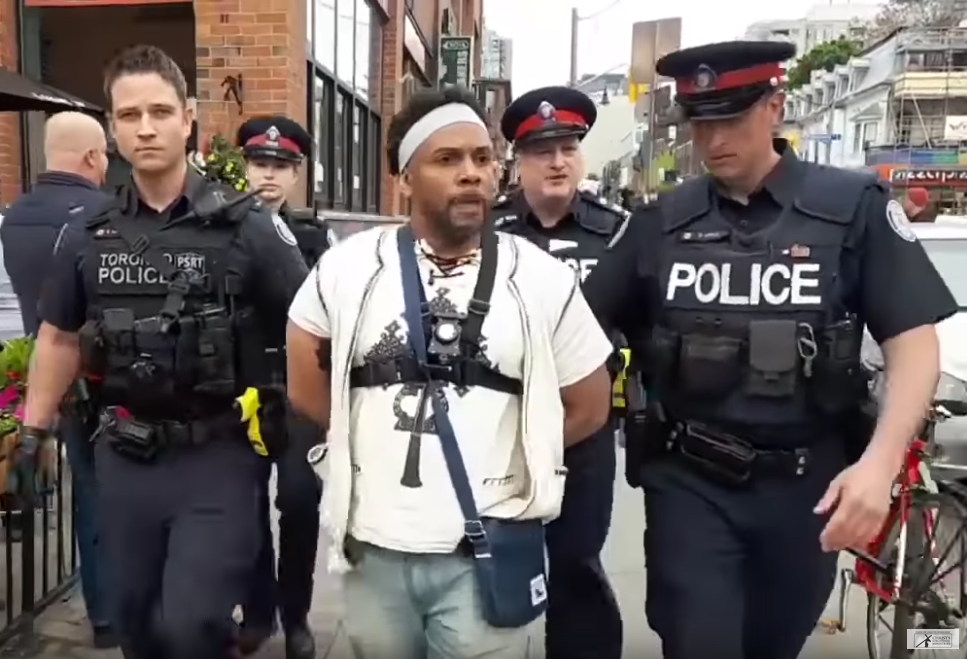
Canadian police officers arrest black pastor for preaching the gospel
I got an essay from a Christian man who lives in Canada who served with the armed forces, but was banned from re-enlistment for expressing orthodox Christian views online about Islam. On this blog, I have urged Christians not to entrust a secular government with too many responsibilities, because it results in diminished liberty. I hope my readers will learn something from his story.
The remained of this post is written by the Canadian writer.
I was in the Canadian army several years ago, and while during this brief period of my life I was somewhat eager to get out. It just wasn’t a good time and I had chosen a less than ideal trade. I also had a difficult time telling myself I did the right thing. My 3 year engagement was valuable in some ways, I made some of my best friends there, and it made me into somewhat of a disciplined civilian, one might say. After my release from the army, I went to school and studied Christian apologetics and philosophy, which gave me an excellent outlet to share ideas. I had taken a course on Islam through Veritas evangelical seminary, which was very informative. I had learned that Islam shares many core ideas of Christianity, but there was also something about it which undoubtedly drives much of the terrorist activity in the world. I decided I could no longer evaluate Islam through what the media was telling me, or some of the attitudes towards Islam I may have picked up in the army. Given the time in which I was in the army (2005-2008), during the Afghanistan conflict, no doubt there was a great deal of vilification of our enemy in order to dehumanize them. This seems to be how war works, as it makes it easier to kill who you believe to be sub-human.
No doubt, Islam has been heavily politicized since then. It has become the preferred religion of the Liberal party in Canada; the object of tolerance, and the line of demarcation, which if you do not tolerate you are a racist, even if you so much as raise concern with regards to its violent roots, and current activity. Either way, I had to understand it for myself.
Is this a misappropriated religion, used by those who would be violent anyway as a pretext to carry out their actions? Is there room for reform within Islam, can a believer move away from the violent passages in the Quran, and adopt a more peaceful form of Islam without compromising essential beliefs?
Without getting into the details of my piece, I answered these questions in the negative, while leaving open the very real possibility that a genuinely peaceful person might be a Muslim, that we might hold two, or more, conflicting ideas at once. I published my ideas on my former blog.
Since then, I had reapplied with the army, I even did my aptitude test again, bringing up my score, in order to open up a more desirable occupation than before. My chosen occupation was intelligence, and I was almost in. I suppose it was appropriate that the recruiter gathered their intelligence on me, and found my apologetics blog.
During the recruiting process, one form which all candidates must sign is “Operation Honour,” instantiated by General Jonathan Vance, an initiative not in place during my previous engagement. This outlines an understanding that members must not sexually harass, or discriminate against other CF members, and such can be grounds for dismissal, which seems reasonable.
I was called into the recruiting centre, and my reapplication to the military was closed due to this post, this post which expressed views criticizing a set of ideas, Islam, as a private citizen.
I had argued, with the recruiters, how no specific person was accused of violence, and how the piece was only intended to draw out the problems I saw contained within. They would have none of it, and were set on a year long deferral. It became clear to me that our freedoms of speech were under attack, and in order to hold jobs in government one cannot hold views contrary to the current cultural milieu. I have since had the opportunity to reapply, but with such a wax nose initiative in place, where any disagreement one might voice against a particular worldview, I am unsure how one’s career could survive in an atmosphere of whistleblowers, and where people’s feelings are a metric for one’s worthiness in the forces. Literally anything which rubs another the wrong way, any concern or disagreement, can become a nightmare for a member.
Would not the mere presence of me, a Christian, be an affront to Islam, or even a homosexual/LGBTQ member? The simple affirmation of Jesus being the Son of God is blasphemy to Islam, which only affirms Him as a prophet. How is anyone to function in such an environment as both a private citizen and a state employee, one which professes inclusivity, but has their own ideas of exclusivity in mind? In the name of tolerance, it does seem that our government, and its agencies, have become some of the most intolerant and divisive amongst us. They seem more interested in catering to special interest groups, rather than evaluating ideas, which is ironic considering my intended trade—intelligence, which examines sociopolitical influences on a region, ideas that might be useful for command decisions.
If Islam were the peaceful religion our politicians claim it to be, wouldn’t this be a valuable thing for a person in a command position to know? One could use this knowledge to reform violent practitioners away from their erroneous ways. Yet, they have chosen to protect it by brute political force, rather than allowing open discussion.
Sure, I was initially bitter about this, but it was a valuable lesson, and it has shown me how under the brief influence of a very pseudo-liberal government, how our basic freedoms of thought and speech become attacked, freedoms which I thought our military was interested in preserving, at home and abroad. I suppose it was a valuable awakening to no longer see the state as the preservers of morality, let alone our basic freedoms. For this, we need to look elsewhere.



 WINTERY KNIGHT