
Tag Archives: Robin Collins

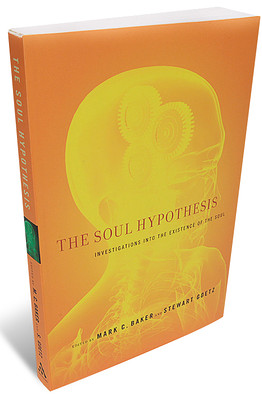
New collection of essays published to defend mind-body dualism

Here’s the new book on J.P. Moreland’s web site.

Full text:

In the Soul Hypothesis: Investigations into the Existence of the Soul (Continuum), co-editors Mark C. Baker and Stewart Goetz have assembled an impressive interdisciplinary team of scholars to address questions about the existence and nature of the soul.

“The Soul of the Matter” – Charles Taliaferro
“Minds, Brains and Brains in Vats” – Daniel N. Robinson
“Brains and Souls; Grammar and Speaking” – Mark Baker
“Making Things Happen: Souls in Action” – Stewart Goetz
“Energy of the Soul” – Robin Collins
“The Measure of All Things: Quantum Mechanics and the Soul” – Dean Zimmerman
“From Seeing to Seer” – Hans Halvorson
“Souls Beastly and Human” – William Hasker
“A Scientific Case for the Soul” – Robin Collins

You can preview the book here.

The book is unique is combining philosophical and scientific arguments for dualism, and the result is a rigorous, exciting, persuasive presentation of the issues and a stimulating challenge to so much of the reductionism that reigns in the sciences. As was noted in a recent review of the book in the WSJ,

Sooner or later, the contributors to “The Soul Hypothesis” warn, scientists will pinpoint the exact three neurons whose firing accompanies the thought of our deciding to make a phone call or, if you prefer, deciding to get up and get a beer from the refrigerator. As ever more such micro-couplings are observed, we will—so scientists tell us with unseemly glee— gradually come to see that our cherished conscious life is nothing but a long series of electrical impulses, not an autonomous realm of free will and free thought. Co-editor Mark C. Baker cites the psychologist Steven Pinker, who finds it plausible to say that neural “activity in the brain” simply “is the mind.”

The book’s contributors set out this scientific challenge fully and engagingly, but they also expose its fallacies. They note, for instance, that even if two things differ in their essential nature, as do mental thoughts and physical actions—or legislatures and laws—there is no reason why the one can’t cause the other. As David Hume argued, what establishes our idea of cause and effect is the regular “conjunction” of two events. That a physical act regularly follows a mental decision suggests, as co-editor Stewart Goetz writes, that the one is “causing” the other and that voluntary human action exists.

The Soul Hypothesis is an excellent text that is sure to provoke a vigorous dialog about its content. I highly recommend it.

I really would like to be able to use this argument more – I just need a good book. I’m a big admirer of Charles Taliaferro. I even met him once at a conference!

Robin Collins explains why fine-tuning is necessary for life

A short video from Lee Strobel’s DVD “The Case for a Creator”.

Actually, that WHOLE DVD is available on YouTube if you want to watch it. Here’s the playlist. There is a lot more about the fine-tuning argument in that DVD.

Fine-tuning of the gravitational force

I actually wrote about the fine-tuning of the force of gravity, which is mentioned in the clip. I link to an article from the New Scientist in the post to show that the fine-tuning argument is quite mainstream.

You can read more about the fine-tuning of the gravitational force from Robin Collins, who is the best we have on the topic. Collins started a Ph.D in Physics at the University of Texas at Austin, but ended up completing a Ph.D in philosophy at Notre Dame, under Alvin Plantinga, the greatest living philosopher today, in my opinion. I heard Collins speak at the Baylor ID conference in 2000.

Other DVDs on design arguments

Actually, I prefer the Unlocking the Mystery of Life and The Privileged Planet DVDs, instead, especially for people who want more detail.

William Lane Craig answers a question from our own commenter Martin

Here’s the original comment from Martin.

I thought this was a pretty good objection, and I said so. Well, Martin submitted it as a question to Bill, and Bill replied.

Here is his question to Dr. Craig, which is similar to what he asked before:

I’ve been thinking about the fine tuning argument, and while I like it and think it carries some weight, something about it bothers me. It seems to suffer from “life chauvinism.”

In a poker hand a royal flush has intrinsic value and thus being dealt that hand is highly improbable and quite amazing. But that’s because the rules of the game define a royal flush as having value before the hand is dealt.

What is the justification for asserting that life is the royal flush?

Life could be defined as an “amazing and improbable phenomenon” X1. Singing gas could be defined as “amazing and improbable phenomenon” X2. Rainbow planets with rings of fire could be X3. And so on.

Each phenomena is equally improbable and can only come about by a certain setting of the universal constants. Why assert that X1 has intrinsic value? Couldn’t X2 “complain” that we are being phenomenonists by claiming that X1 is best?

It just seems to me that the rules about royal flushes are being made up only after the hand has been dealt.

Martin

And you can read Dr. Craig’s reply here. He starts by saying this “This is a very good question, Martin, about which I’d like to think more. But here are some preliminary reflections.”

I like this response because I actually had to study Bayes Theorem for my machine learning classes in grad school. So this was good because I actually get to use computer science for something useful for a change. (By the way, my New Zealand readers, I used the Weka machine learning software library).

Wow! We have the smartest commenters. Just last week that woman who I like was asking me about divine aseity. Like I know what to say about that. Well, I did say something to her that seemed to make sense to her, but she still has more questions. That’s Bill’s current area of research, you know.

On Guard

By the way, I know some of you have no idea who Bill Craig is, and I am afraid I will have to smite you with my foam bat for this grave infraction. But there is a way out. You can read chapter 1 of Bill Craig’s new book “On Guard” right here on his web site. It’s an introduction to apologetics from the top Christian apologist of all time. And if you like it, you can order it and read the whole thing. It’s dirt cheap on Amazon.com.