Thugs who hijacked the tuition fees protest narrowly avoided seriously injuring or even killing police when they threw a fire extinguisher off the seventh floor roof of the Tory HQ, it emerged today.
The dramatic moment was captured on video footage, showing the extinguisher crashing to the ground just inches from a group of officers desperately battling to regain control in Millbank.
A youth was seen on pictures clutching the missile on top of the building and the film showed it being launched over the edge and falling at speed.
It glanced off the helmet of one territorial support group officer and grazes the knees of another. Had it properly hit any of the thousands of people below, it would almost certainly have left fatal injuries.
[…]Militants from far-Left groups whipped up a mix of middle-class students and younger college and school pupils into a frenzy, setting off the most violent student unrest Britain has seen in decades.
The focus of the violence was Tory HQ in Central London, where hundreds of thousands of pounds of damage was caused.
The glass frontage was smashed and protesters swarmed seven floors up to the roof, from where a fire extinguisher was hurled down at police below.
Effigies of David Cameron and Nick Clegg were burned to cheers from the roaring mob. At least 14 casualties were taken to hospital, seven of them police officers, and 51 demonstrators were arrested.
Notice that the signs in the pictures have logos from socialist organizations on them. These are violent left-wing thugs and they nearly killed police officers. And why? To protest against anyone who would cut the flow of taxpayer money that subsidizes their work-free lifestyle.
French refineries remained shut, trains were on half service, schools closed and gas stations ran dry as unions held their fourth strike in two months against President Nicolas Sarkozy’s plan to raise the retirement age.
Sarkozy has refused to retreat from a proposal to increase the retirement age for a full pension to 67 from 65. His plan would bring France closer to Germany and the U.S., which are moving toward setting 67 as the full-retirement age, according to the Organization for Economic Cooperation and Development.
The French Senate is set to vote on the pension measure this week, giving final parliamentary approval to a plan to eliminate the retirement-system deficit by 2018.
“This reform had been postponed for too long and the deadline couldn’t be push further anymore,” Sarkozy said at a press conference in Deauville, France. “I hope that everyone stays calm so that things don’t go beyond certain limits. We cannot live without gasoline. I will see to it with the security forces that public order is guaranteed.”
Some protests turned violent, with youths today fighting police in the Paris suburb of Nanterre. In Lyon, some demonstrators broke shop windows and pillaged stores, L’Express magazine said on its website. Television reports showed snaking lines of drivers waiting to fill up on gas as about a quarter of the country’s 12,000 service stations carried signs saying they’d run out of fuel.
Government ministers said France has enough fuel to last several weeks and that they’ll continue to use police to break up barricades at oil depots.
[…]France’s 12 refineries have been on strike for a week, and no crude is arriving at the ports of Marseille, Le Havre and Nantes.
[…]Exxon Mobil Corp. declared “force majeure,” in France, saying it will be unable to meet some of its oil supply obligations and that it has begun shutting down its Gravenchon refinery, the larger of its two oil-processors in the country.
“A complete shutdown of the refinery is now under way,” Catherine Brun, an Exxon spokeswoman in Paris, said by phone today. “We cannot deliver products out of tanks.”
Total SA, the country’s biggest oil company, said a quarter of the 4,000 service stations it operates in France face shortages of one or more fuel products because of the strike.
[…]In France, the average retiree gets a net 65 percent of his average qualifying wage in government pension payouts, compared with 61.5 percent in Germany, 47 percent in the U.S. and 44 percent in Britain, according to the OECD.
I’m not sure why, but the word “extortion” pops into my mind. Or maybe I was thinking of “arrested development”. What is it called when grown men and women refuse to grow up and take responsibility for their own lives and insist on receiving entitlements provided by their harder-working neighbors?
Could a public sector union pension crisis happen here in the USA? Well, consider this article from The Economist, a radically-left-wing pro-Obama magazine. (H/T ECM)
Excerpt:
CHUCK REED is the Democratic mayor of San Jose, California. You might expect him to be an ally of public-sector workers, a powerful lobby in the Golden State. But last month, at a hearing on pension reform held by the Little Hoover Commission, which monitors the state’s government, Mr Reed lamented his crippling public-pensions bill. “City payments for retirement benefits have tripled over the last ten years even though our workforce has declined dramatically, and we have billions of dollars in unfunded liabilities that the taxpayers must pay,” he said.
Mr Reed estimated that the average cost to his city of employing a police officer or firefighter was $180,000 a year. Not only can such workers retire at 50, but some enjoy annual pension payments greater than their salaries. They are also entitled to cost-of-living increases of 3% a year, health and dental insurance for life and lump-sum payments for unused sick leave that could reach hundreds of thousands of dollars.
Plenty of similar bills are looming in America’s public sector: in municipalities, in the federal government, and especially at state level. Defined-benefit pensions, which link retirement income to salary, are expensive promises to keep. The private sector has been switching to defined-contribution plans, in which employees bear the investment risk. But the public sector has barely begun to adjust, and has built up a huge liability to its staff. Worse, it has not funded the promises properly.
Joshua Rauh, of the Kellogg School of Management at Northwestern University, and Robert Novy-Marx, of the University of Rochester, estimate that the states’ pension shortfall may be as much as $3.4 trillion and that municipalities have a hole of $574 billion. Mr Rauh calculates that seven states will have exhausted their pension assets by 2020—even if they make a return of 8%, a common assumption that looks wildly optimistic. Half will run out of money by 2027. If pension promises are to be kept, this will place immense strain on taxes. Several have promised annual payments that will absorb more than 30% of their tax revenues after their pension funds are exhausted (see chart 1).
Now the problem is making headlines, especially in California, where taxpayer groups have been highlighting the generous pensions of some former employees. More than 9,000 beneficiaries of CalPERS, the largest state retirement plan, receive more than $100,000 a year.
The stage is set for conflict between public-sector workers and taxpayers. Because almost all states are required to balance their budgets, any extra pension contributions they make to mend a deficit will come at the expense of other citizens. Utah has calculated it will have to commit 10% of its general fund for 25 years to pay for the effects of the 2008 stockmarket crash. But attempts to reduce the cost of pensions are being challenged in court and will be opposed by trade unions, which still have plenty of members in the public sector.
It’s not good for people to go through life becoming more and more accustomed to bailouts and redistributed wealth from their neighbors. Everyone should have to earn their own money and provide for themselves during their own retirement years. It’s not good to be dependent on other people – it’s better to make your own way in the world, and to share with others who have less than you do.
Check out this post from GMU economist Veronica de Rugy on Big Government. (H/T ECM)
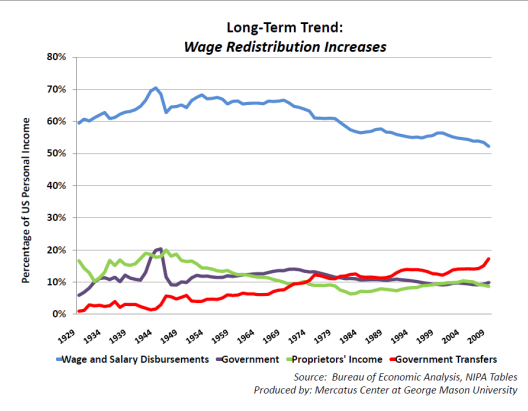
First, she puts up this chart.
Veronique writes:
On this chart we can see the changes over time in the composition of personal income in the United States since 1929. The most notable trend is the increase in the portion of personal income coming from government transfers (mainly social Security payments, unemployment benefits, food stamps, and personal and business tax credits.) And the increase isn’t minor: the proportion of total personal income constituted by government money has grown from 0.9% to 17.2%.
Complementary decreases of wage earnings as percentages of total personal income (from 59.5% to 52.3%) are also going on.
The problem with government giving people money is that it creates a culture of dependency, as with Greece. Politicians take money from job-creating business-owners, or from productive individual workers, and they redistribute it to whiny unproductive, immature victim groups like unions, in order to buy their votes. Eventually, the government goes too far making promises and the productive people just stop or slow their working or they move away, since they keep less and less of their own money for the same amount of work and risk-taking.
And that’s when welfare checks of the losers dry up, and they have no choice but to riot and kill people. Why do they riot? Well, if they were earning their own money by working, then they would know that they are responsible for themselves, not government. They would understand that something might go wrong, and they would know that they had to cut their spending and save for a rainy day. So when things do go bad, they would have known how to live cheaply off of their savings while they find another job.
But people who take welfare don’t save – they think the money will always be there. What do they do when the taxpayers slow or stop production? They have no skills, and they have no savings. They can’t just find a new government because a new government isn’t going to find any more money from somewhere – there isn’t any left. So the only way to get their welfare back is to revolt – which is exactly what the socialists in Greece are doing right now. They’ve been spoiled rotten and they want their welfare back, like little babies crying for their mommies.
It’s sick. And this is what Obama and the Democrats idolize, because that’s how they grew up – begging their rich parents for money and bailouts for their own irresponsible behaviors. Their policies aren’t thought through – it’s just reliving their silver spoon childhoods of never having to work for anything.
At 13, Bachmann was forced to become almost financially independent after her parents divorced. She used her babysitting money to buy her own clothes and lunches at school and saved up enough to purchase her first pair of contact lenses. Between college semesters at Winona State University, she took her hardworking streak to Alaska where on one memorable day she cleaned 280 salmon.
She also quit her job as a tax litigation attorney to homeschool her five kids, because she didn’t like the job the public schools were doing. Her business runs a small business, and she helped him to start it. That’s what Republicans do. We work. And we give.
We need to stop increasing the size of government so they can “take care” of all our needs. We need to take care of all our needs, and to take care of our neighbor’s needs, too. That’s capitalism. Having something to share from what you can make from your own industry and labor.


 WINTERY KNIGHT