I guess everyone already knows about Gary Chapman and his 5 Love Languages. But have you heard of his 5 Love Languages of apologies?
I want to focus on two of them that I think are important, because I don’t want people to think that just saying “I’m sorry” is good enough.
Here they are (straight out of his book):
Apology Language #3: Making Restitution
In the public arena, our emphasis upon restitution is based upon our sense of justice. The one who commits the crime should pay for the wrongdoing. In contrast, in the private sphere of family and other close relationships, our desire for restitution is almost always based upon our need for love. After being hurt deeply, we need the reassurance that the person who hurt us still loves us.
“How could they love me and do that?” is the question that lingers in our minds. The words “I’m sorry; I was wrong” may not be enough.
For some people, restitution is their primary apology language. For them the statement, “It is not right for me to have treated you that way,” must be followed with “What can I do to show you that I still care about you?” Without this effort at restitution, this person will question the sincerity of the apology. They will continue to feel unloved even though you may have said, “I am sorry; I was wrong.” They wait for the reassurance that you genuinely love them.
The question, then, is how do we make restitution in the most effective way? Since the heart of restitution is reassuring the spouse or family member that you genuinely love him or her, it is essential to express restitution in the love language of the other person.
[…]If restitution is the primary apology language of an individual, then this becomes the most important part of the apology. “I’m sorry; I was wrong” will never be taken as sincere if these words are not accompanied by a sincere effort at restitution. They wait for the assurance that you still genuinely love them. Without your effort to make amends, the apology will not have the desired results of forgiveness.
Apology Language #4: Genuinely Repenting
The word repentance means “to turn around” or “to change one’s mind.” In the context of an apology, it means that an individual realizes that his or her present behavior is destructive. The person regrets the pain he or she is causing the other person, and he chooses to change his behavior.
Without genuine repentance, the other languages of apology may fall on deaf ears. What people who’ve been hurt want to know is, “Do you intend to change, or will this happen again next week?”
How then do we speak the language of repentance?
It begins with an expression of intent to change. When we share our intention to change with the person we have offended, we are communicating to them what is going on inside of us. They get a glimpse of our heart—and this often is the language that convinces them we mean what we say.
The second step down the road of repentance is developing a plan for implementing change.Often apologies fail to be successful in restoring the relationship because there is no plan for making positive change.
The third step down the road of repentance is implementing the plan. Following through with the plan gives evidence to the offended party that your apology was sincere.
Most people do not expect perfection after an apology, but they do expect to see effort.
Thus, expressing your desire to change and coming up with a plan is an extremely important part of an apology to this person. Inviting the offended person to help you come up with a plan for change is perhaps the best way to effectively show repentance.
Here are some practical tips that I recommend to someone who has done something morally wrong and who wants to apologize.
To fix the problem you need more than talk
To me, the only thing that needs an apology is breaking a moral rule – you can’t beat someone up for just making a mistake. Whenever someone breaks a moral rule with me, like disrespecting me or being selfish, then I pick out a book for them to read and ask them to read it and then write something about how what they learned in the book applies to what they did to me. I don’t pick very long books! But I do this for a very important reason.
The very important reason is that I don’t trust people who just agree with me. I don’t trust people’s words. If someone is really sorry about something, then I want them to read something that describes the moral rule that they broke, and to be willing to listen to the feelings of the person they harmed by breaking that rule. That goes a long way in my mind.
Kevin Lewis, a professor of Theology and Law at the conservative Biola University, was asked this question:
Recently, I was reading Dr. Kenneth Bailey’s “Jesus Through Middle Eastern Eyes” (IVP press 2008). When commenting on Matthew 6:12-13, he writes,
“It is a common human assumption that the violator of the rights of others must ask for forgiveness before the wronged party can be expected to accept the apology and grant forgiveness…But Jesus here asks the person wronged to forgive the one responsible for the wrongdoing when when there is no confession of guilt… There is a voice from the cross that echoes across history to all saying ‘Father forgive them for they know not what they do.’ Neither Pilate nor the high priest nor the centurion offered any apology to Jesus, yet he prayed for divine forgiveness…(p.125)”
And here’s some of his response copied with permission from his Facebook note:
First, regarding God and His forgiveness, it is undisputed in orthodox Christian theology that God does not forgive everyone. The doctrine of Hell is a sufficient proof of the lack of universal forgiveness by God.
Next, it is clear that God does not forgive without repentance. This doctrine is taught in a number of texts. For example, in Luke 13:3 Jesus says, “unless you repent, you will all likewise perish.” In Mark 1:15 John the Baptist commands that we must “repent and believe the Gospel.” The connection between repentance and forgiveness of sins (i.e. “salvation”) is seen throughout the Scriptures. For example, in Acts 2:38 repentance is directly connected as a condition for the remission of sins. For additional examples of this connection see Matthew 11:20-24; Luke 24:45-49; Acts 3:19; 8:22; 17:30-31; Romans 2:4-5; II Corinthians 7:10; II Tim. 2:25-26.
So since we are to be imitators of God and forgive in the same way God forgives, we would expect the Scriptures to be consistent, stating that the condition of repentance is required to be fulfilled before believers are required to forgive each other’s sins. It does.
Jesus stated in Luke 17:3, “If your brother sins, rebuke him; and if he repents, forgive him.” Here, the meaning is clear. The word “if” (Grk. ean) introduces the condition for a rebuke and for granting forgiveness. If (subjunctive) a person sins, we must (imperative) rebuke him, and if (subjunctive) he repents, we must (imperative) forgive him. This is as clear a statement as you will find on the subject. Forgiveness is conditioned upon repentance—and this is one of the same criteria that God requires before He forgives sin.
This principle of permitting believers to withhold forgiveness unless the condition of repentance is satisfied is also explicitly seen in Matthew 18:15-17. Compared with the Luke 17:3 text above, the situation is the same. If a brother sins, reprove him; if he listens to you, you have won your brother. Here, the word “reprove” is used rather than “rebuke” and the word “listen” is employed rather than “repent,” but the meaning is virtually identical to Luke 17:3. What we see in Matthew 18 is an escalation of the issue and the result if the person fails to repent (i.e. “listen”). If the person fails to repent, we are to shun him in all appropriate ways (v. 17).
[…]Finally, I would make the case that it is harmful to a person to forgive him without requiring repentance. As seen above, the Bible is clear that sin requires a rebuke. Ignoring sin teaches sinners that sin does not bring consequences. This is harmful to their souls. Continuing to have the benefit of a righteous relationship with another and yet remain in sin against that person results in fostering a habituation of sinful inclinations in their soul, which God says brings about suffering and death.
Moreover, since the ultimate purpose of forgiveness is reconciliation, it is meaningless and harmful to forgive when no reconciliation may be had with the sinner. We cannot “walk together” in a biblical manner in righteous peace when the unrepentant sinner walks in unrighteousness. Necessarily, there is a conflict and a want of shalom. Their soul is headed in a different direction than the believer’s soul; they are walking away from God and we cannot have fellowship with darkness. God has no intimate fellowship with unrepentant people, and that is the model for Christians as well (See Matt. 18).
Regarding personal anger issues commonly raised by Christian psychologists, these types of psychologists unbiblically make unconditional forgiveness a part of therapy. By contrast, however, if a counselee will not forgive after the offending party has truly repented, the counselee sins, and this kind of unforgiveness may be one of the causes of his or her problems. But this is a separate issue from universal and unconditional forgiveness raised above.
Human beings in the image of God may be angry in appropriate ways (Eph.4:26, 31). There is a time to love and a time to hate (Ecclesiastes 3:8). The notion that Christians cannot ever hate, be angry, or lack forgiveness is an unbiblical concept. God Himself is eternally angry with sin, but He is certainly not a psychological basket case. He loves, hates, and is angry in appropriate ways. Our task as believers is to imitate this. Be angry with and hate sin appropriately (Rom. 12:9) and love what good appropriately. For example, righteous anger can evolve beyond the biblical limits to become malice, slander, and bitterness while, to give another example, an appropriate love of food can evolve beyond the biblical limits into gluttony.
I agree with Kevin, and I think it is a helpful tool for people to insist on seeing some sort of repentance and restitution from someone who wrongs you before you trust them again. If they are not even sorry for what they’ve done, and they refuse to explain why what they did is wrong, then they can’t be forgiven, and you can’t trust them again.
9 And He also told this parable to some people who trusted in themselves that they were righteous, and viewed others with contempt:
10 “Two men went up into the temple to pray, one a Pharisee and the other a tax collector.
11 The Pharisee stood and was praying this to himself: ‘God, I thank You that I am not like other people: swindlers, unjust, adulterers, or even like this tax collector.
12 I fast twice a week; I pay tithes of all that I get.’
13 But the tax collector,standing some distance away, was even unwilling to lift up his eyes to heaven, but was beating his breast, saying, ‘God, be merciful to me, the sinner!’
14 I tell you, this man went to his house justified rather than the other; for everyone who exalts himself will be humbled, but he who humbles himself will be exalted.”
So again, no forgiveness without repentance.
Forgiveness is what happens when someone who is sinned against treats the sinner as if he had never sinned. It is not on the balance sheet. It is not brought to mind. It is not held against them in the future. The forgiver trusts the sinner again as if the previous sin had never happened.
In divine (vertical) forgiveness, there is no forgiveness without repentance. There are Bible verses above to show that.
My argument is twofold. First, there is a clear teaching of Jesus explaining the sequence of sin and forgiveness. Repentance precedes forgiveness, between humans (Luke 17:3). The verses cited by the forgive without repentance crowd don’t show the mechanics of how to forgive, they are making the point that if you want God to forgive you, you should forgive others. The parable in Luke 18:9-14 affirms this again – repentance always precedes forgiveness.
Second, we have an obligation to imitate God, and that means imitating the way he forgives those who sin against him. When I raise that with the unconditional forgiveness crowd, they want to insist that there is a difference, that the word “forgive” means different things. I’m not convinced.
Finally, I do think that forgiving someone is obligatory if they sincerely repent, and even if they screw up again and again. So long as the repentance is sincere, (like if there is restitution and a genuine effort to show an understanding how the sin affected the wronged party in writing), then forgiveness should be automatic.
Alan E. Kurschner argues that there is serious textual doubt about the originality of Luke 23:34a, a text used by the pro-unconditional-forgiveness crowd. He has a journal article coming out on it, but a synopsis of his argument is here.
He also wrote this in a comment on this blog:
Second, on Matt 6:15, this is what I have to say. Notice the then-clause: “neither will your Father forgive your sins.” This would require universalism on the Father’s part according to the unconditional interpretation given the first half: “But if you do not forgive others their sins.” Since everyone has wronged the Father is the Father required to forgive everyone even if they are not seeking forgiveness?
So I think the case for the forgiveness being conditional on repentance is pretty strong, especially when serious harm has been caused.
The success of children is due to their parents’ choices, not from outside racism
If the underperformance of blacks and Hispanics in America were caused by racism by whites, then it follows that Asian-Americans would be underperforming as well. But Asian-Americans are outperforming whites. Let’s look at three reasons why, and see if blacks and Hispanics can learn how to succeed by looking at the Asian example.
Here is the summary of this post:
Asian Americans marry before they have children
Asian Americans save more of what they earn
Asian Americans monitor their children’s educational progress
Now let’s take a look at each of these in order.
Asians marry before they have children, so the kids have two parents
1. Asian Americans marry before they have children
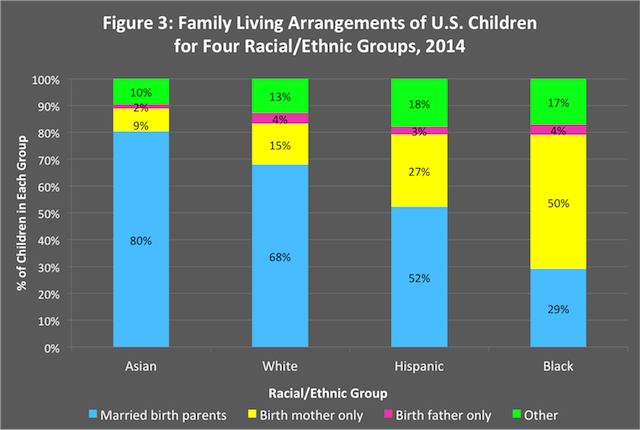
Eight in ten Asian-American kids live with married birth parents, compared with about seven in ten European-American kids, five in ten Hispanic-American kids, and only about three in ten African-American kids. Half of black children live with their mothers only, compared to three in ten Hispanic children, less than two in ten white children and less than one in ten Asian children.
Naturally, children who have two parents to look after them do better, because one parent alone cannot work and do household chores and monitor the children as easily as two parents can. The decision about whether to have sex before marriage is entirely under the control of the grown-ups. It cannot be blamed on racism, poverty and other non-moral pre-occupations of the secular left. Marriage is a moral issue, and Asian-Americans do the moral thing, and marry before they have children.
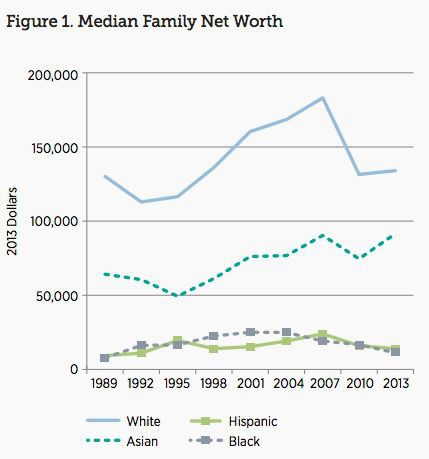
Asians have had higher median incomes than their white counterparts, according to a new study by the Federal Reserve Bank of St. Louis. The typical Asian family has brought home more money for most of the past two decades.
[…][Asians] will surpass whites in net worth in the next decade or two, Fed researchers said.
[…]In 1989, the median Asian family had about half the net worth of its white peer. By 2013, they had more than two-thirds.
The gap between whites and blacks and Hispanics, meanwhile, remained little changed over that time period.
Asians have similar financial habits to whites, in terms of investing and borrowing. Both groups are more likely than blacks and Hispanics to invest in stocks and privately-owned businesses and to have more liquid assets, which serves as a buffer against financial shocks. And, on average, the former have about half as much debt as the later.
As a result, Asians and whites have more financial stability than blacks and Hispanics, which also allows the former to build more wealth.
Everyone has to earn and save money, but in some cultures, it becomes normal to not save part of what you earn. That needs to stop. But it has nothing to do with discrimination due to skin color. In Asian culture, there is no glorification of consumer spending on sparkles, bling and other ostentatious wealth. Asians don’t want to appear to be wealthy, they want to actually be wealthy – by saving money.
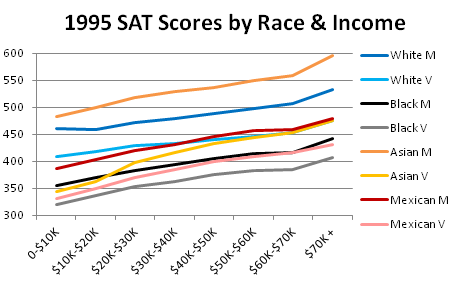
Composite SAT scores by race and income levels: Asians outperform at every income level
3. Asian Americans monitor their children’s educational progress
This article from Investors Business Daily explains how Asian parents don’t just make demands on their kids to learn, they actively monitor their progress and talk to their kids’ teachers:
Asian-American parents tend to oversee their children’s homework, hold them accountable for grades and demand hard work as the ticket to a better life. And it pays off: Their children are soaring academically.
[…]As a group, Americans need to take a page from the Asian parents’ playbook. American teens rank a dismal 28th in math and science knowledge, compared with teens in other countries, even poor countries.
Singapore, Hong Kong, South Korea, Japan and Taiwan are at the top. We’ve slumped. For the first time in 25 years, U.S. scores on the main test for elementary and middle school education (NAEP) fell. And SAT scores for college-bound students dropped significantly.
[…]Many [Asian students]from poor or immigrant families, but they outscore all other students by large margins on both tests, and their lead keeps widening.
In New York City, where Asian-Americans make up 13% of overall students, they win more than 50% of the coveted places each year at the city’s eight selective public high schools, such as Bronx Science and Stuyvesant.
What’s at work here? It’s not a difference in IQ. It’s parenting. That’s confirmed by sociologists from City University of New York and the University of Michigan. Their study showed that parental oversight enabled Asian-American students to far outperform the others.
No wonder many successful charter schools require parents to sign a contract that they will supervise their children’s homework and inculcate a work ethic.
It’s not enough to just outsource the education of your children to a bunch of non-STEM education-degree-holding teachers. Teachers can be good, and some work very hard. But the Democrat teacher unions prevent the firing of teachers who underperform. This is especially true in non-right-to-work states (Democrat states). So, you cannot depend on teachers to educate your children, and Asian parents don’t. That’s why their kids learn. Performance of children in school is not affected by discrimination against skin color, it’s affected by the level of involvement of parents.
Conclusion
We have learned that the success of Asian-Americans in America is all earned. And this proves that there is no such thing as “racism” that holds back non-whites. If blacks and Hispanics imitated the behaviors of Asians (not whites, but Asians), then they would achieve just as well as Asians do. It’s not a race problem, it’s a behavior problem. It’s not a “racism” problem, it’s a behavior problem. It’s an us problem, it’s not a them problem.




 WINTERY KNIGHT