Tag Archives: Relationships

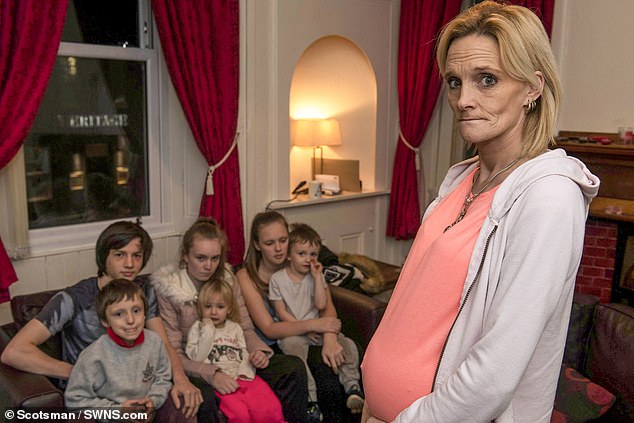
38-year-old single mother of seven, pregnant with twins, demands better government housing

38-year-old single mother with 7 kids, 2 more on the way

I saw this article about an unmarried woman, pregnant with twins, who already has 7 children from a variety of men. She is currently living in a 4-bedroom house paid for by taxpayers. She is angry because the government isn’t giving her enough money to pay for her lifestyle choices.

This article comes from the UK Daily Mail:

A 38-year-old mother-of-seven who is pregnant with twins is begging to be rehoused from her ‘hellish’ four-bedroom council flat which she says isn’t good enough for her.

[…]The single mother said: ‘My relationship with some of my children is at breaking point, we can’t keep living like this.

[…]’I just want to get out of this hell. I’d rather live anywhere else, as long as it is not in here. It has been really tough.

‘I’m feeling down every night and sometimes you just feel like giving up. But I just have to keep going for the sake of the kids.’

She can fix everything that’s gone wrong with a little more taxpayer money. That will make it unnecessary for her to choose men who commit before sex, and let her have the freedom to choose the “best” men for relationships.

More:

After spending a month in various hotels, West Lothian Council found them the flat in Bathgate and they moved in on September 20.

But after moving into her new Bathgate property, Ms Burns complained that the flat did not come with a television…

She wasn’t even provided with a taxpayer-funded telly! How else to people get televisions except from welfare programs?

Anyway, how did this happen? Well, it happens because young women today are increasingly choosing men who are not willing to marry first, and using premarital sex and cohabitation to try to land them. Something that the previous generation of married women from 50 years ago would never have done.

The Daily Caller explains:

Unmarried couples are having roughly 40 percent of all births in the U.S., marking a trend that may be detrimental to the upbringing of those children.

For the first time in U.S. history, out-of-wedlock births in America are largely a result of cohabitation, according to the United Nations Population Fund 2018 State of World report released Wednesday. Single mothers had nearly 90 percent of out-of-wedlock births in 1968, but that number decreased to 53 percent in 2017, according to the Pew Research Center.

“Compared to children of married parents, those with cohabiting parents are more likely to experience the breakup of their families, be exposed to ‘complex’ family forms, live in poverty, suffer abuse, and have negative psychological and educational outcomes,” according to the Institute for Family Studies (IFS).

[…]Children with single parents have the highest rates of poverty followed by children living with unmarried, cohabiting parents, the IFS reported.

Between 2006 and 2010, 23 percent of births to married women were unintended while 51 percent of births to unmarried cohabiting women were unintended. That number rose to 67 percent for unmarried women not cohabiting.

Two-thirds of cohabiting parents split up before their child reaches age 12, while only a quarter of married parents divorce, according to an April 2017 Brookings Institution report.

The problem of fatherless children is getting worse. And taxpayers will be on the hook to pay for it – that’s what the story of the 38-year-old woman shows. Productive people have to pay when women are not persuaded to make better decisions about which men to have relationships with, and when to have sex.

My experience

I know three young women who are cohabitating right now. I have had a few conversations with them about what they are studying, what jobs they want to get, and what their plans for the future are.

All three of these women have never married, and are in their early 20s and attractive. Two of them have children. The live-in boyfriends are getting sex without having to commit first. The boyfriends (judging from photos) seem to have been chosen purely for looks. Tall, muscles, beards, tattoos, piercings, etc. Obviously, none of them is a Christian. And none of the men has a STEM degree, a career or savings -they’re too young to have those things to prove their ability to provide. But they’re still co-habitating, and get all the benefits of a wife without having to have proven themselves capable of the responsibilities, expectations and obligations of a husband. I do not like these men. I do not think women should choose them.

Each of these women is spending the young and attractive period of her life in unstable relationships with men who think of sex as recreational, rather than something that is saved for inside the marriage covenant. If their past relationships fail, they will have a much harder time finding a good man. They will have sexual baggage. They will probably have children from another man. They will have bitterness and mistrust towards men in general. They will be less likely to give generously to a future husband. This is not what marriage-minded men are looking for.

Domestic violence rates are higher for homosexual couples than for heterosexual couples

Young people seem to like gay marriage more than they like individual liberties

Since June is Pride Month, I thought it might be a good idea to take a look at some data to decide what we should be telling young people about homosexuality. Although people on the secular left are very easily offended by any sort of disapproval these days, the safest approach is still to present the scientific facts – maybe from behind an alias (just for safety).

From the left-leaning Atlantic Monthly.

Excerpt:

Data on the rates of same-sex partner abuse have only become available in recent years. Even today, many of the statistics and materials on domestic violence put out by organizations like the Center for Disease Control and the Department of Justice still focus exclusively on heterosexual relationships, and specifically heterosexual women. While the CDC does provide some resources on its website for the LGBT population, the vast majority of the information is targeted at women.  Materials provided by the CDC for violence prevention and survivor empowerment prominently feature women in their statistics and photographs.

In 2013, the CDC released the results of a 2010 study on victimization by sexual orientation, and admitted that “little is known about the national prevalence of intimate partner violence, sexual violence, and stalking among lesbian, gay, and bisexual women and men in the United States.” The report found that bisexual women had an overwhelming prevalence of violent partners in their lives: 75 percent had been with a violent partner, as opposed to 46 percent of lesbian women and 43 percent of straight women. For bisexual men, that number was 47 percent. For gay men, it was 40 percent, and 21 percent for straight men.

The most recent statistics available on same-sex intimate partner violence from the National Coalition of Anti-Violence Programs, which focuses on LGBT relationships, reported 21 incidents of intimate partner homicides in the LGBT community, the highest ever. Nearly half of them were gay men and, for the second year in a row, the majority of survivors were people of color—62 percent.

In 2012, NCAVP programs around the country received 2,679 reports of intimate partner violence, a decrease of around 32 percent from 2011. However the report noted that many of the NCAVP’s member organizations were operating at decreased capacity due to limiting the number of cases they were able to take. The report said that excluding data from organizations, there was actually a 29 percent increase in reports of violence from 2011 to 2012.

That article comes from a source with a very clear pro-gay-agenda bias, so let’s take a look at an article from the Family Research Council to balance it out. They rely on mainstream data sources as well, like the CDC, the DOJ, the US Census, etc.

Excerpt:

A study in the Journal of Interpersonal Violence examined conflict and violence in lesbian relationships. The researchers found that 90 percent of the lesbians surveyed had been recipients of one or more acts of verbal aggression from their intimate partners during the year prior to this study, with 31 percent reporting one or more incidents of physical abuse.[69]

In a survey of 1,099 lesbians, the Journal of Social Service Research found that “slightly more than half of the [lesbians] reported that they had been abused by a female lover/partner. The most frequently indicated forms of abuse were verbal/emotional/psychological abuse and combined physical-psychological abuse.”[70]

In their book Men Who Beat the Men Who Love Them: Battered Gay Men and Domestic Violence,D. Island and P. Letellier report that “the incidence of domestic violence among gay men is nearly double that in the heterosexual population.”[71]

[…]Homosexual and lesbian relationships are far more violent than are traditional married households:

The Bureau of Justice Statistics (U.S. Department of Justice) reports that married women in traditional families experience the lowest rate of violence compared with women in other types of relationships.[72]

A report by the Medical Institute for Sexual Health concurred,

It should be noted that most studies of family violence do not differentiate between married and unmarried partner status. Studies that do make these distinctions have found that marriage relationships tend to have the least intimate partner violence when compared to cohabiting or dating relationships.[73]

In lesbian relationships, the rate of domestic violence is extremely high, from 17% to 45%, depending on the study. I do think that men exert a calming influence on women’s emotions, helping them to channel their feelings into words and reasoned arguments. That short-circuits the tendency toward violent outbursts. That’s why I urge men, if they must marry, to practice disagreeing and debating with women before the marriage is actualized. You need to find out what this other person does in a conflict situation before you commit to her for life.

Study: relationship problems, not family rejection, leading cause of higher gay suicides

Lets take a closer look at a puzzle

Life Site News reports.

Excerpt: (links removed)

 While many assume that family rejection is the leading cause of depression among LBGTI individuals, a new study has found that in fact the problem appears to stem predominantly from the higher incidence of relationship problems among homosexuals.

Dr. Delaney Skerrett led a team of researchers from the Australian Institute for Suicide Research and Prevention (AISRAP) in studying suicides in Queensland. He found that a leading cause of suicide among “lesbian, gay, bisexual, transgender, and intersex” (LGBTI) people is stress from their romantic partners.

“We tend to assume that the psychological distress LGBTI people are often going through is due to family rejection. But it seems that’s not so much the case. The conflict seems to be largely related to relationship problems, with partners,” Dr. Skerrett said.

In fact, he said, “The numbers are telling us there’s a general acceptance at the family level,” something he said is “great” and “really heartening!”

Instead, the study, which was published on April 2 in Asia Pacific Psychiatry, found that “LGBT individuals experienced relationship problems more often” than heterosexuals, “with relationship conflict also being more frequent than in non‐LGBT cases.”

That confirms previous studies finding that homosexuals also face higher rates of intimate partner violence than heterosexuals. A 2007 study in the Journal of Urban Health, which is published by the New York Academy of Medicine, found that 32 percent of homosexuals have been abused by at least one partner during their lifetime.

The researchers with AISRAP also found that a higher percentage of homosexuals took their lives [out] of despondency, rather than other psychological illnesses. While one-eighth of all Queensland suicide victims had been diagnosed with a psychosis that impaired their judgment, Skerrett reports “there were no such diagnoses among LGBT individuals.” The conclusion adds to the consensus that depression disproportionately besets active homosexuals.

Previously, I blogged about a gay activist who thought that disagreement with gay rights caused gays to commit suicide. I wonder what he would do with a study like this? I also blogged previously about the “epidemic” of domestic violence among gays, and the article I linked to for that was from the left-leaning Atlantic Monthly.

But there’s more to say – let’s look at an individual case now, which will put some meat on the bones of the studies.

Here’s an article from the liberal New York Times.

Here’s the set up:

BOB BERGERON was so relentlessly cheery that people sometimes found it off-putting. If you ran into him at the David Barton Gym on West 23rd Street, where he worked out nearly ever morning at 7, and you complained about the rain, he would smile and say you’d be better off focusing on a problem you could fix.

That’s how Mr. Bergeron was as a therapist as well, always upbeat, somewhat less focused on getting to the root of his clients’ feelings than altering behavior patterns that were detrimental to them: therapy from the outside-in.

Over the last decade, he built a thriving private practice, treating well-to-do gay men for everything from anxiety to coping with H.I.V. Mr. Bergeron had also begun work as a motivational speaker, giving talks at gay and lesbian centers in Los Angeles and Chicago. In February, Magnus Books, a publisher specializing in gay literature, was scheduled to print a self-help guide he had written, “The Right Side of Forty: The Complete Guide to Happiness for Gay Men at Midlife and Beyond.”

It was a topic he knew something about. Having come out as gay in the mid-1980s, Mr. Bergeron, 49, had witnessed the worst years of the AIDS epidemic and emerged on the other side. He had also seen how few public examples there were of gay men growing older gracefully.

He resolved to rewrite the script, and provide a toolbox for better living.

“I’ve got a concise picture of what being over 40 is about and it’s a great perspective filled with happiness, feeling sexy, possessing comfort relating to other men and taking good care of ourselves,” Mr. Bergeron said on his Web site.  “This picture will get you results that flourish long-term.”

But right around New Year’s Eve, something went horribly wrong. On Jan. 5, Mr. Bergeron was found dead in his apartment, the result of a suicide that has left his family, his friends and his clients shocked and heartbroken as they attempt to figure out how he could have been so helpful to others and so unable to find help himself.

Look:

To his friends, Mr. Bergeron maintained a positive tone. He went on vacation, dated some, visited museums.

Still, he privately expressed misgivings about what the future held. Olivier Van Doorne, a patient of Mr. Bergeron and the creative director of SelectNY, a fashion advertising firm, recalled Mr. Bergeron telling him that every gay man peaks at one point in his life.

“He said a number of times: ‘I peaked when I was 30 or 35. I was super-successful, everyone looked at me, and I felt extremely cool in my sexuality.’ ”

Mr. Siegel, the therapist who supervised Mr. Bergeron in the early days of his career, said: “Bob was a very beautiful younger man, and we talked a lot about how that shapes and creates a life. The thesis of his book is based very much on his own personal experience with that. And the book also emphasized what to do when you’re not attractive or you no longer have the appeal you once had. The idea was to transcend that and expand your sexual possibilities.”

And:

With the book about to be printed, Mr. Bergeron became convinced that he’d written too much about the shame and isolation involved with hooking up online; that people weren’t even really doing that anymore, now that phone apps like Grindr and Scruff had come along.

His book, he felt, had become antiquated before it even came out.

[…]Though some of his friends, Mr. Rappaport among them, wondered whether drugs were involved, leading to a crash Mr. Bergeron did not anticipate, the suicide seemed to have been carried out with methodical precision. On an island in the kitchen, Mr. Bergeron had meticulously laid out his papers. There was a pile of folders with detailed instructions on top about whom to call regarding his finances and his mortgage. Across from that he placed the title page of his book, on which he also wrote his suicide note. In it he told Mr. Sackheim and Mr. Rappaport that he loved them and his family, but that he was “done.”

As his father remembered it, Mr. Bergeron also wrote, “It’s a lie based on bad information.”

An arrow pointed up to the name of the book.

The inference was clear. As Mr. Bergeron saw it at the end of his life, the only right side of 40 was the side that came before it.

I think that the problem is that in the gay lifestyle, you have a typically male emphasis on physical appearance, sex and pleasure. There is none of the moderating influence of women, which tends to push men into commitments, responsibility and stability. Stuff that provides fulfillment and meaning and purpose after you lose your youth and appearance.

If you really love a person, then you don’t tell them that the dangerous thing they want to do is not dangerous. That’s not love. It’s easier for you to approve of them and be liked by everyone, but it’s not love.