
Tag Archives: Radical Feminism

Are feminists right to think that gender-neutral marriage makes women happier?

Male And Female Happiness After Feminism And Socialism
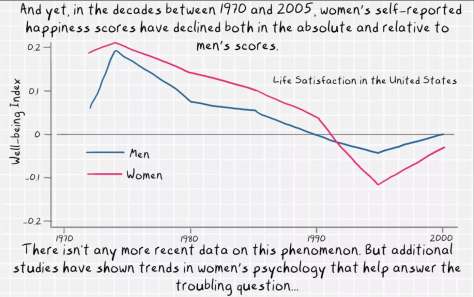
Male and female happiness throughout America’s adoption of radical feminism

I was reading this article by a feminist fiction writer on Vox, where she explains that although feminists have gotten what they wanted (careers, contraceptives, promiscuity, abortion, no-fault-divorce, daycare, etc. it hasn’t made them happier. So, what does this feminist fiction writer think would make feminists happier?

She gives two reasons why women women are still unhappy after feminism has been adopted by our society:

  • men don’t do enough housework
  • women are not as successful as men because they are discriminated against, the so-called “glass ceiling”

I think those complaints are pretty popular among feminists. Let’s take a look at some studies to see if her opinions are supported by peer-reviewed studies.

First study:

COUPLES who share housework duties run a higher risk of divorce than couples where the woman does most of the chores, a study has found.

The divorce rate among couples who shared housework equally was around 50 per cent higher than among those where the woman did most of the work.

“The more a man does in the home, the higher the divorce rate,” Thomas Hansen, co-author of the study entitled Equality in the Home, said.

Second study:

Researchers at the University of Illinois examined data on nearly 1,500 men and 1,800 women, aged between 52 and 60. Their well-being was evaluated through surveys.

The researchers first found that men’s well-being decreased once they had exited the workforce to become home-makers.

Meanwhile, the inverse was not so for women: Women’s psychological well-being was not affected by leaving their jobs to become stay-at-home mothers.

Third study:

A study called “Egalitarianism, Housework and Sexual Frequency in Marriage,” which appeared in The American Sociological Review last year, surprised many, precisely because it went against the logical assumption that as marriages improve by becoming more equal, the sex in these marriages will improve, too. Instead, it found that when men did certain kinds of chores around the house, couples had less sex. Specifically, if men did all of what the researchers characterized as feminine chores like folding laundry, cooking or vacuuming — the kinds of things many women say they want their husbands to do — then couples had sex 1.5 fewer times per month than those with husbands who did what were considered masculine chores, like taking out the trash or fixing the car. It wasn’t just the frequency that was affected, either — at least for the wives. The more traditional the division of labor, meaning the greater the husband’s share of masculine chores compared with feminine ones, the greater his wife’s reported sexual satisfaction.

Regarding the pay gap, that is entirely caused by women’s own choices. E.g. – the choice to study creative writing instead of petroleum engineering, the choice to work 35 hour weeks instead of 70 hour weeks, etc.

Fourth study:  (summarized by AEI economist)

When the [Bureau of Labor Statistics] reports that women working full-time in 2018 earned 81.4% of what men earned working full-time, that is very much different from saying that women earned 81.4% of what men earned for doing exactly the same work while working the exact same number of hours in the same occupation, with exactly the same educational background and exactly the same years of continuous, uninterrupted work experience, and with exactly the same marital and family (e.g., number of children) status. As shown above, once we start controlling individually for the many relevant factors that affect earnings, e.g., hours worked, age, marital status, and having children, most of the raw earnings differential disappears.

Fifth study:

This study leads to the unambiguous conclusion that the differences in the compensation of men and women are the result of a multitude of factors and that the raw wage gap should not be used as the basis to justify corrective action. Indeed, there may be nothing to correct. The differences in raw wages may be almost entirely the result of the individual choices being made by both male and female workers.

I think that women are entitled to make their own decisions, but they aren’t allowed to force the rest of us to subsidize their failures and celebrate their destructive outcomes.

I could go on, but I think enough has been said to show that research is very much at odds with feminist rhetoric. They feel they know what will make them happy and we gave them everything they asked for. They eliminated shaming of promiscuity with sex education. They get preferential treatment in the schools in a female-dominated education system. They are hired because of affirmative action quotas. They get expensive daycare, government schools, welfare and other programs. Taxes are raised to equalize outcomes for divorced women who choose men for feelings, and then nuke their own marriage enterprise. We have been on a long experiment of giving feminists everything they felt they wanted, at the expense of men’s rights and children’s rights, and it hasn’t even produced the results that feminists felt it would.

The social costs of feelings-based decision-making

Let’s look at two examples of policies that feminists asked for in the past, which didn’t work out the way they wanted.

I can understand why feminists would introduce sex education. They felt that “if everyone is having sex, then I won’t be the only one chasing attention from hot no-commitment bad boys by giving them recreational sex before marriage”.  They wanted to eliminate the standards of chastity and marriage-focused dating and normalize fun-focused drunken promiscuity. And they got that. But since they didn’t consult any research and evidence about how that would affect their future marriage stability and marriage happiness, they are even more unhappy than before.

How about no-fault divorce? No-fault divorce was brought in by a coalition of feminists, Marxists and trial lawyers. The Marxists want to destroy the family in order to increase dependence on the state. The trial lawyers wanted to make money. And the feminists thought that the standard approach to courting and marriage was just too much work. They didn’t want to be chaste. They didn’t want to be sober. They didn’t want to evaluate a man for traditional husband and father roles. The no-fault divorce laws gave them an escape from the messes caused by their own feelings-driven choices. But divorce just makes makes men and women much poorer, and passes the costs of supporting single mothers onto taxpayers.

And the costs of the failures of feminism are passed onto taxpayers.

Consider this study:

This paper examines the growth of government during this century as a result of giving women the right to vote. Using cross-sectional time-series data for 1870–1940, we examine state government expenditures and revenue as well as voting by U.S. House and Senate state delegations and the passage of a wide range of different state laws. Suffrage coincided with immediate increases in state government expenditures and revenue and more liberal voting patterns for federal representatives, and these effects continued growing over time as more women took advantage of the franchise. Contrary to many recent suggestions, the gender gap is not something that has arisen since the 1970s, and it helps explain why American government started growing when it did.

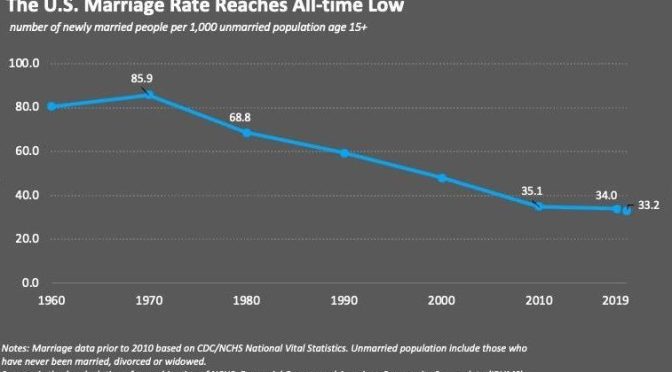
We are already $28 trillion in debt, partly because of feminism’s replacement of husbands and families with higher taxes and big government. Every time we transfer money from tax-paying men to feminists to fix their mistakes, it leaves less money in the hands of the men who actually want to get married. The declining value of marriage after feminism for men explains why marriage is being delayed, and why marriage rates are plunging.
Judge: man must pay more than $50,000 a month to ex-girlfriend for 10 years

A friend of mine was asking me last night whether I had any regrets about never marrying, especially since I had such awesome Christian female friends like her. I thought about it, and I thought that maybe it is better to not have married, especially when I read stories about how family courts trample over the rights of men to favor women, regardless of what the law says.

The story is from one of Canada’s national newspapers, the National Post:

A wealthy businessman will have to pay more than $50,000 a month in spousal support for 10 years to a woman with whom he had a long-term romantic relationship even though they kept separate homes and had no children together, Ontario’s top court has ruled.

Under Ontario law, an unmarried couple are considered common-law spouses if they have cohabited — lived together in a conjugal relationship — continuously for at least three years. But that doesn’t necessarily mean living in the same home, the court found.

[…]When their 14-year relationship finally broke down in May 2015, Climans asked the courts to recognize her as Latner’s spouse and order him to pay her support. He argued she had been a travel companion and girlfriend, nothing more. As such, he said, they were never legally spouses and he owed no support. An eight-day trial ensued.

In her decision in February 2019, Superior Court Justice Sharon Shore sided with Climans. She ruled they were in fact long-time spouses, finding that despite their separate home, they lived under one roof at Latner’s cottage for part of the summer, and during winter vacations in Florida. Shore ordered him to pay her $53,077 monthly indefinitely.

They never married – this woman was not even his ex-wife.

Elsewhere in the article, we learn that he had asked her to sign a pre-nuptial agreement many times, and each time she refused. (Those are not even enforced fairly by the way) She wanted his money, and the judge made sure she got it. Because the law doesn’t matter in a family court. Men are just walking ATMs and women have a right to take men’s money, if it makes the woman happy. Literally just walking ATMs.

So, what I wanted to point out about this is the fact that a female judge decided to bend the law in order to favor a woman. And this sort of thing happens A LOT in Canada – where their female judges are notorious for progressive judicial activism, e.g. Beverley Mclachlin, Bertha Wilson, Claire L’Heureux-Dubé, etc. Ontario family courts are notoriously anti-male, and men know this.

But it’s not just Ontario. I have two Christian friends who married their Christian wives as virgins, and then their wives divorced them. I heard what happened to them in divorce court. Again, female lawyers and female judges disregarded the law in order to punish the man and favor the woman. And I think most men growing up today have a father or a brother or an uncle or someone who has been a victim of this.

When I talk to women about this, they all say things like this to me: “oh, you worry too much” or “you read too many books about divorce” or especially “when you meet the right girl, you’ll fall in love, and all this concern about atheistic feminist judges in the courts won’t stop you”. That last one is the most popular. And it’s always made me think that if this is how women see commitment – feelings-based – it’s no wonder that women initiate 70% of divorces.

I always thought it was a curse that I grew up poor and could not afford to show off my wealth in order to attract attention from women. Now I see that God actually gave me a great blessing. In order for a man to get married, it takes a lot more than finding the right girl. He needs to live in the right culture – a culture that tries to equip women to be content in committed relationships and treat men fairly.

I don’t think even women who claim to be pro-male and/or pro-marriage know or care how stories like this affect men. I’m very wealthy. I certainly do look at what is likely to happen if a woman goes to the courts expecting me to give her money. In fact, whenever I post stories on my wall about how the judges legislate from the bench to transfer money from men to women, there’s just silence or sometimes deflection by attacking men (except for my friend Dina who agrees with me). No one dares to speak up for men, it’s just expected that we be robbed by the government in order to make women happy. Because “marriage is for women”.

And as long as the message keeps being sent by judicial activists in the family courts, men will keep adjusting how they treat women. Women appear very unsafe to us, and nothing that’s going on in the courts is changing the trend towards avoidance. Men are very good at calculating risks vs rewards.

Most Americans think cohabitation leads to a stable marriage, but what does the data say?

Men who cohabitate are not certain that the relationship is permanent

If there’s one thing that ought to lead people to Christianity, it’s the proven ability of the Christian moral rules to guide believers away from the sins that destroy them. A lot of modern “Christians” have reduced Christianity to being about their feelings and their community, while allowing the culture to determine their goals and moral boundaries. But that won’t protect them from danger.

Cohabitation describes the situation of a couple moving into the same home and being sexually active, but without any legally-recognized commitment. It’s extremely popular among young people today, and even Christians.

Consider this article from The Federalist about cohabitation:

A new Pew Research Center study shows Americans both cohabitate (“live with an unmarried partner”) and find cohabitation acceptable more than before.

[…]More young adults have cohabited than have married. Pew’s analysis in the summer of 2019 of the National Survey of Family Growth found that, for the first time ever, the percentage of American adults aged 18-44 who have ever cohabited with a partner (59 percent) exceeded the percentage of those who have ever married (50 percent).

I thought this was very interesting, especially for the Christian parents and pastors who imagine that their lovely pious daughters all have a Christian worldview just because they sing in the church choir:

Just 14 percent hold a view consistent with a biblical sexual ethic, that cohabitation with an unmarried romantic partner outside of marriage is “never acceptable.”

Just to be clear, in my life I’ve met about 6 non-Christian men who cohabitated with women, and every single one of them cohabitated with a Christian-raised woman. That should tell you what young women are being told about relationships in their homes and churches about sex and marriage. “Do whatever you want”.

So what purpose does cohabitation serve?

A majority of Americans (69 percent) say that “it is acceptable for an unmarried couple to live together even if they don’t plan to get married.” They may assume that they can decrease their chances of a bad marriage and increase their chances of a good one by giving the relationship a cohabitation “test run.”

[…]A plurality of Americans believe cohabitating before marriage yields more successful unions. Nearly half of Americans (48 percent) believe that couples who live together before marriage “have a better chance of having a successful marriage.” This view is even more prevalent among young adults aged 18-29 (63 percent).

Another 38 percent of all Americans say cohabitation “doesn’t make much difference” on marital success. Only 13 percent of Americans believe cohabiting couples have “a worse chance” of having a successful marriage.

[…]Most Americans believe cohabitating couples raise children just as well as married couples. Pew also surveyed people’s opinions about cohabiting couples raising children, and 59 percent of Americans declared that cohabiting couples “can raise children just as well as married couples.” Again, the younger respondents were most likely to have a favorable view of cohabitation: among adults aged 18 to 49, 67 percent agreed cohabiting couples do just as well, while 32 percent said: “Married couples do a better job raising children.”

Yes, cohabitation seen as a test run, and it’s supposed to make stable marriage more likely and not be harmful to children at all.

But why think that a test run should be part of getting married? After all, when I buy a parrot from the pet store, I don’t expect to later return that parrot. Why not? Because I am not buying the parrot to enhance MY life. I am buying the parrot to make a commitment to care for the parrot. Whether the parrot fulfills any of my needs is irrelevant to me. I want the bird in my house so that I can decide what it eats, what it drinks, and invest myself into making it happy, according to its birdish nature. This is because I think that parrots have value in and of themselves, and they deserve a certain quality of life. When I buy the parrot, I am guaranteeing a permanent commitment to the bird to provide for its needs, physical and emotional. And that commitment carries forward to the time (now) when the bird is elderly, and can’t even fly up to his cage or down to the floor. He calls for me, and I go over and pick him up and move him. That’s commitment.

Cohabitation, on the other hand, is the practice of saying to another human being: “I am going to try you out as an entertaining commodity in my home, but if you don’t fulfill my needs then I’m going to send you right back.” That’s not a commitment. That’s self indulgence. It’s defining a relationship as entertainment that is designed to meet my needs and make me happy. And that’s because the concept of commitment in relationships is not presented to young people at any time in their lives. Not from parents. Not in churches. Not in the secular left culture as a whole. Everything is a consumer good designed for the purpose of entertainment – including people. It was only the Christian worldview that had a view of people as creatures made by God for eternal life, so that marriage was about guarding the other person’s faith, and building them up to achieve all the things that God wanted them to achieve for his purposes.

But does cohabitation really work to create stable relationships? After all, anyone can find a partner when they’re young and pretty. The real question is whether that partner will stick around when you’re old and ugly and can’t be as “fun” as you used to be.

Here’s a recent (2018) study on cohabitation and stability:

A new study published in the Journal of Marriage and Family finds that the “premarital cohabitation effect” lives on, despite what you’ve likely heard. The premarital cohabitation effect is the finding that those who live together prior to marriage are more likely, not less, to struggle in marriage.

[…]Michael Rosenfeld and Katharina Roesler’s new findings suggest that there remains an increased risk for divorce for those living together prior to marriage, and that prior studies suggesting the effect has gone away had a bias toward short versus longer-term effects. They find that living together before marriage is associated with lower odds of divorce in the first year of marriage, but increases the odds of divorce in all other years tested, and this finding holds across decades of data.

Strategy advice to those who debate this issue: just be aware that Team Secular Leftist is using papers that have short-range samples, which don’t show the instability problem, because they deliberately cherry-pick recently married couples.

And what about children raised in cohabitating relationships?

While Americans are optimistic about the ability of cohabiting couples to raise children, a study published by the American College of Pediatricians in 2014 reported that children whose parents cohabit face a higher risk of: “premature birth, school failure, lower education, more poverty during childhood and lower incomes as adults, more incarceration and behavior problems, single parenthood, medical neglect and chronic health problems both medical and psychiatric, more substance, alcohol and tobacco abuse, and child abuse,” and that “a child conceived by a cohabiting woman is at 10 times higher risk of abortion compared to one conceived in marriage.”

I’m just going to be blunt here. The majority of young people are progressives, and they vote for candidates who believe in abortion through all nine months of pregnancy, and even after birth. Why? Because they don’t want to have their right to seek happiness impacted by the needs of other people. Progressives believe that children, if they exist at all, should enhance the lives of their adult owners. No one should be surprised that people who think that killing inconvenient children is moral are willing to inflict other bad outcomes on them by raising them in an unstable cohabitation environment.