I recently linked to philosopher of physics David Albert’s take down of Lawrence Krauss’s bookA Universe From Nothing. (My own review of Krauss will soon appear in First Things.) A reader calls my attention to this blog post in which Victor Stenger — Adjunct Professor of Philosophy at the University of Colorado, Professor Emeritus of Physics and Astronomy at the University of Hawaii, and author of several atheist tomes — rides to the rescue of Krauss against Albert. (If only the other philosophically incompetent New Atheists had such a knight in shining armor! O Dawkins, where is your Stenger? O Coyne, where is your Victor?)
Unfortunately for Krauss, the intrepid Stenger shoots only blanks. And misses. Krauss, as you may know, argues that the laws of quantum mechanics (QM) show how a universe can arise from nothing. Albert demurs, and Stenger responds:
[Albert] asks, “Where, for starters, are the laws of quantum mechanics themselves supposed to have come from?” Krauss admits he does not know, but suggests they may arise randomly, in which case some universe like ours would have arisen without a prescribed cause. In my 2006 book The Comprehensible Cosmos, I attempt to show that the laws of physics arise naturally from the symmetries of the void.
Later Stenger tells us that the “void” or “nothing” in question “can be described mathematically,” “has an explicit wave function,” and “is the quantum gravity equivalent of the quantum vacuum in quantum field theory.”
Of course, the problem with all of this is the same as the problem with the original suggestion that the laws of QM show that a universe can come from nothing. The laws of QM are not nothing, and neither are “the symmetries of the void” nor anything that “can be described mathematically,” “has an explicit wave function,” etc. In general, if you can characterize it in terms of physical law — which Krauss, Stenger, and like-minded atheists all want to do vis-à-vis “nothing” — then it isn’t nothing. It’s something physical, and thussomething rather than nothing. Obviously.
Obviously, that is, unless you are a New Atheist dogmatically attached to the utterly groundless proposition that all genuine questions simply must be susceptible of a scientific answer. At this juncture Stenger does what an increasing number of atheists do when it is pointed out to them that their “explanations” of how the universe arose from nothing merely change the subject — they feign ignorance of English. Writes Stenger:
Clearly, no academic consensus exists on how to define “nothing.” It may be impossible. To define “nothing” you have to give it some defining property, but, then, if it has a property it is not nothing!
But this is the muddleheaded stuff of a freshman philosophy paper — treating “nothing” as if it were an especially unusual, ethereal kind of substance whose nature it would require tremendous intellectual effort to fathom. Which, as everyone knows until he finds he has a motive for suggesting otherwise, it is not. Nothing is nothing so fancy as that. It is just the absence of anything, that’s all. Consider all the true existential claims that there are: “Stones exist,” “”Trees exist,” “Quarks exist,” etc. To ask why there is something rather than nothing is just to ask why it isn’t the case that all of these statements are false. Pretty straightforward.
To admit the obvious, though, would be to admit that there are questions that physics cannot answer, such as where the laws of physics themselves came from — or more precisely, since “laws” are just abstractions from a concrete physical reality that behaves in accordance with the laws, where this concrete physical reality itself comes from. That nothing in physics answers this question was Albert’s point, and Stenger says absolutely nothing to answer it.
Read the rest. It’s really good! and there’s a lot more goodness there. 176 comments at the time I am writing this.
UPDATE: Peter Sean Bradley note that Krauss is now walking back his rhetoric in response to criticisms from people like atheist John Horgan.
I have been writing about Stenger and Krauss a lot lately, so here are the links in case you missed anything:
The OSU [Oregon State University] Socratic Club will sponsor a public dialogue entitled, “Two Philosophers Debate the Existence of God,” on Monday, March 1, at 7 p.m. in the LaSells Stewart Center on the OSU campus. William Lane Craig will argue for the Christian view that a personal God exists and Victor J. Stenger the atheist position that there is no God.
In this debate, Victor Stenger does affirm his belief that the universe could be eternal in his second rebuttal (1:02:30), thus denying the standard Big Bang cosmology. He also denies the law of conservation of energy and asserts that something can come from nothing in his concluding speech (1:33:50). He also caused the audience to start laughing when he said that Jesus was not moral and supported slavery. There is almost no snark in this summary. Instead, I quoted Dr. Stenger verbatim in many places. I still think that it is very entertaining even without the snarky paraphrasing.
The debate includes 30 minutes of Q&A with the students.
There is no scientific evidence for God’s existence in the textbooks
There is no scientific evidence for God acting in the universe
God doesn’t talk to people and tell them things they couldn’t possibly know
The Bible says that the Earth is flat, etc.
There is no scientific evidence that God answers prayers
God doesn’t exist because people who believe in him are ignorant
Human life is not optimally designed and appears to be the result of a blind, ad hoc evolutionary process
The beginning of the universe is not ordered (low entropy) but random and chaotic
It’s theoretically possible that quantum tunneling explains the origin of the universe
The laws of physics are not objectively real, they are “our inventions”
Regarding the beginning of the universe, the explanation is that something came from nothing*
Nothing* isn’t really nothing, it is “the total chaos that we project existed just before the big bang”
If something has no structure, then “it is as much nothing as nothing can be”
Consciousness is explainable solely on the basis of material processes
There are well-informed, rational non-believers in the world and God would not allow that
Dr. Craig’s first rebuttal:
Stenger’s argument that there is no objective evidence for God’s existence:
First, it is not required that God rely only on objective evidence in order to draw people to himself (Alvin Plantinga)
Second, God is not required to provide evidence to everyone, only to the people who he knows would respond to him
Third, Craig gave lots of objective evidence, from science, history and philosophy
Stenger asks for certain evidence (answered prayers, prophecy, etc.), but Craig presented the evidence we have
Stenger’s argument that the balance of energy is zero so “nothing” exists:
if you have the same amount of assets and liabilities, it doesn’t mean that nothing exists – your assets and liabilities exist
Christopher Isham says that there needs to be a cause to create the positive and negative energy even if they balance
the quantum gravity model contradicts observations
the vacuum is not the same as nothing, it contains energy and matter
the BVG theorem proves that any universe that is expanding must have a beginning
Stenger’s argument that mental operations can be reduced to physical operations:
mental properties are not reducible to physical properties
epiphenomenalism: is incompatible with self-identity over time
epiphenomenalism: is incompatible with thoughts about other things
epiphenomenalism: is incompatible with free will
substance dualism (mind/body dualism) is a better explanation for our mental experience
God is a soul without a body
Dr. Stenger’s first rebuttal:
Craig’s cosmological argument:
Craig’s premise is “everything has a cause”, but quantum mechanics has causeless events
There are speculative theories about how something could have come into being uncaused out of nothing
“I don’t know of a single working cosmologist today who believes there was a singularity prior to the Big Bang”
“If there wasn’t a singularity then there’s no basis for arguing that time began at that point”
“There’s no reason from cosmology that we know of that the universe can’t be eternal”
“When I talk about an eternal universe, I mean a universe that has no beginning or end”
The Hartle-Hawking model doesn’t have a beginning
“There was no violation of energy conservation by having a universe coming from nothing”
“The universe could have come from a previous universe for example or even just from a region of chaos”
The paper by Vilenkin is counteracted by other papers (he doesn’t specify which ones)
Craig’s moral argument:
Dr. Craig is arguing from ignorance
But morality can be decided by humanity just like governments pass laws, and that’s objective
Dr. Craig has too little respect for the human intellect
I don’t need to tell me that slavery is wrong
The Bible supports slavery
Atheists can behave as good as theists
Morality just evolved naturally as an aid to survival
Craig’s resurrection argument:
No Roman historians wrote about the execution of Jesus but none of them did
The empty tomb is doubtful because it is only mentioned in the gospels, not by Paul
John Dominic Crossan says there was no empty tomb
Christianity only survived because the Roman empire thought that they were useful
Dr. Craig’s second rebuttal:
Craig’s cosmological argument:
There is no reason to prefer an indeterministic interpretation of quantum mechanics
Dr. Stenger himself wrote that deterministic interpretations of quantum mechanics are possible
The vacuum in quantum mechanics is not nothing
The quantum vacuum he proposes cannot be eternal
The cosmological argument does not require a singularity
The Hartle-Hawking model is from 1983
Hawking says that there is a beginning of space and time after that model
The Hartle-Hawking model does still have a beginning of time – the model is not eternal
The BVG theorem that requires a beginning for expanding universes is widely accepted among cosmologists
Craig’s moral argument:
Stenger redefined objective to mean that most people agree with it – but that’s not what objective means
Objective means right and wrong whether anyone accepts it or not
Richard Dawkins himself says that on atheism there is “no evil and no good” – why is he wrong?
Even Dr. Stenger says that morality is the same as passing laws – it’s arbitrary and varies by time and place
But on his view, right and wrong are the same as deciding which side of the road to drive on
But somethings really are right and some things are really wrong
Craig’s resurrection argument:
Josephus is a Roman historian and he wrote about Jesus, for example
There were four biographies of Jesus are the best sources for his life
The scholars that Stenger mentioned are on the radical fringe
Dr. Stenger’s second rebuttal:
Knowledge and the burden of proof:
Dr. Craig has to bear the burden of proof, not me – because his claim is more “extravagant”
“I don’t have to prove that a God was not necessary to create the universe”
“I don’t have to prove that a God did not design the universe and life”
“I don’t have to prove that the universe did not have a beginning”
“I don’t have to prove that God did not provide us with our moral sense”
There are a lot of books written about how morality evolved naturally
“I don’t have to prove that the events surrounding the supposed resurrection of Jesus did not take place”
Bart Ehrman says that the gospels are generally unreliable (Note: Ehrman accepts all 3 of Craig’s minimal facts)
Just because people are willing to die for a cause, does not make their leader God, e.g. – the Emperor of Japan
Aesthetic concerns about the universe:
I don’t like dark matter and I wouldn’t have made the universe with dark matter
I don’t like the doctrine of penal substitution
I don’t like the doctrine of original sin
I don’t like the heat death of the universe
Dr. Craig’s conclusion:
The case for atheism:
Dr. Stenger had two arguments and he has to support his premises
Dr. Craig addressed his two arguments and each premise and Dr. Stenger never came back on it
The contingency argument:
Dr. Stenger has dropped the refutation of this argument
The cosmological argument:
The theoretical vacuum he proposes cannot be eternal
The moral argument:
He asserts that things are wrong, but there is no grounding for that to be objective on atheism
The resurrection of Jesus:
There are surveys of scholars on the empty tomb and 75% of them agree with it
Bart Ehrman agrees with all 3 of the minimal facts that Dr. Craig presented
Ehrman’s objection to the resurrection is not historical: he’s an atheist – he thinks miracles are impossible
Religious experience:
No response from Dr. Stenger
Dr. Stenger’s conclusion
The cosmological argument:
“I argued that we have very good physical reasons to understand how something can come from nothing”
“There is a natural tendency in the universe… to go from.. simpler thing to the more complicated thing”
The transition from a vapor to a liquid to ice shows how something could come from nothing
“It cannot be proven that the universe had a beginning”
The moral argument:
Objective morality, which is independent of what people think, could be developed based on what people think
“Jesus himself was not a tremendously moral person… he had no particular regard for the poor… he certainly supported slavery… he was for the subjugation of women” (audience laughter)
The resurrection argument:
Bart Ehrman says that the majority of the gospels are unreliable
Religious experience:
I don’t see any evidence that there is anything more to religious experience than just stuff in their heads
God’s purpose of the world should be to make people feel happy:
God could have made people feel happier
God could have made people not die
God could could have made the universe smaller: it’s too big
God could have made it possible for humans to live anywhere “even in space”
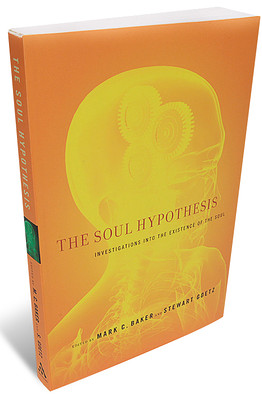
In the Soul Hypothesis: Investigations into the Existence of the Soul(Continuum), co-editors Mark C. Baker and Stewart Goetz have assembled an impressive interdisciplinary team of scholars to address questions about the existence and nature of the soul.
“The Soul of the Matter” – Charles Taliaferro
“Minds, Brains and Brains in Vats” – Daniel N. Robinson
“Brains and Souls; Grammar and Speaking” – Mark Baker
“Making Things Happen: Souls in Action” – Stewart Goetz
“Energy of the Soul” – Robin Collins
“The Measure of All Things: Quantum Mechanics and the Soul” – Dean Zimmerman
“From Seeing to Seer” – Hans Halvorson
“Souls Beastly and Human” – William Hasker
“A Scientific Case for the Soul” – Robin Collins
The book is unique is combining philosophical and scientific arguments for dualism, and the result is a rigorous, exciting, persuasive presentation of the issues and a stimulating challenge to so much of the reductionism that reigns in the sciences. As was noted in a recent review of the book in the WSJ,
Sooner or later, the contributors to “The Soul Hypothesis” warn, scientists will pinpoint the exact three neurons whose firing accompanies the thought of our deciding to make a phone call or, if you prefer, deciding to get up and get a beer from the refrigerator. As ever more such micro-couplings are observed, we will—so scientists tell us with unseemly glee— gradually come to see that our cherished conscious life is nothing but a long series of electrical impulses, not an autonomous realm of free will and free thought. Co-editor Mark C. Baker cites the psychologist Steven Pinker, who finds it plausible to say that neural “activity in the brain” simply “is the mind.”
The book’s contributors set out this scientific challenge fully and engagingly, but they also expose its fallacies. They note, for instance, that even if two things differ in their essential nature, as do mental thoughts and physical actions—or legislatures and laws—there is no reason why the one can’t cause the other. As David Hume argued, what establishes our idea of cause and effect is the regular “conjunction” of two events. That a physical act regularly follows a mental decision suggests, as co-editor Stewart Goetz writes, that the one is “causing” the other and that voluntary human action exists.
The Soul Hypothesis is an excellent text that is sure to provoke a vigorous dialog about its content. I highly recommend it.
I really would like to be able to use this argument more – I just need a good book. I’m a big admirer of Charles Taliaferro. I even met him once at a conference!

 WINTERY KNIGHT