
Tag Archives: Public Sector

Woman can’t apply for government job because of her race

Here’s the news story from Canoe. (H/T Blazing Cat Fur)

Excerpt:

A stay-at-home mother trying to re-enter the workforce after nine years away says she can’t understand why the federal government would stop her from applying for a job simply because she is white.

Sara Landriault, a sometime family activist, says that with her kids in school full time she decided to start looking for work outside of the home.

While surfing on the federal government job website, Landriault says she found a position at Citizenship and Immigration Canada she felt she was qualified for but was blocked from submitting her resume because she was not an aboriginal or visible minority.

“I was flabbergasted,” Landriault said in a telephone interview from her home in Kemptville, Ont., just south of Ottawa. “It was insane. I’m white, so I can’t do it?”

Landriault says she has seen job postings in the past that encourage certain groups to apply.

“Which is fine, it’s an equal opportunity position,” Landriault said. “But an equal opportunity employer does not stop one race from applying.”

Do you know why racism only works for the government, and not for private business? It’s because the government has no competitors, so they can do whatever they want without having to worry about the lower productivity for choosing a worker based on racial concerns.

This book review of Robert P. Murphy’s “The Politically Incorrect Guide to Capitalism” makes the point.

Excerpt:

The free market cannot be blamed, an often-repeated argument tells us, for racial discrimination. Quite the contrary, those who discriminate pay a penalty. If an employer refuses to hire people of a certain race or religion, he will pay a penalty.

If an employer has an opening that pays $50,000 in salary, and the Christian applicant will bring in $51,000 in extra revenue while the Muslim will bring in $55,000, then to discriminate against the creed of the latter will cost the employer $4000 in potential profits. (p. 31)

This point, though expressed characteristically well by Murphy, is well known; but it must withstand an objection.

The argument relies on the fact that businessmen aim at maximizing profits; but to do so, must they not endeavor to satisfy consumers? Here precisely the problem arises. What if the consumers themselves hold discriminatory views? Will it not be to the interest of businessmen to satisfy them? Suppose, e.g., that customers in a restaurant would prefer not to be served by blacks. Why would a restaurant owner interested in profit risk the loss of his business by hiring black waitresses?

Murphy again responds in convincing fashion to this difficult problem.

But in cases like this the free market … still punishes discrimination — only this time the customer pays the “racist fee”: the customer pays extra (in the form of inferior service) to be served by a white waitress who is worse at her job than a better-qualified black candidate. (p. 32)

It does not follow from this that people will be unwilling to pay the price: but the fact that the market imposes a cost tends to deter discrimination by consumers. (One might object that this does not cover the case of a black waitress who is an equally good server as her white competitor; in this situation, will not consumers be able to satisfy their prejudiced tastes without penalty? But here the owner has an incentive to hire the black waitress by offering her a lower salary. So long as his loss of business is outweighed by his lower costs, he will do so.)

If a private business discriminates in hiring, they have to pay more for less productivity. If a consumer discriminates against non-racist businesses, they have to pay more for the same quality of product or service. The free market punishes racism already.

I should also point out that the Wintery Knight is not white. I look more like Bobby Jindal – but less handsome. I oppose racism and the Government of Canada is racist.
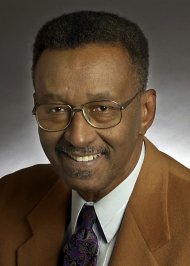
Walter Williams explains why the free market is better for consumers

Walter Williams

His column is here.

He is talking about whether we people should take their services and products from businesses or from government.

Excerpt:

Compare our level of satisfaction with the services of those “in it just for the money and profits” to those in it to serve the public as opposed to earning profits. A major non-profit service provider is the public education establishment that delivers primary and secondary education at nearly a trillion-dollar annual cost.

Public education is a major source of complaints about poor services that in many cases constitute nothing less than gross fraud.

If Wal-Mart, or any of the millions of producers who are in it for money and profits, were to deliver the same low-quality services, they would be out of business, but not public schools. Why? People who produce public education get their pay, pay raises and perks whether customers are satisfied or not. They are not motivated by profits and therefore under considerably less pressure to please customers. They use government to take customer money, in the form of taxes.

The U. S. Postal Service, state motor vehicle departments and other government agencies also have the taxing power of government to get money and therefore are less diligent about pleasing customers. You can bet the rent money that if Wal-Mart and other businesses had the power to take our money by force, they would be less interested and willing to please us.

The big difference between entities that serve us well and those who do not lies in what motivates them. Wal-Mart and millions of other businesses are profit-motivated whereas government schools, USPS and state motor vehicle departments are not.

Businesses can only make money by pleasing customers. Customers who freely choose to trade money for products and services. But government can make money by raising taxes. All they have to do is tell lies, win popularity contests and buy votes.

Can government create jobs more efficiently than private businesses?

Consider this story from CNS News.

Excerpt:

According to the Government Accountability Office (GAO), the federal government helped pay the home air conditioning bills for more than 11,000 dead people, 1,100 federal employees, and 725 convicts in fiscal year 2009.

The payments were made by a $5 billion program known as the Low-Income Home Energy Assistance Program (LIHEAP). LIHEAP is designed to provide federal assistance, administered by the states, to help people pay the energy bills to heat their homes in the winter and cool them in the summer. The funds are disbursed by the Department of Health and Human Services and are distributed based on a formula that takes into account a state’s weather and the size of its low-income population.

The GAO examined the LIHEAP programs in seven states: Virginia, Maryland, Ohio, New York, Illinois, Michigan, and New Jersey.  The agency found evidence of fraud in each state.

“Our analysis of LIHEAP data revealed that the program is at risk of fraud and providing improper benefits in all seven of our selected states,” reported the GAO.  “About 260,000 applications–9 percent of households receiving benefits in the selected states–contained invalid identity information, such as Social Security numbers, names, or dates of birth.”

Think that’s an isolated event?

Consider this list of government spending projects from Andrew Breitbart’s Big Government. (H/T The Blog Prof)

Excerpt:

  • $5 million to create a geothermal energy system for a shopping mall in Tennessee. The mall is over half empty of tenants and has had falling shopper attendance for years *
  • $1.57 million to Penn State University study fossils in Argentina *
  • $100,000 to a puppet theater in Minnesota *
  • $2 million to build a replica railroad tourist trap in Carson City, Nev. *
  • A boat cruise company in Chicago got almost $1 million to “combat terrorism” *
  • $500,000 went to Ariz. State Univ. to study ant genetics *
  • Another $450,000 went to Uinv. of Arizona to study ants *
  • Almost $400,000 went to Univ. of New York to pay students to drink beer and smoke marijuana for a study there *
  • $219,000 to the Nat’l Institute of Health to study if young people “hook-up” after getting drunk *
  • $210,000 to the Univ. of Hawaii to study bees *
  • $700,000 to crab fishermen in Oregon to pay for lost crab pots *
  • $5,000 a person tax rebate if you buy a new electric golf cart (Wall Street Journal)
  • Up to $1 million went to prisoners in $250 stimulus checks (FoxNews)
  • $54 mil to a New York Indian tribe to run its casino (New York Post)
  • $1 billion for a power plant in Mattoon, Illinois that is based on speculative science and may not even work **
  • $15 million to back-road bridges that get little traffic in Wisconsin **
  • $800,000 for a practically unused airport in Pennsylvania **
  • $3.4 million for an animal walk way under a road in Florida **
  • $1.15 million to install a guard rail for a lake that doesn’t even exist in Oklahoma **
  • $10 million to renovate a rail station that has stood unused for a decade **
  • $578,000 to battle homelessness in Union, New York even though the town says they have no homeless people there **
  • $233,000 to the Univ. of Calif. to study why Africans vote… in Africa ***
  • $2 million to build a new fire house in a Nevada town that has no firemen ***
  • North Carolina schools got $4.4 million for literacy and math coaches… to teach their teachers! ***
  • $54 million for a railroad project in Napa Valley went to a minority-owned company that then hired a local construction company for half the price, pocketing the rest ***
  • A California company was given $15 million in stimulus money to monitor water quality in a stream it was under indictment for polluting previously***

I’m sure that no small business has money to waste on boondoggles like these – but they are being taxed to pay for the government to do it! And that leaves less money for them to create jobs.

Obama’s spending spree is about one thing and one thing alone – buying votes from the constituencies that voted for him so that they’ll vote for him again. That’s why public sector employment, public sector salaries and public sector benefits are all up during this massive recession, while millions of jobs have been lost in the private sector.

Economics in One Lesson

Perhaps it is time to review Henry Hazlitt’s Economics in One Lesson, chapter 4, entitled “Public Works Mean Taxes”.

Excerpt:

Therefore, for every public job created by the bridge project a private job has been destroyed somewhere else. We can see the men employed on the bridge. We can watch them at work. The employment argument of the government spenders becomes vivid, and probably for most people convincing. But there are other things that we do not see, because, alas, they have never been permitted to come into existence. They are the jobs destroyed by the $10 million taken from the taxpayers. All that has happened, at best, is that there has been a diversion of jobs because of the project. More bridge builders; fewer automobile workers, television technicians, clothing workers, farmers.

Excerpt that the government, lacking a profit motive, is never as efficient as private business is in spending money – government wastes money that it never earned in the first place.

And consider Chapter 5 as well, entitled “Taxes Discourage Production”.

In our modern world there is never the same percentage of income tax levied on everybody. The great burden of income taxes is imposed on a minor percentage of the nation’s income; and these income taxes have to be supplemented by taxes of other kinds. These taxes inevitably affect the actions and incentives of those from whom they are taken. When a corporation loses a hundred cents of every dollar it loses, and is permitted to keep only fifty-two cents of every dollar it gains, and when it cannot adequately offset its years of losses against its years of gains, its policies are affected. It does not expand its operations, or it expands only those attended with a minimum of risk. People who recognize this situation are deterred from starting new enterprises. Thus old employers do not give more employment, or not as much more as they might have; and others decide not to become employers at all. Improved machinery and better-equipped factories come into existence much more slowly than they otherwise would. The result in the long run is that consumers are prevented from getting better and cheaper products to the extent that they otherwise would, and that real wages are held down, compared with what they might have been.

There is a similar effect when personal incomes are taxed 50, 60 or 70 percent. People begin to ask themselves why they should work six, eight or nine months of the entire year for the government, and only six, four or three months for themselves and their families. If they lose the whole dollar when they lose, but can keep only a fraction of it when they win, they decide that it is foolish to take risks with their capital. In addition, the capital available for risk-taking itself shrinks enormously. It is being taxed away before it can be accumulated. In brief, capital to provide new private jobs is first prevented from coming into existence, and the part that does come into existence is then discouraged from starting new enterprises. The government spenders create the very problem of unemployment that they profess to solve.

George W. Bush cut taxes in his first term and created 1 million NEW JOBS. Government spending is a job killer. In fact, you can even see it failing today in Japan: Did massive government spending succeed or fail in Japan?