Tag Archives: Progress of Science

The importance of having a narrative when confronting the assumption of naturalism

How do you present theism as a rational belief to a person who thinks that the progress of science has removed the need for God?

Canadian science writer Denyse O’Leary writes about the history of cosmology at Evolution News.

Excerpt:

What help has materialism been in understanding the universe’s beginnings?

Many in cosmology have never made any secret of their dislike of the Big Bang, the generally accepted start to our universe first suggested by Belgian priest Georges Lemaître (1894-1966).

On the face of it, that is odd. The theory accounts well enough for the evidence. Nothing ever completely accounts for all the evidence, of course, because evidence is always changing a bit. But the Big Bang has enabled accurate prediction.

In which case, its hostile reception might surprise you. British astronomer Fred Hoyle (1915-2001) gave the theory its name in one of his papers — as a joke. Another noted astronomer, Arthur Eddington (1882-1944), exclaimed in 1933, “I feel almost an indignation that anyone should believe in it — except myself.” Why? Because “The beginning seems to present insuperable difficulties unless we agree to look on it as frankly supernatural.”

One team of astrophysicists (1973) opined that it “involves a certain metaphysical aspect which may be either appealing or revolting.” Robert Jastrow (1925-2008), head of NASA’s Goddard Institute for Space Studies, initially remarked, “On both scientific and philosophical grounds, the concept of an eternal Universe seems more acceptable than the concept of a transient Universe that springs into being suddenly, and then fades slowly into darkness.” And Templeton Prize winner (2011) Martin Rees recalls his mentor Dennis Sciama’s dogged commitment to an eternal universe, no-Big Bang model:

For him, as for its inventors, it had a deep philosophical appeal — the universe existed, from everlasting to everlasting, in a uniquely self-consistent state. When conflicting evidence emerged, Sciama therefore sought a loophole (even an unlikely seeming one) rather as a defense lawyer clutches at any argument to rebut the prosecution case.

Evidence forced theorists to abandon their preferred eternal-universe model. From the mid 1940s, Hoyle attempted to disprove the theory he named. Until 1964, when his preferred theory, the Steady State, lost an evidence test.

Here is a quick summary of some of the experimental evidence that emerged in the last few decades that caused naturalists to abandon the eternal universe that they loved so much when they were younger.

The importance of having a narrative

Now I want to make a very, very important point about Christianity and the progress of science. And that point is that it is very important that Christians present the evidence in exactly the way that Denyse presented it in that article – in its historical context, featuring the conflict between naturalists and the experimental evidence.

All Christians should be familiar with the following basic pieces of evidence which fit the war between science and naturalism narrative:

  1. The origin of the universe
  2. The cosmic fine-tuning
  3. The origin of life (biological information)
  4. The sudden origin of the Cambrian phyla
  5. The habitability/observability correlation

When you talk about these evidences as a Christian theist to non-Christians, you have to have cultivated a genuine interest in reconciling your beliefs with science. You have to accept that there are two books that reveal God’s character and attributes. The book of nature, and the book of Scripture. And you need to be flexible about getting these two books to fit together. The book of nature gives us natural theology (see Romans 1). It tells us that God is Creator and Designer. The book of Scripture tells us that God stepped into history as a man to save us by taking the punishment for our headlong rush away from God, which the Bible calls sin. Science is one way that humans can recover some of basic knowledge about God. Knowledge that is only possible because God created and designed the universe (and us) in such a way that we are capable of making discoveries, and that the universe is capable of being explored and understood.

It’s very important to present these five basic evidences to non-Christians in the historical context. And here is the story you must tell: “In the beginning, there was the naturalism, and the naturalism tried to argue from ignorance that God was not Creator and God was not Designer. And then came the science, and now people have to give up their naturalism in order to not be crazy and irrational”. That’s the narrative you use when talking to non-Christians about science.

In the beginning was the naturalism:

  1. In pre-scientific times, atheists maintained that the universe was eternal
  2. In pre-scientific times, atheists maintained that a life-permitting universe was as likely as a life-prohibiting universe
  3. In pre-scientific times, atheists maintained that the cell was a simple blob of jello that could spontaneously emerge in some warm pond
  4. In pre-scientific times, atheists maintained that the sudden origin of the Cambrian phyla would be explained by subsequent fossil discoveries
  5. In pre-scientific times, atheists maintained that there was nothing special about our galaxy, solar system, planet or moon

But then science progressed by doing experiments and making observations:

  1. Scientists discovered redshift and the cosmic microwave background radiation (evidence for a cosmic beginning) and more!
  2. Scientists discovered the fine-tuning of gravity and of the cosmological constant and more!
  3. Scientists discovered protein sequencing and exposed the myth of “junk DNA” and more!
  4. Scientists discovered an even shorter Cambrian explosion period and the absence of precursor fossils and more!
  5. Scientists discovered galactic habitable zones and circumstellar habitable zones and more!

And now rational people – people who want to have true beliefs about reality – need to abandon a false religion (naturalism).

Now naturally, science is in a state of flux and things change. But you have to look at the trend of discoveries, and those trends are clearly going against naturalism, and in favor of Christian theism. No one is arguing for a deductive proof here, we are simply looking at the evidence we have today and proportioning our belief to the concrete evidence we have today. People who are guided by reason should not seek to construct a worldview by leveraging speculations about future discoveries and mere possibilities. We should instead believe what is more probable than not. That’s what a rational seeker of truth ought to do. Proportion belief to probabilities based on current, concrete knowledge.

It is very important that Christians keep abreast of the progress of science, and give proper respect to science when forming our worldviews, and keep in mind what is really going on with atheism. There is a lot of loud worshiping of science by people like Dawkins and Atkins and Krauss, but if you dig into things a little, you’ll find that they are actually filled with rage and enmity against what science has revealed about nature. And not just in one area, but in many, many areas.

Atheism, as a worldview, is not rooted in an honest assessment about what science tells us about reality. Atheism is rooted in a religion: naturalism. And the troubling thing we learn from looking at the history of science is that this religion of naturalism is insulated from correction from the progress of science. Nothing that science reveals about nature seems to be able to put a dent in the religion of naturalism, at least for most atheists. Their belief in naturalism is so strong that it repels all scientific evidence that falsifies it. Atheists simply don’t let science inform and correct their worldview.

It falls to us Christian theists, then, to hold them accountable for their abuse and misrepresentation of science. And that means telling the story of the progress of science accurately, and accurately calling out the religion of naturalism for what it is – a religion rooted in blind faith and ignorance that has been repeatedly and convincingly falsified by the progress of science in the modern era.

Positive arguments for Christian theism

Sean Carroll debates William Lane Craig on cosmology and God’s existence

Carroll was as good of a speaker as Craig in terms of style. Very easy to listen to, very quick on his feet, very civil. There was no clear winner on style.

It was difficult to assess the truth value of scientific points being made, especially for the layperson. I explained a few of them in my posts earlier this week, but I think laypeople might struggle with them if they are hearing about these things for the first time.

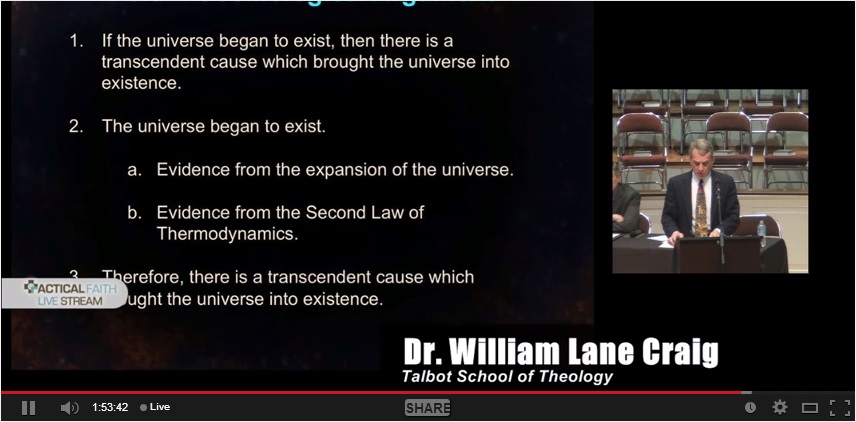
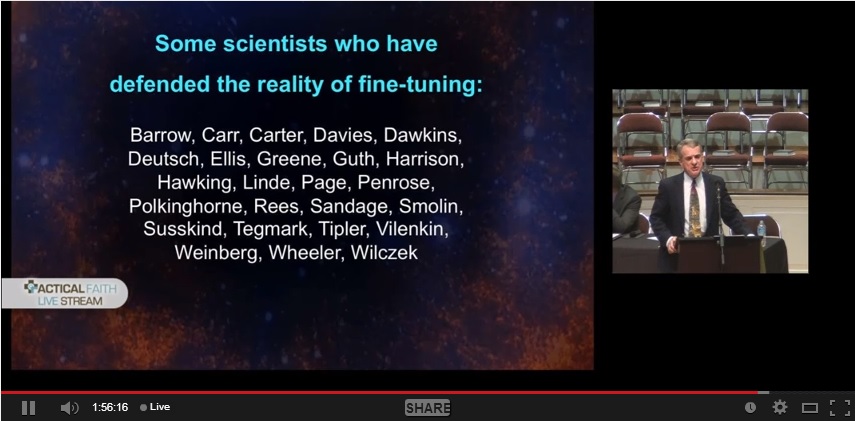
A couple of Craig’s slides: (click for larger images)

Slide 1 of 2:

Dr. Craig slide #1 of 2

Slide 2 of 2:

Dr. Craig slide #2 of 2

Quick summary: (this is not complete, because I couldn’t get everything they were saying noted)

Dr. Craig defended two arguments: 1) the kalam cosmological argument and the fine-tuning argument.

Dr. Craig supported the origin of the universe with 1) the expansion of the universe and 2) the second law of thermodynamics.

Dr. Craig said that the BGV theorem supports a beginning for the universe.

Dr. Craig said that the consensus of scientists did not accept Carroll’s naturalistic cosmology, quoting Stephen Hawking in support.

Dr. Craig said that multiverse models fall victim to the Boltzmann brain problem, where we should observe Boltzmann brains coming into existence and then phasing out again far more probably than embodied minds. But we observe embodied minds, and no Boltzmann brains.

Dr. Carroll said that science cannot study metaphysical questions.

Dr. Carroll said that science is about making models that may or may not be consistent with the experimental data.

Dr. Carroll said that the BGV theorem does not support a beginning for the universe.

Dr. Carroll proposed 17 alternative cosmologies, but did not provide a shred of scientific evidence for any of them, the way that Craig did for the standard model.

Dr. Carroll refuted Dr. Craig’s citation of Stephen Hawking, and Craig yielded the point.

Dr. Carroll speculated that science might progress to the point where the fine-tuning can be explained without an intelligent cause, and he gave an example of where that happened (inflation).

Dr. Craig argued that all 17 of the models suggested by Carroll either conflicted with evidence, had serious problems or did require a beginning.

Dr. Craig argued that Carroll’s own model required a beginning.

Dr. Craig argued that Carroll’s own model fell victim to the Boltzmann brain problem.

Dr. Craig argued that Carroll’s own model violated the second law of thermodynamics.

Dr. Craig re-stated his point that the baby universe spawning in Carroll’s model was speculative and incomplete, and cited Christopher Weaver’s work.

Dr. Carroll denied that things that pop into being out of nothing require a transcendent cause.

Dr. Carroll reiterated that science can only make naturalistic models, and that he did not have to answer questions about ultimate causes.

Dr. Carroll showed a photo of Alan Guth expressing his opinion that the universe is “probably” eternal. No evidence was given for this assertion.

Dr. Carroll said that the fine-tuning was not done in an optimal way, because one fine-tuned value was lower than it needed to be, and it should be exactly what it needed to be if God did it.

Dr. Carroll said that a finely-tuned universe is more probably in naturalism than in theism, because God can do anything he wants and doesn’t need a fine-tuned universe.

Dr. Carroll said he would stop defending his model now, and would instead defend Aguirre-Gratton.

Dr. Craig gave three reasons why the universe popping into being out of nothing requires a transcendent cause.

First, he said that nothing cannot cause anything to happen, because nothing is nothing.

Second, he said that if things pop into being out of nothing, then why don’t we see it happening all the time with other things.

Third, he said that we have no reason to dismiss the causal principle, especially when it is the basis of scientific inquiry and has been so fruitful in the progress of science.

Dr. Craig reiterated that baby universes in Carroll’s model would be dominated by Boltzmann brains, and we don’t observe that.

Dr. Craig said that even on the quantum gravity models that Carroll mentioned, there would still be a beginning.

Dr. Carroll said that Craig mustn’t say “popped into being” but instead that “there was a first moment of time”.

Dr. Carroll said that his model does indeed violate the second law of thermodynamics “YES!”.

At this point Carroll stopped talking about the topic of the debate and started expressing personal opinions about religion. It’s funny how often atheists do this in debates.

Dr. Carroll said that most theists don’t believe in God because of cosmology, but because of community and feelings.

Dr. Carroll said that science had learned a lot in the last 2000 years, so theism was false.

Dr. Carroll said that most philosophers don’t think that God exists, so theism was false.

Dr. Carroll said microscopes and telescopes were absent 2000 years ago, so theism was false.

Dr. Carroll said that religion should be about community and feelings, not about what is true.

Conclusion:

My conclusion was that Carroll lost because he is just satisfied to throw theories out and not to argue that they are true by citing evidence. Carroll never seemed to be interested in finding out what is true, but instead he just wanted to tell a story that didn’t include God, and assert that by Occam’s Razor, his story was a better explanation. I am not impressed with theoretical speculations, although the layperson might be. I kept waiting for him to respond to Craig’s points about how his model was falsified by experimental evidence and observations, e.g. – the Boltzmann brains or the baby universe generation, and he never cited the evidence I wanted him to cite. Craig did have some evidence for his views, but he could have been stronger in making his case. He could have shown the e-mail from Vilenkin that stated that he had understood the BGV theorem, and was using it correctly, for example.

For me the winning side comes down to evidence. The standard model is the standard model because of scientific evidence. Until that evidence is overturned, then speculative models are of no interest to anyone who is evidence-driven. Speculations are not science. A philosophical presupposition of metaphysical naturalism is not science.

The nice thing is that Robin Collins, one of Craig’s respondents, went deep into the science of the fine-tuning, especially on one of my favorite data points, the cosmic microwave background radiation. The paper he presented is now posted on his web site (H/T Christian Apologetics Alliance). I posted about the CMBR before in my post about particle physicist Michael Strauss lecture on cosmology and fine-tuning at Stanford University and the his more recent lecture at the University of Texas. Note that Strauss is an experimental physicist, not a theoretical physicist like Carroll.

Here’s another review of the debate by Randy Everist of Possible Worlds blog. He explains the back-and-forth over Boltzmann brains and the BGV theorem in more detail.

William Lane Craig debates Austin Dacey: Does God Exist?

Here is the video and summary of a debate between Christian theist William Lane Craig and Austin Dacey at Purdue University in 2004 about the existence of God.

The debaters:

The video: (2 hours)

The video shows the speakers and powerpoint slides of their arguments. Austin Dacey is one of the top atheist debaters, and I would put him second to Peter Millican alone, with Walter Sinnott-Armstrong in third place. This is the debate to show people who are new to apologetics. The debate with Peter Millican is better for advanced students, and that’s no surprise since he teaches at Oxford University and is familiar with all of Dr. Craig’s work. The Craig-Dacey debate is the one that I give to my co-workers.

By the way, you can get the DVDs and CDs for the first Craig-Dacey debate and the second Craig-Dacey debate and the second Craig-Sinnott-Armstrong debate. The Peter Millican debate is not available on DVD, but the link above (Peter Millican) has the video and my summary.

Dr. Dacey’s 5 arguments below are all good arguments that you find in the academic literature. He is also an effective and engaging speaker, This is a great debate to watch!

SUMMARY of the opening speeches:

Dr. Craig’s opening statement:

Dr. Craig will present six reasons why God exists:

  1. (Contingency argument) God is the best explanation of why something exists rather than nothing
  2. (Cosmological argument)  God’s existence is implied by the origin of the universe
  3. (Fine-tuning argument) The fine-tuning of the universe for intelligent life points to a designer of the cosmos
  4. (Moral argument) God is the best explanation for the existence of objective moral values and objective moral duties
  5. (Miracles argument) The historical facts surrounding the life, death and resurrection of Jesus
  6. (Religious experience) God’s existence is directly knowable even apart from arguments

Dr. Dacey’s opening argument:

There are two ways to disprove God’s existence, by showing that the concept of God is self-contradictory, or by showing that certain facts about ourselves and the world are incompatible with what we would expect to be true if God did exist. Dr. Dacey will focus on the second kind of argument.

  1. The hiddenness of God
  2. The success of science in explaining nature without needing a supernatural agency
  3. The dependence of mind on physical processes in the brain
  4. Naturalistic evolution
  5. The existence of gratuitous / pointless evil and suffering

One final point:

One thing that I have to point out is that Dr. Dacey quotes Brian Greene during the debate to counter Dr. Craig’s cosmological argument. Dr. Craig could not respond because he can’t see the context of the quote. However, Dr. Craig had a rematch with Dr. Dacey where was able to read the context of the quote and defuse Dr. Dacey’s objection. This is what he wrote in his August 2005 newsletter after the re-match:

The following week, I was off an another three-day trip, this time to California State University at Fresno. As part of a week of campus outreach the Veritas Forum scheduled a debate on the existence of God between me and Austin Dacey, whom I had debated last spring at Purdue University. In preparation for the rematch I adopted two strategies: (1) Since Dacey had come to the Purdue debate with prepared speeches, I decided to throw him for a loop by offering a different set of arguments for God, so that his canned objections wouldn’t apply. I chose to focus on the cosmological argument, giving four separate arguments for the beginning of the universe, and on the evidence for Jesus’ resurrection. (2) I reviewed our previous debate carefully, preparing critiques of his five atheistic arguments. In the process I found that he had seriously misunderstood or misrepresented a statement by a scientist on the Big Bang; so I brought along the book itself in case Dacey quoted this source again. I figured he might change his arguments just as I was doing; but I wanted to be ready in case he used his old arguments again.

[…]The auditorium was packed that night for the debate, and I later learned that there were overflow rooms, too. To my surprise Dr. Dacey gave the very same case he had presented at Purdue; so he really got clobbered on those arguments. Because he wasn’t prepared for my new arguments, he didn’t even respond to two of my arguments for the beginning of the universe, though he did a credible job responding to the others. I was pleased when he attacked the Big Bang by quoting the same scientist as before, because I then held up the book, specified the page number, and proceeded to quote the context to show what the scientist really meant.

Dr. Craig is always prepared!