Tag Archives: Progress of Science

Sean Carroll debates William Lane Craig on cosmology and God’s existence

Here’s the video of the debate:

Carroll was as good of a speaker as Craig in terms of style. Very easy to listen to, very quick on his feet, very civil. There was no clear winner on style.

It was difficult to assess the truth value of scientific points being made, especially for the layperson. I explained a few of them in my posts earlier this week, but I think laypeople might struggle with them if they are hearing about these things for the first time.

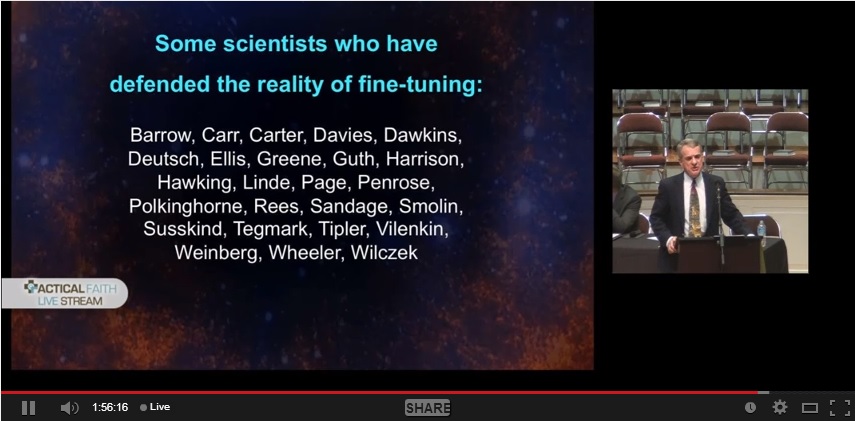
A couple of Craig’s slides: (click for larger images)

Slide 1 of 2:
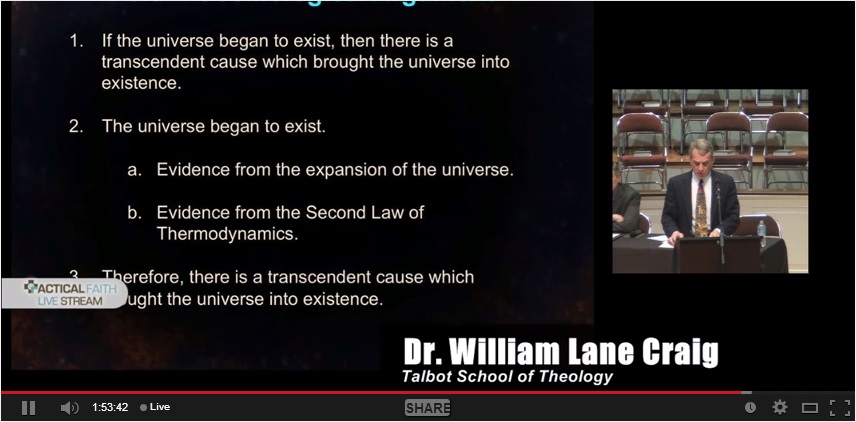
Dr. Craig slide #1 of 2

Slide 2 of 2:

Dr. Craig slide #2 of 2

Quick summary: (this is not complete, because I couldn’t get everything they were saying noted)

Dr. Craig defended two arguments: 1) the kalam cosmological argument and the fine-tuning argument.

Dr. Craig supported the origin of the universe with 1) the expansion of the universe and 2) the second law of thermodynamics.

Dr. Craig said that the BGV theorem supports a beginning for the universe.

Dr. Craig said that the consensus of scientists did not accept Carroll’s naturalistic cosmology, quoting Stephen Hawking in support.

Dr. Craig said that multiverse models fall victim to the Boltzmann brain problem, where we should observe Boltzmann brains coming into existence and then phasing out again far more probably than embodied minds. But we observe embodied minds, and no Boltzmann brains.

Dr. Carroll said that science cannot study metaphysical questions.

Dr. Carroll said that science is about making models that may or may not be consistent with the experimental data.

Dr. Carroll said that the BGV theorem does not support a beginning for the universe.

Dr. Carroll proposed 17 alternative cosmologies, but did not provide a shred of scientific evidence for any of them, the way that Craig did for the standard model.

Dr. Carroll refuted Dr. Craig’s citation of Stephen Hawking, and Craig yielded the point.

Dr. Carroll speculated that science might progress to the point where the fine-tuning can be explained without an intelligent cause, and he gave an example of where that happened (inflation).

Dr. Craig argued that all 17 of the models suggested by Carroll either conflicted with evidence, had serious problems or did require a beginning.

Dr. Craig argued that Carroll’s own model required a beginning.

Dr. Craig argued that Carroll’s own model fell victim to the Boltzmann brain problem.

Dr. Craig argued that Carroll’s own model violated the second law of thermodynamics.

Dr. Craig re-stated his point that the baby universe spawning in Carroll’s model was speculative and incomplete, and cited Christopher Weaver’s work.

Dr. Carroll denied that things that pop into being out of nothing require a transcendent cause.

Dr. Carroll reiterated that science can only make naturalistic models, and that he did not have to answer questions about ultimate causes.

Dr. Carroll showed a photo of Alan Guth expressing his opinion that the universe is “probably” eternal. No evidence was given for this assertion.

Dr. Carroll said that the fine-tuning was not done in an optimal way, because one fine-tuned value was lower than it needed to be, and it should be exactly what it needed to be if God did it.

Dr. Carroll said that a finely-tuned universe is more probably in naturalism than in theism, because God can do anything he wants and doesn’t need a fine-tuned universe.

Dr. Carroll said he would stop defending his model now, and would instead defend Aguirre-Gratton.

Dr. Craig gave three reasons why the universe popping into being out of nothing requires a transcendent cause.

First, he said that nothing cannot cause anything to happen, because nothing is nothing.

Second, he said that if things pop into being out of nothing, then why don’t we see it happening all the time with other things.

Third, he said that we have no reason to dismiss the causal principle, especially when it is the basis of scientific inquiry and has been so fruitful in the progress of science.

Dr. Craig reiterated that baby universes in Carroll’s model would be dominated by Boltzmann brains, and we don’t observe that.

Dr. Craig said that even on the quantum gravity models that Carroll mentioned, there would still be a beginning.

Dr. Carroll said that Craig mustn’t say “popped into being” but instead that “there was a first moment of time”.

Dr. Carroll said that his model does indeed violate the second law of thermodynamics “YES!”.

At this point Carroll stopped talking about the topic of the debate and started expressing personal opinions about religion. It’s funny how often atheists do this in debates.

Dr. Carroll said that most theists don’t believe in God because of cosmology, but because of community and feelings.

Dr. Carroll said that science had learned a lot in the last 2000 years, so theism was false.

Dr. Carroll said that most philosophers don’t think that God exists, so theism was false.

Dr. Carroll said microscopes and telescopes were absent 2000 years ago, so theism was false.

Dr. Carroll said that religion should be about community and feelings, not about what is true.

Conclusion:

My conclusion was that Carroll lost because he is just satisfied to throw theories out and not to argue that they are true by citing evidence. Carroll never seemed to be interested in finding out what is true, but instead he just wanted to tell a story that didn’t include God, and assert that by Occam’s Razor, his story was a better explanation. I am not impressed with theoretical speculations, although the layperson might be. I kept waiting for him to respond to Craig’s points about how his model was falsified by experimental evidence and observations, e.g. – the Boltzmann brains or the baby universe generation, and he never cited the evidence I wanted him to cite. Craig did have some evidence for his views, but he could have been stronger in making his case. He could have shown the e-mail from Vilenkin that stated that he had understood the BGV theorem, and was using it correctly, for example.

For me the winning side comes down to evidence. The standard model is the standard model because of scientific evidence. Until that evidence is overturned, then speculative models are of no interest to anyone who is evidence-driven. Speculations are not science. A philosophical presupposition of metaphysical naturalism is not science.

If you want to see a good lecture on scientific evidence related to cosmology, then there is the particle physicist Michael Strauss lecture on cosmology and fine-tuning at Stanford University and his more recent lecture at the University of Texas. Note that Strauss is an experimental physicist, not a theoretical physicist like Carroll.

Here’s another review of the debate by Randy Everist of Possible Worlds blog. He explains the back-and-forth over Boltzmann brains and the BGV theorem in more detail.
Information Enigma: 21-minute video explains intelligent design

Can random mutation and natural selection create new functional information?

The video is here:

I have read and listened and watched a lot of material on intelligent design, but I have never seen so much value packed into such a short lecture. I really hope you’ll watch this and that it’s helpful to you.

Summary:

  • the big question when discussing the origin of life: where did the information in living systems come from?
  • Until 530 million years ago, the oceans were largely devoid of life
  • In a 10 million year period, many new forms of animal life emerged
  • New biological forms of life require new information
  • the discovery of DNA shows that living systems work because cells have information that allows them to build the components of molecular machines: cell types, proteins, etc.
  • can random mutation and natural selection create new functional information?
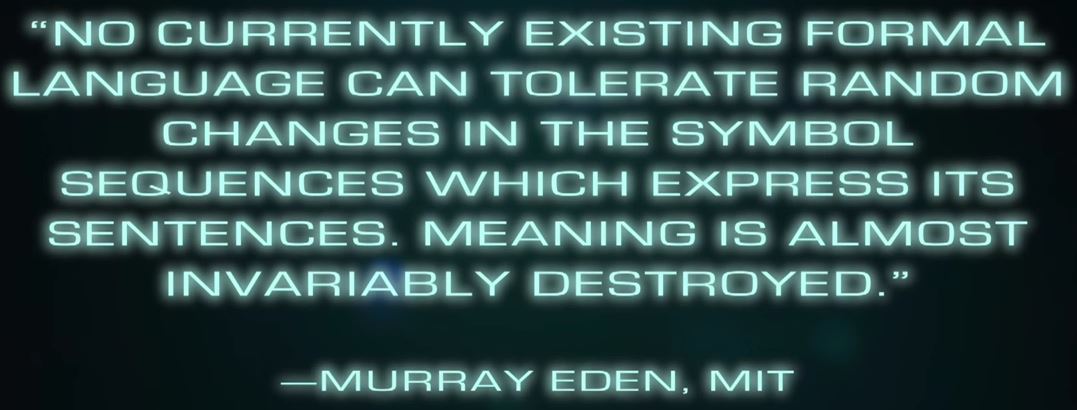
  • normally, random mutations tend to degrade the functionality of information, e.g. – randomly changing symbols in an applications code does not usually introduce useful new functions, it usually renders what is there non-functional
  • the majority of possible sequences will NOT have functions, so random mutations will more likely give you non-functional code, rather than functional code
  • example: a bicycle lock  with 4 numbers has many possible sequences for the 4 numbers, and only one of them has unlock functionality, the rest have no functionality
  • if you have lots of time, then you might be able to guess the combination, but if the lock as has 10 billion numbers, and only one combination that unlocks, you can spend your whole life trying to unlock it and won’t succeed
  • how likely is it to arrive at a functional protein or gene by chance? Is it more like the 4-dial lock (can be done with lots of time) or the 10 billion dial lock (amount of time required exceeds the time available)?
  • the probability is LOW because there is only one sequence of numbers that has unlock function
  • consider a short protein of 150 amino acids has 10 to the 195th power possible sequences
  • if many of these sequences of amino acides had biological function, then it might be easier to get to one by random mutation and selection than it is with a lock that only unlocks for ONE sequence
  • how many of the possible sequences have biological function?
  • Thanks to research done by Douglas Axe, we now know that the number of functional amino acid sequences for even a short protein is incredibly small…
  • Axe found that the odds of getting a functional sequence of amino acids that will fold and have biological function is 1 in 10 to the 77th power
  • Is that number too improbable to reach by chance? well, there are 10 to 65th atoms in the entire Milky Way galaxy… so yes, this is a very improbable outcome
  • can random genetic mutations search through all the sequences in order to find the one in 10 to the 77th power one that has biological function? It depends on how much guessers we have and how many guesses we get in the time available
  • even with the entire 3.5 billion year history of life on Earth, only about 10 to the 40th organisms have ever lived, which far smaller fraction of the 10 to the 77th total sequences
  • even with a very fast mutation rate, you would not be able to reach a functional protein even with all that time, and even with all those organisms

I was once having a discussion with a woman about the research that Axe did at the Cambridge University lab. He published four articles in the Journal of Molecular Biology. I held out one of the papers to her and showed her the numbers. She said over and over “I hate the Discovery Institute! I hate the Discovery Institute!” Well, yeah, but you can’t make the Journal of Molecular Biology go away with hating the Discovery Institute. JMB is peer-reviewed, and this was experimental evidence – not a theory, not a hypothesis.

We have been blessed by the Creator and Designer of the universe in this time and place with overwhelming evidence – an abundance of riches. For those who have an open mind, this is what you’ve been waiting for to make your decision. For the naturalists who struggle so mightily to block out the progress of experimental science, they’ll need to shout louder and shut their eyes tighter and push harder to block their ears. Maybe if they keep screaming “Star Trek” and “Star Wars” over and over to themselves, they will be able to ignore the real science a little longer.

Alexander Vilenkin: “All the evidence we have says that the universe had a beginning”

I’ve decided to explain why physicists believe that there was a creation event in this post. That is to say, I’ve decided to let famous cosmologist Alexander Vilenkin do it.

From Uncommon Descent.

Excerpt:

Did the cosmos have a beginning? The Big Bang theory seems to suggest it did, but in recent decades, cosmologists have concocted elaborate theories – for example, an eternally inflating universe or a cyclic universe – which claim to avoid the need for a beginning of the cosmos. Now it appears that the universe really had a beginning after all, even if it wasn’t necessarily the Big Bang.

At a meeting of scientists – titled “State of the Universe” – convened last week at Cambridge University to honor Stephen Hawking’s 70th birthday, cosmologist Alexander Vilenkin of Tufts University in Boston presented evidence that the universe is not eternal after all, leaving scientists at a loss to explain how the cosmos got started without a supernatural creator. The meeting was reported in New Scientist magazine (Why physicists can’t avoid a creation event, 11 January 2012).

[…]In his presentation, Professor Vilenkin discussed three theories which claim to avoid the need for a beginning of the cosmos.

The three theories are chaotic inflationary model, the oscillating model and quantum gravity model. Regular readers will know that those have all been addressed in William Lane Craig’s peer-reviewed paper that evaluates alternatives to the standard Big Bang cosmology.

But let’s see what Vilenkin said.

More:

One popular theory is eternal inflation. Most readers will be familiar with the theory of inflation, which says that the universe increased in volume by a factor of at least 10^78 in its very early stages (from 10^−36 seconds after the Big Bang to sometime between 10^−33 and 10^−32 seconds), before settling into the slower rate of expansion that we see today. The theory of eternal inflation goes further, and holds that the universe is constantly giving birth to smaller “bubble” universes within an ever-expanding multiverse. Each bubble universe undergoes its own initial period of inflation. In some versions of the theory, the bubbles go both backwards and forwards in time, allowing the possibility of an infinite past. Trouble is, the value of one particular cosmic parameter rules out that possibility:

But in 2003, a team including Vilenkin and Guth considered what eternal inflation would mean for the Hubble constant, which describes mathematically the expansion of the universe. They found that the equations didn’t work (Physical Review Letters, DOI: 10.1103/physrevlett.90.151301). “You can’t construct a space-time with this property,” says Vilenkin. It turns out that the constant has a lower limit that prevents inflation in both time directions. “It can’t possibly be eternal in the past,” says Vilenkin. “There must be some kind of boundary.”

A second option explored by Vilenkin was that of a cyclic universe, where the universe goes through an infinite series of big bangs and crunches, with no specific beginning. It was even claimed that a cyclic universe could explain the low observed value of the cosmological constant. But as Vilenkin found, there’s a problem if you look at the disorder in the universe:

Disorder increases with time. So following each cycle, the universe must get more and more disordered. But if there has already been an infinite number of cycles, the universe we inhabit now should be in a state of maximum disorder. Such a universe would be uniformly lukewarm and featureless, and definitely lacking such complicated beings as stars, planets and physicists – nothing like the one we see around us.

One way around that is to propose that the universe just gets bigger with every cycle. Then the amount of disorder per volume doesn’t increase, so needn’t reach the maximum. But Vilenkin found that this scenario falls prey to the same mathematical argument as eternal inflation: if your universe keeps getting bigger, it must have started somewhere.

However, Vilenkin’s options were not exhausted yet. There was another possibility: that the universe had sprung from an eternal cosmic egg:

Vilenkin’s final strike is an attack on a third, lesser-known proposal that the cosmos existed eternally in a static state called the cosmic egg. This finally “cracked” to create the big bang, leading to the expanding universe we see today. Late last year Vilenkin and graduate student Audrey Mithani showed that the egg could not have existed forever after all, as quantum instabilities would force it to collapse after a finite amount of time (arxiv.org/abs/1110.4096). If it cracked instead, leading to the big bang, then this must have happened before it collapsed – and therefore also after a finite amount of time.

“This is also not a good candidate for a beginningless universe,” Vilenkin concludes.

So at the end of the day, what is Vilenkin’s verdict?

“All the evidence we have says that the universe had a beginning.”

This is consistent with the Borde-Guth-Vilenkin Theorem, which I blogged about before, and which William Lane Craig leveraged to his advantage in his debate with Peter Millican.

The Borde-Guth-Vilenkin (BGV) proof shows that every universe that expands must have a space-time boundary in the past. That means that no expanding universe, no matter what the model, can be eternal into the past. No one denies the expansion of space in our universe, and so we are left with a cosmic beginning. Even speculative alternative cosmologies do not escape the need for a beginning.

Conclusion

If the universe came into being out of nothing, which seems to be the case from science, then the universe has a cause. Things do not pop into being, uncaused, out of nothing. The cause of the universe must be transcendent and supernatural. It must be uncaused, because there cannot be an infinite regress of causes. It must be eternal, because it created time. It must be non-physical, because it created space. There are only two possibilities for such a cause. It could be an abstract object or an agent. Abstract objects cannot cause effects. Therefore, the cause is an agent.

Now, let’s have a discussion about this science in our churches, and see if we can’t train Christians to engage with non-Christians about the evidence so that everyone accepts what science tells us about the origin of the universe.