Tag Archives: Product

Doug Axe explains the chances of getting a functional protein by chance

I’ve talked about Doug Axe before when I described how to calculate the odds of getting functional proteins by chance.

Let’s calculate the odds of building a protein composed of a functional chain of 100 amino acids, by chance. (Think of a meaningful English sentence built with 100 scrabble letters, held together with glue)

Sub-problems:

  • BONDING: You need 99 peptide bonds between the 100 amino acids. The odds of getting a peptide bond is 50%. The probability of building a chain of one hundred amino acids in which all linkages involve peptide bonds is roughly (1/2)^99 or 1 chance in 10^30.
  • CHIRALITY: You need 100 left-handed amino acids. The odds of getting a left-handed amino acid is 50%. The probability of attaining at random only L–amino acids in a hypothetical peptide chain one hundred amino acids long is (1/2)^100 or again roughly 1 chance in 10^30.
  • SEQUENCE: You need to choose the correct amino acid for each of the 100 links. The odds of getting the right one are 1 in 20. Even if you allow for some variation, the odds of getting a functional sequence is (1/20)^100 or 1 in 10^65.

The final probability of getting a functional protein composed of 100 amino acids is 1 in 10^125. Even if you fill the universe with pre-biotic soup, and react amino acids at Planck time (very fast!) for 14 billion years, you are probably not going to get even 1 such protein. And you need at least 100 of them for minimal life functions, plus DNA and RNA.

Research performed by Doug Axe at Cambridge University, and published in the peer-reviewed Journal of Molecular Biology, has shown that the number of functional amino acid sequences is tiny:

Doug Axe’s research likewise studies genes that it turns out show great evidence of design. Axe studied the sensitivities of protein function to mutations. In these “mutational sensitivity” tests, Dr. Axe mutated certain amino acids in various proteins, or studied the differences between similar proteins, to see how mutations or changes affected their ability to function properly. He found that protein function was highly sensitive to mutation, and that proteins are not very tolerant to changes in their amino acid sequences. In other words, when you mutate, tweak, or change these proteins slightly, they stopped working. In one of his papers, he thus concludes that “functional folds require highly extraordinary sequences,” and that functional protein folds “may be as low as 1 in 10^77.”

The problem of forming DNA by sequencing nucleotides faces similar difficulties. And remember, mutation and selection cannot explain the origin of the first sequence, because mutation and selection require replication, which does not exist until that first living cell is already in place.

But you can’t show that to your friends, you need to send them a video. And I have a video!

A video of Doug Axe explaining the calculation

Here’s a clip from Illustra Media’s new ID DVD “Darwin’s Dilemma”, which features Doug Axe and Stephen Meyer (both with Ph.Ds from Cambridge University).

I hope you all read Brian Auten’s review of Darwin’s Dilemma! It was awesome.

Related DVDs

Illustra also made two other great DVDs on intelligent design. The first two DVDs “Unlocking the Mystery of Life” and “The Privileged Planet” are must-buys, but you can watch them on youtube if you want, for free.

Here are the 2 playlists:

I also recommend Coldwater Media’s “Icons of Evolution”. All three of these are on sale from Amazon.com.

Related posts

Thomas Sowell explains the economics of cutting health care costs

The Democrats are talking a lot of about their plan to reduce the costs of health care. And they think that the way to do that is by having government take a bigger role in health care provision. Well, Thomas Sowell doesn’t like the idea that the government can reduce health care costs by using govenrment, and he’s written a four part series on it.

Here’s a quote from the first part about how Democrats attack the suppliers of health care products and services:

Despite all the demonizing of insurance companies, pharmaceutical companies or doctors for what they charge, the fundamental costs of goods and services are the costs of producing them.

If highly paid chief executives of insurance companies or pharmaceutical companies agreed to work free of charge, it would make very little difference in the cost of insurance or medications. If doctors’ incomes were cut in half, that would not lower the cost of producing doctors through years of expensive training in medical schools and hospitals, nor the overhead costs of running doctors’ offices.

What it would do is reduce the number of very able people who are willing to take on the high costs of a medical education when the return on that investment is greatly reduced and the aggravations of dealing with government bureaucrats are added to the burdens of the work.

Britain has had a government-run medical system for more than half a century and it has to import doctors, including some from Third World countries where the medical training may not be the best.

And a quote from the second part about how reducing costs means rationing:

There is no question that you can reduce the payments for medical care by having either a lower quantity or a lower quality of medical care. That has already been done in countries with government-run medical systems.

In the United States, the government has already reduced payments for patients on Medicare and Medicaid, with the result that some doctors no longer accept new patients with Medicare or Medicaid. That has not reduced the cost of medical care. It has reduced the availability of medical care, just as buying a pint of milk reduces the payment below what a quart of milk would cost.

Letting old people die instead of saving their lives will undoubtedly reduce medical payments considerably. But old people have that option already— and seldom choose to exercise it, despite clever people who talk about a “duty to die.”

A government-run system will take that decision out of the hands of the elderly or their families, and thereby “bring down the cost of medical care.” A stranger’s death is much easier to take, especially if you are a bureaucrat making that decision in Washington.

[…]You can even save money by cutting down on medications to relieve pain, as is already being done in Britain’s government-run medical system.

You can save money by not having as many high-tech medical devices like CAT scans or MRIs, and not using the latest medications. Countries with government-run medical systems have less of all these things than the United States has.But reducing these things is not “bringing down the cost of medical care.” It is simply refusing to pay those costs— and taking the consequences.

And a quote from the third part talks about free markets versus government price controls:

If you think the government can lower medical costs by eliminating “waste, fraud and abuse,” as some Washington politicians claim, the logical question is: Why haven’t they done that already?

Over the years, scandal after scandal has shown waste, fraud and abuse to be rampant in Medicare and Medicaid. Why would anyone imagine that a new government medical program will do what existing government medical programs have clearly failed to do?

If we cannot afford to pay for doctors, hospitals and pharmaceutical drugs now, how can we afford to pay for doctors, hospitals and pharmaceutical drugs, in addition to a new federal bureaucracy to administer a government-run medical system?

And a quote from the fourth part talks about equality versus liberty in health care:

What about insurance companies denying reimbursements for treatments? Does anyone imagine that a government bureaucracy will not do that?

Moreover, the worst that an insurance company can do is refuse to pay for medication or treatment. In some countries with government-run medical systems, the government can prevent you from spending your own money to get the medication or treatment that their bureaucracy has denied you. Your choice is to leave the country or smuggle in what you need.

However appalling such a situation may be, it is perfectly consistent with elites wanting to control your life. As far as those elites are concerned, it would not be “social justice” to allow some people to get medical care that others are denied, just because some people “happen to have money.”

But very few people just “happen to have money.” Most people have earned money by producing something that other people wanted. But getting what you want by what you have earned, rather than by what elites will deign to allow you to have, is completely incompatible with the vision of an elite-controlled world, which they call “social justice” or other politically attractive phrases.

What’s frustrating to me is how quickly people think of growing government as the solution to their problems. They don’t want to deal with paying for health care themselves. But what the government does to solve the high prices is fix prices and regulate the producers of health care, like doctors and medical device manufacturers. They make the supply smaller. But when the cost apparently goes down, people are signaled to use more health care. That makes the demand larger. And this is why there is a shortage of health care in countries that have health care provisioning highly regulated by the government.

You can even save money by cutting down on medications to relieve pain, as is already being done in Britain’s government-run medical system.

You can save money by not having as many high-tech medical devices like CAT scans or MRIs, and not using the latest medications. Countries with government-run medical systems have less of all these things than the United States has.But reducing these things is not “bringing down the cost of medical care.” It is simply refusing to pay those costs— and taking the consequences.

Is opposition to evolution based on ignorance of the scientific data?

Consider this article by Jonathan Wells.

First, let’s re-cap the challenge to evolution from the phenomenon of the Cambrian explosion.

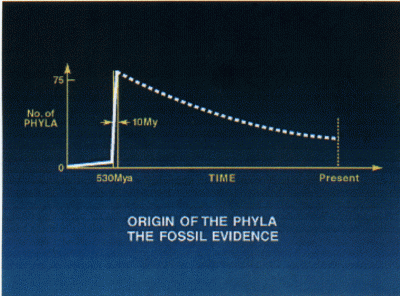
The newly released film “Darwin’s Dilemma” argues that the geologically abrupt appearance of the major groups of animals (the “phyla”) in the Cambrian Explosion posed a serious problem for Charles Darwin’s theory of evolution (as he himself knew), and that subsequent fossil discoveries—far from solving the problem—have made it worse.

Basically, all the major body plans we have today appear in the fossil record in a 2-3 million period about 543 million years ago. There are no precursors in the fossil record showing the gradual evolution of these major body plans.

The Cambrian Explosion: 0 to 60 in a few million years

Darwin expected to discover lots and lots of fossils leading up to the Cambrian explosion period that would show how all these phyla came into existence slowly over time. Unfortunately for the naturalistic evolutionists, the discoveries we’ve been making haven’t shown any hint of precursor fossils leading up the Cambrian explosion.

Since 1859, however, many Precambrian fossils have been found, including microfossils of single-celled bacteria in rocks more than three billion years old. In addition, multicellular Precambrian fossils have been found in the Ediacara Hills of Australia, though there is continuing debate over whether any—or how many—of the Ediacaran fossils were animals, or what relationship—if any—they had to the Cambrian phyla. In 1998, Cambridge University paleobiologist Simon Conway Morris (who is featured in the film “Darwin’s Dilemma”) wrote, “Apart from the few Ediacaran survivors… there seems to be a sharp demarcation between the strange world of Ediacaran life and the relatively familiar Cambrian fossils” (Crucible of Creation, 30).

But wait! Maybe we can’t find the precusor fossils required by Darwinism because they are too small or too soft to have survived for so long?

Since 1859, however, many Precambrian fossils have been found, including microfossils of single-celled bacteria in rocks more than three billion years old. In addition, multicellular Precambrian fossils have been found in the Ediacara Hills of Australia… In 1998, Cambridge University paleobiologist Simon Conway Morris… wrote, “Apart from the few Ediacaran survivors… there seems to be a sharp demarcation between the strange world of Ediacaran life and the relatively familiar Cambrian fossils” (Crucible of Creation, 30).

So there is now no shortage of Precambrian fossils. Not only do we have fossils of bacteria, but we also have many fossils of soft-bodied Multicellular organisms. “In the Ediacaran organisms there is no evidence for any skeletal hard parts,” wrote Conway Morris in 1998. “Ediacaran fossils look as if they were effectively soft-bodied” (Crucible of Creation, 28). The same is true of many of the organisms fossilized in the Cambrian explosion.

But wait! Scientists have discovered lots of exceptionally preserved microbes just before the Cambrian explosion. Don’t microbes count as precursors to the Cambrian explosion phyla?

Richard Callow and Martin Brasier reported in the January 2009 issue of the Journal of the Geological Society, London “a variety of exceptionally preserved microbes” from late Precambrian rocks in England that address “the paradox known as ‘“Darwin’s dilemma’.”

[…]Callow and Brasier didn’t solve Darwin’s dilemma. Instead, they put one more nail in the coffin of Darwin’s attempt to salvage his theory from it. The truth is that “exceptionally preserved microbes” from the late Precambrian actually deepen Darwin’s dilemma, because they suggest that if there had been ancestors to the Cambrian phyla they would have been preserved.

I am willing to believe in evolution. But in order to get me to believe it, I insist on seeing a fossil record that shows the gradual emergence of phyla, one or two at a time, over hundreds of millions of years. That is what Darwinism predicts. We now have a solid record of what came before the Cambrian explosion. So where are the precursors? Where is the record of gradual emergence? Where is my evidence?

More on the Cambrian explosion

The origin of life and biological information

Videos on intelligent design