Tag Archives: Premarital Sex

Study: couples that delay sexual activity experience higher quality relationships

Relationship stability, quality, communication, satisfaction

From Family Studies, news about TWO new studies.

Excerpt: (links removed)

[T]wo recently published studies call into question the validity of testing sexual chemistry early in dating.

My colleagues and I published the first study a few years ago in the American Psychological Association’s Journal of Family Psychology. This study involved a national sample of 2,035 married individuals who participated in the popular online couple assessment survey called “RELATE.” We found that the longer a dating couple waits to have sex, the better their relationship is after marriage. In fact, couples who wait until marriage to have sex report higher relationship satisfaction (20% higher), better communication patterns (12% better), less consideration of divorce (22% lower), and better sexual quality (15% better) than those who started having sex early in their dating (see Figure 2). For couples in between—those that became sexually involved later in their dating, but prior to marriage—the benefits were about half as strong.

[…]These patterns were statistically significant even when controlling for a variety of other variables such as respondents’ number of prior sexual partners, education levels, religiosity, and relationship length.

The second study, by Sharon Sassler and her colleagues at Cornell University, also found that rapid sexual involvement has adverse long-term implications for relationship quality. Using data from the Marital and Relationship Survey, which provides information on nearly 600 low- to moderate-income couples living with minor children, their study examined the tempo of sexual intimacy and subsequent relationship quality in a sample of married and cohabiting men and women. Their analyses also suggest that delaying sexual involvement is associated with higher relationship quality across several dimensions.

They discovered that the negative association between sexual timing and relationship quality is largely driven by a link between early sex and cohabitation. Specifically, sexual involvement early in a romantic relationship is associated with an increased likelihood of moving more quickly into living together, which in turn is associated with lower relationship quality. This finding supports Norval Glenn’s hypothesis that sexual involvement may lead to unhealthy emotional entanglements that make ending a bad relationship difficult. As Sassler and her colleagues concluded, “Adequate time is required for romantic relationships to develop in a healthy way. In contrast, relationships that move too quickly, without adequate discussion of the goals and long-term desires of each partner, may be insufficiently committed and therefore result in relationship distress, especially if one partner is more committed than the other” (p. 710).

The rest of the post talks about two reasons why this works: improved partner selection and prioritizing communication and commitment. Improved partner selection occurs because you haven’t committed too much too soon (sexually) and you have time to let things play out to see if you really fit with the other person. And if you take sex off the table, then you have to use other means in order to build emotional intimacy – communication, service, support, etc.

That’s two studies, and there’s a third. Dina sent me this article from the UK Daily Mail about a new study showing the importance of chastity for relationship quality and stability.

Excerpt:

New couples who jump into bed together on the first date do not last as long in relationships as those who wait a new study has revealed.

Using a sample of almost 11,000 unmarried people, Brigham Young University discovered a direct correlation between the length and strength of a partnership and the amount of time they took to have first have sex.

The study showed that those who waited to initiate sexual intimacy were found to have longer and more positive outcomes in their relationships while those who couldn’t help themselves reported that their dalliances struggled to last more than two years.

‘Results suggested that waiting to initiate sexual intimacy in unmarried relationships was generally associated with positive outcomes,’ said the report authored published by the U.S. National Library of Medicine National Institutes of Health.

‘This effect was strongly moderated by relationship length, with individuals who reported early sexual initiation reporting increasingly lower outcomes in relationships of longer than two years.’

The study examined four sexual-timing patterns: Having sex prior to dating, initiating sex on the first date or shortly after, having sex after a few weeks of dating, and sexual abstinence.

Each one of these fields yielded different results in relationship satisfaction, stability and communication in dating situations.

Here’s another recent study that shows that if a woman has more than her husband as a premarital sex partner, her risk of divorce increases.

His findings:

Using nationally representative data from the 1995 National Survey of Family Growth, I estimate the association between intimate premarital relationships (premarital sex and premarital cohabitation) and subsequent marital dissolution. I extend previous research by considering relationship histories pertaining to both premarital sex and premarital cohabitation. I find that premarital sex or premarital cohabitation that is limited to a woman’s husband is not associated with an elevated risk of marital disruption.However, women who have more than one intimate premarital relationship have an increased risk of marital dissolution.

Here’s another study that makes it even more clear.

Findings:

Data from the 1988 US National Survey of Family Growth (NSFG) were utilized to assess the impact of premarital sexual activity on subsequent marital stability. Among white NSFG subjects first married in 1965-85, virgin brides were significantly less to have become separated or divorced (25%) than women who had not been virgins at marriage (35%).

[…]The lower risk of divorce on the part of white women with no premarital sexual experience persisted even after numerous intervening and background variables were controlled.

If you’re going to talk to a young person about sex, it’s a good idea to use these studies to explain what you lose by having sex too early in the relationship. Although they may respond with anecdotes to refute studies, studies are important because they represent LOTS of data points, not just one or two cherry-picked cases. My view on all this is the Bible’s view – no sex before marriage. But when talking to people about this issue, I find it useful to have evidence ready in order to be convincing in every way possible.

Previously, I blogged on studies that showed that the number of premarital sex partners increases unhappiness in the marriage, which raises the risk of divorce. Read and be wise about sexuality!

My conversation about morality with an atheist millennial man

This is one of the memes from the Wintery Knight facebook page
Congratulations! Your view of what’s moral aligns exactly with your actions!

I spent some time talking to an atheist millennial recently. He considers himself a moral person, and he is very helpful to others. I asked him to define morality, and he said that morality was feeling good, and helping other people to feel good. I was trying to think of a way to punch a hole in his feelings-based utilitarianism. How could I show him that happy feelings are not a good basis for morality?

Now, you’re probably thinking that abortion is the most obvious example of something that is morally wrong – it’s just killing a baby because adults don’t want to take responsibility for their foolish pursuit of pleasure. But atheists typically don’t think of unborn children as people. They usually believe in naturalistic evolution, and they are committed to a view of reality where the universe is an accident, human beings are accidents, there are no objective human rights, and biological evolution progresses because the strong survive while the weak die. So you aren’t going to be able to generate a moral standard that includes compassion for weak unborn children on that scenario. If the rule is “let’s do what makes us happy”, and the unborn child can’t voice her opinion, then the selfish grown-ups win.

Instead, I decided to focus on fatherlessness. I asked him whether he thought that fatherlessness harmed children. Surprisingly, he said that it didn’t, and that he had a relative who was doing a great job raising fatherless kids. I asked him if he had ever looked at the research on what father absence does to children. He hadn’t. Then I asked him if a system of sexual rules based on “me feeling good, and other people around me feeling good”, was likely to protect children. He went silent.

Well, that was the end of that conversation. And I think it was a nice window into how millennials – who are absolutely clueless about what research says about sex, dating, marriage and parenting – think about relationships. They’re making decisions based on their feelings, then acting surprised when their “common sense” decisions based on happiness “in the moment” blow up in their faces, and destroy the lives of their children, including their unborn children.

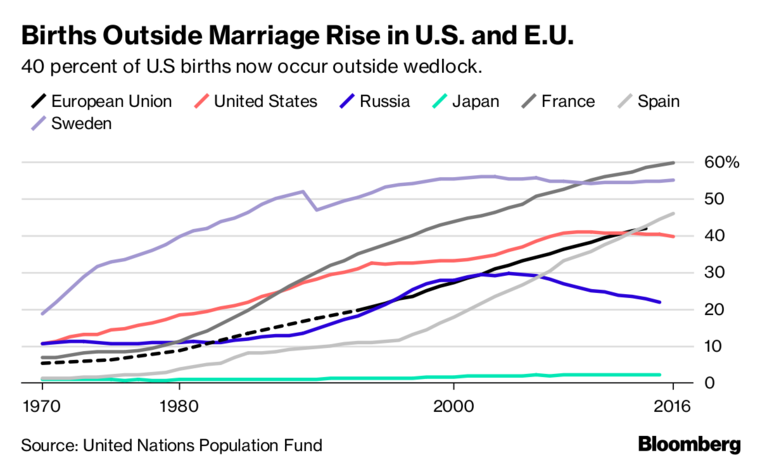
Unfortunately, young people are having children outside of a marriage commitment more and more.

Out-of-wedlocks births rising as cohabitation replaces marriage

Far-left Bloomberg News reports:

Forty percent of all births in the U.S. now occur outside of wedlock, up from 10 percent in 1970, according to an annual report released on Wednesday by the United Nations Population Fund (UNFPA), the largest international provider of sexual and reproductive health services. That number is even higher in the European Union.

The EU has a higher rate of fatherless births because they have high taxes and big government to allow women to have children without having to commit to a husband:

The EU likely sees more births out of wedlock because many member countries have welfare systems that support gender-balanced child care, said Michael Hermann, UNFPA’s senior adviser on economics and demography, in an interview. Public health care systems, paid paternal leave, early education programs and tax incentives give unwed parents support beyond what a partner can provide.

More welfare and more government services make it easier for women to pursue relationships with men who aren’t interested in marriage. Hot bad boys who give them all the tingles. Big government makes those boring, predictable marriage-ready men dispensable. Big government also makes it much harder for a man who does marry to afford a stay-at-home mother for his kids, because he has to pay higher taxes for big government.

More:

The data show such births in the U.S. and EU are predominantly to unmarried couples living together rather than to single mothers, the report says.

[…]Jones also noted that the rise in births outside of marriage is closely correlated to delays in childbearing. “Women are claiming their ground professionally,” she said. “Delaying motherhood is a rational decision when you consider the impact it can have on your career, and that’s contributing to this trend.”

[….]The traditional progression of Western life “has been reversed,” said John Santelli, a professor in population, family health and pediatrics at Columbia’s Mailman School of Public Health. “Cohabiting partners are having children before getting married. That’s a long-term trend across developing nations.”

Regardless of marital status, more couples are choosing not to have kids at all. The U.S. fertility rate hit a historic 30-year low last year, according to the Centers for Disease Control and Prevention. Hermann said the rise in births outside of wedlock has actually mitigated the decline in fertility, which “would be much steeper if women weren’t having children outside marriage.”

What’s interesting about this anti-marriage article is that they have nothing to say about the research showing that cohabitation – and also marriages that occur after a period of cohabitation – are inferior to no-cohabitation marriages. People who are serious about self-control, and who are serious about committing through thick and thin, tend to have longer lasting marriages. But we don’t prioritize chastity, fidelity and self-sacrificial commitment anymore, because that relationships that require self-denial make us unhappy.

The article concludes: “We can’t go back to the ’50s”. Right. Because if feelings-based “morality” is assumed, then any choice between adult happiness and children’s happiness will favor the adults. Today’s young people carefully AVOID any evidence that contradicts their new “happiness-morality”. They act surprised when their unstable relationships dissolve, leaving children separated from their fathers. Marriage requires that both partners have a system of morality that puts the commitment above happy feelings. People have to be accustomed to doing things that feel bad, just because they are good and moral things to do according to an objective standard of morality. The new atheist morality of happy feelings doesn’t develop the character needed for commitment.

If you ask an atheist millennial, they think they are doing a great job of being “moral”. They don’t see the messes they are making for children as something that they are causing themselves, with their own foolish feelings-based decision-making. They think they know everything about relationships through their feelings. They think that they are exempt from the patterns of cause and effect in the peer-reviewed research.

How parents and churches can make better women than the Bachelorette Hannah Brown

Do young women understand how to get to a stable marriage?

My friend Carla sent me a video from a TV show called the Bachelorette, in which a woman named Hannah Brown explains why she thinks that having recreational premarital sex is compatible with Christianity. In this post, I wanted to explain to Christian parents and churches why serious Christian men do not consider women like Hannah Brown to be appropriate candidates for marriage.

First, if you haven’t seen the clip, you can watch it here:

So I just wanted to go over what I think marriage is for, and then try to judge whether Hannah Brown’s view of men, sex and marriage offers me any value. I think this will be useful for parents and churches, because I think a lot of Christian men see marriage the same way as I do.

So, when I think of marriage, I’m looking for a partner who can help me to achieve goals that are consistent with the character of God revealed in the ministry of his son Jesus. So, what did Jesus do? Jesus demonstrated the existence of God by showing people evidence (miracles). Jesus taught people about what moral choices they should make and how to treat others. Jesus taught people that marriage is for one man and one woman, and that children should not be prevented from knowing God. And Jesus taught that people who sin can be forgiven, but that they should “sin no more”.

So, let’s take a look at what marriage-minded Christian men are looking for, and then decide whether Hannah Brown is doing a good job of preparing herself for marriage.

I’d like to model a successful, fruitful marriage to non-Christians, e.g. college students, neighbors, co-workers

A lot of people these days aspire to be married with children, and I want my marriage to be an advertisement to them for how Christianity provides a moral framework for that. So, a marriage candidate should demonstrate that she is good at making and keeping commitments, and investing in other people’s lives self-sacrificially, with a goal of making them grow in their knowledge and influence as Christians. She should also be good at tasks that are related to being a wife and mother, like cooking, cleaning, caring for children, managing money, and so on. She should be a virgin and demonstrate self-control when it comes to things like drinking alcohol, frivolous travel, and managing money. Regarding sex, men are aware of studies that show that the number of premarital sex partners that a woman has is related to her contentment in her future marriage. The more no-commitment hawt bad boys a woman has sex with before marriage, the less content she will be with the “loser” she has to “settle for” when she hits 30. Marriage-minded men understand that women who “settle” for them later on were never attracted to commitment skills. We don’t want to deal with sex-withholding, porn usage, emotional affairs, adultery, and divorce.

I’d like to facilitate discussions with students and faculty about whether the claims of Christian worldview are true

I would like my wife to be familiar with how to discuss and defend the claims of Christianity using evidence. For example, God’s existence, Jesus’ resurrection, etc. I do not mean that she should share her feelings and experiences with non-Christians. I do not mean that she should give her opinions or quote Bible verses to non-Christians. I mean that she should be able to appeal to mainstream scientific and historical evidence when making her case for the core claims of the Christian worldview. Being familiar with the work of people like William Lane Craig, Lee Strobel, Sean McDowell, J. Warner Wallace, etc. is sufficient. She should also be able to defend against objections to the Christian worldview, e.g. – suffering, hiddenness, pluralism, postmodernism, etc. I’m really looking for evidence that she is aware of areas where the culture is challenging Christianity, e.g. – abortion, natural marriage, socialism, border security, environmental stewardship, etc. and that she is able to be persuasive against the secular left with reasons and evidence.

I’d like to raise many effective and influential children who promote the Christian worldview and conditions that allow the practice of Christianity to flourish to society as a whole

In order to have many children, the woman has to be serious about making herself ready or marriage early, and pursuing marriage-ready men early. She should not be spending her late teens and 20s using her finite supply of youth and beauty trying pursuing temporary relationships with men who have superficial qualities. It eats into the “honeymoon period” that she could be giving her future husband, and it reduces the time available for making more children. Regular sex and emotional support are huge gifts that a woman gives to a man, and they should be reserved for a man who commits to love her, lead her, and provide for her and her children. Since she is busy in her 20s riding the carousel with not-her-husband men, she won’t have any effect on her husband’s early career, which means that her husband will have less money to support having more children later on. I’m also looking for evidence that she is investing in relationships with other people that causes them to be more competent and effective in their Christian lives. For example, she could be getting people to be better with money – leading them by example to study hard STEM subjects, get real jobs in the private sector, avoid student loans. Something that shows that she is able to navigate the real world successfully, and isn’t just wasting her time chasing fun and thrills.

I’d like to have an influence on the laws and policies in my community so that behaving as a consistent Christian is not subject to interference from the secular left

I’d like her to demonstrate that she’s going to keep the Christian worldview that she has in the face of pressures from the secular left culture. So, I’m looking for her to be aware of where Christian values are impacted by laws and policies. And I’m looking for her to have strong convictions herself and also to be persuasive to others in debates and discussions. It’s very easy for women to tell men what they want to hear when it comes to issues like abortion, gay rights, definition of marriage, socialism, environmentalism, border security, national debt, etc. Opinions are easy. What’s not easy is having conversations where arguments are made, and supported by factual evidence. I would definitely want to see her taking pro-marriage and pro-family views in her conversations, but also in her writings, and in her activism. A man needs support and understanding when he is engaged in providing for a family, being a spiritual and moral leader, and protecting his family from outside threats. Many of the laws and policies that young Christian women find attractive are incompatible with what a Christian man does as a father and husband.

Conclusion

So, I think it’s pretty clear when you look at Hannah Brown that she has none of these things. But she is a perfect example of what I see being produced by Christian parents and Christian pastors today. She really is not exceptional in any way, she is the normal Christian woman. On the one hand, she hollers Jesus, reads the Bible, sings praise hymns, attends church, and knows just enough about Christianity to satisfy parents and pastors that she is serious about her faith (until she throws the mask off on the first day of college). But to the Christian men who evaluate her for marriage, she has nothing at all that we want in a wife and mother.