Tag Archives: Poverty

If Sweden and Germany became US states, they would be among the poorest states

Lets take a closer look at a puzzle

There seems to be a lot of talk among Democrats and native young people to the effect that European countries have less “income inequality” thanks to bigger government, higher taxes, and more social spending. Is there a downside to this?

The Mises Institute takes a look at it:

The battle over the assumed success of European socialism continues. Many European countries like Sweden have gained a reputation as being very wealthy in spite of their highly regulated and taxed economies. From there, many assume that the rest of Europe is more or less similar, even if slightly poorer. But if we look more closely at the data, a very different picture emerges, and we find that the median household in the US is better off (income-wise) than the median household in all but three European countries.

[…]Using the BEA’s regional price parity index, we can take now account for the different cost of living in different states…
[…]We now see that there’s less variation in the median income levels among the US states. That makes sense because many states with low median incomes also have a very low cost of living. At the same time, many states with high median incomes have a very high cost of living.

Now that we’ve accounted for the low cost of living in Mississippi, we find that Mississippi ($26,517) is no longer the state with the lowest median income in real terms. New York ($26,152) is now the state with the lowest median income due to its very high cost of living.

This has had the effect of giving us a more realistic view of the purchasing power of the median household in US states. It is also more helpful in comparing individual states to OECD members, many of which have much higher costs of living than places like the American south and midwest.  Now that we recognize how inexpensive it is to live in places like Tennessee, Florida, and Kentucky, we find that residents in those states now have higher median incomes than Sweden (a place that’s 30% more expensive than the US) and most other OECD countries measured.

Once purchasing power among the US states is taken into account, we find that Sweden’s median income ($27,167) is higher than only six states: Arkansas ($26,804), Louisiana ($25,643), Mississippi ($26,517), New Mexico ($26,762), New York ($26,152) and North Carolina ($26,819).

We find something similar when we look at Germany, but in Germany’s case, every single US state shows a higher median income than Germany. Germany’s median income is $25,528. Things look even worse for the United Kingdom which has a median income of $21,033, compared to $26,517 in Mississippi.

Meanwhile, Colorado ($35,059) has a median income nearly identical to Switzerland ($35,083), and ten states (Connecticut, Iowa, Maryland, Minnesota, New Hampshire, North Dakota, South Dakota, Utah, Virginia, and Washington State) show higher median incomes than Switzerland. Luxembourg ($38,502), on the other hand, shows a median income higher than every state except New Hampshire ($39,034).

None of this analysis should really surprise us. According to the OECD’s own numbers (which take into account taxes and social benefits, the US has higher median disposable income than all but three OECD countries. Sweden ranks below the US in this regard, as does Finland and Denmark.

The fact that the median level in the US is above most OECD countries thus makes it no surprise that most of these countries then rank below most US states. The US states that have income level above the median US level will, not surprisingly, outpace many OECD countries by a considerable margin.

What’s going on here? Well, it turns out that when you have fewer regulations on business, lower business taxes, and an emphasis on working rather collecting welfare, that people have more money in their pockets and a better standard of living. The trouble with Europe is that too many able-bodied people can get by without working. In the United States, we put more emphasis on making your own way, earning your own pay, and spending or saving your money as you please.

In America, the system is geared towards equipping each person to serve their fellows in the private sector workplace. More people working means more wealth is produced, and more wealth produced means that people have a higher standard of living. You wouldn’t have a higher standard of living in a country where most people didn’t work, and just relied on the few who did work. There isn’t enough to go around in society where most people don’t work.


Under Obama’s socialist policies, youth “Misery Index” reaches record high

Young people usually only get one side of every issue - because we don't tell them the other side
Young people usually only get one side of every issue – because we don’t tell them the other side

Obama added $10 trillion to the national debt in his 8 years, doubling it from $10 trillion to $20 trillion. That will be placed on the backs of the next generation of younger Americans. But it turns out that they have many other problems as well.

This is from the College Fix.

Excerpt:

In the last two presidential elections, young voters served as a key demographic that helped catapult Barack Obama to the White House. What has he done for millennials in return? According to a new analysis, made them more miserable than ever.

Young America’s Foundation on Wednesday released its annual Youth Misery Index, calculated by adding youth unemployment, student loan debt, and national debt (per capita) numbers.

Today the youth unemployment rate exceeds 16 percent, and the average student in the class of 2015 graduated with a record $35,000 in student loan debt; national debt per capita, “a remarkable burden that will fall squarely on the shoulders of millennials,” is just under $59,000, the foundation reports.

With that, the index has spiked to a record high of 109.9 this year, up from 106.5 last January, and 83.5 in 2009 when President Obama took office, the foundation reports.

What about entitlement programs?

Business Daily reports on a Social Security problem:

The Social Security Trust Fund just suffered its first annual decline since Congress shored up the retirement program in 1983.

The unexpected $3 billion decline is an indication of the precarious state of Social Security’s finances. Since 2010, the program has been paying out more in benefits than it gets in tax revenue, but the trust fund, which earns about $95 billion a year in interest, had kept growing, though a little less each year.

[…]Under current policies, the CBO says the trust fund will be gone by 2029.

If nothing were done before that point, it would take an across-the-board 29% benefit cut — including on the oldest retirees and the disabled — to bring program costs in line with revenues.

Since we aborted the next generation of workers, we can’t afford to keep paying out benefits at the current rate. There are more people retiring than entering the work force. I hope they start to invest early, but what I am seeing is that they want to take out loans and travel the world for fun and thrills.

Obama doubled the national debt in 8 years

Anyway, on to the next problem, trillion dollar deficits. They’re back!

Investors Business Daily explains:

The federal budget deficit is back on the rise — by an expected $105 billion this year — the Congressional Budget Office said Tuesday, the first increase since fiscal 2009. Deficits topping $1 trillion will be back before you know it — three years sooner than expected.

[…]The CBO said the rise was primarily due to the year-end budget deal that extended, and in some cases expanded, corporate and individual tax cuts, as well as busting spending caps. The deficit-to-GDP ratio is expected to grow to 2.9% in fiscal 2016 from 2.5% last year. That would also be the first increase since 2009, with the trend getting worse in the years ahead.

From 2016 to 2025, the CBO expects cumulative deficits of $8.5 trillion — $1.5 trillion more than it predicted in August.

This is the budget deal that establishment Republicans like Paul Ryan supported. Rubio didn’t show up to vote against the Ryan deal. I assume that Rubio was OK with the spending bill passing, and these trillion dollar deficits returning. Cruz showed up to vote against the deal, of course.

And finally, the last problem – Obamacare is making health care more expensive than ever for the middle class.

Investors Business Daily again:

People making just $36,000 a year can easily end up spending 22% of it on health costs, even if they are enrolled in a subsidized ObamaCare insurance plan, according to a report from the Robert Wood Johnson Foundation and the Urban Institute.

[…]Individuals earning between 300% and 400% of the poverty level — which works out to roughly between $35,000 and $47,000 — will pay close to a median of 10% of their income on insurance premiums. (This group is eligible for ObamaCare insurance subsidies but at far lower levels than poorer people.)

And because ObamaCare plans typically come with high deductibles and copays, they’ll spend another 5% on out-of-pocket costs. For a worker making $36,000, the combined costs add up to $5,220.

The report found, however, that these costs could easily double. One in 10 people in this income group will end up devoting 22% of their incomes to insurance and out-of-pocket costs.

Even those in the lowest income group could get hit with big bills. One in 10 of those who make less than 200% of the poverty level will face health costs that eat up 18.5% of their income.

Obama likes to paint a rosy picture of the economy in his state of the union, but the real truth is not so rosy. Young people shouldn’t have voted for him, they are not going to live as prosperously as their elders did under Reagan and George W. Bush.

Can blacks and Hispanics blame their troubles on racism by whites?

Does government provide incentives for people to get married?
The success of children is due to their parents’ choices, not from outside racism

If the underperformance of blacks and Hispanics in America were caused by racism by whites, then it follows that Asian-Americans would be underperforming as well. But Asian-Americans are outperforming whites. Let’s look at three reasons why, and see if blacks and Hispanics can learn how to succeed by looking at the Asian example.

Here is the summary of this post:

  1. Asian Americans marry before they have children
  2. Asian Americans save more of what they earn
  3. Asian Americans monitor their children’s educational progress

Now let’s take a look at each of these in order.

Asians marry before they have children, so the kids have two parents

1. Asian Americans marry before they have children

This article is from Family Studies.

It says:

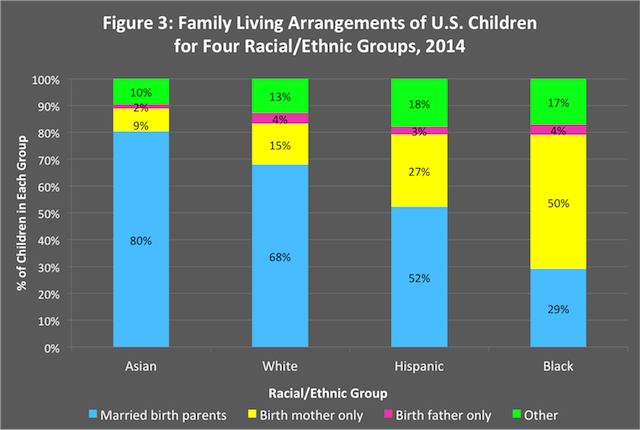
Eight in ten Asian-American kids live with married birth parents, compared with about seven in ten European-American kids, five in ten Hispanic-American kids, and only about three in ten African-American kids. Half of black children live with their mothers only, compared to three in ten Hispanic children, less than two in ten white children and less than one in ten Asian children.

Naturally, children who have two parents to look after them do better, because one parent alone cannot work and do household chores and monitor the children as easily as two parents can. The decision about whether to have sex before marriage is entirely under the control of the grown-ups. It cannot be blamed on racism, poverty and other non-moral pre-occupations of the secular left. Marriage is a moral issue, and Asian-Americans do the moral thing, and marry before they have children.

Asian household wealth set to surpass whites

2. Asian Americans save more of what they earn

This article from CNN Money explains:

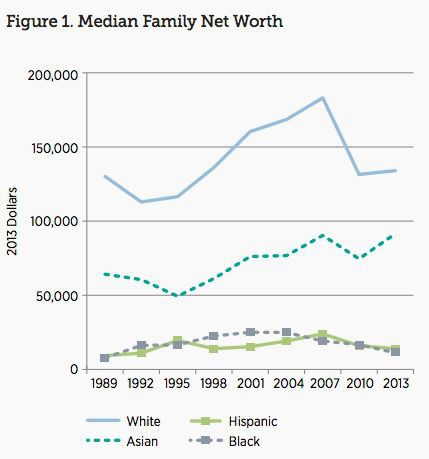
Asians have had higher median incomes than their white counterparts, according to a new study by the Federal Reserve Bank of St. Louis. The typical Asian family has brought home more money for most of the past two decades.

[…][Asians] will surpass whites in net worth in the next decade or two, Fed researchers said.

[…]In 1989, the median Asian family had about half the net worth of its white peer. By 2013, they had more than two-thirds.

The gap between whites and blacks and Hispanics, meanwhile, remained little changed over that time period.

Asians have similar financial habits to whites, in terms of investing and borrowing. Both groups are more likely than blacks and Hispanics to invest in stocks and privately-owned businesses and to have more liquid assets, which serves as a buffer against financial shocks. And, on average, the former have about half as much debt as the later.

As a result, Asians and whites have more financial stability than blacks and Hispanics, which also allows the former to build more wealth.

Everyone has to earn and save money, but in some cultures, it becomes normal to not save part of what you earn. That needs to stop. But it has nothing to do with discrimination due to skin color. In Asian culture, there is no glorification of consumer spending on sparkles, bling and other ostentatious wealth. Asians don’t want to appear to be wealthy, they want to actually be wealthy – by saving money.

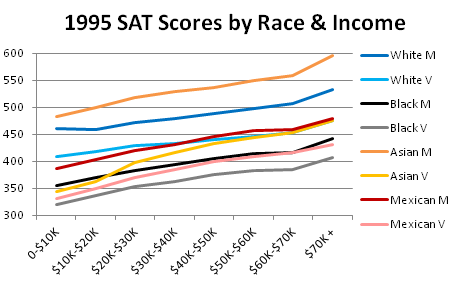
Composite SAT scores by race and income levels
Composite SAT scores by race and income levels: Asians outperform at every income level

3. Asian Americans monitor their children’s educational progress

This article from Investors Business Daily explains how Asian parents don’t just make demands on their kids to learn, they actively monitor their progress and talk to their kids’ teachers:

Asian-American parents tend to oversee their children’s homework, hold them accountable for grades and demand hard work as the ticket to a better life. And it pays off: Their children are soaring academically.

[…]As a group, Americans need to take a page from the Asian parents’ playbook. American teens rank a dismal 28th in math and science knowledge, compared with teens in other countries, even poor countries.

Singapore, Hong Kong, South Korea, Japan and Taiwan are at the top. We’ve slumped. For the first time in 25 years, U.S. scores on the main test for elementary and middle school education (NAEP) fell. And SAT scores for college-bound students dropped significantly.

[…]Many [Asian students]from poor or immigrant families, but they outscore all other students by large margins on both tests, and their lead keeps widening.

In New York City, where Asian-Americans make up 13% of overall students, they win more than 50% of the coveted places each year at the city’s eight selective public high schools, such as Bronx Science and Stuyvesant.

What’s at work here? It’s not a difference in IQ. It’s parenting. That’s confirmed by sociologists from City University of New York and the University of Michigan. Their study showed that parental oversight enabled Asian-American students to far outperform the others.

No wonder many successful charter schools require parents to sign a contract that they will supervise their children’s homework and inculcate a work ethic.

You can see an updated image with the latest scores here.

It’s not enough to just outsource the education of your children to a bunch of non-STEM education-degree-holding teachers. Teachers can be good, and some work very hard. But the Democrat teacher unions prevent the firing of teachers who underperform. This is especially true in non-right-to-work states (Democrat states). So, you cannot depend on teachers to educate your children, and Asian parents don’t. That’s why their kids learn. Performance of children in school is not affected by discrimination against skin color, it’s affected by the level of involvement of parents.

Conclusion

We have learned that the success of Asian-Americans in America is all earned. And this proves that there is no such thing as “racism” that holds back non-whites. If blacks and Hispanics imitated the behaviors of Asians (not whites, but Asians), then they would achieve just as well as Asians do. It’s not a race problem, it’s a behavior problem. It’s not a “racism” problem, it’s a behavior problem. It’s an us problem, it’s not a them problem.