Tag Archives: Police

Ohio Issue 2: Should voters vote yes or vote no on Ohio State Issue 2?

In the 2010 mid-term elections, Republican John Kasich won the governorship and promised to balance the state’s budget by reining in the state’s spending on salaries and benefits for public sector union employees. To accomplish this, the Ohio legislature pass Senate Bill 5. However, an effort is on the ballot to repeal the law, and Ohio voters will get a chance to keep or scrap the law on Tuesday, November 8th, 2011.

Here’s what Ohio’s Issue 2 is all about:

Issue 2 makes some very fair and common sense requests of our government employees to give local communities the flexibility they need to get taxes and spending under control, while providing the essential services that we rely on.

  • It allows an employee’s job performance to be considered when determining compensation, rather than just awarding automatic pay increases based only on an employee’s length of service.
  • It asks that government employees pay at least 15 percent of the cost of their health insurance premium.  That’s less than half of what private sector workers are currently paying.
  • It requires that government health care benefits apply equally to all government employees, whether they work in management or non-management positions.  No special favors.
  • It asks our government employees to pay their own share of a generous pension contribution, rather than forcing taxpayers to pay both the employee and employer shares.
  • It keeps union bosses from protecting bad teachers and stops the outdated practice of laying off good teachers first just because they haven’t served long enough.
  • Finally, it preserves collective bargaining for government employees, but it also returns some basic control of our schools and services to the taxpayers who fund them, not the union bosses who thrive on their mismanagement.

Even under the reforms of State Issue 2, Ohio’s government employees will still receive better pay, better health care and better retirement benefits, on average, than the vast majority of Ohioans who work in the private sector.

There are a number of myths going around about Issue 2, and it’s important to set the record straight, so I’ll do that below.
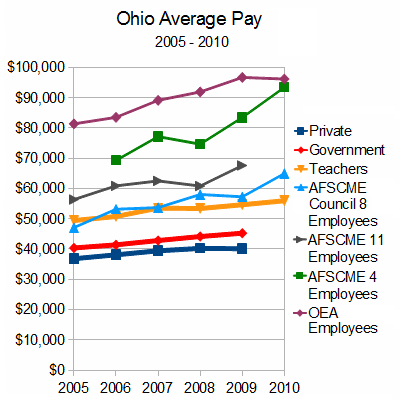
Ohio Average Pay: Public vs. Private
Ohio Average Pay: Public Unions vs. Private

Myths and truths about Ohio State Issue 2

Here’s a common myth:

State Issue 2 would “cut salaries and benefits.”

The truth:

Issue 2 would not cut salaries or benefits for any government employee. Employees would simply be asked to pay a modest share of their benefits, just like employees in the private sector do. For health care coverage, they would pay at least 15% of their overall plan. (Many local government employees currently pay less than 9% of their health care premium, while the average private sector worker pays upwards of 30%.) In addition, employees would be required to pay their personal share of a retirement plan (only 10%), rather than asking taxpayers to pay that share. That’s not too much to ask at a time when many private sector workers get no retirement benefit at all. Finally, Issue 2 requires that benefits apply equally to all public employees, so no one gets special treatment.

And another common myth:

State Issue 2 will eliminate government employee pensions.

The truth:

Government employees will still get a very generous pension benefit – an annual payment that averages their three highest annual salaries. That’s a pretty nice deal, when many private sector workers get no retirement benefit at all. State Issue 2 only ends a practice where some government union contracts require taxpayers to pick up the tab for BOTH the employer AND employee shares of a required pension contribution. In this economy, it’s simply not right to ask struggling taxpayers to foot the bill so government employees can get a free retirement. Issue 2 simply says government employees should pay their required share (10 percent) and taxpayers will contribute the employer share (14 percent).

Another myth:

State Issue 2 will cut teacher salaries.

The truth:

That’s one of the scare tactics government unions are using to turn people against these reforms. Nothing in Issue 2 determines salary levels. It only ends the practice of handing out automatic pay raises, or “step” increases, and longevity pay – or bonuses just for holding the job for a certain period of time. Issue 2 also asks that performance be added as a factor in teacher compensation, a goal President Barack Obama set out in his national education policy in 2009.

And another myth:

State Issue 2 will cost jobs

The truth:

Just the opposite is true. Ohio’s state and local tax burden ranks among the top third in the nation. As a result, companies large and small have left our state in pursuit of better tax incentives elsewhere, taking hundreds of thousands of jobs with them. If Ohio hopes to compete for new job growth, we have to make our state a more affordable place to live, work and do business. That starts with getting the cost of government under control so we can direct more of our limited resources into economic development, community revitalization and better schools.

More myths are corrected on this page.

Newspaper endorsements

So far, Issue 2 has been endorsed by several Ohio newspapers, including the biggest ones.

The Cleveland Plain Dealer:

The fiscal picture of local governments and school districts, especially, will improve as they are able to right-size their work forces and their expenditures on services. That will happen over time, not overnight, as new contracts are established.

Repeal SB 5, though, and it’s going to be awfully hard for local governments to manage their payrolls without resorting to larger-scale layoffs than would otherwise be necessary. And local governments will continue to be hamstrung by anti-merit seniority rules that lead to worker complacency and protect dead weight and time-servers.

Voting YES on Issue 2 will prevent layoffs by keeping public sector wages and benefits in line with what the private sector can afford to pay.

The Columbus Dispatch:

Despite the insistence of opponents, the effort to reform Ohio’s out-of-balance collective-bargaining law is not an expression of disrespect for or dissatisfaction with Ohio teachers, police officers, firefighters and other government employees. It is a much-needed attempt to restore control over public spending to the public officials elected to exercise that control.

It does not assert that public employees are worth less than the compensation they’re receiving, only that the compensation has grown faster than the public’s ability to pay for it.

[…]With more ability to control the escalation of salary and benefit costs, governments won’t be forced as often to impose layoffs, and might be able to afford to keep even more police and firefighters on the streets.

Again, no one is saying that public sector workers don’t matter – the question is whether we can afford to give them better wages and benefits than the private sector workers who are their customers and their employers. Public sector workers work for the public, and the public can only afford to pay so much.

Conclusion

Government employees are paid 43% more than private sector employees, in salary and benefits:

I think that people who care about the long-term prosperity of Ohio should vote “YES” on Issue 2 to make public and private salaries and benefits MORE EQUAL. Ohio is facing enormous economic pressure from the global recession, and everyone has to make sacrifices. Now is not the time for public sector workers to insist on higher wages and benefits, especially when the private sector workers who pay their salaries don’t make as much money, nor do they get the pensions, nor do they get the better job security. Ohio voters can certainly go back and renegotiate union salaries and benefits when Ohio is out of the recession.

Click here to learn more about Ohio Issue 2.

Crime rates in Chicago and DC drop after gun control laws are struck down

From Fox News – what happens to crime rates when gun control laws are repealed? (H/T Reason To Stand)

Excerpt:

Murder and violent crime rates were supposed to soar after the Supreme Court struck down gun control laws in Chicago and Washington, D.C.

Politicians predicted disaster. “More handguns in the District of Columbia will only lead to more handgun violence,” Washington’s Mayor Adrian Fenty warned the day the court made its decision.

Chicago’s Mayor Daley predicted that we would “go back to the Old West, you have a gun and I have a gun and we’ll settle it in the streets…”

The New York Times even editorialized this month about the Supreme Court’s “unwise” decision that there is a right for people “to keep guns in the home.”

But Armageddon never happened. Newly released data for Chicago shows that, as in Washington, murder and gun crime rates didn’t rise after the bans were eliminated — they plummeted. They have fallen much more than the national crime rate.

Not surprisingly, the national media have been completely silent about this news.

One can only imagine the coverage if crime rates had risen. In the first six months of this year, there were 14% fewer murders in Chicago compared to the first six months of last year – back when owning handguns was illegal. It was the largest drop in Chicago’s murder rate since the handgun ban went into effect in 1982.

Meanwhile, the other four most populous cities saw a total drop at the same time of only 6 percent.

Similarly, in the year after the 2008 “Heller” decision, the murder rate fell two-and-a-half times faster in Washington than in the rest of the country.

It also fell more than three as fast as in other cities that are close to Washington’s size. And murders in Washington have continued to fall.

If you compare the first six months of this year to the first six months of 2008, the same time immediately preceding the Supreme Court’s late June “Heller” decision, murders have now fallen by thirty-four percent.

Gun crimes also fell more than non-gun crimes.

Robberies with guns fell by 25%, while robberies without guns have fallen by eight percent. Assaults with guns fell by 37%, while assaults without guns fell by 12%.

Just as with right-to-carry laws, when law-abiding citizens have guns some criminals stop carrying theirs.

Read the whole thing, there are more lovely facts in there. If you ever need to debate this, I recommend buying these academic studies published by the University of Chicago Press and by Harvard University Press. The former shows how crime rates dropped in the USA when Americans rescinded gun control laws, and the latter shows how crime rates rose in the UK when the British strengthened their gun control laws. Sometimes is good to have the data handy.

Let’s learn about the issue from the news

ABC News explains in this short 6-minute clip:

And here is a longer 44-minute show from Fox Business: (featuring a debate between economist John Lott and the Brady Campaign spokesman)

There are other debates in the show as well.

Now watch a 3-on-3 debate on gun control

This debate is in 13 parts, featuring the two of the best proponents of legal firearm ownership – John Lott and Gary Kleck. The real sparks fly during the Q&A, so don’t miss that. (If you can’t watch the debate, then you can read this post and this post instead).

Here’s part 1, which contains the introduction.

Here are the remaining speeches:

This is everything you need to know about whether legal ownership of firearms reduce crime.

UK police force man not to display Bible DVDs in his cafe

From UK Daily Mail. (H/T Adina via Mary)

Excerpt:

The Salt and Light cafe in Blackpool has for years repeatedly played the entire 26-hour-long Watchword Bible, a 15-DVD set produced in America in which a narrator reads the whole of the New Testament, on a small flatscreen TV on the back wall.

The sound is turned down but the words flash on to the screen against a series of images.

[…]Mr Murray said the two uniformed officers from Lancashire Constabulary arrived at lunchtime on Monday, the cafe’s busiest time of day. WPC June Dorrian, the community beat manager, told him there had been a complaint and he was breaching the Public Order Act 1986.

Mr Murray said: ‘I told them that all that appeared on the screen were the words of the New Testament. There is no sound, just the words on the screen and simple images in the background of sheep grazing or candles burning. I thought there might be some mix-up but they said they were here to explain the law to me and how I had broken it.

‘I said, “Are you really telling me that I am facing arrest for playing the Bible?” and the WPC fixed me with a stare and said, “If you broadcast material that causes offence under the Public Order Act then we will have to take matters further. You cannot break the law.” ’

Mr Murray, who worked in a homeless shelter for five years before taking over the cafe three months ago, said he realised the only way to appease the police was to pull the plug on the Bible.

‘I was worried about being handcuffed and led out of the shop in front of my customers. It wouldn’t have looked good so I thought it was better to comply. It felt like a betrayal. They left the shop and told me they would continue to monitor if we were displaying inflammatory material. At no stage had they spoken to me like I was a law-abiding citizen trying to earn a living. I felt like a criminal.’

[…]Lancashire Police said they had received a complaint on Saturday afternoon from a female customer who was ‘deeply offended’ by the words she had seen on the screen.

A spokesman said they were ‘duty bound’ to respond to the complaint and had concluded the cafe could be in breach of Section 29E of the Public Order Act, which warns that people who play images or sounds that stir up hatred against homosexuals could be guilty of an offence.

However, it also says criticism of sexual conduct ‘shall not be taken of itself to be threatening or intended to stir up hatred’.

I think that if I went in to most Christian churches today and asked them whether Christianity was more about telling people the truth or about making people feel good, that they would think it was the latter.In fact, I can believe that the woman who complained was probably a straight Christians who had simply reinterpreted Christianity to mean “the voice of God speaking in my head” or “my emotions and intuitions”. I have seen many Christian women deny offensive Bible verses, deny Hell, and deny other passages, and yet still claim to be Christians. We aren’t doing a good enough job of separating out the moral claims of the Bible and setting them against our emotions, intuitions and feelings. And I think the reason why this happens is because the church presents the Bible in a feminized way – Christianity as personal preference, Christianity as life enhancement. Instead of presenting the words of the Bible, and then the evidence from outside the Bible. E.g. – the words against same-sex marriage, then the evidence against same-sex marriage. The words against abortion, then the evidence against abortion. The words for capital punishment and then the evidence for capital punishment.

How about showing this instead:

Or this?

Those should be real winners in the UK, because the bad guys are both British.

Sometimes, I think that Christians have their heads so stuck in Christian culture that they are unaware of how to present Christianity to non-Christians. Throwing Bible verses in someone’s face is not the right way to go. Instead of showing Bible verses, the cafe owner should switch to showing debates about God’s existence, the resurrection, the reliability of the Bible, abortion, and same-sex marriage. That would be more practical, and would be less inflammatory that Romans 1, since it concentrates on claims of fact and evidence.