Tag Archives: Pastor

Are young people really leaving Christianity?

J Warner Wallace of Please Convince Me summarizes the research by citing a number of sources.

Here’s one:

Soul Searching: The Religious and Spiritual Lives of American Teenagers
Christian Smith and Melinda Lundquist Denton, Oxford University Press, 2005
Book Findings: The majority of teenagers are incredibly inarticulate about their faith, religious beliefs and practices, and its place in their lives. The de facto dominant religion among contemporary U.S. teenagers is what they call ‘Moralistic Therapeutic Deism’: A God exists who created and orders the world and watches over human life on earth; God wants people to be good, nice, and fair to each other, as taught in the Bible and by most world religions; the central goal of life is to be happy and to feel good about oneself; God does not need to be particularly involved in one’s life except when God is needed to resolve a problem; and good people go to heaven when they die.

And another:

Southern Baptist Convention Data
Pinkney, T.C., Remarks to the Southern Baptist Convention Executive Committee, Nashville, Tennessee (2001)
Study Findings: Data from the Southern Baptist Convention indicates that they are currently losing 70-88% of their youth after their freshman year in college. 70% of teenagers involved in church youth groups stop attending church within two years of their high school graduation.

And another:

Soul Searching: The Religious and Spiritual Lives of American Teenagers
Christian Smith and Melinda Lundquist Denton, Oxford University Press (2005)
Book Findings: Students leave faith behind primarily because of intellectual doubt and skepticism (page 89). “Why did they fall away from the faith in which they were raised?” This was an open-ended question there were no multiple-choice answers. 32% said they left faith behind because of intellectual skepticism or doubt. (“It didn’t make any sense anymore.” “Some stuff is too far-fetched for me to believe.” “I think scientifically and there is no real proof.” “Too many questions that can’t be answered.”)

And one more:

Lost in Transition: The Dark Side of Emerging Adulthood
Christian Smith with Kari Christoffersen, Hilary Davidson and Patricia Snell Herzog
Oxford University Press (2011)
Book Findings: Young adults are unable to think coherently about moral beliefs and problems. Young adults have an excessive focus on consumption and materialism as the good life. The prevalent lifestyle of young adults includes routine intoxication and drug usage. The sexual encounters of young adults are not practiced in an environment of physical, mental, or emotional health. Young adults appear to have an inability to care about, invest in, and hope for the larger world through civic and political participation.

He concludes:

There you have it; a short summary of some of the research being done on the exodus of young people from the Church and some of the reasons they give for their departure. Can a case be made that young Christians are leaving the Church in record numbers? Yes. Can a case be made that many of these young people are leaving because the culture around them has impacted them deeply and caused them to question the truth claims of Christianity? Yes, again.

He finishes the post with a cliff-hanger ending, in which he promises to give us a plan for dealing with this problem. Stay tuned!
Coalition of African American Pastors launches national pro-marriage campaign

Here’s some good news from CNS News.

Excerpt:

The Coalition of African American Pastors (CAAP) announced at the National Press Club on Tuesday that  the grassroots group – comprised of the more than 3,000 members – is a launching a national campaign to support marriage between one man and one woman and to oppose the Obama administration’s efforts to advance same-sex marriage.

“The time has come for a broad-based assault against the power that be that wants to change our culture to one of men marrying men and women marrying women,” CAAP President William Owens said at the press conference, held to announce the Marriage Mandate campaign, which includes a petition seeking 100,000 signatures pledging support for traditional marriage.

“Mr. President, I’m not going to stand with you, and there are thousands of others across this country that are not going to stand with you with this foolishness,” Owens said.

In a press release announcing the campaign, Owens encouraged black pastors and the black community to “withdraw their support for [Obama].”

“Today we will be launching a nationwide campaign rallying black pastors and African Americans to voice their opposition to the president’s position on same-sex marriage, and withdraw their support from him,” said Owens, who told reporters he voted for Obama in the 2008 presidential election.

“We will see that the black community is informed that the president is taking them for granted while pandering to the gay community,” Owens said.

Bishop Janice Hollis, presiding Prelate of the Covenant of International Fellowship of Churches, called Obama’s support of gay marriage a “travesty” and said it reflects the “disorder in the highest office in the land.”

Owens said CAAP sent a letter to Obama and Attorney General Eric Holder in May asking for a meeting to discuss the gay marriage issue.

“We wrote the president and Mr. Holder May the second, requesting an audience with him to discuss this very issue,” Owens said. “He has not given us the courtesy of any reply.

“The Coalition of African American Pastors (CAAP) consists of 3,742 African American pastors, and he has totally ignored us,” Owens said.

He said Obama is ignoring the black community “because he feels that he has us in his pocket.”

“Well, we are not in his pocket,” Owens said.

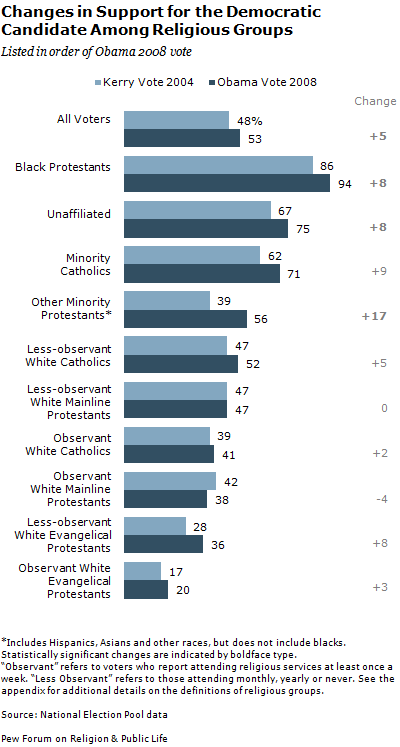
In the 2008 election, black Protestants voted overwhelmingly for the pro-abortion and pro-gay-marriage Obama. (He had a radical pro-abortion record and had come out for gay marriage earlier, so this was all known then).

Which religions supported Obama most in 2008?

So 94% of African-American Christians voted for an abortion and gay marriage radical. NINETY-FOUR PERCENT.

I actually believed, based on this voting data, that American black Protestant churches were officially pro-abortion and pro-gay-marriage. I just considered them to be apostate denominations the same way that denominations like the Episcopal Church and the Presbyterian Church United States of America are apostate. (Note: this does not apply to non-American black churches, which are conservative).

These voting numbers confirm my experiences. For example, I remember one African American woman at work who was interested in me who could not understand why I would not join her in working on The United Way workplace partnership initiative. I took her aside in the hallway and told her that the United Way supported abortion and opposed the Boy Scouts, and she was like “So what?“. She attended church weekly and she supported Barack Obama. So I just figured based on these voting numbers and my personal experiences that most African-American churches were pro-abortion, pro-gay-marriage, pro-socialism, etc.

This action by the 3,742 black African-American pastors shocks me as much as if those gay bishops in the Episcopal church had suddenly came out in favor of defending traditional marriage. Maybe these 3,742 pastors will be able to begin to educate their flocks about what the Bible actually says on these issues so that these voting numbers change. I did know about the good African-American pastors like Harry Jackson and Ken Hutcherson who are pro-life and pro-marriage, but I just thought that there were only a handful of faithful black pastors. I guess I was wrong, at least on the marriage issue, and that’s a good thing. Color me surprised.

Who is responsible for building up the faith of children? Parents or pastors?

This article is from Probe Ministries. (H/T The Poached Egg)

Excerpt:

In 2010, we commissioned a survey to help us examine the causes and potential opportunities to change the marked shift in the thinking of young adults over the last decade. We surveyed over 800 born again, young adults across America to get an understanding for what they thought about spiritual and cultural issues and how they felt about their beliefs and actions. One area of questioning was, “When you think about how you developed the religious beliefs you hold today, who do you feel had the greatest influence on you? Did your beliefs come from your family, your friends, your church, your independent studies, your college professors, or others?”

The answers we received to this question were not shocking but still sobering. Over sixty-five percent of the respondents reported that the source that had the greatest influence on their religious beliefs was a family member, with the vast majority of those saying it was parents or grandparents. Over twenty percent of the respondents pointed to another influential individual such as a pastor, youth leader, or college professor. Only about eleven percent stated that something less personal such as a youth group or the Bible was the greatest influencer of their religious beliefs.

As Christian Smith noted, “What the best empirical evidence shows . . . is that . . . when it comes to religion, parents are in fact hugelyimportant.”{5}In fact, “religious commitments, practices, and investments made during childhood and the teenage years, by parents and others in families and religious communities, matter – they make a difference.”{6}

Of those who stated that a family member was the primary influence, over seven out of ten stated it was their mother or grandmother while less than three out of ten said it was their father or grandfather. So clearly amongst born again young adults, the female side of the family has a greater influence in passing down religious beliefs than do the males. One can postulate that this may be due to a combination of greater spiritual involvement on the female side of the family and a higher level of communication with their children. However, the rate of fatherly influence almost doubles for young adults with a biblical worldview compared to those without such a worldview. So it appears that fathers who hold a biblical worldview are much more likely to be involved in establishing the spiritual beliefs of their children.

Less than one out of ten of the respondents listed a pastor as the primary source of influence, and only three percent listed a youth group. These church-related functions may have an important role in helping to shape our religious beliefs, but our survey shows that it is at best a secondary role for the vast majority of people. We are mistaken if we are relying on the church to pass on the right type of beliefs to our children. Parents, what you communicate through your lives is picked up by your children. What are you communicating to them concerning religious beliefs?

I have been working through a Bible study with a regular WK-reader (Tracy) and we are going through Deuteronomy right now. Today (Thursday) I read Deuteronomy 6-8. And here are a couple of verses that I think you should see related to this topic.

Deuteronomy 6:4-9:

Hear, O Israel: The Lord our God, the Lord is one.

Love the Lord your God with all your heart and with all your soul and with all your strength.

These commandments that I give you today are to be on your hearts.

Impress them on your children. Talk about them when you sit at home and when you walk along the road, when you lie down and when you get up.

Tie them as symbols on your hands and bind them on your foreheads.

Write them on the doorframes of your houses and on your gates.

It’s our responsibility to teach our children, and if you don’t have children, then you just pick someone else who is willing to listen to you. We must all make an effort.