Tag Archives: Part-Time

Companies announce layoffs in the wake of Obama’s re-election

The Washington Times links to this article by Freedom Works.

Excerpt:

 With 20 or so new or higher taxes set to be implemented, ranging from a $123 billion surtax on investment income, through the $20 billion medical device tax, all the way down to the $600 million executive compensation limit, Obamacare will be a nearly unbearable tax burden on the economy.

Who will pay?  The middle-class workforce, of course.

So with another four years for President Obama to look forward to, and the obvious inevitability of Obamacare that this entails, let’s examine the very real jobs that will be lost, and the very real lives that will be affected.

Here are some of the companies impacted by Obamacare:

Welch Allyn

Welch Allyn, a company that manufactures medical diagnostic equipment in central New York, announced in September that they would be laying off 275 employees, or roughly 10% of their workforce over the next three years.  One of the major reasons discussed for the layoffs was a proactive response to the Medical Device Tax mandated by the new healthcare law.

Dana Holding Corp.

As recently as a week ago, a global auto parts manufacturing company in Ohio known as Dana Holding Corp., warned their employees of potential layoffs, citing “$24 million over the next six years in additional U.S. health care expenses”.  After laying off several white collar staffers, company insiders have hinted at more to come.  The company will have to cover the additional $24 million cost somehow, which will likely equate to numerous cuts in their current workforce of 25,500 worldwide.

Stryker

One of the biggest medical device manufacturers in the world, Stryker will close their facility in Orchard Park, New York, eliminating 96 jobs in December.  Worse, they plan on countering the medical device tax in Obamacare by slashing 5% of their global workforce – an estimated 1,170 positions.

Boston Scientific

In October of 2009, Boston Scientific CEO Ray Elliott, warned that proposed taxes in the health care reform bill could “lead to significant job losses” for his company.  Nearly two years later, Elliott announced that the company would be cutting anywhere between 1,200 and 1,400 jobs, while simultaneously shifting investments and workers overseas – to China.

Medtronic

In March of 2010, medical device maker Medtronic warned that Obamacare taxes could result in a reduction of precisely 1,000 jobs.  That plan became reality when the company cut 500 positions over the summer, with another 500 set for the end of 2013.

Obamacare encourages companies to limit their number of full-time employees by switching to part-time employees. Some companies are doing that to avoid having to pay Obamacare fines.

Look:

Darden Restaurants

According to the Orlando Sentinel, Darden Restaurants, a casual dining chain best known for their Red Lobster, Olive Garden and LongHorn Steakhouse restaurants, is “experimenting with limiting the hours of some of its workers to avoid health care requirements under the Affordable Care Act when they take effect in 2014”.

JANCOA Janitorial Services

The CEO of JANCOA, Mary Miller, testified to Congress that Obamacare was a “dream killer”, adding that one option she had to consider “is reducing the majority of my team members to part-time employment in order to reduce the amount that I will be penalized.”

Kroger

The American retailer in Cincinnati, Ohio recently was reported to be planning a significant slashing of their hourly workers.  Doug Ross writes:

Operative Faith (a mid-level manager with the company) reveals that Kroger will soon join the ranks of Darden Restaurants and slash the hours of its non-exempt (hourly) workers to avoid millions in Obamacare penalties.

According to the source, Obamacare could result in tens of thousands of Kroger employees being limited to working 28 hours per week.

And of course there are the layoffs by defense companies like Boeing, because of Obama’s defense cuts. The one thing that the government is actually supposed to do – that’s the thing he cuts.

The effects of Obamacare were well-known before the 2012 election took place. But the Democrat voters were just not paying attention when the voted to re-elect Obama.
How did Dutch women get to be the happiest women in the world?

Mary sends me this article from Macleans, which she found on pastor Mark Driscoll’s blog.

Excerpt:

Like many Dutch women, Marie-Louise van Haeren views herself as liberated. “Every woman in Holland can do whatever she wants with her life,” says Van Haeren, 52, who lives just outside of Rotterdam and rides her bicycle or the train to work three days a week at a police academy, where she counsels students. She has worked part-time her entire career, as have almost all of her friends—married or unmarried, kids or no kids—save one or two who logged more hours out of financial necessity. Van Haeren, who wasn’t married until last year and has no children, says she’s worked part-time “to have time to do things that matter to me, live the way I want. To stay mentally and physically healthy and happy.”

Many women in the Netherlands seem to share similar views, valuing independence over success in the workplace. In 2001, nearly 60 per cent of working Dutch women were employed part-time, compared to just 20 per cent of Canadian women. Today, the number is even higher, hovering around 75 per cent. Some, like Van Haeren, view this as progress, evidence of personal freedom and a commitment to a balanced lifestyle.

[…]…Dutch women appear deaf to the siren call of the workplace. Asked whether they’d like to increase their hours, just four per cent said yes, compared to 25 per cent of French women. And while across the Channel, British media are heralding the resurgence of feminism—last weekend, some 500 women crowded into a feminist training camp, UK Feminista, to be trained in direct action and activism—in Holland, women like Van Haeren baldly proclaim no further need for the movement. “Feminism wasn’t necessary anymore by the time I grew up,” she says. “In my eyes, it was a thing of the past.”

The relationship between personal lifestyle choices and the socio-economic standing of women has been under the microscope in Holland ever since the publication of Dutch Women Don’t Get Depressed in 2008. Ellen de Bruin, who patterned her book after Mireille Guiliano’s bestseller French Women Don’t Get Fat, began by defining the stereotypical Dutch woman: naturally beautiful with a no-fuss sense of style, she rides her bike to fetch the groceries, has ample time with her kids and husband, takes art classes in the middle of the week, and spends leisurely afternoons drinking coffee with her friends. She loves to work part-time and does not earn as much as her husband, but she’s fine with that—he takes care of the bills. The book went on to note that Dutch women rank consistently low, compared to those in other Western countries, in terms of representation in top positions in business and government—and rank consistently near the top in terms of happiness and well-being. In fact, just about everyone in Holland seems pleased with the status quo; in 2009, the Netherlands ranked highest of all OECD countries in terms of overall well-being.

Could it be that the Bible actually speaks truly about the differences between men and women? That doesn’t mean that women and men should be careless when choosing a spouse – they should choose wisely. But maybe it is better for men and women to play complementary roles. Maybe they were designed to be able to do different things, because they have different strengths?  Maybe they fit together hand in glove in marriage, canceling out the weaknesses of the other?

Canada created twice the number of jobs as the United States in January

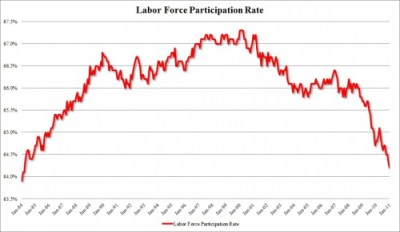
U.S. Labor Force Participation

By now, everyone has heard that Marxist Obama has failed to create jobs again, so that the underemployment rate is at 19.2%. (Underemployment is even higher than employment because it takes into account people working part-time who want to work full-time but can’t). That means that 20% of the population either cannot find work, or cannot find full-time work. The labor force participation under Obama’s socialist regime is now at a 26-year low.

Excerpt:

At 64.2%, the labor force participation rate (as a percentage of the total civilian noninstitutional population) is now at a fresh 26 year low, the lowest since March 1984, and is the only reason why the unemployment rate dropped to 9% (labor force declined from 153,690 to 153,186). Those not in the Labor Force has increased from 83.9 million to 86.2 million, or 2.2 million in one year! As for the numerator in the fraction, the number of unemployed, it has plunged from 15 million to 13.9 million in two months! The only reason for this is due to the increasing disenchantment of those who completely fall off the BLS rolls and no longer even try to look for a job. Lastly, we won’t even show what the labor force is as a percentage of total population. It is a vertical plunge.

But these kinds of failures are not unavoidable. For example, look at Canada’s latest unemployment numbers.

Excerpt:

Canada’s job creation in January was more than four times the median forecast, pushing the Canadian dollar to its strongest level since May 2008 and adding to evidence the country’s economic recovery may be accelerating.

Employment rose by 69,200 and the labor force increased by 106,400, Statistics Canada said today in Ottawa. The jobless rate rose to 7.8 percent from December’s 7.6 percent, as more people sought work. Economists forecast 7.6 percent unemployment and job growth of 15,000, according to the median estimates of 25 and 26 economists surveyed by Bloomberg News.

“This adds confidence to the notion we are headed for a better year for growth and growth in the job market,” said Mark Chandler, head of Canadian currency and rates strategy at Royal Bank of Canada’s RBC Capital Markets unit in Toronto. “There isn’t a lot of slack in the labor market in Canada, certainly on a relative basis to other countries.”

Canadian policy makers have been dealing with the impact of a strong currency and a slowdown in growth of household and government spending that crimped the economic recovery in the second half of last year. Bank of Canada Governor Mark Carney stopped raising interest rates after September and Finance Minister Jim Flaherty scaled back plans to exit stimulus.

“It’s one of these reports that’s strong through and through – it’s hard to find any weakness,” said David Tulk, chief Canada macro strategist at Toronto-Dominion Bank’s TD Securities unit.

“The Bank of Canada would likely just see this as a step towards a stronger recovery, but not a point where they would need to respond,” he said. He predicts a July rate increase.

[…]The report restores Canada’s status as having regained all the jobs lost in the recession, after a Jan. 28 revision based on updated census data reduced Statistics Canada’s estimate of total employment.

The Canadian dollar gained 0.4 percent to 98.75 cents per U.S. dollar at 4:30 p.m. in New York from 99.11 cents yesterday, after earlier touching 98.32 cents, the strongest level since May 2008. The benchmark 10-year Canadian government bond yield increased four basis points to 3.46 percent, the highest since May.

[…]“Too many Canadians are still looking for work, the economic recovery is fragile,” Flaherty said today in response to a question in the House of Commons. “We need to continue with our job-creating, low-tax plan.”

Prime Minister Stephen Harper has said reductions in corporate taxes are the best way to boost employment.

[…]Wal-Mart Stores Inc., the world’s largest retailer, said Jan. 26 it will open 40 “supercenters” in Canada by the end of January 2012, creating 9,200 construction and store jobs.

Basically, the Canadians listened to Obama’s speeches, and then decided to do the EXACT OPPOSITE of what he said. They are drilling for more oil, lowering corporate taxes below 20%, (ours is 36%), cutting spending and raising interest rates to encourage people to spend less and invest more, which supports job creation. This is what Hayek would recommend. In order to create jobs, you need to cut corporate taxes to provide businesses with a profit motive. And you need to make sure that there is capital to borrow for risk-taking, which happens when interest rates are higher because people save more money by giving it to banks to lend to businesses. When a business sees that it can keep profits that it makes then that’s what they’ll do. That’s when they start expanding their businesses and taking risks – when there is money to be made. If you keep banning drilling, imposing health care costs and demonizing businesses in speeches, like Obama does, then they WON’T hire anyone.

I hope that all the young people who voted for the first MTV President are happy with their 18% youth unemployment rate. Ideas have consequences.

But the differences between Canada are even more pronounced. Recall that Canada is ONE TENTH the size of the United States, with one-tenth the population, one-tenth the GDP, and one-twentieth the national debt. A 700,000 increase in the number of jobs is really like a 700,000 increase when projected proportionally to the United States. Canada didn’t spend massive amounts of money on “stimulus” spending, because the prime minister is NOT a Keynesian. He’s a Hayekian, like me. He’s not following the socialist, academic playbook – he’s following the capitalist, real-world playbook. He doesn’t believe that lowering interest rates and wasting money of government public works projects is a way out of a recession. And he’s right.