Tag Archives: Parenting

Ryan T. Anderson lectures on marriage and why it matters

Here’s the lecture:

About the speaker:

Ryan T. Anderson researches and writes about marriage and religious liberty as the William E. Simon Fellow at The Heritage Foundation. He also focuses on justice and moral principles in economic thought, health care and education, and has expertise in bioethics and natural law theory.

Anderson, who joined the leading Washington think tank’s DeVos Center for Religion and Civil Society in 2012, also is the editor of Public Discourse, the online journal of the Witherspoon Institute of Princeton, N.J.

Anderson’s recent work at Heritage focuses on the constitutional questions surrounding same-sex “marriage.” He is the co-author with Princeton’s Robert P. George and Sherif Girgis of the acclaimed book “What Is Marriage? Man and Woman: A Defense” (Encounter Books, December 2012).

The lecture starts at 7:20 in. The lecture ends at 49:35. There are 32 minutes of Q&A.

Introduction:

  • When talking about marriage in public, we should talk about philosophy, sociology and public policy
  • Gay marriage proponents need to be pressed to define what marriage is, on their view
  • Every definition of marriage is going to include some relationships, and exclude others
  • It’s meaningless to portray one side as nice and the other mean
  • Typically, marriage redefiners view marriage as a more intense emotional relationship
  • Marriage redefiners should be challenged in three ways:
  • 1) Does the redefined version of marriage have a public policy reason to prefer only two people?
  • 2) Does the redefined version of marriage have a reason to prefer permanence?
  • 3) Does the redefined version of marriage have a reason to prefer sexual exclusivity?
  • Also, if marriage is just about romance, then why is the state getting involved in recognizing it?
  • The talk: 1) What marriage is, 2) Why marriage matters, 3) What are the consequences of redefining marriage?

What marriage is:

  • Marriage unites spouses – hearts, minds and bodies
  • Marriage unites spouses to perform a good: creating a human being and raising that human being
  • Marriage is a commitment: permanent and exclusive
  • Male and female natures are distinct and complementary

The public purpose of marriage:

  • to attach men and women to each other
  • to attach mothers and fathers to their children
  • there is no such thing as parenting, there is only mothering and fathering
  • the evidence shows that children benefit from mothering and fathering
  • boys who grow up without fathers are more likely to commit crimes
  • girls who grow up without fathers are more likely to have sex earlier
  • Children benefit from having a mother and a father
  • can’t say that fathers are essential for children if we support gay marriage, which makes fathers optional
  • without marriage: child poverty increases, crime increases, social mobility decreases, welfare spending increases
  • when government encourages marriage, then government has less do to – stays smaller, spends less
  • if we promote marriage as an idea, we are not excluding gay relationships or even partner benefits
  • finally, gay marriage has shown itself to be hostile to religious liberty

Consequences redefining marriage:

  • it undermines the norm in public like that kids deserve a mom and a dad – moms and dads are interchangeable
  • it changes the institution of marriage away from the needs of children, and towards the needs of adults
  • it undermines the norm of permanence
  • we learned what happens when marriage is redefined before: with no-fault divorce
  • no-fault divorce: after this became law, divorce rates doubled – the law changed society
  • gay marriage would teach society that mothers and fathers are optional when raising children
  • if marriage is what people with intense feelings do, then how can you rationally limit marriage to only two people?
  • if marriage is what people with intense feelings do, then if other people cause intense feelings, there’s no fidelity
  • if marriage is what people with intense feelings do, then if the feelings go away, there is no permanence
  • the public policy consequences to undermining the norms of exclusivity and permanence = fatherless children and fragmented families
  • a final consequences is the decline and elimination of religious liberty – e.g. – adoption agencies closing, businesses being sued

We’re doing very well on abortion, but we need to get better at knowing how to discuss marriage. If you’re looking for something short to read, click here. If you want to read a long paper that his book is based on.

Poll: few Millennials describe belief in God as “very important”

Beliefs of millennials and boomers

I saw a very interesting article that compared the attitudes of young people about things like patriotism, religion, freedom, etc. The numbers are very discouraging.

So, here’s the article from the Washington Examiner:

The importance of patriotism, faith in God, and having children is significantly lower among millennials and Generation Z, compared to previous generations.

In a new poll conducted by the Wall Street Journal and NBC News, nearly 80% of people aged 55-91 said being patriotic is important to them, while only 42% of millennials and Generation Z, or those aged 18-38, said the same. Thirty percent of millennials and Generation Z said religion was important, compared to the over 75% of baby boomers, with just over 30% of millennials and Generation Z saying it was important to have children.

Areas where the younger generations had placed higher importance compared to boomers were tolerance for others and self-fulfillment, with financial security being almost tied between the two age groups.

I’m sure that everyone has seen other polls showing the decline of Christianity, especially in mainline and Catholic churches. Evangelicals are declining less, but they are still declining.

The reason I linked to this post is because I’ve noticed that some Christians don’t really think that there is anything to be concerned about. Everything is working fine, they say. Whatever we’re doing right now must be working, because there is no decline. We’re winning, and if you think otherwise, then you’re just complaining.

Well, I don’t really know why there is this decline, all I can do is speak from my experiences. I’ve met people through my blog who did lose their faith in college, and I’ve met ex-Christians in my office, too. I asked them what the problem was, and it seems to be that when they were growing up, they often bullied into behaving like a Christian without being able to ask any questions about whether it was true. And then as soon as they got to college away from their parents and pastors, they just dumped the whole thing.

I remember listening to an amazing lecture a while back by Dr. Scott Waller. I think it was a lecture he gave for the Stand to Reason “Masters Series in Christian Thought” in 2003. The lecture was about Postmodernism in the University. Postmodernism is the view that there are no true or false views, especially with “soft” issues like religion and morality. In the lecture, he talked about how a father had sent his devout Christian son to university, and the son had returned an atheist after one semester. I remember Dr. Waller quoting the son telling his parents “I have come to think of my time growing up in this house as the dark period of my life”. The father was very upset. So Dr. Waller told him what to do. He said, you’re going to need to read a few books on the most common questions that your son has, and then work through the answers with him. And he made a little pile of books about common questions that college students ask, and pushed the pile across the table to the father. And the father pushed the books back across the table to Dr. Waller, and said “well, I don’t have time for reading so many books… but could you just talk to him instead?”

Another thing that seems to cause a lot of young people to  leave the faith in college is sex. Now if I were trying to convince someone to be responsible about sex, I’d try to show them studies and statistics to explain why there really are best practices to relationships and marriage. For example, I’d might show them that the number of premarital sex partners increases marital instability, or that sliding into cohabitation early tends to make marriages less stable. But this takes a bit of work, and you have to work through it with the young people. I just don’t know if parents really reason with their kids like this. But in churches, I’ve noticed that trying to make an argument using evidence isn’t very popular. To me, if I were trying to be convincing to someone about something, I would use evidence. It’s just natural to me to make a case if I’m trying to be persuasive. But making a case just hasn’t been a really big priority in the churches I’ve attended.

So, I guess if I had to give any advice to parents of children, or pastors in churches, it would be that Christianity is in decline, and we need to do more than just order people to memorize Bible verses and creeds, go to church, etc. It’s hard for me to know what’s really going on in everyone’s home, and in everyone’s church. But I don’t think that whatever we’re doing in our homes and churches is working to convince young people that belief in God is very important.

Is it easy for a woman to get pregnant after age 30?

This UK Daily Mail article is a bit old now, but I still it’s important to spread around the knowledge about when a woman’s fertility starts to decline. Somehow, in this age of feminism, there is this idea that women can put off pregnancy into their 40s. The truth is quite different. Let’s take a look at the facts from an unlikely source – the British socialist single-payer health system.

It says:

One of Britain’s top NHS fertility specialists last night issued a stark warning to women: Start trying for a baby before you’re 30 – or risk never having children.

In a strongly worded letter to Education Secretary Nicky Morgan, consultant gynaecologist Professor Geeta Nargund has also demanded that teenagers are taught about the dangers of delaying parenthood, because of the spiralling cost to the taxpayer of IVF for women in their late 30s and 40s.

Professor Nargund cites the agony of a growing number of women left childless as a key reason why fertility lessons must be included in the national curriculum. Her controversial intervention – in which she warns Britain faces a ‘fertility timebomb’ – will fuel the debate over the best time to start a family, amid the rise in women delaying motherhood to pursue careers.

[…]Arguing passionately for fertility lessons, she tells Mrs Morgan: ‘Information is power and the best way to empower people to take control of their fertility is through education.’ Prof Nargund said last night: ‘Ideally, if a woman is ready for a child, she should start trying by the time she is 30. She should consider having a child early because as a woman gets older, her fertility declines sharply.’

If a woman started trying early enough, doctors would still have time to diagnose problems and take action before it was too late, she said.

Her comments were endorsed by Professor Allan Pacey, outgoing chair of the British Fertility Society.

‘You need to be trying by 30 because if there is a problem and you need surgery, hormones or IVF, then you’ve got five years to sort it out,’ he said. ‘If a woman starts trying at 35, doctors have got to sort it out when she is already on a slippery fertility slope’.

Let’s see how accurate women’s beliefs about fertility and age are.

Consider this article from Aeon magazine.

It says:

Many studies show that women are not only woefully ignorant when it comes to fertility, conception and the efficacy of assisted reproductive technologies (ART) – but they overestimate their knowledge about the subject. For instance, a 2011 study in Fertility and Sterility surveyed 3,345 childless women in Canada between the ages of 20 and 50; despite the fact that the women initially assessed their own fertility knowledge as high, the researchers found only half of them answered six of the 16 questions correctly. 72.9 per cent of women thought that: ‘For women over 30, overall health and fitness level is a better indicator of fertility than age.’ (False.) And 90.9 per cent felt that: ‘Prior to menopause, assisted reproductive technologies (such as IVF) can help most women to have a baby using their own eggs.’ (Also false.) Many falsely believed that by not smoking and not being obese they could improve their fertility, rather than the fact that those factors simply negatively affect fertility.

[…]According to a 2011 study in Human Reproduction, which surveyed 410 undergraduate students, most overestimated a women’s chances of spontaneous pregnancy in all age groups, but particularly after receiving IVF beyond age 40. Only 11 per cent of the students knew that genetic motherhood is unlikely to be achieved from the mid-40s onward, unless using oocytes or egg cells frozen in advance. ‘This can be explained by technological “hype” and favourable media coverage of very late pregnancies,’ the authors concluded.

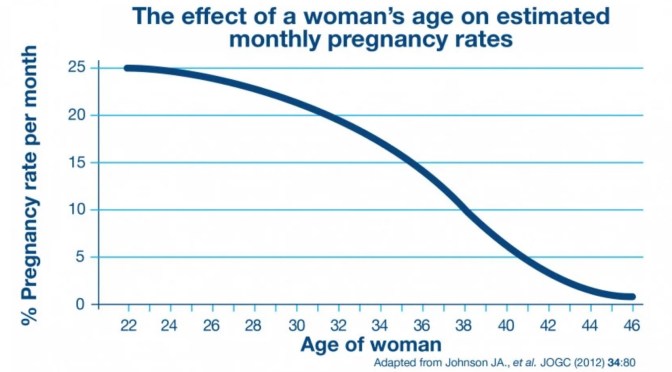
People see graphs of pregnancy chances, but they forget that the rate of miscarriage is also increasing as you age. So, even if you get pregnant, there is a higher risk of miscarriage. Not to mention ectopic pregnancies, and pregnancy complications. It’s also harder to get pregnant your first time after age 30. It’s easier to get pregnant after 30, if it’s not your first time. Also, pregnancies after 30 are much harder on a woman’s body than pregnancies in her 20s.

So, I guess now I’ll issue my advice to women in their 20s on how to avoid infertility:

If you went to college, chances are that you absorbed a lot of feminism. Feminism emphasizes being free of constraints, feeling happy, having fun, career over family, and independence from the needs of men and children. You need to renew your mind in order to undo the cultural denigration of marriage and children. Get yourself a marriage mentor, ask for book recommendations that will educate you about the challenges and rewards of marriage. A good marriage mentor will explain to you why marriage is a better plan than the feminist plan, and will emphasize self-denial, self-sacrifice, self-control and serving others. It’s only by getting specific about marriage and parenting that your heart will change to want to work on marriage rather than work on the things that the feminist culture prefers.

I guess my closing advice would be to be careful about the things you hear about marriage in the culture. It’s very tempting to just believe the words of other people, when they tell you what you want to hear. A lot of people have agendas that sound good, but ultimately, they don’t satisfy. Once your fertility is gone, it’s really gone. IVF and egg-freezing are expensive and unreliable. Again, you should look into this yourself, rather than rely on people who say whatever you want to hear so that you will like them.