
Tag Archives: Out of Wedlock

How can we win the war on poverty?

Director Blue has a very long and informative post with tons of useful graphs. (H/T ECM)

Here’s what doesn’t work:
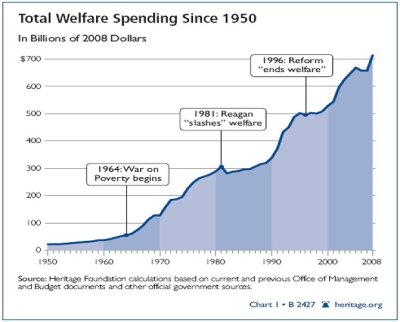
Director Blue explains:

After adjusting for inflation, America’s welfare expenditures are 1300% higher than in 1965. And the results have been absolutely catastrophic. But the documented failures haven’t stopped President Obama and the Democrats from charting a course for massive new spending programs, at a time when the country can least afford it.

What could be the problem? Well, think of welfare as a cash payment given to women who have have babies with men who they chose knowing that those men were not interested in becoming fathers or husbands. Women are having sex with men and having babies with men who have not married them and have no intention of marrying them. And the government is paying them to do this. The government is paying them to oppose chastity. The government is paying them to avoid courting. The government is paying them to avoid chivalry. The government is paying them to avoid marriage.

So what happens next?

Director Blue explains:

The out-of-wedlock birthrate is now 40 percent and the African-American out-of-wedlock birthrate is a shocking 72 percent. But when the “War on Poverty” began, the out-of-wedlock birthrate was just 7 percent.

Of 23 peer-reviewed U.S. studies since 2000, 20 found that family structure directly affects crime and/or delinquency. Research “strongly suggests both that young adults and teens raised in single-parent homes are far more likely to commit crimes, and that communities with high rates of family fragmentation (especially unwed childbearing) suffer higher crime rates as a result.”

Why are the Democrats paying people not to marry?

Director Blue has no hypothesis, but I think the answer is feminism. Feminists do not like the idea that men have a role in marriage as the provider and protector and moral/spiritual leader. The best way to knock men out of their perch as husbands and fathers is to have the state take over the man’s role in the family so that women do not need men. And this is exactly what has happened.

So it’s actually very ironic that the people who whine the most about the poor actually cause poverty. And the people who are strongest in defense of traditional morality, like chastity, chivalry, courting and marriage, are the ones who the most concerned about the poor. Marriage is good for the poor. Democrats aren’t concerned about the poor – they are concerned buying votes by redistributing wealth, so that they can stay in power and line their own pockets. They are willing to put politics – their opposition to marriage because of feminism – ahead of real people’s well-being and prosperity.

Read the whole post at Director Blue’s blog. It turns out that the Democrats want to continue subsidizing the feminist dream of destroying marriage and family with even more government spending on welfare. Eventually the money that the producers in this society for the Democrats to confiscate will run out – and where will we be then?

Jennifer Roback Morse publishes an excerpt from a new book

Dr. J the Shorter has a new technique where she weaves statistics into a story to show how bad things happen to people who don’t plan and prepare to have strong marriages. She’s got a new post up on her blog to show it off.

Excerpt:

Rather than regale the reader with statistics, let me tell the story of a hypothetical young woman named Lucy. Not all of the outcomes that happen to Lucy happen to each and every unmarried mother. Lucy’s story is a composite of the outcomes that are systematically more likely to happen to unmarried women, or to cohabiting women, than to married women. (I have omitted the hazards associated with drugs and alcohol, so as not to cloud the marriage issue.) Telling Lucy’s story illustrates what multiple partner fertility looks like in the lives of ordinary people of modest means.

Lucy has graduated from high school, has a job as a dental assistant, and lives with her boyfriend, Izzy. Lucy becomes pregnant. It isn’t entirely clear whether this is an “accidental” pregnancy. She has been on the Pill, but she missed one or two. (The failure rate for the Pill for low-income, cohabitating women younger than twenty is 48 percent.)44

Lucy is glad to be pregnant. She has always wanted to be a mother. Izzy isn’t so happy. He isn’t ready to be a father. Pregnancy was not part of the deal. He feels cheated. They quarrel frequently, and he sometimes hits her. (Domestic violence is more common in cohabiting couples than in married couples.)45

As her pregnancy proceeds, Lucy becomes less and less interested in sex, and Izzy becomes less and less interested in her. He has sex with a former girlfriend. (Cohabiting couples are more likely to have “secondary sex partners.”)46 He feels entitled, since he isn’t “getting any” from Lucy, and after all, she cheated him by becoming pregnant in the first place. They quarrel some more, and he moves out for a while. By the time baby Anna is born, Izzy has moved back in with Lucy.

Now Lucy isn’t so happy. In fact, she becomes depressed. (The presence of children increases a cohabiting woman’s probability of depression. Children do not affect a married woman’s probability of becoming depressed.)47 Izzy is caught up in the excitement for a while. But the combination of sleep deprivation, a needy infant, and a preoccupied and depressed Lucy are more than Izzy can handle. He moves out for good when Anna is six months old. (Cohabiting relationships are less stable than married relationships.)48 He never offers to contribute support to the care of Anna. (Never-married fathers are much less likely to pay child support than fathers who were once married to the child’s mother.)49 Lucy finds that she can’t handle the demands of her job and the care of her baby by herself. She goes to court to try to get Izzy to pay child support.

Then the stepfather Tom enters the picture so things get even more interesting, and it goes on like that with more bad things that happen to Lucy. I’ve never seen this story/statistics technique done before – I think it’s a really winsome way to make the point to people who are skeptical about statistics. I am so going to steal this technique when I talk about these things to young women who don’t understand what marriage is for, what a man does in a marriage, and what decisions a man makes all along his life in order to take on the man’s roles in a marriage.

If I told you what young women look for in men and what they think that men do in marriage, you would laugh your head off. Women today think that men are best if they are handsome and fun – and that’s all men are good for! No wonder the out-of-wedlock birth rate is 40% and the divorce rate is 50%! But I have confidence in Dr. J – she can fix all of these problems. She knows everything there is to know about men and marriage and children. Every time I read anything she has written about marriage, it gets me really enthusiastic about getting married.

Melanie Phillips has a radical plan to stop the breakdown of marriages

From the UK Daily Mail.

Here’s the problem:

Devastating new research by sociologist Geoff Dench shows that not only is one in four mothers single, but more than half of such mothers have never lived with a man at all and are choosing to live alone on state benefits.

[…]Back in the mists of time … relationships between men and women were based on a bargain between the sexes which, although never stated openly, everyone accepted as a given.

Women realised they needed the father of their children to stick around to help bring them up.

In turn, men committed themselves to the mothers of their children on the basis that they could trust they were indeed the father because the woman was sexually faithful.

Today, this bargain has been all but destroyed. A number of factors have conspired to make women and girls think they can go it alone without men.

The first has been that so many women work and are therefore economically independent. Next was the sexual revolution which saw women becoming as sexually free as men.

In short order, any stigma over having babies out of wedlock was abolished. Then there was the collapse of manufacturing industry, which deprived many boys of the job prospects which once made them an attractive, marriageable proposition.

Finally, the coup de grace was administered by welfare benefits to single mothers which enabled them to live without the support of their babies’ fathers.

The result of all this was that many women and girls decided they no longer needed their children’s fathers to be part of the family unit.

This has given rise to an increasing number of women-only households where fathers have been written out of the family script for three or four generations or more.

The consequences of such family disintegration – as is now indisputable – are in general catastrophic for both individuals and for society.

This problem will not be cracked, however, unless women come to believe once again that their interests lie in attracting one man to father their children and then stick with them. Which is where my proposal of a Man Benefit comes in.

Click here to find out what the “Man Benefit” is. This is a fine article, and every man and woman who wants to understand how big government government causes the destruction of the family should read it. Then forward it to all of your friends. I think that we have a problem today where we just don’t think intelligently about what it takes to have a good marriage. Does government help children to grow up in stable homes, or does government make it more likely for children to grow up in a broken home? What does the evidence say?

This column by Stephen Baskerville is a nice follow-up to Melanie’s article.