
Tag Archives: Origins

Alexander Vilenkin: “All the evidence we have says that the universe had a beginning”

I’ve decided to explain why physicists believe that there was a creation event in this post. That is to say, I’ve decided to let famous cosmologist Alexander Vilenkin do it.

From Uncommon Descent.

Excerpt:

Did the cosmos have a beginning? The Big Bang theory seems to suggest it did, but in recent decades, cosmologists have concocted elaborate theories – for example, an eternally inflating universe or a cyclic universe – which claim to avoid the need for a beginning of the cosmos. Now it appears that the universe really had a beginning after all, even if it wasn’t necessarily the Big Bang.

At a meeting of scientists – titled “State of the Universe” – convened last week at Cambridge University to honor Stephen Hawking’s 70th birthday, cosmologist Alexander Vilenkin of Tufts University in Boston presented evidence that the universe is not eternal after all, leaving scientists at a loss to explain how the cosmos got started without a supernatural creator. The meeting was reported in New Scientist magazine (Why physicists can’t avoid a creation event, 11 January 2012).

[…]In his presentation, Professor Vilenkin discussed three theories which claim to avoid the need for a beginning of the cosmos.

The three theories are chaotic inflationary model, the oscillating model and quantum gravity model. Regular readers will know that those have all been addressed in William Lane Craig’s peer-reviewed paper that evaluates alternatives to the standard Big Bang cosmology.

But let’s see what Vilenkin said.

More:

One popular theory is eternal inflation. Most readers will be familiar with the theory of inflation, which says that the universe increased in volume by a factor of at least 10^78 in its very early stages (from 10^−36 seconds after the Big Bang to sometime between 10^−33 and 10^−32 seconds), before settling into the slower rate of expansion that we see today. The theory of eternal inflation goes further, and holds that the universe is constantly giving birth to smaller “bubble” universes within an ever-expanding multiverse. Each bubble universe undergoes its own initial period of inflation. In some versions of the theory, the bubbles go both backwards and forwards in time, allowing the possibility of an infinite past. Trouble is, the value of one particular cosmic parameter rules out that possibility:

But in 2003, a team including Vilenkin and Guth considered what eternal inflation would mean for the Hubble constant, which describes mathematically the expansion of the universe. They found that the equations didn’t work (Physical Review Letters, DOI: 10.1103/physrevlett.90.151301). “You can’t construct a space-time with this property,” says Vilenkin. It turns out that the constant has a lower limit that prevents inflation in both time directions. “It can’t possibly be eternal in the past,” says Vilenkin. “There must be some kind of boundary.”

A second option explored by Vilenkin was that of a cyclic universe, where the universe goes through an infinite series of big bangs and crunches, with no specific beginning. It was even claimed that a cyclic universe could explain the low observed value of the cosmological constant. But as Vilenkin found, there’s a problem if you look at the disorder in the universe:

Disorder increases with time. So following each cycle, the universe must get more and more disordered. But if there has already been an infinite number of cycles, the universe we inhabit now should be in a state of maximum disorder. Such a universe would be uniformly lukewarm and featureless, and definitely lacking such complicated beings as stars, planets and physicists – nothing like the one we see around us.

One way around that is to propose that the universe just gets bigger with every cycle. Then the amount of disorder per volume doesn’t increase, so needn’t reach the maximum. But Vilenkin found that this scenario falls prey to the same mathematical argument as eternal inflation: if your universe keeps getting bigger, it must have started somewhere.

However, Vilenkin’s options were not exhausted yet. There was another possibility: that the universe had sprung from an eternal cosmic egg:

Vilenkin’s final strike is an attack on a third, lesser-known proposal that the cosmos existed eternally in a static state called the cosmic egg. This finally “cracked” to create the big bang, leading to the expanding universe we see today. Late last year Vilenkin and graduate student Audrey Mithani showed that the egg could not have existed forever after all, as quantum instabilities would force it to collapse after a finite amount of time (arxiv.org/abs/1110.4096). If it cracked instead, leading to the big bang, then this must have happened before it collapsed – and therefore also after a finite amount of time.

“This is also not a good candidate for a beginningless universe,” Vilenkin concludes.

So at the end of the day, what is Vilenkin’s verdict?

“All the evidence we have says that the universe had a beginning.”

This is consistent with the Borde-Guth-Vilenkin Theorem, which I blogged about before, and which William Lane Craig leveraged to his advantage in his debate with Peter Millican.

The Borde-Guth-Vilenkin (BGV) proof shows that every universe that expands must have a space-time boundary in the past. That means that no expanding universe, no matter what the model, can be eternal into the past. No one denies the expansion of space in our universe, and so we are left with a cosmic beginning. Even speculative alternative cosmologies do not escape the need for a beginning.

Conclusion

If the universe came into being out of nothing, which seems to be the case from science, then the universe has a cause. Things do not pop into being, uncaused, out of nothing. The cause of the universe must be transcendent and supernatural. It must be uncaused, because there cannot be an infinite regress of causes. It must be eternal, because it created time. It must be non-physical, because it created space. There are only two possibilities for such a cause. It could be an abstract object or an agent. Abstract objects cannot cause effects. Therefore, the cause is an agent.

Now, let’s have a discussion about this science in our churches, and see if we can’t train Christians to engage with non-Christians about the evidence so that everyone accepts what science tells us about the origin of the universe.
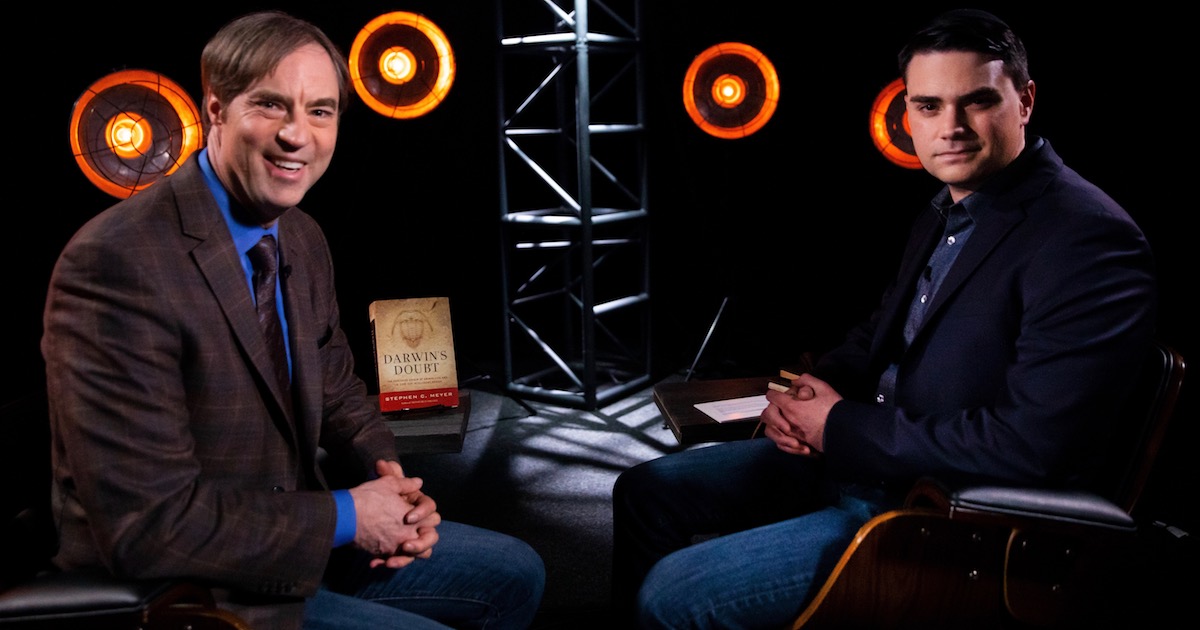
Video, audio and summary of intelligent design discussion, with Ben Shapiro and Stephen C. Meyer

Stephen C. Meyer and Ben Shapiro discuss evolution and intelligent design

This is a must-see / must-hear conversation. Famous conservative Ben Shapiro discusses evolution and intelligent design with Dr. Stephen C. Meyer, author of “Signature in the Cell” (origin of life) and “Darwin’s Doubt” (fossil record). These are the two best books on intelligent design. Their conversation covers the most important issues in the origins debate.

So to start, here’s the full video:

And here is a link to the audio. You can download the MP3 there.

Someone actually put out an outline on Youtube, with a time-based index, so I’ll just steal that as a base, and add to it:

  • 1:34 What is your scientific background? Science undergraduate degree, professional geologist, later did a PhD in philosophy of science from Cambridge University.
  • 2:39 What is the difference between intelligent design and creationism? Creationism starts from the Bible and posits a shorter history of the universe. ID starts from the data of the natural world and is neutral about the age of the Earth / universe. Meyer accepts the old-Earth.
  • 3:36 How is Intelligent Design a scientific theory? The discovery of DNA reveals that code is central to living systems. Intelligent design uses the method of “inference to the best explanation” in order to argue that the best explanation for the code is an intelligent agent.
  • 6:10 What evidence would have to arise to make Intelligent Design Falsifiable? If a naturalistic mechanism was discovered that could produce biological information using the probabilistic resources of the universe, and the time available, then intelligent design would be falsified.
  • 7:26 Is religion separate from science or intertwined within it? There are three views: science is totally separate from religion, science is in total conflict with religion, science and religion agree on some issues, e.g. – the origin of the universe and Genesis 1:1. There are areas where science and religion overlap.
  • 9:55 Why are the most prominent Darwinians also militant atheists? Evolution is a theory that tries to explain nature using naturalistic mechanisms, so it is compatible with atheism.
  • 10:45 What does the theory of evolution say? The term evolution has multiple meanings, and should be defined before discussions. It can refer to change over time. It can refer to animals changing slightly to adapt to enviromental changes. It can refer to the idea that all animals evolved from simpler life forms, and that there is a tree of life showing how different types of organisms share common ancestors. And it can refer to the idea that purely undirected processes can explain the history of life using purely materialistic forces. It’s that final view that intelligent design challenges.
  • 13:15 Where is the discontinuity in naturalistic processes in the development of life? The first discontinuity is the origin of simple life from non-living components. The second discontinuity is the sudden appearance of different body plans in a very narrow window of time in the Cambrian era.
  • 15:42 Why does information theory suggest that code requires some sort of designer? DNA is a true information-bearing system identical to the software in computers, e.g. – operating system, applications.
  • 19:45 Can information be created by random mutation, and favorable mutations preserved by natural selection? Just as in software code, instructions must be added in order to develop new functionality. Random additions of characters will almost always degrade biological function. The number of possible sequences that do nothing useful is vastly higher than the number of sequences that perform biological functions. Doug Axe did research on this at Cambridge University, and he found that the number of functional sequences of amino acids is 1 in 10 to the 77th power. Given the probabilistic resources (replicating organisms)and the time available, it is extremely unlikely to find sequences that have functional information by chance.
  • 25:05 What about Stephen Jay Gould’s model of punctuated equilibrium – doesn’t it explain the sudden jumps in information? Gould’s mechanism is accurate according to the fossil record, which shows a lot of jumps. But he did not have a naturalistic explanation for sudden jumps in biological function. Darwinian mechanisms work slowly and would (in theory) produce different body plans gradually. But this is not what the fossil record shows.
  • 27:22 What is the mechanism for injecting information in the theory of intelligent design? The information comes in from an intelligence when new major body plans appear, and minor variations within types could be explained by evolution.
  • 29:25 Does the Miller-Urey experiment provide a naturalistic explanation for the building blocks necessary for the origin of life? The MU experiment only produced a few types of amino acids, it doesn’t say anything about how to sequence the amino acids in order to form protein folds that can perform biological functions. The MU experiment also pre-supposes conditions on the early Earth (reducing gases) that do not match what was there (oxidyzing or neutral gases).
  • 32:00 Is the RNA world hypothesis is a good explanation for the origin of life? Evolution requires that replication already be in place, because evolution assumes that mutations appear during the replication. The RNA world hypothesis suggests that sequences contain information, but also catalyze origin of life chemistry. The problem with RNA world is that it starts with self-replicating systems. And those replicating systems require the scientist to inject information into the system to get even the simplest replication started.
  • 34:56 How do scientists respond to the critiques of Darwinism proposed by intelligent design advocates? By and large, they accept them. They think that mutation and selection works once living systems are in place, but they realize it has no explanation for the origin of life or the sudden origin of body plans. (Tells about the  conference of the Royal Society, where problems with Darwinian mechanisms were discussed, and the 2003 MIT Press book by Muller and Newman).
  • 37:16 Why do people hold to Darwinian evolution in the face of these problems? Many scientists presuppose methodological naturalism, which requires that any explanation for the origin of life and the origin of major body plans involve materialist explanations only. No intelligent agents are allowed. The problems occur when assumption of naturalism causes scientists to propose incorrect explanations for what we observe in nature. It’s also not clear how naturalistic mechanisms could produce organisms who are capable of reason and free will.
  • 40:43 Does naturalistic evolution have an answer for conscious minds, reasoning, free will? No, consider the work of atheist scholar Thomas Nagel, who argues in his book “Mind and Cosmos” (Oxford University Press 2012) that the existence of mind is a disproof of the neo-Darwinian explanation for life. Darwinism stops us from accepting the reality of minds.
  • 42:06 So do naturalistic evolutionists have to explain away the mind as an illusion? First, we humans have immediate experience of consciousness, reason and free will. Second, our whole legal system is based on the idea free will, because you can’t hold someone guilty unless they chose to do something they knew was wrong. Third, we have an epidemic of suicide among young people. This is caused by a crisis of meaning. Intelligent design opens up the possibility of their being a mind behind the universe, who we could have a relationships with.
  • 44:53 Why aren’t schools allowed to be honest about the problems with neo-Darwinian evolution? The intellignt design view is to that teachers should be allowed to teach all the vidence for Darwinian evolution, and also discuss some of the problems with the theory. Students learning science should not be told that everything is solved. Students learn science better when they are presented with peer-reviewed evidence for and against a theory, rather than being indoctrinated.
  • 47:37 Is intelligent design theory connected to God? Intelligent design infers from the information content in nature that a mind with capabilities like ours injected information into living systems. Intelligent design is agnostic about the designer, because in principle, embodied or unembodied agents could inject information into living systems. Intelligent design is friendly to theism, because theists will immediately identify the mind as God. Furthermore, the fine-tuning in the initial conditions of the universe is another intelligent design argument. In that case, since the design occurs at the beginning of the universe, the intelligent agent acting prior to the creation of the universe would have to be supernatural, i.e. – God.
  • 50:53 Can naturalists say that the imposition of “function” on a sequence is arbitrary, in the same way that the English language is arbitrary? This won’t work, because biological function is not arbitrary in the same way as language. Biological function is not arbitrary, because sequences can be tested for function objectively by observing whether sequences can perform functions necessary for life, e.g. – replication.
  • 52:43 Doesn’t the multiverse explain away the improbabilities of the fine-tuning, the origin of life, and the development of life? No, because all models of the multiverse require fine-tuning in the mechanism that generates the different universes.
  • 55:42 What about cosmological models that eliminate the beginning of the universe? The standard Big Bang model and the inflationary model both posit a beginning of the universe. There is also the Borde-Guth-Vilenkin theory which proves that any universe that is expanding requires a beginning. The only chance for naturalists is quantum cosmologies, but this doesn’t work because 1) it requires an abstract reality of mathematics to actualize the physical universe, but this presupposes a mind. 2)  The model requires an earlier input of information, which can only have come from a mind.

If you listen to this lecture, or watch the video, and you enjoyed it, then please share. If you have questions, I can try to answer them for you – just leave your question in the comments, or shoot me an e-mail, or message me from the blog’s Facebook page, or direct message me on Twitter. I’ve invested a lot of time in this, and have been studying intelligent design since the late 1990s.

By the way, I listen to the Ben Shapiro podcast, (and the Andrew Klavan podcast), every day. I never miss an episode, and I think if you give them a try, you’ll enjoy them, too.

New study: parrots have similar brain mechanisms to humans

A cockatoo uses a little tool he made to reach a snack

OK, it’s a fun Friday post. I guess most of my readers know that I love almost all the birds, and especially parrots. I have owned parrots most of my life, and want to get more, too. I also like to feed the wild birds who come to visit my house. One reason I like them so much is that they are very intelligent and obviously designed by a very clever engineer.

First, let me explain what convergence is, then we’ll look at a recent peer-reviewed scientific publication.

We have to start this Science Daily post with the definition of convergence in biology.

In evolutionary biology, convergent evolution is the process whereby organisms not closely related (not monophyletic), independently evolve similar traits as a result of having to adapt to similar environments or ecological niches.

It is the opposite of divergent evolution, where related species evolve different traits.

On a molecular level, this can happen due to random mutation unrelated to adaptive changes; see long branch attraction. In cultural evolution, convergent evolution is the development of similar cultural adaptations to similar environmental conditions by different peoples with different ancestral cultures. An example of convergent evolution is the similar nature of the flight/wings of insects, birds, pterosaurs, and bats.

All four serve the same function and are similar in structure, but each evolved independently.

So, naturalists say that if two organisms have traits that are similar, it must mean that the trait evolved once in their ancestors, and then the modern species inherited the trait from those ancestors. If evolution is true, the only mechanism they have to develop traits shared by two organisms is mutation and selection. The problems occur when two organisms share similar traits, but they have no recent common ancestor, and no recent shared evolutionary history of mutation and selection.

Here’s the latest study from the New Scientist:

To learn more how these birds’ brains develop, Mello and his team compared the genome of the blue-fronted Amazon parrot with that of 30 other birds. They found that regions of the parrot genome that regulate when and how genes for brain development are turned on are the same as those found in humans. These so-called ultra-conserved elements evolved in both species at different times, but with similar results.

Well, parrots and humans are completely different creatures, with no recent evolutionary history, and no recent common ancestors. So, if these changes are due to evolution, then we should see them in the very very very distance common ancestor shared by birds and humans. But then shouldn’t they be in all the other animals who descend from that very very very distant common ancestor to?

Watch this:

I’ll tell you what the real explanation is: the real explanation is that God created birds and humans. And, like a clever engineer, he re-used components that produced the behavior he wanted in his birds and his humans. We know how this works, because this is how intelligent agents write code today. Why do we need a naturalistic theory that requires magic to work, when we have a simple explanation that we can  observe every time someone writes a blog post, or some code, or anything with information in it?

Anyway, however you feel about that, try to be kind to birds, as they are much smarter and more sensitive than most people think. Put out some bird feeders in the yard, if you don’t have an outdoor cat. And if you do have a cat, then why not put a bell on it, or keep it indoors?

Related posts