Tag Archives: Origin of Life

Stephen C. Meyer and Keith Fox debate intelligent design and evolution

How did life begin?
How did life begin?

From Justin Brierley’s “Unbelievable” podcast.

Details:

Stephen Meyer is a leading proponent of Intelligent Design who directs the Centre for Science and Culture at the Discovery Institute in Seattle. His [first] book “Signature in the Cell” claims to show that the DNA code is the product of intelligent mind, not naturalistic processes. Keith Fox is Professor of Biochemistry at Southampton University. He chairs the UK Christians in Science network but disagrees strongly with ID. They debate how life could have originated and whether design is allowed as an explanation in science.

Summary: (stuff in italics is my snarky paraphrase)

Meyer:

  • background and how he got interested in intelligent design
  • his research focus is on the origin of life – the first replicator
  • summarizes the history of origin of life studies
  • authored the book “Signature in the Cell”
  • the DNA enigma: where did the information in DNA come from?
  • naturalistic explanations of the DNA information have failed
  • but intelligent agents are known to be able to produce information
  • the best explanation of the information in DNA is that an intelligent agent authored it
  • Meyer’s book was named by atheist philosopher of science Thomas Nagel as a Times Literary Supplement Book of the Year in 2010
  • why is design so controversial? Many people think that Darwin explained why nature appears design
  • the Darwinian view is that nature can create the appearance of design using mutation and selection
  • however, Darwinian mechanisms cannot explain the origin of the first living cell, it assumes replication, and the origin of life is about where the first replicator comes from

Fox:

  • Meyer’s argument is not about the evolution of life after the first cell
  • Meyer’s case for design is about the origin of life
  • naturalists do not know a naturalistic explanation for the origin of life
  • there are a number of naturalistic hypotheses for the origin of life, like the RNA-first hypothesis
  • maybe in a few years one of them will turn out to be correct
  • what intelligent design is arguing from a gap in our current naturalistic knowledge to infer that God intervened in nature

Meyer:

  • that’s not what intelligent design is at all
  • the approach ID theorists use is the inference to best explanation
  • you evaluate all explanations, non-intelligent causes and intelligent causes
  • you prefer the best possible explanation
  • we know that minds are capable of producing information just like the information we find in DNA

Fox:

  • living cells replicate, so they have the ability to introduce mutations as they replicate and then some of those mutations can be selected
  • so maybe the process of replicating that living cells do created the first living cell
  • maybe the first living cell created itself, X brought X into being, self-creation, what’s irrational about that?

Meyer:

  • the issue is the origin of life – where did the first living cell come from?
  • you cannot appeal to the operations that a living cell can perform to explain the origin of the first living cell
  • there was no first living cell operating before the first living cell
  • there was no replication, mutation or selection before the first living cell
  • in fact, in my book I show that there is no known naturalistic mechanism that is able to produce the information needed for the first living cell
  • nothing can create itself, that is self-contradictory
Fox:
  • Well, you are just saying that because something is complex that God did it
Meyer:
  • Sadly, no. What I actually said needed to be explained was the information, not complexity
  • And we know from software engineering that the process of adding information to code is performed by programmers
  • in the absence of any adequate naturalistic explanation for information, we are justified in taking the explanation that we are familiar with – namely, intelligent agency – based on our uniform, universal experience of what causes information
Fox:
  • well, maybe we can appeal to the mutation and selection in existing living cells to explain the origin of the first living cell
  • maybe there were living cells before the first living cell, and then these other living cells created the first living cell
Meyer:
  • we can’t keep invoking mutation and selection when those processes are not operating prior to the origin of the first living cell
Fox:
  • well maybe some bare-bones self-replication molecule was a precursor to the first living cell
Meyer:
  • even to generate very limited replicator would require a large amount of information
  • the argument I am making is – where does the evolution come from?
Fox:
  • well, maybe we will think of an explanation for information that is naturalistic in 20 years
  • we’ve thought of explanations to things that were NOT information before
  • so maybe we will be able to think of something to explain information based on our ability to explain NOT information before

Moderator: Change topics: the Dover decision

Meyer:

  • the Discovery Institute opposed the policy that causes the trial
  • the wording of the statute was poor
  • the judge was completely wrong in his decision
  • young earth creationists used the phrase “intelligent design” to cover their agenda
  • intelligent design is an inference using the normal methods of science
Fox:
  • intelligent design is a science stopper because it stops looking for a naturalistic explanation
  • everything in nature must have a naturalistic explanation
  • everything has to be explained using matter and time and chance
  • it just has to be that way!!!!
Meyer:
  • well, what luck would you have explaining an effect like Mt. Rushmore?
  • can you explain that using matter,time and chance?
  • Mt. Rushmore was the product of intelligence, not wind and erosion
  • similarly, there is information in the cell, and we know that intelligence causes information
Fox:
  • So you are saying that we don’t understand and therefore an intelligence is necessary?

Meyer:

  • no I am saying we DO understand and we are making an inference based on that understanding
  • you are the one who is insisting on a material explanation because you pre-suppose materialism
  • we know that minds have causal powers, and we can infer mind as an explanation from information
Fox:
  • well nature is a seamless chain of material causes and effects
Meyer:
  • agents can act without violating the laws of nature
  • even humans can act as intelligent agents to create information in books, and they don’t violate the laws of nature
  • intelligent causes are real, and they explain effects in nature
Fox:
  • you’re trying to impose on science something to do with meaning and purpose
Meyer:
  • no that’s not what we’re doing, we’re inferring from from the fact that we ourselves are known causes of information to the fact that an intelligence cause is the best explanation for information in the cell
Fox:
  • but I am a materialist, I need a materialist explanation
Meyer:
  • mind IS an answer to the how question
  • we infer to mind in many other scientific disciplines, like cryptography, archaeology, etc.
  • a materialist might accuse an archaeologist of engaging in a “scribe-of-the-gaps” argument, but the best explanation of an artifact with information is a scribe
  • we are inferring that mind is the cause from the nature of the effect: information
Moderator: is it appropriate to call DNA “information”

Fox:

  • well DNA is just a molecular polymer, any reference to information is just by analogy
Meyer:
  • DNA is a molecular polymer, but it also exhibits the property of specified complexity
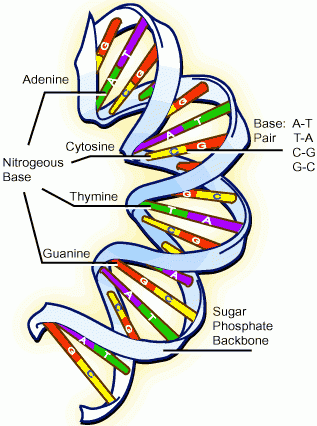
  • the arrangement of bases, which function as machine instructions in a software program, for performings task in the cell
  • we have observed that the property of specified complexity always comes from an intelligence
Fox:
  • well, maybe there are other sequences that would work, so maybe it’s really not uncommon to develop functioning sequences by chance alone, without an intelligence
Meyer:
  • you can measure how precise the functional specificity is in DNA and proteins

Moderator: is Shannon information the same as functional information

Meyer:

  • Shannon information refers to the sequences of digits or symbols that do not necessarily have any function, i.e. – a four character string QSZX has as much Shannon information as WORD. However, only the latter is functional against the pattern of the English language. There are arrangements of DNA bases and amino acids that have the same number of symbols/characters as a functional sequence would have, but they have no biological function – they do not exhibit specified complexity
Fox:
  • Well, maybe there are lots and lots of sequences of DNA and proteins so that it is fairly easy to get a functional one by chance

Meyer:

  • DNA sequences that are functional are extremely rare, protein sequences are even more rare
  • this is not my opinion, this is what the research shows – functional protein sequences are rare
Fox:
  • well maybe there are other functional sequences that are occur before the first functional sequence that are precursors to the first functional sequence
  • maybe there are billions of years of replication, mutation and selection before the first replication, mutation and selection

Meyer:

  • you can’t get to the first selectable functional sequence by appealing to precursor selectable functional sequences – there are no selectable functional sequences before the FIRST one
  • you have to get the first selectable functional sequence by chance alone, because there is nothing to mutate or select before the first replicator
  • the chance hypothesis has been rejected because the minimal amount of information for the simplest replicator is too high to get by chance alone, given the resources, including time, that are available

Moderator: Keith are you confident that naturalism will be able to substantiate these naturalism-of-the-gap speculations that you offer in response to Meyer’s actual science that we have today? 

Fox:

  • well, it is hard to know for sure because it was just a fluke event
  • but there’s nothing irrational or unscientific or miraculous about it – the fluke would have a material explanation
  • there is nothing that we can detect that would implicate God, my speculations about a fluke which I cannot observe or measure or test would all be compatible with an atheistic worldview that omits God as a causal entity

Meyer:

  • where are those material processes that could account for this fluke then?
  • the whole point of this argument is that the information in DNA transcends the material components in the sequence
  • it’s the arrangement of the material parts/letters/characters/symbols/instructions that needs to be explained
Fox:
  • Well, I just have a different philosophy of science that rules out intelligent causation a priori

Meyer:

  • Yes, that’s the difference between us – you pre-suppose that all explanations of natural phenomena must exclude intelligent causes

There is a bit more where Meyer talks about how parts of the cell are implementations of various design patterns (Gang of Four design patterns) that are used by software architects who design software.


Find more posts on Stephen C. Meyer here.

New software calculates the probability of generating functional proteins by chance

Apologetics and the progress of science

Here’s an article sent to me by JoeCoder about a new computer program written by Kirk Durston.

About Kirk:

Kirk Durston is a scientist, a philosopher, and a clergyman with a Ph.D. in Biophysics, an M.A. in Philosophy, a B.Sc. in Mechanical Engineering, and a B.Sc. in Physics. His work involves a significant amount of time thinking, writing and speaking about the interaction of science, theology and philosophy within the context of authentic Christianity. He has been married for 34 years to Patti and they have six children and three grandchildren. He enjoys landscape photography, antiques of various types, wilderness canoeing and camping, fly fishing, amateur astronomy, reading, music, playing the saxophone (alto), and enjoying family and friends.

Kirk grew up on a cattle and grain farm in central Manitoba, Canada, where he spent countless hours wandering around on his own in the forest as a young boy, fascinated with the plants and animals that are native to that region of the province. Throughout his teen years he spent six days a week in the summer working as a farm hand with cattle and grain. He left his father’s farm at the age of 19 to go to university.

Canada? Can anything good come out of Canada? Oh well, at least he’s not from Scotland. Anyway, on to the research, that’s what we care about. Code!

Summary of the article:

  • Biological life requires proteins
  • Proteins are sequences of amino acids, chained together
  • the order of amino acids determines whether the sequence has biological function
  • sequences that have biological function are rare, compared to the total number of possible sequences
  • Durston wrote a program to calculate the number of the probability of getting a functional sequence by random chance
  • The probability for getting a functional protein by chance is incredibly low

With that said, we can understand what he wrote:

This program can compute an upper limit for the probability of obtaining a protein family from a wealth of actual data contained in the Pfam database. The first step computes the lower limit for the functional complexity or functional information required to code for a particular protein family, using a method published by Durston et al. This value for I(Ex) can then be plugged into an equation published by Hazen et al. in order to solve the probability M(Ex)/N of ‘finding’ a functional sequence in a single trial.

I downloaded 3,751 aligned sequences for the Ribosomal S7 domain, part of a universal protein essential for all life. When the data was run through the program, it revealed that the lower limit for the amount of functional information required to code for this domain is 332 Fits (Functional Bits). The extreme upper limit for the number of sequences that might be functional for this domain is around 10^92. In a single trial, the probability of obtaining a sequence that would be functional for the Ribosomal S7 domain is 1 chance in 10^100 … and this is only for a 148 amino acid structural domain, much smaller than an average protein.

For another example, I downloaded 4,986 aligned sequences for the ABC-3 family of proteins and ran it through the program. The results indicate that the probability of obtaining, in a single trial, a functional ABC-3 sequence is around 1 chance in 10^128. This method ignores pairwise and higher order relationships within the sequence that would vastly limit the number of functional sequences by many orders of magnitude, reducing the probability even further by many orders of magnitude – so this gives us a best-case estimate.

There are only about 10^80 particles in the entire physical universe – 10^85 at the most. These are long odds. But maybe if we expand the probabilistic resources by buying more slot machines, and we pull the slot machine lever at much faster rate… can we win the jackpot then?

Nope:

What are the implications of these results, obtained from actual data, for the fundamental prediction of neo-Darwinian theory mentioned above? If we assume 10^30 life forms with a fast replication rate of 30 minutes and a huge genome with a very high mutation rate over a period of 10 billion years, an extreme upper limit for the total number of mutations for all of life’s history would be around 10^43. Unfortunately, a protein domain such as Ribosomal S7 would require a minimum average of 10^100 trials, about 10^57 trials more than the entire theoretical history of life could provide – and this is only for one domain. Forget about ‘finding’ an average sized protein, not to mention thousands.

So even if you have lots of probabilistic resources, and lots of time, you’re still not going to get your protein.

Compare these numbers with the 1 in 10^77 number that I posted about yesterday from Doug Axe. There is just no way to account for proteins if there is no intelligent agent to place the amino acids in sequence. When it comes to writing code, writing blog posts, writing music, or placing Scrabble letters, you need an intelligence. Sequencing amino acids into proteins? You need an intelligence.

Walter Bradley lectures on the creation and design of the universe

Dr. Walter L. Bradley

This lecture is special to me, because I bought a VHS tape of it just after I started working full-time, and watched it a million times. It changed my life. The lecture was delivered at the University of California, Santa Barbara.

About the speaker:

Dr. Bradley received his B.S. in Engineering Science and his Ph.D. in Materials Science from the University of Texas in Austin.

Dr. Bradley taught for eight years at the Colorado School of Mines before assuming a position as Professor of Mechanical Engineering at Texas A&M University (TAMU) in 1976.

During his 24 years at Texas A&M, Dr. Bradley served as Head of the Department of Mechanical Engineering at Texas A&M University and as Director of the Polymer Technology Center, and received five College of Engineering Research Awards. He has received over $4,500,000 in research grants and has published over 140 technical articles and book chapters. He has also co-authored “The Mystery Of Life’s Origin: Reassessing Current Theories. He is a Fellow of the American Society for Materials and of the American Scientific Affiliation and serves as a consultant for many Fortune 500 companies.

He currently serves as Distinguished Professor of Engineering at Baylor University.

The lecture: (63 minutes lecture, 25 minutes audience Q&A)

Summary slide:

This slide summarizes the content of the lecture

Introduction:

  • At the beginning of the 20th century, people believed that the progress of science was pointing away from an intelligent Creator and Designer, and towards naturalism
  • A stream of new discoveries has shifted the support of science towards theism, and away from naturalism
  • Richard Dawkins, an atheist, says that nature only has the appearance of design, but that if you look closer, naturalistic mechanisms can account for the appearance of design
  • When deciding between design and apparent design (“designoid”), it matters whether you think there is an intelligence there to do the designing

Evidence #1: The Big Bang:

  • an eternal “steady state” universe is more compatible with naturalism, but a created universe is more compatible with a Creator
  • In 1929, Hubble used telescopes to observe that the light from distant galaxies was redshifted. The further away galaxies were, the faster they were moving away. Therefore, space is expanding in all directions, suggesting an explosive origin of the universe
  • In 1965, the discovery of the cosmic microwave background radiation matched a prediction of the Big Bang cosmology, and of the creation event
  • In 1992, the COBE space telescope allowed us to test four specific predictions of the Big Bang model, especially the predictions for light element abundances (hydrogen and helium), which matched the predictions of the creation model

Evidence #2: Simple mathematical structure of the physical laws

  • the simple mathematical structure of natural laws allows us to understand these laws, make discoveries, and engineer solutions to problems
  • early scientists saw the mathematical structure of the universe to mean that nature was designed by an intelligent to be understood
  • the fundamental equations of the laws of the universe can be easily written on one side of one sheet of paper
  • Eugene Wigner’s famous paper, “The Unreasonable Effectiveness of Mathematics in the Physical Sciences” makes the point that this simple structure is an unexpected gift that allows is to do science

Evidence #3: fine-tuning of the physical constants and quantities

  • in order for any kind of complex life to survive, we need stars that provide energy within specific ranges for long periods of time
  • in order for any kind of complex life to survive, we need planets with stable orbits that will not suffer from extreme temperature swings as it varies in distance from its star
  • in order for any kind of complex life to survive, we need stable atomic structure
  • in order for any kind of complex life to survive, we need to have chemical diversity and correct relative abundances of each element
  • organic life has minimum requirements: process energy, store information, replicate, and you can’t fulfill those functions if there is only one element, e.g. – hydrogen
  • the energy level from the photons from the sun have to match the energy levels of the different elements in order to drive the chemical bonding needed for life
  • These requirements for life of any imaginable type depend on the values of the constants and quantities. The constants and quantities cannot vary much from what they are, or the universe will lose the characteristics (above) that allow it to support complex life of any imaginable time
  • For example, ratio of strong force to electromagnetic force:
    – if 2% larger, then no stable hydrogen, no long-lived stars, no compounds containing hydrogen, e.g. – water
    – if 5% smaller, no stable stars, heavy hydrogen would be unstable, few elements other than hydrogen

Evidence #4: initial conditions for habitability

  • Universe: expansion rate of the universe must be fast enough to avoid a re-collapse, but slow enough to allow matter to clump together and form stars and planets for complex life to live on
  • Planet: right distance from the star to get the right climate
  • Planet: right mass to retain the right atmosphere

Evidence #5: origin of life and information theory

  • It’s possible to explain every process in an automobile engine using plain old naturalistic mechanisms – no supernatural explanation is necessary to understand the processes
  • But the existence of engine itself: engineering all the parts has to be explained by the work of an intelligence
  • Similarly, we can understand how living systems work, but the existence of the living systems requires an intelligence
  • Even the simplest living system has to perform minimal function: capture energy, store information and replicate
  • Living systems are composed of objects like proteins that are composed of sequences of components complex such that the order of the components gives the overall structure function
  • Developing the components for a simple living cell is very improbable – even given the large number of galaxies, stars and planets in the universe, it is unlikely that complex, embodied life would exist anywhere in the universe

Evidence #6: more initial conditions for habitability

  • Location within the galaxy: you need to be away from the center of the galaxy, because the explosions from dying stars, and excessive radiation will kill life
  • Location within the galaxy: you need to be close enough to the center in order catch the heavy elements you need for life from the explosions of other stars
  • Location within the galaxy: the best location is between two arms of  a spiral galaxy, where you can get the heavy elements you need from dying stars, but without being hit with explosions and harmful radiation
  • Star mass: determines rate at which the sun burns, determines the energy level of photons that are used to drive chemical bonding reactions, determines the length of time the star will be stable
  • Star mass: star mass must be the correct value in order to allow liquid water on the planet’s surface, while still preserving stable orbit

I wish there was more curiosity about science in churches, and young Christians understood how critical science is for grounding the rationality of the Christian worldview. We need to be training up more scientists who think about the big questions, like Dr. Walter Bradley.