

Tag Archives: Naturalism

Is the presupposition of naturalism in science good for the pursuit of truth?

I have a key that will unlock a puzzling mystery

This topic came up recently in a discussion, and I wanted to be sure that all my readers were aware of how to think about the work that the presupposition of naturalism does in supporting naturalistic views of science. When I was little, way back in the 1990s, Phillip E. Johnson’s work on the definitions of science, evolution and creation were very important stuff. He was everywhere, doing lectures on university campuses and debates on the radio with Eugenie Scott. I was able to get a bunch of this audio from Access Research Network on AUDIO CASSETTES, but now that’s all obsolete.

Thankfully, I was able to find an old column written by Johnson in the Wall Street Journal, and preserved by Access Research Network.

Excerpt:

A Chinese paleontologist lectures around the world saying that recent fossil finds in his country are inconsistent with the Darwinian theory of evolution. His reason: The major animal groups appear abruptly in the rocks over a relatively short time, rather than evolving gradually from a common ancestor as Darwin’s theory predicts. When this conclusion upsets American scientists, he wryly comments: “In China we can criticize Darwin but not the government. In America you can criticize the government but not Darwin.”

That point was illustrated last week by the media firestorm that followed the Kansas Board of Education’s vote to omit macro-evolution from the list of science topics which all students are expected to master. Frantic scientists and educators warned that Kansas students would no longer be able to succeed in college or graduate school, and that the future of science itself was in danger. The New York Times called for a vigorous counteroffensive, and the lawyers prepared their lawsuits. Obviously, the cognitive elites are worried about something a lot more important to themselves than the career prospects of Kansas high school graduates.

The root of the problem is that “science” has two distinct definitions in our culture. On the one hand, science refers to a method of investigation involving things like careful measurements, repeatable experiments, and especially a skeptical, open-minded attitude that insists that all claims be carefully tested. Science also has become identified with a philosophy known as materialism or scientific naturalism. This philosophy insists that nature is all there is, or at least the only thing about which we can have any knowledge. It follows that nature had to do its own creating, and that the means of creation must not have included any role for God. Students are not supposed to approach this philosophy with open-minded skepticism, but to believe it on faith.

[…]All the most prominent Darwinists proclaim naturalistic philosophy when they think it safe to do so. Carl Sagan had nothing but contempt for those who deny that humans and all other species “arose by blind physical and chemical forces over eons from slime.” Richard Dawkins exults that Darwin “made it possible to be an intellectually fulfilled atheist,” and Richard Lewontin has written that scientists must stick to philosophical materialism regardless of the evidence, because “we cannot allow a Divine Foot in the door.”

So, if you’re having a discussion with a person who believes in naturalism – that everything in nature can be explained by material forces alone – then they will give you a stock response to all of your evidence for something outside of nature.

  • Origin of the universe? That’s not science
  • Cosmic fine-tuning? That’s not science
  • Origin of life? That’s not science
  • Cambrian explosion? That’s not science
  • Habitability-discoverability? That’s not science

It’s not that the people who did the science around these discoveries invoked God, and that’s why it’s not science. On the contrary, the mainstream scientists who made these discoveries scrupulously left God out of their microscopes and telescopes. These discoveries – which have only gotten worse for the naturalists as more details emerge – do not have easy naturalistic explanations. If you ask the naturalist for an explanation, they will resort to various sorts of speculations:

  • future science will undermine all our current knowledge
  • we are in an unobservable multiverse that exists eternally
  • aliens seeded the Earth with life, and THEY evolved
  • there are lots of fossils we haven’t discovered yet
  • there are lots of stars and planets we haven’t discovered yet

What’s the answer to this arguing from ignorance?

I think ridicule is best. You need to start by telling the full story about how these discoveries were made. Name the scientists, state the dates. Tell the whole story of how the science was done. Do this for each discovery. Then, at the end, ask them which of these scientific discoveries they deny. Ask them for naturalistic explanations of the ones they accept. Pretend to be confused, then concerned about their sanity. Finally, you should be as condescending as possible, and just explain that we can’t believe in fairies and unicorns. Explain things to them as if they were a child: we have to base our worldview on what science has revealed. We can’t hold out for Santa Claus to come down the chimney with new science that undermines all we have discovered. We have to go with the science we have today, and the science we have today says Creator and Designer. That is the best explanation of the what we know right now. And the trend is that these discoveries are becoming even MORE difficult for naturalism to account for. I guarantee you that the average rank-and-file atheist knows more about Star Wars and Star Trek lore than they do about actual scientific discoveries that threaten their beloved religion of naturalism.

Try to make your face look like Tucker Carlson:
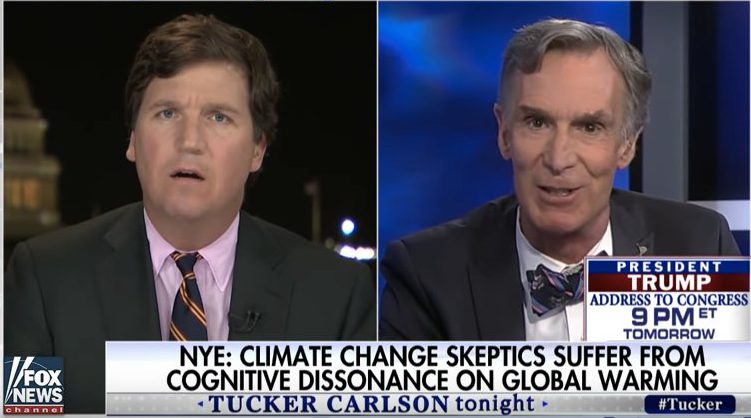
When dealing with a naturalist fundamentalist, make the Tucker Carlson face
The Tucker Carlson face conveys a mix of confusion, disappointment and horror

For God’s sake, even Richard Dawkins admitted in his debate with John Lennox that a good case can be made for a deistic God from the science we have now. If Dawkins can admit this, then you need to be extremely harsh to the village atheists.

If the word “naturalism” is all new to you, you should probably read the whole article and this longer article as well. The longer article really explains the different definitions of the words that are used in these debates. Johnson’s an excellent writer, and you will learn a lot.

Stephen C. Meyer: does the Big Bang cosmology disprove the existence of God?

Christianity and the progress of science

Here’s the 66-minute video featuring Dr. Stephen C. Meyer, who holds the Ph.D in philosophy of science from Cambridge University, and other degrees in the hard sciences.

The lecture starts really, really slowly. You can just fast-forward to the 12 minute mark, or you might die of boredom.

Topics:

  • Up until the the last 100 years or so, everyone agreed that the universe was eternal
  • This is at odds with the traditional Christian view that God created the universe
  • Materialism, the view that matter is all there is, requires eternally existing matter
  • Discovery #1: Hubble discovers that the universe is expanding (redshift observation)
  • The expanding universe was resisted by proponents of the eternal universe, like Einstein
  • Some naturalists even proposed speculative static models like the steady-state model
  • However, not of the speculative models fit with observations and experimental results
  • Discovery #2: Penzias and Wilson discover the cosmic microwave background radiation
  • Measurements of this background radiation confirmed a prediction of the Big Bang theory
  • The steady-state theory was falsified of by the discovery of this background radiation
  • The oscillating model was proposed to prevent the need for an absolute beginning
  • But the oscillating model is not eternal, it loses energy on each “bounce”
  • A paper by Alan Guth and Marc Sher from 1982 proved that our universe will not bounce
  • In addition, experiments reveal that the universe will expand forever, and not contract
  • The beginning of the universe is more at home in a theistic worldview than an atheistic one
  • The beginning of the universe fits in well with the Bible, e.g. – Genesis 1, Titus 1, etc.

In case you are wondering about what the evidence is for the Big Bang, here are 3 of the evidences that are most commonly offered:

Three main observational results over the past century led astronomers to become certain that the universe began with the big bang. First, they found out that the universe is expanding—meaning that the separations between galaxies are becoming larger and larger. This led them to deduce that everything used to be extremely close together before some kind of explosion. Second, the big bang perfectly explains the abundance of helium and other nuclei like deuterium (an isotope of hydrogen) in the universe. A hot, dense, and expanding environment at the beginning could produce these nuclei in the abundance we observe today. Third, astronomers could actually observe the cosmic background radiation—the afterglow of the explosion—from every direction in the universe. This last evidence so conclusively confirmed the theory of the universe’s beginning that Stephen Hawking said, “It is the discovery of the century, if not of all time.”

By the way, Dr. Meyer also does a great job of explaining the problem of proteins, DNA and the origin of life in this lecture. And you can hear him defend his views in this debate podcast with Keith Fox and in this debate podcast with Peter Atkins. He does a great job in these debates.

Positive arguments for Christian theism

New study: first life pushed back earlier, leaving less time for naturalistic magic

Christianity and the progress of science

Whenever you discuss origins with naturalists, it’s very important to get them to explain how the first living organism emerged without any help from an intelligent agent. The origin of life is an information problem. A certain minimal amount of biological information for minimum life function has to be thrown together by chance. No evolutionary mechanisms have the potential to work until replication is already in place.

Evolution News reports on a new study that makes the window for naturalistic forces to create the first self-replicating organism even smaller.

Excerpt:

A paper in Nature reports the discovery of fossil microbes possibly older, even much older, than any found previously. The lead author is biogeochemist Matthew Dodd, a PhD student at University College London. If the paper is right, these Canadian fossils could be 3.77 billion years old, or even as old as — hold onto your hat, in case you’re wearing one — 4.28 billion years.

From the Abstract:

Although it is not known when or where life on Earth began, some of the earliest habitable environments may have been submarine-hydrothermal vents. Here we describe putative fossilized microorganisms that are at least 3,770 million and possibly 4,280 million years old in ferruginous sedimentary rocks, interpreted as seafloor-hydrothermal vent-related precipitates, from the Nuvvuagittuq belt in Quebec, Canada. These structures occur as micrometre-scale haematite tubes and filaments with morphologies and mineral assemblages similar to those of filamentous microorganisms from modern hydrothermal vent precipitates and analogous microfossils in younger rocks. The Nuvvuagittuq rocks contain isotopically light carbon in carbonate and carbonaceous material, which occurs as graphitic inclusions in diagenetic carbonate rosettes, apatite blades intergrown among carbonate rosettes and magnetite–haematite granules, and is associated with carbonate in direct contact with the putative microfossils.

This new paper is interesting to compare with a paper from last year, Nutman et al., “Rapid emergence of life shown by discovery of 3,700-million-year-old microbial structures,” also in Nature, which found microbial structures that are a bit younger.

But the “microbial structures” from Nutman et al. 2016 are different from these new “microfossils” presented by Dodd et al. 2017. In Nutman et al., they only found stromatolite-type structures rather than actual microfossils. Some stromatolite experts were a bit skeptical that what they found were really stromatolites.

But the new paper by Dodd and his colleagues, “Evidence for early life in Earth’s oldest hydrothermal vent precipitates,” seems to offer potential bacteria-like microfossils. They are tiny black carbonaceous spheres and “hematite tubes” which the authors think are biogenically created. We’ve seen more convincing ancient microfossils, but these aren’t bad.

According to Dodd et al., these new finds would be the oldest known microfossils, if that is in fact what they are. Very interesting. If so, that just keeps pushing unquestionable evidence of life’s existence on Earth further and further back, which leaves less and less time for the origin of life to have occurred by unguided chemical evolution after Earth became habitable.

If they are in fact 4.28 billion years old, then that would mean there was life very, very early in Earth’s history — as Cyril Ponnamperuma said, it’s like “instant life.”

Instant life is “rational” for naturalistic fideists, but for evidence-driven people who understand the long odds on generating even a simple protein by chance, it’s irrationality.

Let’s recall exactly how hard it is to make even a simple protein without intelligent agency to select the elements of the sequence.

The odds of creating even a single functional protein

I’ve talked about Doug Axe before when I described how to calculate the odds of getting functional proteins by chance.

Let’s calculate the odds of building a protein composed of a functional chain of 100 amino acids, by chance. (Think of a meaningful English sentence built with 100 scrabble letters, held together with glue)

Sub-problems:

  • BONDING: You need 99 peptide bonds between the 100 amino acids. The odds of getting a peptide bond is 50%. The probability of building a chain of one hundred amino acids in which all linkages involve peptide bonds is roughly (1/2)^99 or 1 chance in 10^30.
  • CHIRALITY: You need 100 left-handed amino acids. The odds of getting a left-handed amino acid is 50%. The probability of attaining at random only L–amino acids in a hypothetical peptide chain one hundred amino acids long is (1/2)^100 or again roughly 1 chance in 10^30.
  • SEQUENCE: You need to choose the correct amino acid for each of the 100 links. The odds of getting the right one are 1 in 20. Even if you allow for some variation, the odds of getting a functional sequence is (1/20)^100 or 1 in 10^65.

The final probability of getting a functional protein composed of 100 amino acids is 1 in 10^125. Even if you fill the universe with pre-biotic soup, and react amino acids at Planck time (very fast!) for 14 billion years, you are probably not going to get even 1 such protein. And you need at least 100 of them for minimal life functions, plus DNA and RNA.

Research performed by Doug Axe at Cambridge University, and published in the peer-reviewed Journal of Molecular Biology, has shown that the number of functional amino acid sequences is tiny:

Doug Axe’s research likewise studies genes that it turns out show great evidence of design. Axe studied the sensitivities of protein function to mutations. In these “mutational sensitivity” tests, Dr. Axe mutated certain amino acids in various proteins, or studied the differences between similar proteins, to see how mutations or changes affected their ability to function properly. He found that protein function was highly sensitive to mutation, and that proteins are not very tolerant to changes in their amino acid sequences. In other words, when you mutate, tweak, or change these proteins slightly, they stopped working. In one of his papers, he thus concludes that “functional folds require highly extraordinary sequences,” and that functional protein folds “may be as low as 1 in 10^77.”

The problem of forming DNA by sequencing nucleotides faces similar difficulties. And remember, mutation and selection cannot explain the origin of the first sequence, because mutation and selection require replication, which does not exist until that first living cell is already in place.