Tag Archives: Naturalism

Stephen C. Meyer lectures on intelligent design and the origin of life

Christianity and the progress of science

A MUST-SEE lecture based on Dr. Stephen C. Meyer’s book “Signature in the Cell“.

I highly recommend watching the lecture, and looking at the slides. The quality of the video and the content is first class. There is some Q&A (9 minutes) at the end of the lecture.

Topics:

  • intelligent design is concerned with measuring the information-creating capabilities of natural forces like mutation and selection
  • Darwinists think that random mutations and natural selection can explain the origin and diversification of living systems
  • Darwinian mechanisms are capable of explaining small-scale adaptive changes within types of organisms
  • but there is skepticism, even among naturalists, that Darwinian mechanisms can explain the origin of animal designs
  • even if you concede that Darwinism can account for all of the basic animal body plans, there is still the problem of life’s origin
  • can Darwinian mechanisms explain the origin of the first life? Is there a good naturalistic hypothesis to explain it?
  • there are at least two places in the history of life where new information is needed: origin of life, and Cambrian explosion
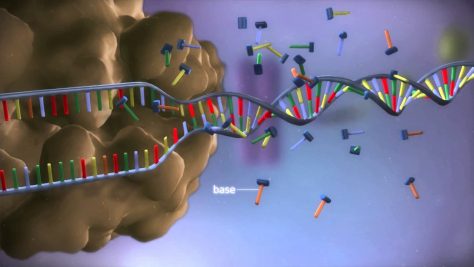
  • overview of the structure of DNA and protein synthesis (he has helpful pictures and he uses the snap lock blocks, too)
  • the DNA molecule is composed of a sequence of bases that code for proteins, and the sequence is carefully selected to have biological function
  • meaningful sequences of things like computer code, English sentences, etc. require an adequate cause
  • it is very hard to arrive at a meaningful sequence of a non-trivial length by randomly picking symbols/letters
  • although any random sequence of letters is improbable, the vast majority of sequences are gibberish/non-compiling code
  • similarly, most random sequences of amino acids are lab-proven (Doug Axe’s work) to be non-functional gibberish
  • the research showing this was conducted at Cambridge University and published in the Journal of Molecular Biology
  • so, random mutation cannot explain the origin of the first living cell
  • however, even natural selection coupled with random mutation cannot explain the first living cell
  • there must already be replication in order for mutation and selection to work, so they can’t explain the first replicator
  • but the origin of life is the origin of the first replicator – there is no replication prior to the first replicator
  • the information in the first replicator cannot be explained by law, such as by chemical bonding affinities
  • the amino acids are attached like magnetic letters on a refrigerator
  • the magnetic force sticks the letters ON the fridge, but they don’t determine the specific sequence of the letters
  • if laws did determine the sequence of letters, then the sequences would be repetitive
  • the three materialist explanations – chance alone, chance and law, law alone – are not adequate to explain the effect
  • the best explanation is that an intelligent cause is responsible for the biological explanation in the first replicator
  • we know that intelligent causes can produce functional sequences of information, e.g. – English, Java code
  • the structure and design of DNA matches up nicely with the design patterns used by software engineers (like WK!)

There are some very good tips in this lecture so that you will be able to explain intelligent design to others in simple ways, using everyday household items and children’s toys to symbolize the amino acids, proteins, sugar phosphate backbones, etc.

Proteins are constructed from a sequence of amino acids:

A sequence of amino acids forming a protein

Proteins sticking onto the double helix structure of DNA:

Some proteins sticking onto the sugar phosphate backbone

I highly, highly recommend this lecture. You will be delighted and you will learn something.

Here is an article that gives a general overview of how intelligent design challenges. If you want to read something more detailed about the material that he is covering in the lecture above related to the origin of life, there is a pretty good article here.

There is a good breakdown of some of the slides with helpful flow charts here on Uncommon Descent.

Positive arguments for Christian theism

New study: parrots have similar brain mechanisms to humans

A cockatoo uses a little tool he made to reach a snack

OK, it’s a fun Friday post. I guess most of my readers know that I love almost all the birds, and especially parrots. I have owned parrots most of my life, and want to get more, too. I also like to feed the wild birds who come to visit my house. One reason I like them so much is that they are very intelligent and obviously designed by a very clever engineer.

First, let me explain what convergence is, then we’ll look at a recent peer-reviewed scientific publication.

We have to start this Science Daily post with the definition of convergence in biology.

In evolutionary biology, convergent evolution is the process whereby organisms not closely related (not monophyletic), independently evolve similar traits as a result of having to adapt to similar environments or ecological niches.

It is the opposite of divergent evolution, where related species evolve different traits.

On a molecular level, this can happen due to random mutation unrelated to adaptive changes; see long branch attraction. In cultural evolution, convergent evolution is the development of similar cultural adaptations to similar environmental conditions by different peoples with different ancestral cultures. An example of convergent evolution is the similar nature of the flight/wings of insects, birds, pterosaurs, and bats.

All four serve the same function and are similar in structure, but each evolved independently.

So, naturalists say that if two organisms have traits that are similar, it must mean that the trait evolved once in their ancestors, and then the modern species inherited the trait from those ancestors. If evolution is true, the only mechanism they have to develop traits shared by two organisms is mutation and selection. The problems occur when two organisms share similar traits, but they have no recent common ancestor, and no recent shared evolutionary history of mutation and selection.

Here’s the latest study from the New Scientist:

To learn more how these birds’ brains develop, Mello and his team compared the genome of the blue-fronted Amazon parrot with that of 30 other birds. They found that regions of the parrot genome that regulate when and how genes for brain development are turned on are the same as those found in humans. These so-called ultra-conserved elements evolved in both species at different times, but with similar results.

Well, parrots and humans are completely different creatures, with no recent evolutionary history, and no recent common ancestors. So, if these changes are due to evolution, then we should see them in the very very very distance common ancestor shared by birds and humans. But then shouldn’t they be in all the other animals who descend from that very very very distant common ancestor to?

Watch this:

I’ll tell you what the real explanation is: the real explanation is that God created birds and humans. And, like a clever engineer, he re-used components that produced the behavior he wanted in his birds and his humans. We know how this works, because this is how intelligent agents write code today. Why do we need a naturalistic theory that requires magic to work, when we have a simple explanation that we can  observe every time someone writes a blog post, or some code, or anything with information in it?

Anyway, however you feel about that, try to be kind to birds, as they are much smarter and more sensitive than most people think. Put out some bird feeders in the yard, if you don’t have an outdoor cat. And if you do have a cat, then why not put a bell on it, or keep it indoors?

Related posts

Yale computer science professor David Gelernter expresses doubts about Darwinism

How did life begin?
How did life begin?

I had to learn about David Gelernter when I was doing my Masters in computer science. We studied his book “Mirror Worlds”. A few weeks ago, I blogged about his impressions of the difficulty in forming a simple protein by chance – something that naturalistic mechanisms would have to do in order to avoid intelligent agency as a cause in nature. He found it very unlikely. But there’s more!

Recently, my friend Terrell sent me a video featuring Peter Robinson (who hosts the splendid Uncommon Knowledge show out of Stanford University), and three interesting people. First, there was Dr. Stephen C. Meyer, who is one of my two favorite thinkers. I’ve blogged on his work about the origin of life and the Cambrian explosion here many times. Then, there was Dr. David Berlinski, a secular Jewish professor of mathematics, who has studied origins issues. And then Dr. David Gelernter, who teaches computer science at Yale University, and is a legend in computer science research.

Here’s the video: (H/T Terrell)

Here is an article by Jennifer Kabbany in The College Fix about the video.

She writes about his recent Claremont Review of Books article, as well as the interview above:

In May, the Claremont Review of Books published a column by Gelernter headlined “Giving Up Darwin.” In it, he explained how his readings and discussions of Darwinian evolution and its competing theories, namely intelligent design, have convinced him Darwin had it wrong.

In particular, he cited Stephen Meyer’s 2013 book Darwin’s Doubt as well as The Deniable Darwin by David Berlinski. The professor expanded on his views in an interview with Stanford University’s Hoover Institution that was published last week.

Gelernter stops short of fully embracing intelligent design, both in his essay and during his interview. He said in his interview he sees intelligence in Earth’s design, and has no quarrel with ID proponents, but notes the world a mess, its suffering far outweighs its goodness.

“My argument is with people who dismiss intelligent design without considering, it seems to me — it’s widely dismissed in my world of academia as some sort of theological put up job — it’s an absolutely serious scientific argument,” Gelernter said during his interview. “In fact it’s the first and most obvious and intuitive one that comes to mind. It’s got to be dealt with intellectually.”

I found this part the most interesting, since we are seeing so much intolerance from the secular left, whenever anyone disagrees with their dogma:

Gelernter said he likes many of his colleagues at Yale, that they are his friends, but when he looks at “their intellectual behavior, what they have published — and much more importantly what they tell their students — Darwinism has indeed passed beyond a scientific argument as far as they are concerned. You take your life in your hands to challenge it intellectually. They will destroy you if you challenge it.”

“Now, I haven’t been destroyed, I am not a biologist, and I don’t claim to be an authority on this topic,” Gelernter added, “but what I have seen in their behavior intellectually and at colleges across the West is nothing approaching free speech on this topic. It’s a bitter, fundamental, angry, outraged rejection [of intelligent design], which comes nowhere near scientific or intellectual discussion. I’ve seen that happen again and again.”

Gelernter acknowledges “I am attacking their religion and I don’t blame them for being all head up, it is a big issue for them.”

Dr. Gelernter cited three arguments in his article: the origin of life, and the Cambrian explosion, and genetic entropy. In the first two problems, there is a problem of huge amounts of biological information coming into being . We know that software engineers can write code like that, but there is no Darwinian mechanism for writing that much code and that short of a time period. The third problem shows that Darwinian mechanisms not only don’t produce functional code – they actually break it down.

I’ve covered both of the arguments before on this blog, but if you really want the details, you should pick up the books that convinced Dr. Gelernter: Dr. Stephen C. Meyer’s “Signature in the Cell” and “Darwin’s Doubt”. Each book tackles one of the arguments. For the third problem, a good book is Dr. Michael Behe’s “Darwin Devolves”. Even if you just read something about each book, then you’ll know about the arguments for intelligent causes being the best explanation for the history of life on this planet.