Tag Archives: Marriage

Two black economists explain how to not be poor in America

Economist Walter Williams

Walter Wiliams is one of my two favorite economists, the other being Thomas Sowell.

Here is his article on wealth and poverty on Creators written by Dr. Williams.

First, real poverty is not common in America:

There is no material poverty in the U.S. Here are a few facts about people whom the Census Bureau labels as poor. Dr. Robert Rector and Rachel Sheffield, in their study “Understanding Poverty in the United States: Surprising Facts About America’s Poor”, report that 80 percent of poor households have air conditioning; nearly three-quarters have a car or truck, and 31 percent have two or more. Two-thirds have cable or satellite TV. Half have one or more computers. Forty-two percent own their homes. Poor Americans have more living space than the typical non-poor person in Sweden, France or the U.K. What we have in our nation are dependency and poverty of the spirit, with people making unwise choices and leading pathological lives aided and abetted by the welfare state.

Second, the “poverty” is not caused by racism, but by poor choices:

The Census Bureau pegs the poverty rate among blacks at 35 percent and among whites at 13 percent. The illegitimacy rate among blacks is 72 percent, and among whites it’s 30 percent. A statistic that one doesn’t hear much about is that the poverty rate among black married families has been in the single digits for more than two decades, currently at 8 percent. For married white families, it’s 5 percent. Now the politically incorrect questions: Whose fault is it to have children without the benefit of marriage and risk a life of dependency? Do people have free will, or are they governed by instincts?

There may be some pinhead sociologists who blame the weak black family structure on racial discrimination. But why was the black illegitimacy rate only 14 percent in 1940, and why, as Dr. Thomas Sowell reports, do we find that census data “going back a hundred years, when blacks were just one generation out of slavery … showed that a slightly higher percentage of black adults had married than white adults. This fact remained true in every census from 1890 to 1940”? Is anyone willing to advance the argument that the reason the illegitimacy rate among blacks was lower and marriage rates higher in earlier periods was there was less racial discrimination and greater opportunity?

Third, avoiding poverty is the result of good choices:

No one can blame a person if he starts out in life poor, because how one starts out is not his fault.

If he stays poor, he is to blame because it is his fault. Avoiding long-term poverty is not rocket science. First, graduate from high school. Second, get married before you have children, and stay married. Third, work at any kind of job, even one that starts out paying the minimum wage. And finally, avoid engaging in criminal behavior. It turns out that a married couple, each earning the minimum wage, would earn an annual combined income of $30,000. The Census Bureau poverty line for a family of two is $15,500, and for a family of four, it’s $23,000. By the way, no adult who starts out earning the minimum wage does so for very long.

Fourth, what stops people from making good choices is big government:

Since President Lyndon Johnson declared war on poverty, the nation has spent about $18 trillion at the federal, state and local levels of government on programs justified by the “need” to deal with some aspect of poverty. In a column of mine in 1995, I pointed out that at that time, the nation had spent $5.4 trillion on the War on Poverty, and with that princely sum, “you could purchase every U.S. factory, all manufacturing equipment, and every office building. With what’s left over, one could buy every airline, trucking company and our commercial maritime fleet. If you’re still in the shopping mood, you could also buy every television, radio and power company, plus every retail and wholesale store in the entire nation”. Today’s total of $18 trillion spent on poverty means you could purchase everything produced in our country each year and then some.

Regarding those last two points, here is Thomas Sowell:
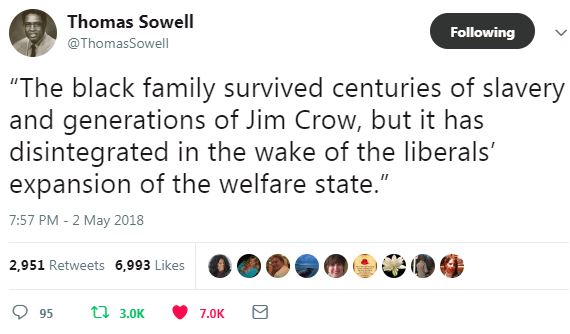
Economist Thomas Sowell blames welfare for killing the black family

To illustrate this point, I stole a graph from the Twitter feed of a famous man-blaming sociology professor who shall not be named (although his name rhymes with Vlad FillBox).

Black women were more likely to be married before welfare programs

In fact, there is a whole video featuring Thomas Sowell to go with this graph:

And an article to go with it:

If we wanted to be serious about evidence, we might compare where blacks stood a hundred years after the end of slavery with where they stood after 30 years of the liberal welfare state. In other words, we could compare hard evidence on “the legacy of slavery” with hard evidence on the legacy of liberals.

Despite the grand myth that black economic progress began or accelerated with the passage of the civil rights laws and “war on poverty” programs of the 1960s, the cold fact is that the poverty rate among blacks fell from 87 percent in 1940 to 47 percent by 1960. This was before any of those programs began.

Over the next 20 years, the poverty rate among blacks fell another 18 percentage points, compared to the 40-point drop in the previous 20 years. This was the continuation of a previous economic trend, at a slower rate of progress, not the economic grand deliverance proclaimed by liberals and self-serving black “leaders.”

Ending the Jim Crow laws was a landmark achievement. But, despite the great proliferation of black political and other “leaders” that resulted from the laws and policies of the 1960s, nothing comparable happened economically. And there were serious retrogressions socially.

Nearly a hundred years of the supposed “legacy of slavery” found most black children being raised in two-parent families in 1960. But thirty years after the liberal welfare state found the great majority of black children being raised by a single parent.

The rest of the article points out how even crime rates among blacks were caused by the implementation of soft law enforcement policies by progressives. Just look at the big cities if you want to know what it is like for blacks to be ruled by Democrats. It sucks!

You might have heard about Thomas Sowell because some celebrity I don’t know anything about has been tweeting all kinds of stuff by Dr. Sowell:

Now this celebrity is tweeting my favorite economist Thomas Sowell

If everybody started to read more Thomas Sowell books, we would be much better off as a country! Only good things happen when people stop watching TV and listening to music and watching movies, and instead settle down in a chair with a Thomas Sowell book. I recommended a bunch of them in this previous post.

Study: couples that delay sexual activity experience higher quality relationships

Relationship stability, quality, communication, satisfaction

From Family Studies, news about TWO new studies.

Excerpt: (links removed)

[T]wo recently published studies call into question the validity of testing sexual chemistry early in dating.

My colleagues and I published the first study a few years ago in the American Psychological Association’s Journal of Family Psychology. This study involved a national sample of 2,035 married individuals who participated in the popular online couple assessment survey called “RELATE.” We found that the longer a dating couple waits to have sex, the better their relationship is after marriage. In fact, couples who wait until marriage to have sex report higher relationship satisfaction (20% higher), better communication patterns (12% better), less consideration of divorce (22% lower), and better sexual quality (15% better) than those who started having sex early in their dating (see Figure 2). For couples in between—those that became sexually involved later in their dating, but prior to marriage—the benefits were about half as strong.

[…]These patterns were statistically significant even when controlling for a variety of other variables such as respondents’ number of prior sexual partners, education levels, religiosity, and relationship length.

The second study, by Sharon Sassler and her colleagues at Cornell University, also found that rapid sexual involvement has adverse long-term implications for relationship quality. Using data from the Marital and Relationship Survey, which provides information on nearly 600 low- to moderate-income couples living with minor children, their study examined the tempo of sexual intimacy and subsequent relationship quality in a sample of married and cohabiting men and women. Their analyses also suggest that delaying sexual involvement is associated with higher relationship quality across several dimensions.

They discovered that the negative association between sexual timing and relationship quality is largely driven by a link between early sex and cohabitation. Specifically, sexual involvement early in a romantic relationship is associated with an increased likelihood of moving more quickly into living together, which in turn is associated with lower relationship quality. This finding supports Norval Glenn’s hypothesis that sexual involvement may lead to unhealthy emotional entanglements that make ending a bad relationship difficult. As Sassler and her colleagues concluded, “Adequate time is required for romantic relationships to develop in a healthy way. In contrast, relationships that move too quickly, without adequate discussion of the goals and long-term desires of each partner, may be insufficiently committed and therefore result in relationship distress, especially if one partner is more committed than the other” (p. 710).

The rest of the post talks about two reasons why this works: improved partner selection and prioritizing communication and commitment. Improved partner selection occurs because you haven’t committed too much too soon (sexually) and you have time to let things play out to see if you really fit with the other person. And if you take sex off the table, then you have to use other means in order to build emotional intimacy – communication, service, support, etc.

That’s two studies, and there’s a third. Dina sent me this article from the UK Daily Mail about a new study showing the importance of chastity for relationship quality and stability.

Excerpt:

New couples who jump into bed together on the first date do not last as long in relationships as those who wait a new study has revealed.

Using a sample of almost 11,000 unmarried people, Brigham Young University discovered a direct correlation between the length and strength of a partnership and the amount of time they took to have first have sex.

The study showed that those who waited to initiate sexual intimacy were found to have longer and more positive outcomes in their relationships while those who couldn’t help themselves reported that their dalliances struggled to last more than two years.

‘Results suggested that waiting to initiate sexual intimacy in unmarried relationships was generally associated with positive outcomes,’ said the report authored published by the U.S. National Library of Medicine National Institutes of Health.

‘This effect was strongly moderated by relationship length, with individuals who reported early sexual initiation reporting increasingly lower outcomes in relationships of longer than two years.’

The study examined four sexual-timing patterns: Having sex prior to dating, initiating sex on the first date or shortly after, having sex after a few weeks of dating, and sexual abstinence.

Each one of these fields yielded different results in relationship satisfaction, stability and communication in dating situations.

Here’s another recent study that shows that if a woman has more than her husband as a premarital sex partner, her risk of divorce increases.

His findings:

Using nationally representative data from the 1995 National Survey of Family Growth, I estimate the association between intimate premarital relationships (premarital sex and premarital cohabitation) and subsequent marital dissolution. I extend previous research by considering relationship histories pertaining to both premarital sex and premarital cohabitation. I find that premarital sex or premarital cohabitation that is limited to a woman’s husband is not associated with an elevated risk of marital disruption.However, women who have more than one intimate premarital relationship have an increased risk of marital dissolution.

Here’s another study that makes it even more clear.

Findings:

Data from the 1988 US National Survey of Family Growth (NSFG) were utilized to assess the impact of premarital sexual activity on subsequent marital stability. Among white NSFG subjects first married in 1965-85, virgin brides were significantly less to have become separated or divorced (25%) than women who had not been virgins at marriage (35%).

[…]The lower risk of divorce on the part of white women with no premarital sexual experience persisted even after numerous intervening and background variables were controlled.

If you’re going to talk to a young person about sex, it’s a good idea to use these studies to explain what you lose by having sex too early in the relationship. Although they may respond with anecdotes to refute studies, studies are important because they represent LOTS of data points, not just one or two cherry-picked cases. My view on all this is the Bible’s view – no sex before marriage. But when talking to people about this issue, I find it useful to have evidence ready in order to be convincing in every way possible.

Should we be trying to change the world from the bottom up or the top down?

Two Air Force JTACs discuss mission parameters prior to calling in CAS

Dr. Paul Gould is a professor of philosophy (PhD from Purdue) at Southwestern Baptist Theological Seminary.

Here is his bio, which says, in part:

I have a Masters in Philosophy of Religion and Ethics from Talbot School of Theology and a Ph.D. in Philosophy from Purdue University.

I am an Assistant Professor of Philosophy and Christian Apologetics at Southwestern Baptist Theological Seminary in Fort Worth, Texas.

What his bio page doesn’t say is that he left a career in business to go onto this apologetics/philosophy track. I find that very interesting, because like most professionals with an interest in apologetics, I had the same dream – to go and do a PhD and get into a college and be a positive influence on Christian kids. But the main thing is that he has had some experience in the real world.

Anyway, Dr. Gould has written two posts on how to change the world, and I want you to look at an excerpt from the first one.

First post:

Christians like to talk—and aspire—to changing the world. This language stems very naturally from our God-given desire to make a difference, to live a life that matters. In a very real sense, making a difference is to change the world. But, usually, when Christians talk about “changing the world” they mean something like “winning the world for Christ” or “helping the gospel to gain a hearing in culture” or “contributing toward shalom.”Recently, there have been a number of very helpful books written by folks who challenge the common view of how to go about the task of world-changing, and call into question the relationship between Christ and culture. One of the most important books to enter this discussion is James Davison Hunter’s To Change the World. I highly recommend it to anyone interested in the topic of world-change. In this post I will share his critique of the “common view” of world change. I think his critique is dead on.

Hunter argued that by and large, Christians have gone about the task of world changing in completely the wrong way and the result is that Christianity in our country at least and in the western world in general, represents a weak culture.

He focuses on world-view ministries (primarily from the US such as Chuck Colson’s Wilberforce Forum and Focus on the Families’ Truth Project) and those like them that offer the following view of how to change the world:

Common view of world change: as we change the individual beliefs and values of persons, and change enough persons, then we will ultimately change society. This is a bottom up approach.

On the common view, the implicit view of culture is that “the essence of culture is found in the hearts and minds of individuals” and that culture change will come as enough individual lives are transformed.

Hunter argues that this approach fails to take into account cultural elites and the institutions that yield power within culture.

Instead, cultural change has always been top-down: it is always elites—those who have cultural capital to exert influence and power—who have changed the culture. This is why the university, and the media, and the arts are so important in shaping the culture.

All of this leads to a fascinating conclusion: some ideas have consequences—namely ideas propagated by those within society who possess cultural capital and a supporting network of other individuals and institutions also within the center of cultural influence and production.

Second post is here. The second post has a link to his review of Hunter’s book (PDF), which is published by Oxford University Press.

I agree completely with the top-down thesis of James Davison Hunter, and I think that it is a tragedy that the Christian parents and Christian churches don’t do a good job of challenging and guiding young Christians to study the things that will allow them to have an influence. Most Christians I talk to have a negative view of steering young Christians towards advanced degrees, or towards making a lot of money, or towards positions of cultural influence, etc. Instead of focusing on being effective, they tell me “I will do what I want to do, because God has a mysterious will for me to be happy”. I don’t buy it. I am happy to consider alternative plans that serve God better, but I don’t think that the “I’ll do what feels good” view is interested in producing a return for God in terms of money and/or influence. Crazy plans do not work out just because we want them to. There are costs to every plan, and not every plan is as likely to lead to influencing the culture as any other plan. This is reality.

I also think it is important to steer children into positions where they can be prosperous and/or influential. Again, many Christians disagree with guiding children that way. In my experience, it is assumed that children need to be happy, and that they are the best people to decide what they should be doing in life. Well, I’m not a heavy-handed bully, but I am not letting my children do whatever they like, because they don’t have enough wisdom and experience to know what to do. For example, I am not letting my children study ballet in university. It doesn’t pay the bills, and it isn’t likely that they will have an influence compared to other choices. Money is important because money can be used to fund Christian scholars, apologetics ministries and apologetics events. Marriage is a great way to have an influence, but marriage costs money, and that means that marriage-minded people should have a plan to pay the bills before they consider marriage. We do not have the right to do whatever we feel like, because we have a boss who expects a return on his investment. If a person is capable of doing hard things that produce a better return (money or influence or children, etc.) then he should do that.

We have a problem in this country as it is with young people borrowing tens of thousands of dollars to study things that either don’t pay off, or that don’t allow them to have an influence. It’s not unloving to tell children the truth about the choices they make. Especially when the cost of having a child is over six figures per child. You can have a huge Christian influence with that kind of money if you spent it on other things, like apologetics scholars, their ministries and their events. So, if you are going to have children and spend it on them, you’d better have some sort of plan, and look for a spouse who is on board with that idea of providing God with a good return on his investment. Everything we do – including the choices to marry and have children – should be focused on serving God. If people shy away from the idea of steering children to have an influence, I don’t think it’s a good idea to get married at all. Save the money and use it for the kingdom somewhere else. Marriage is about making the best decisions you can in order to serve God, and you can’t marry someone who puts their own happiness over the need to produce that return for the boss.

Having said that, if you are already married, stick with it. I am advocating for making smarter decisions before you commit. And before you go off to college, ask yourself: is what you are thinking of studying worth it? Trade school is an excellent option that will give you an income that can support a family AND give to apologetics ministries, with less exposure to debt. If you must go to university, then it’s generally wiser to stick with STEM degrees, so that you can get a job and actually pay off those loans. Marriages and children are NOT free. Retirement is not free. Health care is not free. Christian apologetics ministries do not run on wishes and hopes. Christian scholars do not get their degrees for free – they need support. I think another good plan is to have one person do philosophy or history and then be supported by other people with jobs in STEM fields. That’s what I do – I help out Christian scholars on my team to finish their graduate degrees in fields related to apologetics. Those non-STEM degrees are the best way to have an influence, but it’s easier to get them as a multi-disciplinary team effort. Everyone has to pull their weight!

And one last point. The most amazing thing in the world is when I meet people who are very very skeptical about mentoring young people and steering children towards prosperous and influential areas, even though they themselves may be facing the results of their own poor decisions. You would think that someone who has burned $60,000 on a degree in Women’s Studies and can’t find a job would be on your side about helping other young people to make better decisions, but they are often not on your side. Why is that? Somewhere along the way, this culture stopped liking the Mr. Knightleys who were praised for loving people by telling them the truth about their bad decisions. Now we think that the Emmas can do whatever they want, and no one should be giving them any guidance. How sad.