
Tag Archives: Marriage

New study: outstanding student loans reduce a woman’s odds of marrying

The best majors for women to avoid student loan debt
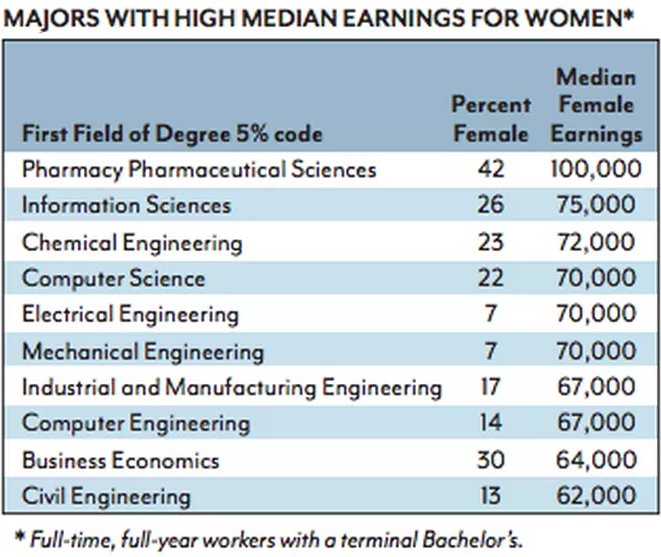
Top 10 majors with the highest median earnings for women

First, the study, which was published in Demographic Research.

Abstract:

BACKGROUND

With increasing levels of student loan debt, the path to economic stability may be less smooth than it was for earlier generations of college graduates. This paper explores this emerging trend by assessing whether or not student loan debt influences family formation.

OBJECTIVE

The objective of this study is to examine whether student loan debt delays marriage in young adulthood, whether or not the relationship between student loan debt and marriage differs for women and for men, and if this relationship attenuates during the years immediately after college graduation.

METHODS We estimate a series of discrete-time hazard regression models predicting the odds of first marriage as a function of time-varying student loan debt balance, using a nationally representative sample of bachelor’s degree recipients from the 1993 Baccalaureate and Beyond Longitudinal Study (N = 9,410).

RESULTS We find that the dynamics of loan repayment are related to marriage timing for women, but not for men. Specifically, an increase of $1,000 in student loan debt is associated with a reduction in the odds of first marriage by 2 percent a month among female bachelor degree recipients during the first four years after college graduation. This relationship attenuates over time.

CONCLUSION Our study lends support to the proposition that the financial weight of monthly loan repayments impedes family formation in the years immediately following college graduation – however, only for women. This finding questions traditional models of gender specialization in family formation that emphasize the economic resources of men.

I think that a woman who is serious about studying something that will allow her to get a job related to her field so she can quickly pay off her loans in the first few years is a very good sign of RESPECT for a man, and for his role as primary/sole provider. Men choose tough majors / trades for a reason, and they do tough jobs for a reason. When a woman chooses something hard to study and then chooses a hard job to do to pay off her loans, it’s showing to her man that she respects what he is doing to provide for the family. I think this is something that parents need to encourage young women to do, but so often parents focus too much on spiritual / emotional concerns instead of practical wisdom when leading their kids.

When a woman asks a man to work to pay for the marriage – with all the costs of home, furniture, diapers, tuition, etc. – she is asking him for a commitment to work until he is 65. That is a lot to ask, and it is very hard to accept this from a woman who doesn’t understand the difficulty of earning and saving money.

So what do I recommend to a woman? I recommend she do a STEM degree, pay off her debts, guard her chastity, marry young when she is fertile, have a few years of work to pay off student loans and get used to the workplace, demonstrate ability in apologetics and mentoring others, etc. A wife needs to have a lot more skills than just being pretty and young. There are things she has to do in the marriage – things that take preparation. The more accustomed she is to hard work and self-sacrifice, the easier she will take to her role in the marriage. Women who are used to having to do hard things that they don’t feel like doing make the best wives and mothers. It’s something that a woman can grow into, if she lets herself be challenged to grow.

My friend Amy is fond of telling me that people usually adapt to their friends. So if all your friends are very spiritual and impractical, and they don’t have jobs or savings, then chances are you’ll be like them, too. To get out of debt, don’t take financial advice from people who, in their own lives, show no evidence of knowing what to study, how to find a job, how to save money, and so on. Instead of pushing away the people who “rain on your parade” with wisdom, grab them and keep them close. Watch what they do. Talk to them about your finances. Rely on them to hold you accountable for choosing a good major, updating your resume, and continuously growing your salary, through annual raises or job changes. That’s how you get better.

I don’t say these things in order to make women feel bad, or limit their freedom unnecessarily. I tell women to make good decisions to prepare for marriage, to practice self-denial and self-sacrifice, to choose the right men, to not be scared away by strong providers and men with moral and religious convictions. Although on one level, women can be scared off by men who have firm and definite convictions, they need to understand that these men are the most reliable men to marry. Men who don’t make demands on women usually don’t respond well to demands that women make on them. A strict moral and theological framework can seem scary to a woman – she might feel scared that she could be rejected. But it’s exactly these convictions that ground a man’s ability to keep loving her, to stick with her, and to encourage and support her as she grows.

Instead of being frightened by men who ask her to do good things, she should view it as an asset, not a liability. And the more she listens to his leading and grows, the more independent and capable she will be. She will feel better about doing hard things and playing a role. Better than she would feel about always choosing the easy way and then finding herself without accomplishments. Demanding men can be bad, but not if the demands they make are to build the woman up. The demand that a woman be serious about paying her debts with a real plan might seem scary to some women, but the study shows that this is good advice for her to be more attractive – to any man who might want to marry her.

Why don’t men go to church anymore? The decline of male church attendance

Church sucks, that's why men are bored there
Church sucks, that’s why men are bored there

I most recently spent half a year at a PCA church, and then another half a year at a Southern Baptist church. I attended Sunday services as well as Wednesday night Bible study. I am now looking for a new church. For now, I just look around for a sermon I like and listen to that. In this post, I’ll explain why I think men don’t like church.

There are three areas where churches fail to attract men:

    1. Apologetics
    2. Feminism, sex and marriage
    3. Policy and current events

Apologetics

The PCA church discouraged me from becoming a member of the church because they said that conversion to Christianity due to reason and evidence was contrary to their teachings, and a “red flag”. Their words. I didn’t try to fight them on it, because they are Reformed Presbyterian, and this is their actual view. Their approach to apologetics was “pre-suppositional”, which is to say, they try to convince people to become Christians by asking them to assume that the Bible is infallible, without any argumentation or evidence. Naturally, this doesn’t work, so they aren’t trained to answer any serious questions from non-Christians. (1 Pet 3:15-16)

The Reformed Baptist SBC church is led by people like Russell Moore and Al Mohler, who take the “magic words” approach to evangelism. I.e. – they think that people become Christians just by speaking Bible verses out of context to them. So, when the atheist asks “do you have any evidence for God’s existence?” or “do you have any evidence for Jesus’ resurrection?”, their response is to quote Bible verses to the atheist, which have nothing to do with those topics. Christianity has lost so much influence in the culture under their approach, which is not even Biblical. (Mat 12:38–41)

These approaches to evangelism are not used in any other area of human endeavor. No one replies to questions about auto mechanics, or software engineering, or gardening, or cooking, by spouting Bible verses. In literally every other area of human endeavor, the laws of logic and supporting evidence are seen as assets when making claims to know something about the world to someone who disagrees with you.

Feminism, Sex and Marriage

First wave feminism simply asked for women to be given the same liberty and opportunity as men. That was good. But later versions of destroyed all distinctions between men and women. By destroying femininity, feminism directed women away from the traditional life plan of marriage, children and home-making.

Feminism changed how women voted. Today, about 75% of young, unmarried women vote for policies like taxpayer-funded birth control, taxpayer-funded abortion, no-fault divorce, affirmative action for women in schools and in the workplace, taxpayer-funded daycare, public schools, single-mother welfare, social security, etc. These policies and programs raised tax rates, and grew government, making it easier for women to have children without having to choose a marriage-ready man she wasn’t attracted to. Instead, she could choose men she was attracted to, and just use government programs as a substitute provider if it didn’t “work out”. Thanks to feminism, we have a 42% out-of-wedlock birth rate, and it’s rising. Few female college graduates are debt-free. About 5% of women emerge from college as virgins.

Under feminism, the traditional male roles and virtues were deemed “sexist”. Women were shamed for choosing early marriage, large families, and stable men who were good at being husbands and fathers. Instead, women today chose men based on appearance. They spend their 20s and early 30s giving men who will not commit to them premarital sex. The men who are getting sex thrown at them have no interest in Judeo-Christian values, chastity, fidelity, commitment or raising children. Women mistake the men’s willingness to have sex and cohabitate as signs that they are close to marriage. But in fact, chasing the hot bad boys just eats up the chastity, youth and beauty that could have made them interesting to the marriage-minded men they scorned. Later on, they realize that they’ve wasted their 20s on bad boys, but by then they are not attractive for marriage.

What has the response been to feminism from pastors and churches? They accept the anti-male, anti-marriage policies, that came out of feminism. They accept the promiscuity, and the marriage-delaying that came from feminism. Today, pastors just try to bully the men who were passed over to marry the women who had previously rejected them, despite the higher risk of divorce caused by the women’s past behavior.

Policy and current events

Most pastors are anti-intellectual, and they believe that this is a virtue, since they are focused narrowly on what the Bible explicitly says. Because of this, they aren’t able to understand which laws and policies allow Christianity and Christian families to flourish. I agree that what the Bible speaks about is of the highest importance. But we need to understand how to achieve the goals that the Bible states, as well as how to counter the forces that threaten the achievement of those goals.

For example, Christianity thrives when marriage thrives. Christianity is passed on from parents to children. Anything that threatens marriage, or interferes with parental authority, weakens the influence of Christianity. So, policies like higher taxes, no-fault divorce, SOGI laws, all harm the Christian family, while policies like lower taxes, protections for Christian businesses, protection for Christian schools (statements of faith, moral codes), etc. are all good for Christian families. But most pastors never talk about policies or laws, because they don’t think about how to defend the Christian worldview, how to educate Christian children, how to promote marriage, how promote Christian moral values in the public square. Even protecting the right to life of unborn children is ignored.

As the churches lose relevance, it becomes tempting for pastors to accept what the secular left promotes as good and true and beautiful. The big one is pastors pushing for redistribution of wealth by the secular government as a solution to “poverty”, even though the Bible only sanctions voluntary charity. This diminishes the cultural relevance of the church and elevates the secular government. SBC leaders like Russell Moore champion amnesty for refugees and unskilled illegal immigrants, not realizing how it will harm Christian institutions and values down the road to import large numbers of people who will eventually vote for policies like higher taxes, bigger government, etc.

More and more women are asking why they can’t find a good man to marry

Do young women understand how to get to a stable marriage?

In the last few months, I’ve met 5 different Christian women in their 30s who all asked me the same question: where are all the good men who want to marry me?

Christian men’s rights blogger Dalrock had two different posts where he described the answer to this question.

Here is the first post from Dalrock that concisely illustrates the problem:

As I wrote in A very long season, feminists don’t want to waste a day more of their youth and fertility on their husbands than absolutely necessary. As if to prove this very point, 30 year old Mona Chalabi writes in the NY Times* I Want My 2.3 Bonus Years:

If I could prolong my time as a young adult by, say, 2.3 years, here is a list of things I would like to do:

• Go to more parties. Preferably wild parties that I can think about, years later, at mild parties.

[…]• Have more romantic partners.

[…]• Get a bit higher up the career ladder a bit earlier on. That would probably boost my earnings, giving me more financial security. I could use that money to go to more parties, get a membership to a fancy gym and maybe even meet a romantic partner on the ab machines.

To drive the message home, the image at the top of the article is a cartoon of a resentful Chalabi giving her future husband the side eye for her lost years of sampling penises!

Surely, this must be an isolated case just for New York Times feminists, right? It’s not widespread, is it?

Second post from Dalrock:

Margaret Wente at the Globe and Mail* asks where all the good men have gone.  Wente comes to the conclusion that women need a sex cartel:

…it’s up to us to make the rules. “Why buy the cow when you can get the milk for free?” my father used to say. It drove me crazy when he said that. Now, it’s dawned on me that he was right.

Since the women’s cartel collapsed, women’s bargaining power has seriously eroded. That’s why so many single women hate Tinder, which has further commodified sex for the benefit of men. Women are just another consumer good in the shop window.

The apex fallacy aside, Wente is partially right.  Women (as a group) have signaled to men that what they really want are exciting sexy badboys, not boring loyal dudes. It isn’t that women no longer want to marry beta providers, they just don’t want to waste a day more of their youth and fertility on their husband than absolutely necessary.

As a result, some up and coming boring loyal dudes aren’t knocking themselves out in their twenties while they wait for their future wife to tire of having sex with other men.

If you wonder why men are no longer performing in school, and exchanging careers for video games, the answer is simple. Men have realized that young women today, under the influence of feminism, are not interested in traditional husbands during their late teens and 20s. During these years, women are interested in travel, fun, drinking, hook-ups and cohabitation with amoral atheists. This is what I have personally observed. In the minds of young women, the highest value men are good-looking men who have no religion, and make no moral judgments, and are left of center politically – especially on abortion.

There are actually many other men who don’t meet this standard – marriage-minded men – who want to get married young and have children. But when these men see what young women really want, they just give up on school and work, since doing the traditional male roles has no value to young women. Many good men even give up on morality and Christianity, because they want a relationship with a woman so badly. They know that women don’t want marriage-minded men when women are youngest and prettiest.

More from second post:

What Wente doesn’t understand is that timing is everything.  From an economic point of view, women are dividing up sexual access that traditionally would have been reserved only for their husband into two blocks.  The first block contains their most attractive and fertile years, and it is dedicated to no strings sex with exciting badboys.  Then, once women reach what Rollo calls the epiphany phase, they want to bargain sexual access in their remaining (older and less fertile) years for maximum beta bucks.

The problem with this strategy is (generally speaking) not that the previously overlooked beta men will refuse to marry the suddenly reformed party girls.  The problem is that young men now look at the men 3-5 (and even 5-10) years older than them and don’t see an indication that signaling provider status will make them attractive to women.  They also see a society that holds married fathers in contempt**.  Most of these men are still working hard in their late teens and twenties to prepare to signal provider status in their 30s.  But a growing minority of young men are no longer doing so.  These men are instead working like women.  Once the reformed party girls are ready to find Mr. Beta Bucks, there is a shortage of 30 something men who fit the bill.  Even worse, no amount of complaining or shaming will cause the missing beta providers to go back in time and spend the prior decade preparing for this moment.

I’m one of the last men who followed the marriage-preparedness script for traditional men who wanted to marry and have four children and have a stay-at-home homeschooling mom to raise them from birth to graduate school. I find myself now in my mid-40s, with a 6-figure income and a 7-figure net worth. I never used my success to play the field with hot bad girls. I wanted to keep my sexual past completely clean for my eventual wife. However, what I observed in my late teens and 20s and even early 30s was a complete lack of interest in marriage ability, from non-Christian women and Christian women alike. Christian women aren’t learning to value early marriage from their married parents or their evangelical churches. None of the traditional husband skills are valued by young women, i.e. – chastity, gapless resume, alcohol abstinence, undergraduate and graduate STEM degrees, experience nurturing and mentoring others, stewardship of earned income.

I recently caused an uproar on my Facebook page by saying that even if the perfect woman showed up right now to marry me, I would not pursue her because the critical time where the woman could have applied maximum youth, beauty and fertility as a wife to make an impact on my education, early career, health, and finances has passed. A younger woman develops value to her husband precisely by applying herself to him and to her family in these critical early years. Men who have experienced this self-sacrificial love and support are loyal to their wives even after their wives lose their youth and beauty. Why? Because the men know that they are much better than they could have been, having enjoyed that early investment of value made by their young wives.

Young women very supportive of premarital sex

As Christian writer Matt Walsh notes in a recent article at the Daily Wire, this “follow your heart” focus on happiness in women is lethal to marital stability, and men know it.

Excerpt:

There was an article in Cosmo this week with a title that summarizes all that’s wrong with Cosmo and modern society as a whole: “I eloped at 25, divorced at 26, and dated my way across Europe all summer.” Of course, by “dated my way across Europe” she means that she slept with half the continent.

The author, Elise, says she “started fighting” with her husband and within a few months they both decided that their differences were irreconcilable. Despite counseling, she says, “neither of us was happy.” So, exhausted from 12 whole months of marriage, Elise embarked on a voyage of self-discovery and STD cultivation. She met random dudes in half a dozen countries and had sex with them, learning quite a lot as she went, though she can’t really explain what exactly she learned or why sex was a necessary component in learning it. Finally, she came home and started dating some other guy. The end.

Well, not really the end. 20 years from now I’m sure we’ll get the follow up article: “I’m alone and miserable and it’s everyone’s fault but mine.” After all, you may be able to fill the emptiness in your soul with frivolous sex when you’re young and physically desirable, but that phase is fleeting. People who don’t want to “waste” their beauty and youth on a spouse, so they waste it instead on strangers who don’t love them or even care what happens to them tomorrow, will be shocked when a tomorrow comes where even strangers aren’t interested anymore. This is where the single-minded, utterly selfish pursuit of “happiness” at all costs inevitably leads: to rejection, despair, and a quiet, unnoticed death on a lonely hospital bed.

As Elise helpfully demonstrated, “do what makes you happy” is poison in a marriage. Many a vow has been broken because one or both partners decide to chase “happiness” instead of commitment, fidelity, and love. “I deserve to be happy,” reports the legion of serial divorcees, as they drift on to the next spouse, and the next, and the next, and the next, looking for the one — the one, finally — who might cure the misery they’ve inflicted on themselves. Increasingly unhappy, yet increasingly convinced that they deserve to be.

And this follow your heart to happiness situation is alive and well in the church today. Marriage-minded Christian men who have prepared for husband roles are surprised to find that there is often little or no difference between Elise and the Christian women the church produces. Christian men who desire to invest in a marriage that is stable, productive and influential have nowhere to turn for a wife who is able and willing to help. In my experience, the problem with happiness-focused women who delay marriage is never discussed in churches from the pulpit. The “good men to marry” that today’s 30-something women are looking for were plentiful back when those same women were in their early-to-mid 20s.