Tag Archives: Marriage

What is the definition of marriage according to Jesus?

It’s Pride Month! This is when Big Corporations spend an entire month celebrating the LGBT community, and pressuring everyone else to celebrate behaviors and lifestyles that are at odds with the teachings of Jesus. So, since the LGBT activists are about to get 30 days of celebration, I thought I would celebrate what Jesus taught about marriage on my little blog.

Here’s what Jesus says about marriage.

Matthew 19:1-11:

1 Now when Jesus had finished these sayings, he went away from Galilee and entered the region of Judea beyond the Jordan.

2 And large crowds followed him, and he healed them there.

3 And Pharisees came up to him and tested him by asking, “Is it lawful to divorce one’s wife for any cause?”

4 He answered, “Have you not read that he who created them from the beginning made them male and female,

5 and said, ‘Therefore a man shall leave his father and his mother and hold fast to his wife, and the two shall become one flesh’?

6 So they are no longer two but one flesh. What therefore God has joined together, let not man separate.”

7 They said to him, “Why then did Moses command one to give a certificate of divorce and to send her away?”

8 He said to them, “Because of your hardness of heart Moses allowed you to divorce your wives, but from the beginning it was not so.

9 And I say to you: whoever divorces his wife, except for sexual immorality, and marries another, commits adultery.”

10 The disciples said to him, “If such is the case of a man with his wife, it is better not to marry.”

11 But he said to them, “Not everyone can receive this saying, but only those to whom it is given.

To be a Christian, minimally, is to be a follower of Jesus Christ. That means that we accept what Jesus teaches, on whatever he teaches about. We don’t overturn the teachings of Jesus in order to make people who are rebelling against God feel better about their rebellion. It is central to the Christian worldview that Christians care more about what God thinks of them than what non-Christians think of them. In fact, Christians are supposed to be willing to endure suffering rather than side with non-Christians against God’s authority.

Matt Walsh had a fine article about this issue.

He said:

As Christians, our goal is not to avoid being like the big bad “other Christians,” but to strive to be like Christ Himself. This is one of the advantages to having an Incarnate God. He went around acting and speaking and teaching and generally functioning in our realm, thereby giving us a model to follow. This is the model of a loving and merciful man, and also a man of perfect virtue who fought against the forces of evil, condemned sin, defended his Father in Heaven with sometimes violent force, spoke truth, and eventually laid down His life for those He loved (which would be all of us).

[…]This is what it means to believe in Christ. Not just to believe that He existed, but to believe that Christ is Truth itself, and that everything He said and did was totally and absolutely and irreversibly true forever and always. Many Christians today — not only the ones in the video, but millions alongside them — seem to think we can rightly claim to have “faith” in Jesus or a “relationship” with Him while still categorically denying much of His Word. This is a ridiculous proposition. We can’t declare, in one breath, that Christ is Lord, and in the next suggest that maybe God got it wrong on this or that point. Well, we can make that declaration, but we expose our belief as fraudulent and self-serving. We worship a God we either invented in our heads, which is a false idol, or a God who is fallible, which is a false idol.

If you really accept Jesus as God, then you can’t think he is wrong when he explains what marriage is. Period. End of issue.

Real Christians don’t make excuses for sin. Real Christians present the gospel. The gospel is that all men have rebelled against God and fallen short of perfect submission to and obedience of him. For this, they deserve to be separated from God eternally. Jesus paid the price for this rebellion on the cross, and anyone who accepts him as Savior and Lord will be with God eternally after they die. There is no salvation apart from Jesus. That’s what Christians say. And they say it regardless of how weird they look, and how many non-Christians don’t like them for saying it.

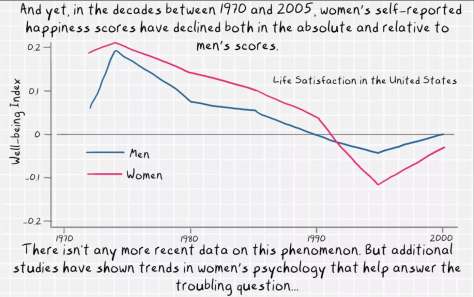
Are feminists right to think that gender-neutral marriage makes women happier?

Male And Female Happiness After Feminism And Socialism
Male and female happiness throughout America’s adoption of radical feminism

I was reading this article by a feminist fiction writer on Vox, where she explains that although feminists have gotten what they wanted (careers, contraceptives, promiscuity, abortion, no-fault-divorce, daycare, etc. it hasn’t made them happier. So, what does this feminist fiction writer think would make feminists happier?

She gives two reasons why women women are still unhappy after feminism has been adopted by our society:

  • men don’t do enough housework
  • women are not as successful as men because they are discriminated against, the so-called “glass ceiling”

I think those complaints are pretty popular among feminists. Let’s take a look at some studies to see if her opinions are supported by peer-reviewed studies.

First study:

COUPLES who share housework duties run a higher risk of divorce than couples where the woman does most of the chores, a study has found.

The divorce rate among couples who shared housework equally was around 50 per cent higher than among those where the woman did most of the work.

“The more a man does in the home, the higher the divorce rate,” Thomas Hansen, co-author of the study entitled Equality in the Home, said.

Second study:

Researchers at the University of Illinois examined data on nearly 1,500 men and 1,800 women, aged between 52 and 60. Their well-being was evaluated through surveys.

The researchers first found that men’s well-being decreased once they had exited the workforce to become home-makers.

Meanwhile, the inverse was not so for women: Women’s psychological well-being was not affected by leaving their jobs to become stay-at-home mothers.

Third study:

A study called “Egalitarianism, Housework and Sexual Frequency in Marriage,” which appeared in The American Sociological Review last year, surprised many, precisely because it went against the logical assumption that as marriages improve by becoming more equal, the sex in these marriages will improve, too. Instead, it found that when men did certain kinds of chores around the house, couples had less sex. Specifically, if men did all of what the researchers characterized as feminine chores like folding laundry, cooking or vacuuming — the kinds of things many women say they want their husbands to do — then couples had sex 1.5 fewer times per month than those with husbands who did what were considered masculine chores, like taking out the trash or fixing the car. It wasn’t just the frequency that was affected, either — at least for the wives. The more traditional the division of labor, meaning the greater the husband’s share of masculine chores compared with feminine ones, the greater his wife’s reported sexual satisfaction.

Regarding the pay gap, that is entirely caused by women’s own choices. E.g. – the choice to study creative writing instead of petroleum engineering, the choice to work 35 hour weeks instead of 70 hour weeks, etc.

Fourth study:  (summarized by AEI economist)

When the [Bureau of Labor Statistics] reports that women working full-time in 2018 earned 81.4% of what men earned working full-time, that is very much different from saying that women earned 81.4% of what men earned for doing exactly the same work while working the exact same number of hours in the same occupation, with exactly the same educational background and exactly the same years of continuous, uninterrupted work experience, and with exactly the same marital and family (e.g., number of children) status. As shown above, once we start controlling individually for the many relevant factors that affect earnings, e.g., hours worked, age, marital status, and having children, most of the raw earnings differential disappears.

Fifth study:

This study leads to the unambiguous conclusion that the differences in the compensation of men and women are the result of a multitude of factors and that the raw wage gap should not be used as the basis to justify corrective action. Indeed, there may be nothing to correct. The differences in raw wages may be almost entirely the result of the individual choices being made by both male and female workers.

I think that women are entitled to make their own decisions, but they aren’t allowed to force the rest of us to subsidize their failures and celebrate their destructive outcomes.

I could go on, but I think enough has been said to show that research is very much at odds with feminist rhetoric. They feel they know what will make them happy and we gave them everything they asked for. They eliminated shaming of promiscuity with sex education. They get preferential treatment in the schools in a female-dominated education system. They are hired because of affirmative action quotas. They get expensive daycare, government schools, welfare and other programs. Taxes are raised to equalize outcomes for divorced women who choose men for feelings, and then nuke their own marriage enterprise. We have been on a long experiment of giving feminists everything they felt they wanted, at the expense of men’s rights and children’s rights, and it hasn’t even produced the results that feminists felt it would.

The social costs of feelings-based decision-making

Let’s look at two examples of policies that feminists asked for in the past, which didn’t work out the way they wanted.

I can understand why feminists would introduce sex education. They felt that “if everyone is having sex, then I won’t be the only one chasing attention from hot no-commitment bad boys by giving them recreational sex before marriage”.  They wanted to eliminate the standards of chastity and marriage-focused dating and normalize fun-focused drunken promiscuity. And they got that. But since they didn’t consult any research and evidence about how that would affect their future marriage stability and marriage happiness, they are even more unhappy than before.

How about no-fault divorce? No-fault divorce was brought in by a coalition of feminists, Marxists and trial lawyers. The Marxists want to destroy the family in order to increase dependence on the state. The trial lawyers wanted to make money. And the feminists thought that the standard approach to courting and marriage was just too much work. They didn’t want to be chaste. They didn’t want to be sober. They didn’t want to evaluate a man for traditional husband and father roles. The no-fault divorce laws gave them an escape from the messes caused by their own feelings-driven choices. But divorce just makes makes men and women much poorer, and passes the costs of supporting single mothers onto taxpayers.

And the costs of the failures of feminism are passed onto taxpayers.

Consider this study:

This paper examines the growth of government during this century as a result of giving women the right to vote. Using cross-sectional time-series data for 1870–1940, we examine state government expenditures and revenue as well as voting by U.S. House and Senate state delegations and the passage of a wide range of different state laws. Suffrage coincided with immediate increases in state government expenditures and revenue and more liberal voting patterns for federal representatives, and these effects continued growing over time as more women took advantage of the franchise. Contrary to many recent suggestions, the gender gap is not something that has arisen since the 1970s, and it helps explain why American government started growing when it did.

We are already $28 trillion in debt, partly because of feminism’s replacement of husbands and families with higher taxes and big government. Every time we transfer money from tax-paying men to feminists to fix their mistakes, it leaves less money in the hands of the men who actually want to get married. The declining value of marriage after feminism for men explains why marriage is being delayed, and why marriage rates are plunging.

Two black economists explain how to end poverty in America

These days, everyone seems to think that being good to the poor means looking around to see what people are saying is good to the poor, then loudly shouting your agreement with it. People want to look good to others more than they want to help others. Besides, looking good by loud virtue signaling is free. If we really wanted to help people, though, we should tell them to do what will work.

So let’s talk about poverty in America, with help from famous black economist Walter Williams.

First, he says real poverty is not common in America:

There is no material poverty in the U.S. Here are a few facts about people whom the Census Bureau labels as poor. Dr. Robert Rector and Rachel Sheffield, in their study “Understanding Poverty in the United States: Surprising Facts About America’s Poor”, report that 80 percent of poor households have air conditioning; nearly three-quarters have a car or truck, and 31 percent have two or more. Two-thirds have cable or satellite TV. Half have one or more computers. Forty-two percent own their homes. Poor Americans have more living space than the typical non-poor person in Sweden, France or the U.K. What we have in our nation are dependency and poverty of the spirit, with people making unwise choices and leading pathological lives aided and abetted by the welfare state.

Second, the “poverty” is not caused by racism, but by poor choices:

The Census Bureau pegs the poverty rate among blacks at 35 percent and among whites at 13 percent. The illegitimacy rate among blacks is 72 percent, and among whites it’s 30 percent. A statistic that one doesn’t hear much about is that the poverty rate among black married families has been in the single digits for more than two decades, currently at 8 percent. For married white families, it’s 5 percent. Now the politically incorrect questions: Whose fault is it to have children without the benefit of marriage and risk a life of dependency? Do people have free will, or are they governed by instincts?

There may be some pinhead sociologists who blame the weak black family structure on racial discrimination. But why was the black illegitimacy rate only 14 percent in 1940, and why, as Dr. Thomas Sowell reports, do we find that census data “going back a hundred years, when blacks were just one generation out of slavery … showed that a slightly higher percentage of black adults had married than white adults. This fact remained true in every census from 1890 to 1940”? Is anyone willing to advance the argument that the reason the illegitimacy rate among blacks was lower and marriage rates higher in earlier periods was there was less racial discrimination and greater opportunity?

Third, avoiding poverty is the result of good choices:

No one can blame a person if he starts out in life poor, because how one starts out is not his fault.

If he stays poor, he is to blame because it is his fault. Avoiding long-term poverty is not rocket science. First, graduate from high school. Second, get married before you have children, and stay married. Third, work at any kind of job, even one that starts out paying the minimum wage. And finally, avoid engaging in criminal behavior. It turns out that a married couple, each earning the minimum wage, would earn an annual combined income of $30,000. The Census Bureau poverty line for a family of two is $15,500, and for a family of four, it’s $23,000. By the way, no adult who starts out earning the minimum wage does so for very long.

Fourth, what stops people from making good choices is big government:

Since President Lyndon Johnson declared war on poverty, the nation has spent about $18 trillion at the federal, state and local levels of government on programs justified by the “need” to deal with some aspect of poverty. In a column of mine in 1995, I pointed out that at that time, the nation had spent $5.4 trillion on the War on Poverty, and with that princely sum, “you could purchase every U.S. factory, all manufacturing equipment, and every office building. With what’s left over, one could buy every airline, trucking company and our commercial maritime fleet. If you’re still in the shopping mood, you could also buy every television, radio and power company, plus every retail and wholesale store in the entire nation”. Today’s total of $18 trillion spent on poverty means you could purchase everything produced in our country each year and then some.

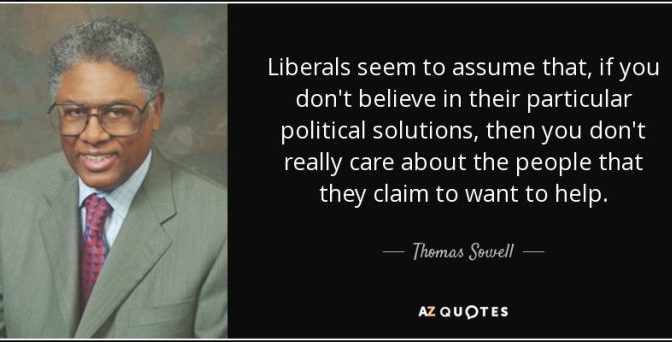
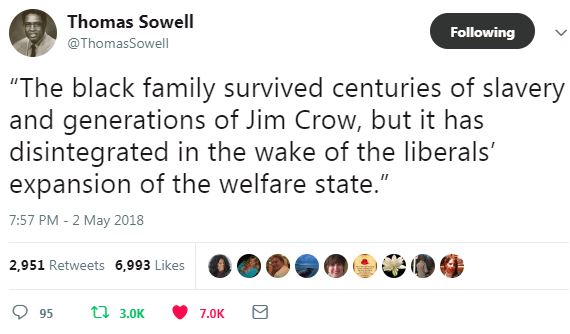
Regarding those last two points, here is another famous black economist, Thomas Sowell:

Economist Thomas Sowell blames welfare for killing the black family

To illustrate this point, here’s a graph with some helpful data taken from the U. S. Census.

In fact, there is a whole video featuring Thomas Sowell to go with this graph:

Black women were more likely to be married before welfare programs

And an article to go with it:

If we wanted to be serious about evidence, we might compare where blacks stood a hundred years after the end of slavery with where they stood after 30 years of the liberal welfare state. In other words, we could compare hard evidence on “the legacy of slavery” with hard evidence on the legacy of liberals.

Despite the grand myth that black economic progress began or accelerated with the passage of the civil rights laws and “war on poverty” programs of the 1960s, the cold fact is that the poverty rate among blacks fell from 87 percent in 1940 to 47 percent by 1960. This was before any of those programs began.

Over the next 20 years, the poverty rate among blacks fell another 18 percentage points, compared to the 40-point drop in the previous 20 years. This was the continuation of a previous economic trend, at a slower rate of progress, not the economic grand deliverance proclaimed by liberals and self-serving black “leaders.”

Ending the Jim Crow laws was a landmark achievement. But, despite the great proliferation of black political and other “leaders” that resulted from the laws and policies of the 1960s, nothing comparable happened economically. And there were serious retrogressions socially.

Nearly a hundred years of the supposed “legacy of slavery” found most black children being raised in two-parent families in 1960. But thirty years after the liberal welfare state found the great majority of black children being raised by a single parent.

The rest of the article points out how even crime rates among blacks were caused by the implementation of soft law enforcement policies by progressives. Just look at the big cities if you want to know what it is like for blacks to be ruled by Democrats. It sucks!

If everybody started to read more Thomas Sowell books, we would be much better off as a country! Only good things happen when people stop watching TV and listening to music and watching movies, and instead settle down in a chair with a Thomas Sowell book. I recommended a bunch of them in a previous post.