Tag Archives: Marriage

Unmarried 35-year-old woman reflects on her adventurous life of fun, travel and serial cohabitation

I found an interesting article featuring a 35-year-old woman who is alarmed that her approach to life has left her in debt and single, with a gap-filled resume of short-term jobs. I thought it might be useful for young women to read this, and consider whether making “rash” decisions and being “adventurous” works out.

She writes:

I feel like a ghost. I’m a 35-year-old woman, and I have nothing to show for it. My 20s and early 30s have been a twisting crisscross of moves all over the West Coast, a couple of brief stints abroad, multiple jobs in a mediocre role with no real upward track. I was also the poster child for serial monogamy. My most hopeful and longest lasting relationship (three and a half years, whoopee) ended two years ago. We moved to a new town (my fourth new city), created a home together, and then nose-dived into a traumatic breakup that launched me to my fifth and current city and who-knows-what-number job.

Rash decisions, adventure, exploring…. and lots of debt:

For all these years of quick changes and rash decisions, which I once rationalized as adventurous, exploratory, and living an “original life,” I have nothing to show for it. I have no wealth, and I’m now saddled with enough debt from all of my moves, poor decisions, and lack of career drive that I may never be able to retire. I have no career milestones and don’t care for my line of work all that much anyway, but now it’s my lifeline, as I only have enough savings to buy a hotel room for two nights.

No STEM degree, which means she doesn’t like to study hard things that can be tested against the real world for correctness:

I used to consider myself creative — a good writer, poetic, passionate, curious. Now, after many years of demanding yet uninspiring jobs, multiple heartbreaks, move after move, financial woes, I’m quite frankly exhausted.

Surprised by aging and poor health:

Also, within the past year I’ve had a breast-cancer scare and required surgery on my uterus due to a fertility issue. On top of that, I’m 35 and every gyno and women’s-health website this side of the Mississippi is telling me my fertility is dropping faster than a piano falling out of the sky. Now I’m looking into freezing my eggs, adding to my never-ending financial burden, in hopes of possibly making something of this haunted house and having a family someday with a no-named man.

She’s still trying to be the sexpot 25-year-old she used to be:

I’m dating. I’m working out and working hard. Listening to music I enjoy and loving my cat. Calling my mom…. I’m drinking too much… And with men I date, I feel pressure to make something of the relationship too soon (move in, get married, “I have to have kids in a couple of years”; fun times!). All the while still trying to be the sexpot 25-year-old I thought I was until what seemed like a moment ago.

But her plan hasn’t worked out:

I used to think I was the one who had it all figured out. Adventurous life in the city! Traveling the world! Making memories! Now I feel incredibly hollow. And foolish. How can I make a future for myself that I can get excited about out of these wasted years?  What reserves or identity can I draw from when I feel like I’ve accrued nothing up to this point with my life choices?

Well, I’ve known women like this, and I think we’re going to see more and more women like this as the society becomes more secular and feminist. I want to say something about whether she is sincere about wanting to get married and have children, and what women should do to avoid ending up like her.

Do women today understand male nature and marriage?

This woman’s demonstrated life plan is that she chose whatever made her feel good from age 18-35+, and now wants to enter into a marriage some time after age 35. And what does marriage mean to her? Has she prioritized entering the traditional roles of wife and mother? Don’t listen to her words. Look at her actions. Her actions show that marriage and children were of NO importance to her. And her current approach to getting married and having kids is the same as ever – work out in order to look hot, and try to coerce a man who signs up for recreational sex with no commitment into becoming a man who makes a life-long commitment to provide for her and her children (which is the opposite of what he signed up for). She wants marriage now for the same reason that she’s wanted anything: for fun, thrills, adventure and to keep up with her girlfriends who are already married.

What kind of man should she have been pursuing from age 18 to 35, if she really wanted marriage and children? Well, the first thing to realize is that not all men want marriage. And the next thing to realize is that women who are serious about marriage need to focus ONLY on men who want to marry. All the men that the women quoted above wanted in her youth didn’t want to marry. They wanted premarital recreational sex with her, and that was fine with her – she chose them, and disregarded the men who were interested in marriage.

A man who was interested in marrying her would have:

  • ….told her no to sex before marriage (because the more sexual partners a woman has, the less happy she will be in marriage, and the more unstable her marriage will be).
  • …led her to become better at being a wife and mother, by discouraging her thrill-seeking, traveling and wasteful spending, and instead encouraging her focus on a STEM education, career and getting debt-free.
  • …led her to develop a Christian worldview in which she would understand the importance of marriage and children, and learn to sacrifice her own interests to love and care for others.

Was she interested in getting ready for marriage? No. She never chose those marriage-minded men. She didn’t want to be a wife. The men she chose were chosen for fun, for thrills, and to show off their outward appearance to her girlfriends.

So, who are the men in this group of marriage-minded men? How do you recognize them? Marriage-minded men are interested in marriage because they want to lead a home. They will have invested a lot of time learning how to protect others, how to provide, and how to debate and lead on moral and spiritual issues. Marriage-minded men see the marriage enterprise as a way of advancing the causes that they care about most. Women who really want to get married will recognize those men, and pursue those men. And they’ll do it early, so that they can invest in their husbands early and be young enough to have children.
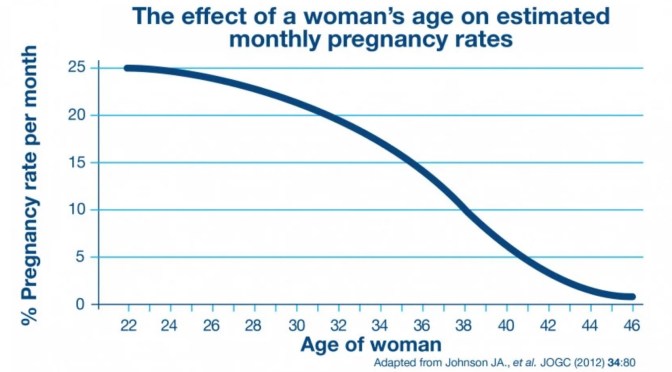

Is it easy for a woman to get pregnant after age 30?

This UK Daily Mail article is a bit old now, but I still it’s important to spread around the knowledge about when a woman’s fertility starts to decline. Somehow, in this age of feminism, there is this idea that women can put off pregnancy into their 40s. The truth is quite different. Let’s take a look at the facts from an unlikely source – the British socialist single-payer health system.

It says:

One of Britain’s top NHS fertility specialists last night issued a stark warning to women: Start trying for a baby before you’re 30 – or risk never having children.

In a strongly worded letter to Education Secretary Nicky Morgan, consultant gynaecologist Professor Geeta Nargund has also demanded that teenagers are taught about the dangers of delaying parenthood, because of the spiralling cost to the taxpayer of IVF for women in their late 30s and 40s.

Professor Nargund cites the agony of a growing number of women left childless as a key reason why fertility lessons must be included in the national curriculum. Her controversial intervention – in which she warns Britain faces a ‘fertility timebomb’ – will fuel the debate over the best time to start a family, amid the rise in women delaying motherhood to pursue careers.

[…]Arguing passionately for fertility lessons, she tells Mrs Morgan: ‘Information is power and the best way to empower people to take control of their fertility is through education.’ Prof Nargund said last night: ‘Ideally, if a woman is ready for a child, she should start trying by the time she is 30. She should consider having a child early because as a woman gets older, her fertility declines sharply.’

If a woman started trying early enough, doctors would still have time to diagnose problems and take action before it was too late, she said.

Her comments were endorsed by Professor Allan Pacey, outgoing chair of the British Fertility Society.

‘You need to be trying by 30 because if there is a problem and you need surgery, hormones or IVF, then you’ve got five years to sort it out,’ he said. ‘If a woman starts trying at 35, doctors have got to sort it out when she is already on a slippery fertility slope’.

Let’s see how accurate women’s beliefs about fertility and age are.

Consider this article from Aeon magazine.

It says:

Many studies show that women are not only woefully ignorant when it comes to fertility, conception and the efficacy of assisted reproductive technologies (ART) – but they overestimate their knowledge about the subject. For instance, a 2011 study in Fertility and Sterility surveyed 3,345 childless women in Canada between the ages of 20 and 50; despite the fact that the women initially assessed their own fertility knowledge as high, the researchers found only half of them answered six of the 16 questions correctly. 72.9 per cent of women thought that: ‘For women over 30, overall health and fitness level is a better indicator of fertility than age.’ (False.) And 90.9 per cent felt that: ‘Prior to menopause, assisted reproductive technologies (such as IVF) can help most women to have a baby using their own eggs.’ (Also false.) Many falsely believed that by not smoking and not being obese they could improve their fertility, rather than the fact that those factors simply negatively affect fertility.

[…]According to a 2011 study in Human Reproduction, which surveyed 410 undergraduate students, most overestimated a women’s chances of spontaneous pregnancy in all age groups, but particularly after receiving IVF beyond age 40. Only 11 per cent of the students knew that genetic motherhood is unlikely to be achieved from the mid-40s onward, unless using oocytes or egg cells frozen in advance. ‘This can be explained by technological “hype” and favourable media coverage of very late pregnancies,’ the authors concluded.

People see graphs of pregnancy chances, but they forget that the rate of miscarriage is also increasing as you age. So, even if you get pregnant, there is a higher risk of miscarriage. Not to mention ectopic pregnancies, and pregnancy complications. It’s also harder to get pregnant your first time after age 30. It’s easier to get pregnant after 30, if it’s not your first time. Also, pregnancies after 30 are much harder on a woman’s body than pregnancies in her 20s.

So, I guess now I’ll issue my advice to women in their 20s on how to avoid infertility:

If you went to college, chances are that you absorbed a lot of feminism. Feminism emphasizes being free of constraints, feeling happy, having fun, career over family, and independence from the needs of men and children. You need to renew your mind in order to undo the cultural denigration of marriage and children. Get yourself a marriage mentor, ask for book recommendations that will educate you about the challenges and rewards of marriage. A good marriage mentor will explain to you why marriage is a better plan than the feminist plan, and will emphasize self-denial, self-sacrifice, self-control and serving others. It’s only by getting specific about marriage and parenting that your heart will change to want to work on marriage rather than work on the things that the feminist culture prefers.

I guess my closing advice would be to be careful about the things you hear about marriage in the culture. It’s very tempting to just believe the words of other people, when they tell you what you want to hear. A lot of people have agendas that sound good, but ultimately, they don’t satisfy. Once your fertility is gone, it’s really gone. IVF and egg-freezing are expensive and unreliable. Again, you should look into this yourself, rather than rely on people who say whatever you want to hear so that you will like them.

Christians should support natural marriage because it protects children from adult selfishness

I have been following Katy Faust’s work on Twitter. She runs the organization “Them Before Us”. She fights laws and policies which allow adults to put their desires above the needs of children. And especially a child’s need for a relationship with his or her mother and father. In a recent article for The Federalist, she takes on a Joshua Harris, who is attacking traditional Christian moral values.

She writes:

In a recent interview, newly ex-mega-church pastor Joshua Harris and author of the 1990s best-seller “I Kissed Dating Goodbye” remarked that the support President Trump has received from the evangelical community has been “incredibly damaging to the gospel and to the church.” I’d wager Harris is projecting something fierce.

In August, Harris announced that he and his wife Shannon were divorcing, that he no longer considers himself a Christian, and that he regrets “standing against marriage equality.” Just in case the point was lost on any of us, he followed up his announcement by posting a picture of himself eating a rainbow donut at the Vancouver Pride parade.

It’s no coincidence that Harris reversed himself on biblical teachings on sex and marriage while abandoning the core tenets of the faith.

The denial of sexual and marital norms by believers is often adjacent to a rejection of the core tenets of the faith. That’s because to arrive at these “inclusive” and “affirming” positions on marriage, Christians must exalt intoxicants such as emotion over uncompromising scripture, tradition, and natural law. Once you shift the authority from sola scriptura to sola feels, it’s only a matter of time before every other orthodox teaching finds itself on the woke chopping block.

I love this SO MUCH.

If I had to pick one conclusion that I have found to be true in 30 years of debating Christian truth claims, it would be that the normal process for becoming an atheist has nothing to do with reason or evidence. People abandon their faith in their teens, long before they have ever done any research into whether Christianity is true. And why? Because they know that their desire to be free of the moral demands of Christianity is true. And they know that their desire to be liked by their non-Christian friends is true.

Katy explains that she loves loves to discuss and debate with non-Christians and LGBT people about the issue she cares about: natural marriage and children’s rights. But she gets annoyed with Christian leaders who misunderstand the gospel.

She writes:

Whether approaching the issue from a natural law perspective where male and female complementarity features prominently, or considering the most widely ratified treaty in human history outlines a child’s right to be known and loved by their mother and father, or through the lens of scripture where God joins together man and woman in life-long union because he is seeking “godly offspring” (Malachi 2), Christian leaders have no excuse for getting marriage wrong.

Zip. Zero. Nada. Their more-tolerant-than-Jesus definition of marriage (Mark 10:6-9) is, to use Harris’ own words, incredibly damaging not only to the church, but to the most vulnerable as well.

The reality is that Christians cannot get gay marriage wrong unless they first get the gospel wrong. Progressive Christians are under the wrong impression that ours is a gospel of affirmation: the idea that God affirms everything we think and say and do and want. This misconceived notion of the gospel believes that for God to genuinely love us, he has to love everything about us.

In this self-esteem-driven, everyone-gets-a-prize culture, a God who sometimes disapproves of our thoughts and behavior (*cough* Psalm 19:14) appears to be quite a bigot. In the “Born This Way” version of the Gaga gospel, Matthew 5:29 would read, “If your right eye causes you to stumble, by all means, redefine the word ‘stumble’ because, well, I wouldn’t want you to lose an eye now, would I?”

An honest reading of scripture reveals that ours is not a gospel of affirmation. Leave aside the 613 laws of the Old Testament in which God is rigidly un-affirming as he imposes devastating consequences on his people when they misuse their words, money, bodies, land, and worship. The New Testament and the gospels are also brimming with commands to put off behaviors that displease God and put on an entirely new nature.

Katy likes to tweet a lot of stories where children who have been impacted by divorce or same-sex marriage or donor-conception or surrogacy speak about how they feel about not having a relationship with their father or mother (or both). But she also knows how to argue against adult selfishness using data.

My advice to Christians is this. If you want to have confidence when defending the Christian teaching on marriage, or defending the rights of children to a Mom and a Dad, then you need to be equipped with research, statistical evidence and stories of those who have been impacted. Being a Christian means advocating for the teachings of Jesus. Jesus cared about children, and he wanted adults to act in a way towards children that would help those children to come to know him and follow him. We should not be affirming adult selfishness when it harms the children who are made to know God.

I think one of the reasons why people like Joshua Harris are abandoning the faith is because abandoning the morality came first. And before the abandoning of morality, there was a refusal to get informed about the harm that sin does. Instead of putting in the time to look at the evidence, they just altered their worldviews in order to feel good and be liked. Well, feeling good and being liked has never been important to the Christian life. But valuing truth, defending Christian convictions with evidence, and protecting the weak from the strong is found everywhere in the New Testament.