Tag Archives: Love

Why doesn’t God make his existence more obvious to people?

Sherlock Holmes and John Watson are going to take a look at the data

Have you ever heard someone say that if God existed, he would give us more evidence? This is called the “hiddenness of God” argument. It’s also known as the argument from “rational non-belief”.

Basically the argument is something like this:

  1. God is all powerful
  2. God is all loving
  3. God wants all people to know about him
  4. Some people don’t know about him
  5. Therefore, there is no God.

In this argument, the atheist is saying that he’s looked for God real hard and that if God were there, he should have found him by now. After all, God can do anything he wants that’s logically possible, and he wants us to know that he exists. To defeat the argument we need to find a possible explanation of why God would want to remain hidden when our eternal destination depends on our knowledge of his existence.

What reason could God have for remaining hidden?

Dr. Michael Murray, a brilliant professor of philosophy at Franklin & Marshall College, has found a reason for God to remain hidden.

His paper on divine hiddenness is here:
Coercion and the Hiddenness of God“, American Philosophical Quarterly, Vol 30, 1993.

He argues that if God reveals himself too much to people, he takes away our freedom to make morally-significant decisions, including responding to his self-revelation to us. Murray argues that God stays somewhat hidden, so that he gives people space to either 1) respond to God, or 2) avoid God so we can keep our autonomy from him. God places a higher value on people having the free will to respond to him, and if he shows too much of himself he takes away their free choice to respond to him, because once he is too overt about his existence, people will just feel obligated to belief in him in order to avoid being punished.

But believing in God just to avoid punishment is NOT what God wants for us. If it is too obvious to us that God exists and that he really will judge us, then people will respond to him and behave morally out of self-preservation. But God wants us to respond to him out of interest in him, just like we might try to get to know someone we admire. God has to dial down the immediacy of the threat of judgment, and the probability that the threat is actual. That leaves it up to us to respond to God’s veiled revelation of himself to us, in nature and in Scripture.

(Note: I think that we don’t seek God on our own, and that he must take the initiative to reach out to us and draw us to him. But I do think that we are free to resist his revelation, at which point God stops himself short of coercing our will. We are therefore responsible for our own fate).

The atheist’s argument is a logical/deductive argument. It aims to show that there is a contradiction between God’s will for us and his hiding from us. In order to derive a contradiction, God MUST NOT have any possible reason to remain hidden. If he has a reason for remaining hidden that is consistent with his goodness, then the argument will not go through.

When Murray offers a possible reason for God to remain hidden in order to allow people to freely respond to him, then the argument is defeated. God wants people to respond to him freely so that there is a genuine love relationship – not coercion by overt threat of damnation. To rescue the argument, the atheist has to be able to prove that God could provide more evidence of his existence without interfering with the free choice of his creatures to reject him.

Murray has defended the argument in works published by prestigious academic presses such as Cambridge University Press, (ISBN: 0521006104, 2001) and Routledge (ISBN: 0415380383, 2007).

Positive arguments for Christian theism

Why should a woman marry a man while she’s still under 25?

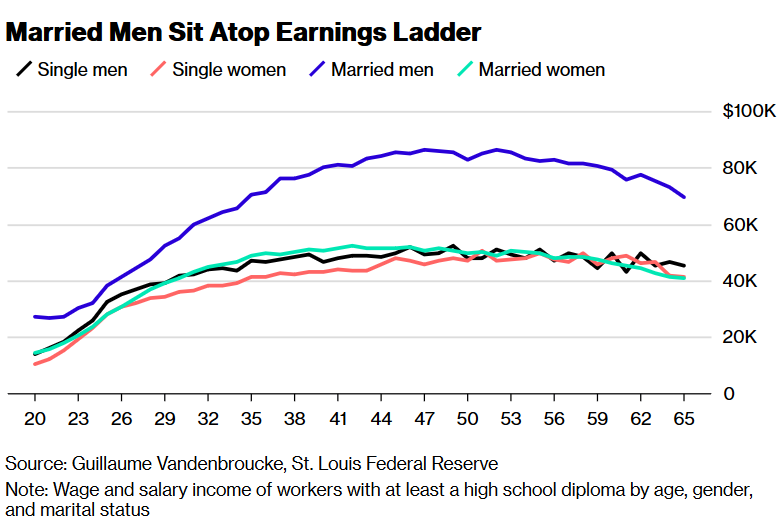
Married men seem to enjoy a boost in earnings from age 23-43
Married men seem to enjoy a boost in earnings between age 22-45

I saw a bunch of pro-marriage friends were tweeting about this article from the St. Louis Federal Reserve which talks about how well married men do financially compared to single men, and using it as a reason to argue that men should get married. The article from the St. Louis Reserve doesn’t have much commentary, but this article from the far-left Washington Post by Brad Wilcox has a lot to say.

Excerpt:

Marriage has a transformative effect on adult behavior, emotional health, and financial well-being—particularly for men.

[…]Men who get married work harder and more strategically, and earn more money than their single peers from similar backgrounds. Marriage also transforms men’s social worlds; they spend less time with friends and more time with family; they also go to bars less and to church more.

[…]Our research, featured in a recent report, “For Richer, For Poorer: How Family Structures Economic Success in America,” indicates that men who are married work about 400 hours more per year  than their single peers with equivalent backgrounds. They also work more strategically: one Harvard study found that married men were much less likely than their single peers to quit their current job unless they had lined up another job.

This translates into a substantial marriage premium for men. On average, young married men, aged 28-30, make $15,900 more than their single peers, and married men aged 44-46 make $18,800 more than their single peers.

That’s even after controlling for differences in education, race, ethnicity, regional unemployment, and scores on a test of general knowledge. What’s more: the marriage premium operates for black, Hispanic, and less-educated men in much the same way as it does for men in general.

For instance, men with a high-school degree or less make at least $17,000 more than their single peers.

So, what about these differences between married men and single men? Are men able to earn more if they have a wife to support them and care for their needs? Or is it just that women prefer men who are already able to take care of themselves?

Well, in most cases, it’s the former:

2. Married men are motivated to maximize their income. For many men, this responsibility ethic translates into a different orientation toward work, more hours, and more strategic work choices. Sociologist Elizabeth Gorman finds that married men are more likely to value higher-paying jobs than their single peers.

This is partly why studies find that men increase their work hours after marrying and reduce their hours after divorcing. It’s also why married men are less likely to quit a current job without finding a new job. Indeed, they are also less likely to be fired than their single peers.

3. Married men benefit from the advice and encouragement of their wives. Although there is less research on this, we suspect that men also work harder and more strategically because they are encouraged to do so by their wives, who have an obvious interest in their success. One study appears to buttress this point, finding that men with better-educated wives earn more, even after controlling for their own education.

4. Employers like married men with children.  There is evidence that employers  prefer and promote men who are married with children, especially compared to their childless male peers and to mothers. Married men are often seen as more responsible and dedicated workers and are rewarded with more opportunities by employers. While illegal bias and long-held stereotypes appear to play a role in this historic preference, it nonetheless helps explain why married family men get paid more.

Now what’s the purpose of me writing this? Well, I’m actually NOT writing this to pressure men to get married. Why not? Because although marriage was a pretty good deal 100 years ago, it’s not as good of a deal under the current laws and policies, e.g. – no-fault divorce, the threats of false accusations, the Sexual Revolution, etc. So I wouldn’t advise a man to rush into marriage to just anybody in order to get the financial (and health) benefits of having a wife. Marriage is only safe when you choose a woman carefully.

But I am writing this to women who are being told by the culture to delay marriage, and especially to delay marriage to use your youth and beauty to “have fun” with boys who won’t commit to marriage. If a woman loves a marriage-focused man and really wants to take care of him and support him, then early marriage is one of the very best ways to really help him during the years (22-45) when it really makes a difference. Marrying a man who wants marriage when you’re still young means that he will have many, many measurable benefits.

It’s important to marry a man when the marriage has the potential to do the most good for him in areas like health, career, finances and children. Men typically don’t want to marry women who are older, because they have more sexual experience and because they get used to giving a man sex in order to get him to do what she wants. Once a woman gets used to doing this, it becomes much harder to trust a good man to lead, and to give a man respect as a leader.

In addition, men know that women never change who they are really attracted to. If a woman chooses superficially attractive men who won’t commit over and over, then even if she “settles” for a man later on, she probably won’t be able to be attracted him. Men know not to choose women who won’t value them for their traditional moral values, conservative politics and ability to perform traditional male roles like providing. Men know that a woman who feels that she is “settling” for less than she deserves is more likely to disrespect him, and to withhold sex from him.

Now pro-marriage parents and pro-marriage pastors will typically tell you that they want to let their daughters decide when to marry, so that they will be happy having “fun” before marriage, and happy being provided for after marriage. But when those women are done playing the field and in their mid-thirties, their relatives and pastors are not thinking about what men’s interests are. They’re thinking about how to get this woman married, regardless of the man’s interests. And men know that. So they aren’t going to be bullied or shamed into a marriage after the window when it benefits them has closed. If parents and pastors want their daughters married AT ALL, then they need to encourage women to be self-controlled and marriage-focused EARLY.

What did early church fathers think about abortion and infanticide?

Unborn Baby - 10 weeks old
Unborn Baby – 10 weeks old

I noticed that the Southern Baptists over at ERLC had a post up which seemed to say that preaching against abortion was morally wrong, because it hurts women’s feelings. This didn’t seem like a very traditional Christian view to me.

The author Phoebe Cates writes:

So, you don’t have to post internet memes and videos, display bumper stickers, or make rude comments to tell me how terrible abortion is. Nor do you need to shout it from street corners or pulpits—I know. My mother knows. Over 66% of women know.

I quoted her from Pulpit and Pen, and it looks like the post has been edited to remove this shaming of pro-life apologists.

The author thinks that women do think abortion is wrong, despite the fact that young, unmarried women vote overwhelmingly for abortion rights in elections. Her goal doesn’t seem to be to convince women not to have abortions by making a case for the right to life of the unborn. Her goal seems to be to stop Christians from making women feel judged when they kill their children. Her focus is on women’s feelings, not the right to life of unwanted children.

The church has been changing a lot lately to accept the teachings of radical feminism. Radical feminism urges women to abandon chastity, delay marriage, get on birth control, and have reckless recreational sex with attractive, no-commitment men, while pursuing their careers. And abortion is fine with these Christians, because they think it’s just a method of birth control to be used to help women to avoid being “punished with a baby” as Obama said. The concern of these Christians about abortion isn’t that it kills babies, it’s that women feel judged when they kill babies.

So, what did Christians used to believe about protecting children before they tossed out the Bible for radical feminism?

This is from Birds of the Air.

Summary:

Recently I came across a reading of the Didache. “The what?” you may ask. The Didache is a book written somewhere in the first or second century. For a long time it was up for consideration as Scripture. It was believed to be the Teaching of the Twelve Apostles. Eventually it was agreed that the book was an excellent book, but not inspired Scripture. So I was pleased to be able to download this admirable book containing good teachings from the early Church fathers.

The book seemed to be largely a lot of quotes from Scripture. You’ll learn the basic rules of Christianity — “First, you shall love God who made you; second, love your neighbor as yourself.” You’ll learn that “grave sins” are forbidden, like adultery, murder, fornication, and so on. (They specifically include pederasty in the list.) There are instructions regarding teachers, prophets, Christian assembly, and so on. Lots of the normal, good stuff. But, since this was written sometime prior to 200 AD, I was somewhat surprised at this instruction: “You shall not murder a child by abortion” (Didache, Ch 2).

I got curious about what babies look like when they are just a few weeks old, so I went looking for pictures of them.

This post from Life News has ten excellent pictures of life inside the womb.

Here’s my favorite from 10 weeks:

Unborn Baby - 10 weeks old

Unborn Baby – 10 weeks old

This is a first trimester baby!

I decided to go hunting to see what is developed at this time, and found this list:

  • From this week until birth, the developing organism is called a fetus.
  • The fetus is now the size of a small strawberry.
  • The feet are 2mm long (one tenth of an inch).
  • The neck is beginning to take shape.
  • The body muscles are almost developed. Baby has begun movement.
  • While still too small for you to feel, your little one is wriggling and shifting.
  • The jaws are in place. The mouth cavity and the nose are joined.
  • The ears and nose can now be seen clearly.
  • Fingerprints are already evident in the skin.
  • Nipples and hair follicles begin to form.

The unborn baby is now called a fetus. Though the fetus is constantly moving, you will not be able to actually feel fetal movement for several more weeks. All of the organs, muscles, and nerves are in place and beginning to function. As the hands and feet develop fingers and toes, they have lost their paddle like look. The touch pads on the fingers form and already have fingerprints.

During this week of pregnancy the crown to rump length of the fetus is 0.9 inch to 1.2 inches (22 to 30mm), weight 0.07 ounce (2gm). They are now on the way to forming their testicles or ovaries, getting ready for the next generation. Until the ninth week of fetus development, the fetal reproductive apparatus is the same one for the both sexes. The head is still large and curves into chest.

Each week your uterus grows larger with the baby growing inside it. You may begin to see your waistline growing thicker by this time. A pelvic exam will detect that your uterus has grown from it’s normal, size of your fist, to a little bigger than a grapefruit.

Fascinating!