I have a friend who is considering Christianity and he is stuck on the doctrine of the Trinity. Tom, this one’s for you.
Excerpt:
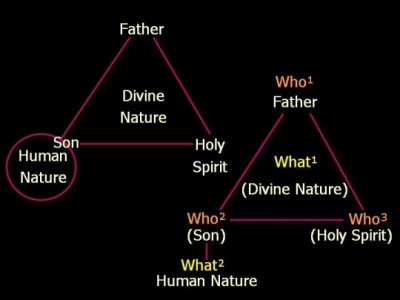
So, what exactly do we mean when we talk about the Trinity? Writing in the early third century, in hisAgainst Praxeas, Tertullian is credited with first employing the words “Trinity”, “person” and “substance” to convey the idea of the Father, Son and Spirit being “one in essence — but not one in person”. Indeed, Tertullian writes,
“Thus the connection of the Father in the Son, and of the Son in the Paraclete, produces three coherent Persons, who are yet distinct One from Another. These Three are, one essence, not one Person, as it is said, “I and my Father are One,” in respect of unity of substance not singularity of number.”
This concept was established as church orthodoxy at the famous Council of Nicaea in A.D. 325. The Nicene Creed speaks of Christ as “God of God, Light of Light, very God of very God, begotten not made, being of one substance with the Father.”
It is this definition that I am going to assume in the discussion that follows. Succinctly, then, the doctrine of the Trinity may be defined thusly: Within the one being or essence that is God, there exists three co-equal and co-divine distinct persons — namely the Father, Son and Holy Spirit — who share that essence fully and completely. This concept is not to be confused with polytheism, which maintains that there are multiple gods. While orthodox Christianity emphatically holds there to be only one God, we nonetheless understand God to be complex in his unity. The concept is also not to be confused with the ancient heresy of modalism, which maintains that God exists in three different modes. The Son has never been the Father and the Holy Spirit has never been the Son or the Father. Modalism is refuted by the picture given to us in all four gospels (Matthew 3:16-17; Mark 1:9-11; Luke 3:21-22; John 1:32-34) in which the Holy Spirit descends on Jesus in the form of a dove and a voice is heard from Heaven “This is my beloved Son. With him I am well pleased.” Similarly, it should be noted that the Father, Son and Spirit do not each make up merely a third of the Godhead. Rather, each of the three persons is God in the full and complete sense of the word.
Having shown that Scripture emphatically rejects the notion that the Father, Son and Spirit are synonymous persons, only five propositions remain to be demonstrated in order to provide Biblical substantiation for the concept of the Trinity. Those propositions are:
There is only one eternal God.
The Father is the eternal God.
The Son is the eternal God.
The Holy Spirit is the eternal God.
Although the Father, Son and Holy Spirit are non-synonymous persons, the concept of the Trinity does not violate the law of non-contradiction.
Let’s take a look at each of these in turn.
He then takes a close look at what the Bible says about God with respect to those assertions. There can be no doubt that the Bible teaches that God is one divine substance, and three persons.
In a documentary from the Discovery Channel on the search for extraterrestrial life, Stephen Hawking provides an extraordinarily candid example of the fallacious materialist logic for why extraterrestrial life “must” be possible.
Around 1:15 of the clip below, Hawking states:
The life we have on earth must have spontaneously generated itself. It must therefore be possible for life to be generated spontaneously elsewhere in the universe.
The gaping hole in Hawking’s logic should be immediately apparent to anyone willing to think critically and skeptically: If we haven’t yet explained how life could have spontaneously generated on earth, how do we know that it can be generated spontaneously elsewhere in the universe?
What makes Hawking’s position even worse is that in this clip he admits that “we don’t understand how life formed.”
So according to Hawking, “we don’t understand how life formed,” but he knows that “the life we have on earth must have spontaneously generated itself.” Hawking might be, as the documentary puts it, “one of the greatest minds of our generation,” but as anti-ID biochemist Russell Doolittle once said to me in grad school (when attacking Michael Behe), smart guys are great rationalizers.
Here’s the clip:
I would not want to be a materialist. I would have to believe in magic and defend a lot of nonsensical things. Then I would lose a lot of arguments. I wouldn’t like it. I guess I haven’t believed in the Flying Spaghetti Monster of materialism since I learned about the Big Bang. Abandoning materialism is just part of growing up. You put the science fiction down, and start reading science.
Conference sessions will examine the conflicting worldviews of theism and materialism; the widespread impact of materialism on science, ethics, society, Biblical studies and theology; the latest scientific evidence against materialism and for intelligent design in biology and cosmology; and the positive implications of modern science for theism.
Speakers will include Westminster faculty Vern Poythress, author of Redeeming Science; K. Scott Oliphint, author of Reasons for Faith; Jeffrey Jue, author of Heaven Upon Earth; Brandon Crowe, Lecturer in the New Testament; and Westminster President Peter Lillback, author of George Washington’s Sacred Fire. Speakers will also include Discovery Institute Fellows such as astronomer Guillermo Gonzalez, co-author of The Privileged Planet; molecular and cell biologist Jonathan Wells, co-author of The Design of Life and author of The Myth of Junk DNA (forthcoming, 2011); philosopher of biology Paul Nelson; philosopher and theologian Jay Richards, editor of God and Evolution: Protestants, Catholics, and Jews Explore Darwin’s Challenge to Faith; and social scientist John West, author of Darwin Day in America: How Our Politics and Culture Have Been Dehumanized in the Name of Science.
If any of my readers are interested in seeing how science is at war with the religion of materialism, please get the book “Who Made God?” by Edgar Andrews, which is suitable for readers of virtually any experience level. I also loved “The Case for a Creator” by Lee Strobel, which is also good for beginners.
This lecture is based on the book “Truth in Religion” by famous philosopher Mortimer J. Adler. At the time of writing the book, he was not a Christian, but there is still a lot of value in the book for Christians who are trying to understand what religion is about. In one sense, the material on this lecture should be the first thing that Christians learn about Christianity before they ever open the Bible. And I mean before even knowing about the existence of the Bible. The most important question when it comes to religion is this: “IS RELIGION CONCERNED WITH TELLING THE TRUTH ABOUT REALITY”? That is the first question to answer.
Here’s a bio from his faculty page at Baylor University:
Walter Bradley (B.S., Ph.D. University of Texas at Austin) is Distinguished Professor of Engineering at Baylor. He comes to Baylor from Texas A&M University where he helped develop a nationally recognized program in polymeric composite materials. At Texas A&M, he served as director of the Polymer Technology Center for 10 years and as Department Head of Mechanical Engineering, a department of 67 professors that was ranked as high as 12th nationally during his tenure. Bradley has authored over 150 refereed research publications including book chapters, articles in archival journals such as the Journal of Material Science, Journal of Reinforced Plastics and Composites, Mechanics of Time-Dependent Materials, Journal of Composites Technology and Research, Composite Science and Technology, Journal of Metals, Polymer Engineering and Science, and Journal of Materials Science, and refereed conference proceedings.
Dr. Bradley has secured over $5.0 million in research funding from NSF grants (15 yrs.), AFOSR (10 years), NASA grants (10 years), and DOE (3 years). He has also received research grants or contracts from many Fortune 500 companies, including Alcoa, Dow Chemical, DuPont, 3M, Shell, Exxon, Boeing, and Phillips.
He co-authored The Mystery of Life Origin: Reassessing Current Theories and has written 10 book chapters dealing with various faith science issues, a topic on which he speaks widely.
He has received 5 research awards at Texas A&M University and 1 national research award. He has also received two teaching awards. He is an Elected Fellow of the American Society for Materials and the American Scientific Affiliation (ASA), the largest organization of Christians in Science and Technology in the world. He is President elect of the ASA and will serve his term in 2008.
some propositions are true culturally – just for certain groups in certain times (cultures)
some proposition are true trans-culturally – true independently of what anyone wants or feels
Mathematical truth is trans-cultural – it is true regardless of cultural fashions
Scientific truth is trans-cultural – it is true regardless of cultural fashions
Some truths are not like this – cooking traditions, clothing traditions and greeting traditions
These kinds of truths are NOT trans-cultural, they vary by culture
The question is – is religion true like math and science, or true depending on the culture
Some people think that your religion depends on where you were born or what your family believes
Religions make conflicting claims about the way the world really is, so they can’t all be true
And these conflicts are at the core of the religions – who God is, how can we be related to him, etc.
So if religions convey trans-cultural truth, then either one is true or none are true
If they are not trying to convey trans-cultural truth, then they are not like math and science
Let’s assume that religion is the same as trans-cultural truth
How can we know which religion is true? 1) the laws of logic, 2) empirical testing against reality
Logical consistency is needed to make the first cut – self-contradictory claims cannot be true
To be true trans-culturally, a proposition must at least NOT break the law of non-contradiction
According to Mortimer Adler’s book, only Christianity, Judaism and Islam are not self-contradictory
All the others can be excluded on the basis of overt internal contradictions on fundamental questions
The others that are self-contradictory can be true culturally, but not trans-culturally
The way to proceed forward is to test the three non-contradictory religions against science and history
One of these three may be true, or they could all be false
We can test the three by evaluating their conflicting truth claims about the historical Jesus
Famous skeptics have undertaken studies to undermine the historical Jesus presented in the Bible
Lew Wallace, Simon Greenleaf and Frank Morrison assessed the evidence as atheists and became Christians
There is a lot of opposition in culture to the idea that one religion might be true
But if you take the claims of Jesus at face value, he claims to be the unique revelation of God to mankind
Either he was telling the truth about that, or he was lying, or he was crazy
So which is it?
Why don’t religious people ask if their religion is true?
Truth claims are necessarily divisive. If God wants people to know him as he is, and I tell them a lie that they can invent their own view of him, then that is sinning against God. And the only reason I would lie about that is because I can’t be bothered studying these things and taking the heat for standing up for God’s real personality and goals for his creatures to his creatures. Nowhere in Bible does it say that our goal is to tell people that they can believe anything they want about God and he really doesn’t care since he just wants us to be nice to each other and be happy and have fun and believe whatever we want about him whether it’s true or not.
People who think that all religions are true are doing it for three reasons: 1) they don’t want to study and be bound to one view through study, 2) they want to use religion to be comforted, but to leave it when it makes demands, 3) they want other people to like them so they want to say that all views of God are true. But this pluralism is not a view that is consistent with the plain meaning of the Bible – the people who embrace the idea that all religions are true based on personal preferences or cultures reject the plain meaning of the gospel, which makes exclusive claims. It is NOT TRUE that you can believe whatever you want as long as you are sincere – sincerity doesn’t mean that you can’t be mistaken. Not wanting to know whether Christianity is true is really just another way of saying that you don’t think God’s existence and character matters that much to you. Is that a good relationship? Is that the right way to be God’s friend?
I think that God’s existence and character can be assessed and known based on logic and evidence. I think that God exists independently of whether I want him to or not, and I think that his character and desires are not the same as my character and desires. And I don’t really care what my neighbors think of my disagreeing with them, my goal is not to keep silent and to just get along with them and be happier in my community. God’s first commandment to us is not to love our neighbor – that’s number two. Number one is to love him. And how can we love him, if we don’t want to know him. And how can we love him, if we don’t tell people the truth about him, (when asked to, and within the context of a respectful relationship, as in 1 Pet 3:15).
13If there is no resurrection of the dead, then not even Christ has been raised.
14And if Christ has not been raised, our preaching is useless and so is your faith.
15More than that, we are then found to be false witnesses about God, for we have testified about God that he raised Christ from the dead. But he did not raise him if in fact the dead are not raised.
16For if the dead are not raised, then Christ has not been raised either.
17And if Christ has not been raised, your faith is futile; you are still in your sins.
18Then those also who have fallen asleep in Christ are lost.
19If only for this life we have hope in Christ, we are to be pitied more than all men.
That message is not going to win us a lot of friends, but our job as Christians is to tell how and why God stepped into history. Jesus expects us to be his ambassadors and to carry out the task of evangelism faithfully, and to suffer with him and to be rejected like he was rejected.


 WINTERY KNIGHT