

Tag Archives: Logic

Does God’s omniscience conflict with human free will?

I have a key that will unlock a puzzling mystery

Here’s the setup for the question, from Come Reason Ministries.

Excerpt:

Hello,

Christian doctrine holds that God is all knowing (1 John 3:20), and humans have free will (Deuteronomy 30:19 is my favorite example). however, at my favorite apologetics debate board, I have seen skeptics raise an objection to these points several times. the basic logic behind their arguments is this:

  1. A being with free will, given two options A and B, can freely choose between A and B.
  2. God is omniscient (all-knowing).
  3. God knows I will choose A.
  4. God cannot be wrong, since an omniscient being cannot have false knowledge.
  5. From 3 and 4, I will choose A and cannot choose B.
  6. From 1 and 5, omniscience and free will cannot co-exist.

I have read many counter-arguments from apologetics sites, but they were either too technical (I couldn’t understand them), or not satisfying. so, I was wondering what would your input be on this issue?

Thank you,

Justin

Ever heard that one? I actually had that one posed to me by a guy I used to work with who had a Ph.D in computer science from Northwestern. So this is an objection you may actually here.

Here’s Lenny Eposito’s answer:

Hi Justin,

Thanks for writing. This is a great question as it shows how even those who appeal to logic can have biases that blind them. Let’s examine this argument and see if it follows logically.

Premises 1 and 2 in your outline above are the main premises to the argument and are not disputed. The Christian worldview argues that every human being is a free moral agent and is capable of making choices simply by exercising their will, not under compulsion or because of instinct. Also, it is a long held doctrine of Christianity that God is all-knowing. The Bible says that God knows “the end from the beginning (Isaiah 46:10).” For omniscience to be truly knowledgeable it must be correct knowledge, so premise number 4 is also granted.

However, point number 5 is where the logic falters. Those who argue in this manner make the mistake of thinking that because God possesses knowledge about a specific matter, then he has influenced it. That does not follow at all. Just because God can foresee which choice you will make, it does not mean you couldn’t still freely choose the other option.

Let me give you an example. I have a five year old son. If I were to leave a chocolate chip cookie on the table about a hour before dinner time and my son was to walk by and see it, I know that he would pick up the cookie and eat it. I did not force him to make that decision. In fact, I don’t even have to be in the room at all. I think I know my son well enough, though, to tell you that if I come back into the kitchen the cookie will be gone. His act was made completely free of my influence, but I knew what his actions would be.

In examining the argument, the assumption is made in premise 3 that because God knows I will choose A somehow denies me the choice of B. That is the premise that Christianity rejects. Omniscience and free will are not incompatible and it is a non-sequitor to claim otherwise.

Thank you Justin for this interesting question. I pray that you will continue to defend the gospel of our Lord and may He continue to bless you as you seek to grow in Him.

That’s a great answer and should work in ordinary conversations.

More technical

J.W. Wartick maps out the arguments more fully with symbolic logic here on his Always Have A Reason blog. But I’ll just excerpt the gist of it.

Excerpt:

It is necessarily true that if God knows x will happen, then x will happen. But then if one takes these terms, God knowing x will happen only means that x will happen, not that x will happen necessarily. Certainly, God’s foreknowledge of an event means that that event will happen, but it does not mean that the event could not have happened otherwise. If an event happens necessarily, that means the event could not have happened otherwise, but God’s foreknowledge of an event doesn’t somehow transfer necessity to the event, it only means that the event will happen. It could have been otherwise, in which case, God’s knowledge would have been different.

[…]Perhaps I could take an example. Let’s say that I’m going to go to classes tomorrow (and I do hope I will, I don’t like missing classes!). God knows in advance that I’m going to go to classes tomorrow. His knowledge of this event means that it will happen, but it doesn’t mean that I couldn’t choose to stay in and sleep for a while, or play my new copy of Final Fantasy XIII, or do something more useless with my time. If I chose to, say, play Final Fantasy XIII (a strong temptation!), then God simply would have known that I would play FFXIII. His knowledge does not determine the outcome, His knowledge is simply of the outcome.

If we choose A, God would foreknow A. If we choose B, God would foreknow B. His foreknowledge of our choices is contingent on our making free choices.
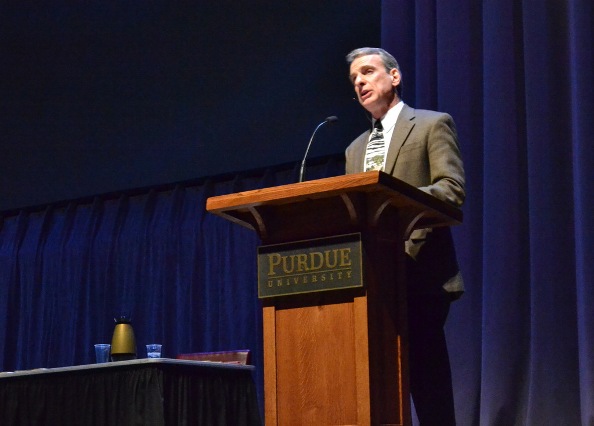
William Lane Craig lectures on naturalistic alternatives to the Big Bang

William Lane Craig lecturing to university students

Here’s the lecture, which was given in 2004 at the University of Colorado, Boulder.

This lecture might be a little advanced for beginners, but if you stretch your mind first, you shouldn’t tear anything. (Note: standard disclaimers apply if you do tear something!)

The description of the video states:

This is quite simply one of the best lectures William Lane Craig (a philosopher of science) has given. Craig explores the origins of the universe. He argues for a beginning of the universe, while refuting scientific models like the Steady State Theory, the Oscillating Theory, Quantum Vacuum Fluctuation Model, Chaotic Inflationary Theory, Quantum Gravity Theory, String Theory, M-Theory and Cyclic Ekpyrotic Theory.

And here is the description of the lecture from Reasonable Faith:

A Templeton Foundation lecture at the University of Colorado, Boulder, laying out the case from contemporary cosmology for the beginning of the universe and its theological implications. Includes a lengthy Q & A period which features previous critics and debate opponents of Dr. Craig who were in attendance, including Michael Tooley, Victor Stenger, and Arnold Guminski.

Craig has previously debated famous atheists Stenger and Tooley previously. And they both asked him questions in the Q&A time of this lecture. Imagine – having laid out your entire case to two people who have debated you before and who know your arguments well. What did they ask Craig, and how did he respond?

The scientific evidence

The Big Bang cosmology that Dr. Craig presents is the standard model for how the universe came into being. It is a theory based on six lines of experimental evidence.

Scientific evidence:

  1. Einstein’s theory of general relativity (GTR)
  2. the red-shifting of light from distant galaxies implies an expanding universe
  3. the cosmic background radiation (which also disproves the oscillating model of the universe)
  4. the second law of thermodynamics applied to star formation theory
  5. hydrogen-helium abundance predictions
  6. radioactive element abundance predictions

It’s probably a good idea to be familiar with these if you are presenting this argument, because experimental science is a reliable way of knowing about reality.

Published research paper

This lecture by Dr. Craig is based on a research paper published in an astrophysics journal, and was delivered to an audience of students and faculty, including atheist physicist Victor Stenger and prominent atheist philosopher Michael Tooley, at the University of Colorado at Boulder.

Here’s the peer-reviewed article that the lecture is based on.

Here’s the abstract:

Both cosmology and philosophy trace their roots to the wonder felt by the ancient Greeks as they contemplated the universe. The ultimate question remains why the universe exists rather than nothing. This question led Leibniz to postulate the existence of a metaphysically necessary being, which he identified as God. Leibniz’s critics, however, disputed this identification, claiming that the space-time universe itself may be the metaphysically necessary being. The discovery during this century that the universe began to exist, however, calls into question the universe’s status as metaphysically necessary, since any necessary being must be eternal in its existence. Although various cosmogonic models claiming to avert the beginning of the universe predicted by the standard model have been and continue to be offered, no model involving an eternal universe has proved as plausible as the standard model. Unless we are to assert that the universe simply sprang into being uncaused out of nothing, we are thus led to Leibniz’s conclusion. Several objections to inferring a supernatural cause of the origin of the universe are considered and found to be unsound.

The whole text of the article is posted online here.

If you want something to post on your Twitter or Facebook that is much shorter than this lecture, then you should check out this quick 4-minute explanation of the kalam argument.

William Lane Craig discusses faith and reason with university students

William Lane Craig lecturing to university students

This is an interview of Dr. William Lane Craig before college students at the University of Central Florida. (95 minutes)

You can get an MP3 of the lecture here. (33 MB)

Questions from the interviewer: (40 minutes)

  • What started you on his journey of studying faith and reason?
  • How would you define the word “faith”?
  • Are faith and reason compatible? How are they related?
  • How can reasonable faith help us to avoid the two extremes of superstition and nihilism?
  • Who makes the best arguments against the Christian faith?
  • Why are angry atheists like Dawkins and Hitchens more well known than better-informed academic atheists?
  • Does the Bible require Christians to give the unbeliever reasons for their faith?
  • How does faith spur Christians to think carefully about the big questions in life?
  • Should the American church prod churchgoers to develop their minds so they can engage the secular culture?
  • When talking about Christianity intellectually, is there a risk of neglecting the experience of being a Christian?
  • Which Christian apologist has shaped your thinking the most?
  • Which Christian philosopher has shaped your thinking the most?
  • Does the confidence that comes from apologetics undermine humility and reverence?
  • If you had to sketch out a 5 minute case for Christianity, what would you present?
  • Can non-Christians use their reason to arrive at truth?
  • Are there cases where atheists must affirm irrational things in order to remain atheists?
  • Can the universe have existed eternal, so that there is no need to explain who created it?
  • Even if you persuade someone that Christianity is true, does that mean they will live it out?

There is also a long period of questions, many of them hostile, from the audience of students (55 minutes).

  • Haven’t you said nasty things about some atheists? Aren’t you a meany?
  • What do you make of the presuppositional approach to apologetics?
  • Can a person stop being a Christian because of the chances that happen to them as they age?
  • Why did God wait so long after humans appeared to reveal himself to people through Jesus?
  • Can a person be saved by faith without have any intellectual assent to truth?
  • How do you find time for regular things like marriage when you have to study and speak so much?
  • How would you respond to Zeitgeist and parallels to Christianity in Greek/Roman mythology?
  • Do Christians have to assume that the Bible is inerrant and inspired in order to evangelize?
  • If the universe has a beginning, then why doesn’t God have a beginning?
  • Can you name some philosophical resources on abstract objects, Platonism and nominalism?
  • How can you know that Christianity more right than other religions?
  • Should we respond to the problem of evil by saying that our moral notions are different from God’s?
  • Define the A and B theories of time. Explain how they relate to the kalam cosmological argument.
  • How can Christians claim that their view is true in the face of so many world religions?
  • What is the role of emotions in Christian belief and thought?
  • Can evolution be reconciled with Christian beliefs and the Bible?
  • When witnessing person-to-person, should you balance apologetics with personal testimony?
  • Is there a good analogy for the trinity that can help people to understand it? [Note: HE HAS ONE!]
  • How can Christians reconcile God’s omniscience, God’s sovereignty and human free will?

This is a nice introductory lecture that is sure to get Christians to become interested in apologetics. As you watch or listen to it, imagine what the world would be like if every Christian could answer the questions of skeptical college students and professors like Dr. Craig. What would non-Christians think about Christianity if every Christian had studied these issues like Dr. Craig? Why aren’t we making an effort to study these things so that we can answer these questions?

It is really fun to see him fielding the questions from the skeptical university students. My favorite question was from the physics student who sounds really foreign, (at 1:19:00), then you realize that he is a Christian. I do think that Dr. Craig went a little far in accommodating evolution, but I put that down to the venue, and not wanting to get into a peripheral issue. I’m also surprised that no one asked him why God allows humans to suffer and commit acts of evil.

If you are looking for a good basic book on apologetics, then I would choose “Is God Just a Human Invention?” by Sean McDowell and Jonathan Morrow.

Who is William Lane Craig?

About William Lane Craig:

William Lane Craig is Research Professor of Philosophy at Talbot School of Theology in La Mirada, California.

Dr. Craig pursued his undergraduate studies at Wheaton College (B.A. 1971) and graduate studies at Trinity Evangelical Divinity School (M.A. 1974; M.A. 1975), the University of Birmingham (England) (Ph.D. 1977), and the University of Munich (Germany) (D.Theol. 1984). From 1980-86 he taught Philosophy of Religion at Trinity… In 1987 they moved to Brussels, Belgium, where Dr. Craig pursued research at the University of Louvain until assuming his position at Talbot in 1994.

He has authored or edited over thirty books, including The Kalam Cosmological ArgumentAssessing the New Testament Evidence for the Historicity of the Resurrection of JesusDivine Foreknowledge and Human FreedomTheism, Atheism and Big Bang Cosmology; and God, Time and Eternity, as well as over a hundred articles in professional journals of philosophy and theology, including The Journal of PhilosophyNew Testament StudiesJournal for the Study of the New TestamentAmerican Philosophical QuarterlyPhilosophical StudiesPhilosophy, and British Journal for Philosophy of Science.

Craig’s CV is here.

Craig’s list of publications is here.

William Lane Craig is, without a doubt, the top living defender of Christianity. He has debated all of the most famous atheists, including Christopher Hitchens, Sam Harris, etc. as well as academic atheists like Quentin Smith, Peter Millican, etc. if you search this blog, you’ll find many debates posted here, sometimes even with snarky summaries.