
Tag Archives: Liar

Is Eugenie Scott right? Are there no peer-reviewed papers supporting ID?

The video above is discussed in this must-hear podcast, featuring Casey Luskin.

The MP3 file is here.

Details:

On this episode of ID The Future, Casey Luskin puts to rest once and for all the common assertion by opponents of intelligent design that there are no scientific papers supporting the claims of ID. This wasn’t true in 2005 when Eugenie Scott of the NCSE stated it on MSNBC and it certainly isn’t true six years later. Luskin discusses the most recent scientific paper, by Stephen Meyer and Paul Nelson, and talks about the importance of the peer-reviewed scientific literature: “These papers collectively make a case that intelligent causation is necessary to produce the sort of biological complexity that we are discovering in the cell today.”

If you listen to the podcast, Luskin goes over some of the recent peer-reviewed papers that support ID. But much more importantly, he proves that Eugenie Scott is a liar. She is literally caught in a lie in the video above. She claims that there are no peer-reviewed papers that support ID. Stephen Meyer cites a peer-reviewed paper that he authored. Eugenie Scott claims that the paper does not mention ID. Casey Luskin reads from the paper. The paper explicitly supports ID. Eugenie Scott lied in order to defend her religion of naturalism from the scientific publication that falsifies it.

Here’s an excerpt from the paper that Eugenie Scott claims doesn’t support intelligent design:

Does neo-Darwinism or any other purely materialistic model of morphogenesis account for the origin of the genetic and other forms of CSI necessary to produce novel organismal form? If not, as this review has argued, could the emergence of novel information-rich genes, proteins, cell types and body plans have resulted from actual design, rather than a purposeless process that merely mimics the powers of a designing intelligence? The logic of neo-Darwinism, with its specific claim to have accounted for the appearance of design, would itself seem to open the door to this possibility. Indeed, the historical formulation of Darwinism in dialectical opposition to the design hypothesis (Gillespie 1979), coupled with the neo-Darwinism’s inability to account for many salient appearances of design including the emergence of form and information, would seem logically to reopen the possibility of actual (as opposed to apparent) design in the history of life.

And:

Yet it is precisely for this reason that current advocates of the design hypothesis want to reconsider design as an explanation for the origin of biological form and information. This review, and much of the literature it has surveyed, suggests that four of the most prominent models for explaining the origin of biological form fail to provide adequate causal explanations for the discontinuous increases of CSI that are required to produce novel morphologies. Yet, we have repeated experience of rational and conscious agents–in particular ourselves–generating or causing increases in complex specified information, both in the form of sequence-specific lines of code and in the form of hierarchically arranged systems of parts.

And:

There is a third reason to consider purpose or design as an explanation for the origin of biological form and information: purposive agents have just those necessary powers that natural selection lacks as a condition of its causal adequacy. At several points in the previous analysis, we saw that natural selection lacked the ability to generate novel information precisely because it can only act after new functional CSI has arisen. Natural selection can favor new proteins, and genes, but only after they perform some function. The job of generating new functional genes, proteins and systems of proteins therefore falls entirely to random mutations. Yet without functional criteria to guide a search through the space of possible sequences, random variation is probabilistically doomed. What is needed is not just a source of variation (i.e., the freedom to search a space of possibilities) or a mode of selection that can operate after the fact of a successful search, but instead a means of selection that (a) operates during a search–before success–and that (b) is guided by information about, or knowledge of, a functional target.

And the conclusion:

An experience-based analysis of the causal powers of various explanatory hypotheses suggests purposive or intelligent design as a causally adequate–and perhaps the most causally adequate–explanation for the origin of the complex specified information required to build the Cambrian animals and the novel forms they represent. For this reason, recent scientific interest in the design hypothesis is unlikely to abate as biologists continue to wrestle with the problem of the origination of biological form and the higher taxa.

Those are just a few excerpts.

According to Eugenie Scott, this paper “doesn’t mention intelligent design”. She is a liar.

In listening to this podcast, it really struck me how proponents of evolution must lie in order to defend their religion – the religion of naturalism. You would think that the refutation of naturalism by the Big Bang cosmology would cause these naturalists to abandon the religion of naturalism, and be open to the reality of non-material intelligent causation. But it’s not the case. Naturalists must necessarily oppose the progress of science. They oppose the Big Bang cosmology. They oppose the cosmic fine-tuning. They oppose origin of life research. They oppose the fossils found in the Cambrian explosion. They oppose findings showing the high requirements for habitable galaxies, solar systems and planets.

It’s a case of religion versus science. The speculations of a blind-faith religion against the experimental results of scientific research. The anti-ID people have the religion of naturalism to defend, and the pro-ID people have the science.  One side is willing to lie about nature, and the other side tells the truth about nature.

If you missed it, my previous post noted how the list of pro-ID peer-reviewed papers is now up to 50.
Why does Warren Buffett pay less in taxes than his secretary?

Let’s take a look at this article from the libertarian Cato Institute.

Excerpt:

In 2007, Buffett said that he paid a 17.7 percent tax rate. Alan Reynolds notes that Buffett earns large amounts of capital gains, which are taxed at a maximum federal rate of 15 percent. People in the top income groups do report a lot of capital gains, which reduces their overall effective tax rate. However, capital gains are included in chart 1, above, and you can see that the top income groups still pay much higher tax rates than others on average. One reason is that a large amount of income at the top is small business income, which is hit by ordinary income tax rates of up to 35 percent.

You have to go to the extreme top end of the income spectrum in order for capital gains realizations to really push down overall effective tax rates. The IRS publishes data for the 400 highest-income taxpayers. For these taxpayers, the average effective income tax rate in 2008 was 18.1 percent.

Since the beginning of the income tax, we have nearly always had special treatment of capital gains for some very good reasons, as I discuss here. I point out that virtually all high-income nations recognize that capital gains are different and that special rules are needed. A number of OECD nations have long-term capital gains tax rates of zero, including New Zealand and the Netherlands.

Another important aspect to this debate regards the link between capital gains and dynamism in the economy and dynamism in tax payments. The political left makes it seem as if there were a permanent aristocracy at the top end of the income spectrum in America. However, IRS data show the exact opposite—the top 400 are a highly dynamic group. Notice first in IRS Table 1 that 57 percent of AGI for these taxpayers is capital gains. That is a key reason why the people in this group are constantly changing—large capital gains realizations are occasional events that rocket people to the top of the AGI heap. One example is when an entrepreneur sells her successful and longstanding business and retires.

The last table in the IRS document reveals the dynamism. The IRS traced the identities of all taxpayers who showed up in the top 400 anytime between 1992 and 2008. The IRS found that there were a huge 3,672 different taxpayers who appeared during that timeframe. Of these 3,672, fully 73 percent only appeared once in the top 400! And 85 percent appeared only once or twice.

So at the top end of our capitalist system is a continual generation of new wealth and new wealthy people, and that dynamism reflects the still-energetic and free-wheeling nature of our economy.

Another thing to keep in mind is that Warren Buffett is a big hypocrite.

Excerpt:

Two weeks ago, when billionaire Warren Buffett called for higher taxes on rich people like him, the liberal media predictably gushed and fawned.

Yet when Americans for Limited Government revealed last week that Buffett’s company Berkshire Hathaway has been in an almost decade-long dispute with the IRS over how much taxes it owes, these same press members couldn’t care less:

According to Berkshire Hathaway’s own annual report — see Note 15 on pp. 54-56 — the company has been in a years-long dispute over its federal tax bills.

According to the report, “We anticipate that we will resolve all adjustments proposed by the U.S. Internal Revenue Service (‘IRS’) for the 2002 through 2004 tax years at the IRS Appeals Division within the next 12 months. The IRS has completed its examination of our consolidated U.S. federal income tax returns for the 2005 and 2006 tax years and the proposed adjustments are currently being reviewed by the IRS Appeals Division process. The IRS is currently auditing our consolidated U.S. federal income tax returns for the 2007 through 2009 tax years.”

Americans for Limited Government researcher Richard McCarty, who was alerted to the controversy by a federal government lawyer, said, “The company has been short-changing the tax collection agency for much of the past decade.   Mr. Buffett’s company has not fully settled its tax bills from 2002-2009.  Yet he says he’d happily pay more.  Except the IRS has apparently been asking him to pay more going on nine years.”

As if that wasn’t bad enough, Obama’s cancellation of the Keystone XL pipeline will benefit Buffett.

Excerpt:

Some 20,000 middle-class jobs could have immediately come from Obama’s approval of the Keystone XL pipeline from Canada, with hundreds of thousands more created over the project’s lifetime. Yet he shut it down, even while he claimed in his address that he supported an “all of the above” energy strategy.

As Bosanek might be aware, her boss stands to benefit handsomely from that decision, much as other Obama supporters, like the campaign donors who owned Solyndra and other green enterprises, cleaned up from the diversion of tax dollars from the middle class into green boondoggles.

Keystone XL was designed to transport oil from the Canadian tar sands to the Gulf of Mexico. It apparently also would have enabled oil producers in the booming oil fields of North Dakota to ship their product to Gulf refineries more cheaply.

Keystone XL would help to advance further development of the oilfields in the Bakken Shale formation, which has led to an economic boom in North Dakota.

Plans were under way to tie into Keystone XL and ship increasing amounts of Bakken oil south through the pipeline to Gulf Coast refineries.

Would we rather get our oil from Canada and North Dakota or from the Middle East through the Strait of Hormuz?

Now Bakken producers say they’ll be dependent on railway tank cars — Buffett’s railway tank cars.

Many of the rail shipments from the Bakken fields are being handled by Burlington Northern & Santa Fe Railway Co., which has more than 1,000 miles of track in the region.

Buffett’s holding company, Berkshire Hathaway, has agreed to buy BNSF in a deal valuing the railroad at $34 billion. Berkshire already owns 22% of Burlington Northern and will pay $100 a share in cash and stock for the rest.

It is the American people who should benefit from our government’s energy policies, not just billionaires and friends of Obama like Warren Buffett.

Now, that would be fair.

And finally, Warren Buffett’s secretary pays a lot in taxes because she has a huge income, which is highly taxed. Her annual income is at least $200,000.

Obama says that adding 4 trillion to the debt is unpatriotic… then does it

Here’s the speech from July 3, 2008:

Ha! That looks like Obama giving that speech. Oh, it is Obama. Ha ha.

In that clip, Obama says:

The problem is, is that the way Bush has done it over the last eight years is to take out a credit card from the Bank of China in the name of our children, driving up our national debt from $5 trillion for the first 42 presidents – #43 added $4 trillion by his lonesome, so that we now have over $9 trillion of debt that we are going to have to pay back — $30,000 for every man, woman and child. That’s irresponsible. It’s unpatriotic.

Obama liked to talk about the credit card from the bank of China during the campaign. And many people who watch Jon Stewart and Stephen Colbert and Rachel Maddow believed him. They believed him because the comedians told them to believe him. They did not want to stop laughing long enough to look at Obama’s voting record to see that he was consistently getting F ratings on spending and government waste and pork in all of his years as a legislator.

So Obama said that spending 4 trillion is “unpatriotic”. But then Obama did a funny thing. CBS News reports.

The latest posting by the Treasury Department shows the national debt has now increased $4 trillion on President Obama’s watch.

The debt was $10.626 trillion on the day Mr. Obama took office. The latest calculation from Treasury shows the debt has now hit $14.639 trillion.

It’s the most rapid increase in the debt under any U.S. president.

The national debt increased $4.9 trillion during the eight-year presidency of George W. Bush. The debt now is rising at a pace to surpass that amount during Mr. Obama’s four-year term.

Mr. Obama blames policies inherited from his predecessor’s administration for the soaring debt. He singles out:

“two wars we didn’t pay for”
“a prescription drug program for seniors…we didn’t pay for.”
“tax cuts in 2001 and 2003 that were not paid for.”

He goes on to blame the recession, and its resulting decrease in tax revenue on businesses, for making fewer sales, and more employees being laid off. He says the recession also resulted in more government spending due to increased unemployment insurance payments, subsidies to farms and funding of infrastructure programs that were part of his stimulus program.

Obama’s explanation for the deficits doesn’t wash, since the deficit was only $162 billion in 2007, the last year the Republicans had control of the House and Senate.

The Washington Times explains.

Excerpt:

A favorite liberal narrative is that President George W. Bush squan- dered the Clinton-era budget surpluses and piled up deficits with expensive wars and tax cuts for the rich. Candidate Barack Obama used this tale to great effect, and President Obama tells it still. Take his State of the Union address last week, when Mr. Obama attributed the Bush-era deficits to “paying for two wars, two tax cuts, and an expensive prescription drug program.”

The truth is that Mr. Bush’s deficits were the product of spending, not tax cuts. In fact, Mr. Obama could learn an important lesson for his own economic plan by studying Mr. Bush’s two very different attempts at tax-cutting.

As the Wall Street Journal’s Stephen Moore illuminates in his 2008 book “The End of Prosperity” (Threshold Editions), Mr. Bush’s 2001 tax cuts failed to revive an economy still staggering from the bursting of the dot-com bubble. Mr. Bush’s strategy had been to adopt a demand-side, Keynesian stimulus, hoping that putting a few extra dollars in Americans’ pockets would jump-start the economy through increased consumption. This approach faltered, not just because Americans opted to save their rebates, but because it neglected the importance of business investment to overall growth. Predictably, the economy lagged and government revenues stagnated. What the United States needed then (and needs now) was to stimulate investment, not consumption.

By 2003, Mr. Bush grasped this lesson. In that year, he cut the dividend and capital gains rates to 15 percent each, and the economy responded. In two years, stocks rose 20 percent. In three years, $15 trillion of new wealth was created. The U.S. economy added 8 million new jobs from mid-2003 to early 2007, and the median household increased its wealth by $20,000 in real terms.

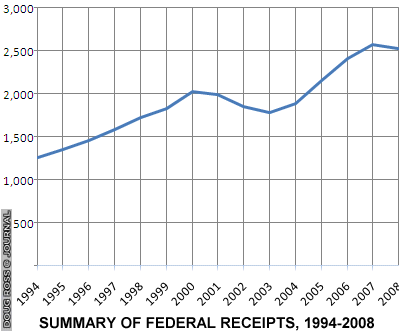
But the real jolt for tax-cutting opponents was that the 03 Bush tax cuts also generated a massive increase in federal tax receipts. From 2004 to 2007, federal tax revenues increased by $785 billion, the largest four-year increase in American history. According to the Treasury Department, individual and corporate income tax receipts were up 40 percent in the three years following the Bush tax cuts. And (bonus) the rich paid an even higher percentage of the total tax burden than they had at any time in at least the previous 40 years. This was news to theNew York Times, whose astonished editorial board could only describe the gains as a “surprise windfall.”

Unfortunately, Mr. Bush allowed Congress to spend away those additional tax revenues. The fact is that the increase in tax revenues that flowed from the ‘03 tax cuts could have paid for the wars in Afghanistan and Iraq and then some but for rampant discretionary domestic spending.

So, Bush passed his tax cuts in 2001 and 2003, but revenue went up:

Federal receipts after Bush tax cuts

And the deficits went down from 2004 to 2007:

Obama Budget Deficit 2011

Bush was on track to balance the budget, then Nancy Pelosi came along and added 5.34 trillion to the debt in her 4 years as Speaker.