Tag Archives: Jobs

132 economists prefer the Republican job creation strategy

From John Boehner’s web site.

Excerpt:

House Speaker John Boehner (R-OH) today released a list of 132 American economists who believe the job creation strategy used in the House GOP Plan for America’s Job Creators will do more to boost private-sector job growth in America in both the near-term and long-term than the “stimulus” spending approach favored by President Obama.

“This list underscores the need for immediate action on the now-22 bipartisan jobs bills passed by the Republican-led House that are awaiting a vote in the Democratic-controlled Senate,” Boehner said.  “All 22 of these bills passed the House with bipartisan support, but to date have not been brought to a vote by Senate Democrats.  To help support job creation in both the short-term and long-term, we need bipartisan action to halt unnecessary government regulations and fix the tax code to help private-sector job creators.  Our plan does that.  The Senate needs to pass these 22 bills and send them to the president’s desk.” 

Last month, Boehner asked a group of economists across the nation: which do you believe is more likely to provide a boost for private-sector job growth in America in both the near- and long-term: a plan focused on billions of dollars in additional “stimulus” spending by government – or a plan focused on halting excessive government regulations and fixing the tax code to help private-sector job creators?  A total of 132 economists indicated they clearly favor the latter strategy.  The list of 132 economists includes experts from Stanford University’s Hoover Institution, Carnegie Mellon University, and Harvard University; economists from the American Enterprise Institute (AEI), the Manhattan Institute, and the American Action Forum; and many others.

On Friday, in response to the U.S. Department of Labor’s announcement that October 2011 marked the 33rd consecutive month in which the national unemployment rate exceeded eight percent, Boehner asked President Obama to prod the Democratic-controlled Senate for action on the stalled jobs bills.  Boehner and other Republicans have called for President Obama to be more engaged in the legislative process this fall and less focused on his re-election campaign.

“I urge the president to call on Senate Democrats to bring these common-sense jobs bills to a vote,” Boehner said.  “As long as these bipartisan jobs bills are stalled in the Senate, it is unacceptable for the White House to be anything less than 100 percent engaged in the legislative process.”

Here’s the plan:

Empower Small Business Owners and Reduce Regulatory Burdens:

  • Require congressional review and approval of any government regulations that have a significant impact on the economy or burden small businesses.
  • Audit existing and pending regulations to identify and address those that hinder economic growth.

Fix the Tax Code to Help Job Creators:

  • Increase American competitiveness to spur investment and create more American jobs by streamlining the tax code and lowering the tax rate for businesses and individuals including small business owners to no more than 25%.
  • Reform the tax code to allow American businesses to bring back their overseas profits without having to pay a tax penalty so they can invest in our economy and create American jobs.

Increase Competitiveness for American Manufacturers:

  • Pass the three pending free trade agreements with Colombia, Panama, and South Korea to create up to 250,000 jobs.
  • Continue to open new markets to American made products. Encourage Entrepreneurship and Growth:
  • Modernize our patent system to protect our nation’s innovators, discourage frivolous lawsuits, and expedite patent reviews.
  • Re-Authorize and improve federal programs and approval processes to streamline development of new products.
  • Remove barriers to building a first class workforce so that the United States can compete in the global marketplace and lead the way in technological development and growth.

Maximize Domestic Energy Production to Ensure an Energy Policy for the 21st Century:

  • Promote lower energy prices through increased domestic production.
  • Encourage all forms of energy production.
  • Pay Down America’s Unsustainable Debt Burden and Start Living Within our Means:
  • Build upon the House Republicans’ Budget by enacting significant spending cuts.

And they already passed about 20 bills through the House with bipartisan support.
Irony: the young men who voted for Obama now suffer from record unemployment

This article from the Wall Street Journal explain why men are in decline. (H/T Mary, Tom)

Excerpt:

Few groups were hit harder by the recession than young men… The unemployment rate for males between 25 and 34 years old with high-school diplomas is 14.4%—up from 6.1% before the downturn four years ago and far above today’s 9% national rate. The picture is even more bleak for slightly younger men: 22.4% for high-school graduates 20 to 24 years old. That’s up from 10.4% four years ago.

[…]The share of men age 25-34 living with their parents jumped to 18.6% this year, up from 14.2% four years ago and the highest level since at least 1960, according to the Census Bureau.

Suzanne Venker comments on the consequences of this data for women for National Review.

Full text:

New data from the U.S. Census Bureau shows the percentage of men between the ages of 25 and 34 living at home rose from 14 percent in 2005 to 19 percent in 2011. Women, on the other hand, are doing just fine. Not only do they dominate today’s college campuses, they have little trouble staying away from mom and dad’s place. That’s because women are flourishing in the workforce while men are not. Writers and pundits blame this phenomenon on the economy, but the trend reflects a much larger sociological problem. America is in the midst of a sea change: Never before has it been more difficult for men and women to find their way to one another, settle in for the long haul, and build strong families together.

To read about it, you’d think the entire mess is out of our hands. You’d think the circumstances involving the roles of men and women in society have happened to us, rather than the other way around. The truth is that we created this new world — and while we may not be able to undo it, we can certainly stop the freight train from running off the tracks.

Hardly a day goes by that we aren’t made aware of this heartbreaking reality. It is so acute we now have not one but six new television series dedicated to men’s social demotion. In these programs, husbands are made to look like fools — while the wives wield a power so ugly it’s no wonder marriage has become so elusive. The modern generation has been sold a bill of goods about human nature, and the result is that men now have no idea how to be men. Why? Because women won’t let them.

There is a large and powerful group of women who see this shift in gender roles as a good thing. Hanna Rosin’s provocative piece in The Atlantic, called “The End of Men,” and Kate Bolick’s new piece “All the Single Ladies” (which may now become a TV series) make light of the demise of masculinity and the role men once played in society. They represent the kind of movers and shakers who help lead the feminist fight. Pointing to the latest statistics about men, they’d be likely to respond, “See how hopeless men are? Everything we’ve been saying about men all these years has proven to be true.”

But the laugh will be on them — if not for their own families, then for their children’s. The feminist policies that were put in place to help women flourish outside the home have suffocated men’s opportunities for economic self-sufficiency. In short, men’s desire to be good workers and family providers has been undermined. This is more than unfortunate; it is a loss of catastrophic proportions, for it is men’s consistent, full-time, year-round work that women depend on in order to live that ever-coveted “balanced life.” What too many women don’t understand (because they’ve been unduly influenced by feminist groupthink) is that male nature is ultimately beneficial to them, for women continue to put family — not career — at the center of their lives and are thus dependent on men to pick up the slack at the office.

It is a dangerous thing to create a society of frustrated young men. Feminists have no idea what a can of worms they’ve created — and what it’s about to do to our nation.

I think if we want men to marry, not only do we have to ask why the recession is affecting men disproportionately, but why the education system isn’t working for boys. We need to ask whether men learn better from female teachers or male teachers. We need to ask whether boys learn better in all-boys schools or in co-ed schools. We need to ask whether the promotion of sex education and contraception, which produces freely available sex, is the best way to encourage young men to prove themselves to women by trying hard to fit the traditional roles of protector, provider and moral/spiritual leader. We need to ask whether the denial of male-female differences encourages men to take on traditional male roles, and whether women are encouraged to prefer men who take on those roles. We need to ask whether our energy and economic policies favor job creation in areas dominated by men. We need to ask whether stimulus programs should be slanted towards industries dominated by women.  We need to ask whether affirmative action for women in education and at work helps men to be able to provide for a family. We need to ask whether men are well-served by no-fault divorce laws and biased domestic violence laws that promote false charges – especially during custody hearings. And lastly, we need to ask whether church serves men when it accepts or rejects postmodernism, anti-intellectualism and moral relativism.

But can’t we just tell men to “Man Up”?

The answer to the discincentives facing marriage-minded men is not a lazy, ignorant pronouncement for men to “Man Up”. That doesn’t solve any of the problems that cause men not to marry.

I think the desire of certain people to remove every incentive and capacity for men to perform as husbands and fathers – and then to nevertheless demand they marry and take on the traditional roles of men anyway without incentives or capacities  is the height of narcissism. Men are people too – we are not inanimate objects. We are not sperm donors and wallets. And if society decides to go in a direction where the traditional roles of men are replaced with  government social programs funded by high taxes and deficit spending, then marriage will die in this society.

What is issue 2? Should you vote no on Ohio issue 2?

In the 2010 mid-term elections, Republican John Kasich won the governorship and promised to balance the state’s budget by reining in the state’s spending on salaries and benefits for public sector union employees. To accomplish this, the Ohio legislature pass Senate Bill 5. However, an effort is on the ballot to repeal the law, and Ohio voters will get a chance to keep or scrap the law on Tuesday, November 8th, 2011.

Here’s what Ohio’s State Issue 2 is all about:

Issue 2 makes some very fair and common sense requests of our government employees to give local communities the flexibility they need to get taxes and spending under control, while providing the essential services that we rely on.

  • It allows an employee’s job performance to be considered when determining compensation, rather than just awarding automatic pay increases based only on an employee’s length of service.
  • It asks that government employees pay at least 15 percent of the cost of their health insurance premium. That’s less than half of what private sector workers are currently paying.
  • It requires that government health care benefits apply equally to all government employees, whether they work in management or non-management positions. No special favors.
  • It asks our government employees to pay their own share of a generous pension contribution, rather than forcing taxpayers to pay both the employee and employer shares.
  • It keeps union bosses from protecting bad teachers and stops the outdated practice of laying off good teachers first just because they haven’t served long enough.
  • Finally, it preserves collective bargaining for government employees, but it also returns some basic control of our schools and services to the taxpayers who fund them, not the union bosses who thrive on their mismanagement.

Even under the reforms of State Issue 2, Ohio’s government employees will still receive better pay, better health care and better retirement benefits, on average, than the vast majority of Ohioans who work in the private sector.

There are a number of myths going around about Issue 2, and it’s important to set the record straight, so I’ll do that below.

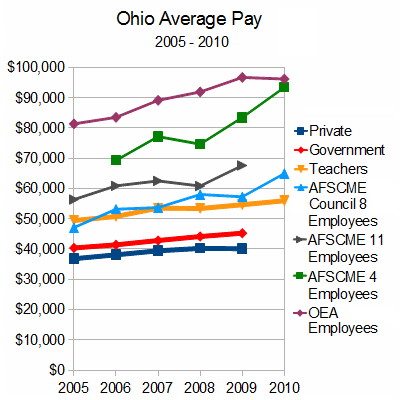
Ohio Average Pay: Public vs. Private
Ohio Average Pay: Public Unions vs. Private

Myths and truths about Ohio State Issue 2

Here’s a common myth:

State Issue 2 would “cut salaries and benefits.”

The truth:

Issue 2 would not cut salaries or benefits for any government employee. Employees would simply be asked to pay a modest share of their benefits, just like employees in the private sector do. For health care coverage, they would pay at least 15% of their overall plan. (Many local government employees currently pay less than 9% of their health care premium, while the average private sector worker pays upwards of 30%.) In addition, employees would be required to pay their personal share of a retirement plan (only 10%), rather than asking taxpayers to pay that share. That’s not too much to ask at a time when many private sector workers get no retirement benefit at all. Finally, Issue 2 requires that benefits apply equally to all public employees, so no one gets special treatment.

And another common myth:

State Issue 2 will eliminate government employee pensions.

The truth:

Government employees will still get a very generous pension benefit – an annual payment that averages their three highest annual salaries. That’s a pretty nice deal, when many private sector workers get no retirement benefit at all. State Issue 2 only ends a practice where some government union contracts require taxpayers to pick up the tab for BOTH the employer AND employee shares of a required pension contribution. In this economy, it’s simply not right to ask struggling taxpayers to foot the bill so government employees can get a free retirement. Issue 2 simply says government employees should pay their required share (10 percent) and taxpayers will contribute the employer share (14 percent).

Another myth:

State Issue 2 will cut teacher salaries.

The truth:

That’s one of the scare tactics government unions are using to turn people against these reforms. Nothing in Issue 2 determines salary levels. It only ends the practice of handing out automatic pay raises, or “step” increases, and longevity pay – or bonuses just for holding the job for a certain period of time. Issue 2 also asks that performance be added as a factor in teacher compensation, a goal President Barack Obama set out in his national education policy in 2009.

And another myth:

State Issue 2 will cost jobs

The truth:

Just the opposite is true. Ohio’s state and local tax burden ranks among the top third in the nation. As a result, companies large and small have left our state in pursuit of better tax incentives elsewhere, taking hundreds of thousands of jobs with them. If Ohio hopes to compete for new job growth, we have to make our state a more affordable place to live, work and do business. That starts with getting the cost of government under control so we can direct more of our limited resources into economic development, community revitalization and better schools.

More myths about Ohio State Issue 2 are corrected on this page.

Newspaper endorsements

So far, Issue 2 has been endorsed by several Ohio newspapers, including the biggest ones.

The Cleveland Plain Dealer:

The fiscal picture of local governments and school districts, especially, will improve as they are able to right-size their work forces and their expenditures on services. That will happen over time, not overnight, as new contracts are established.

Repeal SB 5, though, and it’s going to be awfully hard for local governments to manage their payrolls without resorting to larger-scale layoffs than would otherwise be necessary. And local governments will continue to be hamstrung by anti-merit seniority rules that lead to worker complacency and protect dead weight and time-servers.

Voting YES on Issue 2 will prevent layoffs by keeping public sector wages and benefits in line with what the private sector can afford to pay.

The Columbus Dispatch:

Despite the insistence of opponents, the effort to reform Ohio’s out-of-balance collective-bargaining law is not an expression of disrespect for or dissatisfaction with Ohio teachers, police officers, firefighters and other government employees. It is a much-needed attempt to restore control over public spending to the public officials elected to exercise that control.

It does not assert that public employees are worth less than the compensation they’re receiving, only that the compensation has grown faster than the public’s ability to pay for it.

[…]With more ability to control the escalation of salary and benefit costs, governments won’t be forced as often to impose layoffs, and might be able to afford to keep even more police and firefighters on the streets.

Again, no one is saying that public sector workers don’t matter – the question is whether we can afford to give them better wages and benefits than the private sector workers who are their customers and their employers. Public sector workers work for the public, and the public can only afford to pay so much.

Conclusion

Government employees are paid 43% more than private sector employees, in salary and benefits:

I think that people who care about the long-term prosperity of Ohio should vote “YES” on Issue 2 to make public and private salaries and benefits MORE EQUAL. Ohio is facing enormous economic pressure from the global recession, and everyone has to make sacrifices. Now is not the time for public sector workers to insist on higher wages and benefits, especially when the private sector workers who pay their salaries don’t make as much money, nor do they get the pensions, nor do they get the better job security. Ohio voters can certainly go back and renegotiate union salaries and benefits when Ohio is out of the recession.

Click here to learn more about Ohio State Issue 2.