Tag Archives: Issues

The Wintery Knight demands that Michele Bachmann run for President

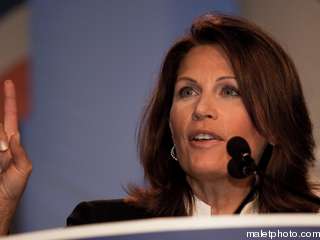
Rep. Michele Bachmann

Michele Bachmann still hasn’t announced that she is willing to run for President!

I have therefore decided to protest her tarrying by posting two interviews that she did this past week, so that you can all tell me if you think that she would make a good President, or not. Maybe she will stop by and read our comments and realize how badly she is needed, and how well she would do as President.

First, Bret Baier spends some time with Michele going over her pluses and minuses: (MP3 version here – 3 Mb)

If you have Fox News, Bret Baier’s show is the best thing on that entire network.

Second, here is an interview with popular social conservative Mike Huckabee: (MP3 version here – 3 Mb)

And for those who do not want to watch videos or listen to MP3s, I found this brand new profile of Michele Bachmann.

Excerpt:

Michele Bachmann was a self-styled “education researcher” making a run for a Minnesota school board seat in 1999 when the question came up at a candidate forum: If elected, would she serve all four years?

Maybe not, she said.

Bachmann, now a three-term congresswoman and tea party favorite who may run for president in 2012, opened up about a confrontation she’d had with a state senator over Minnesota’s new school standards.

“I told him that if he’s not willing to be more responsive to the citizens, that I may have to run for his seat or find someone else who would do so,” she said, according to a newspaper account of the meeting.

Bachmann lost the school board race, but then knocked off the senator, a fellow Republican, just months later using the standards as her primary issue.

It was an early indicator of a recurring theme: Bachmann often wins by losing.

[…]The race would test her resilience because she would start far back. But as a little-known House member only a few years ago, Bachmann became hero of the conservative tea party movement in part by fighting losing battles with the GOP establishment. Her path to Congress was paved by failed efforts to pass a ban on gay marriage in the Minnesota Legislature.

“She is very good at turning lemons into lemonade all the time,” said Sal Russo, a California political consultant who came to know Bachmann through the tea party.

[…]From her first involvement in politics, the 55-year-old Bachmann has shown a determination to keep pressing forward and find opportunities, even when the way seemed blocked.

In the late 1990s, Bachmann was a stay-at-home mother of five in Stillwater, a scenic St. Croix River town east of St. Paul. Then she was drawn into a revolt over education standards.

[…]”People had been predicting her demise since Day One: ‘Oh, she’s a radical, she’s too far right, she’s too outspoken, she’s too inflammatory,'” Pulkrabek said. “The fact of the matter is, with the exception of the first race, she wins.”

Parlaying her school board defeat into a victorious legislative campaign, she moved to the state Senate and seized on a new issue.

Around Thanksgiving 2003, justices in Massachusetts ruled the commonwealth couldn’t prevent same-sex marriage. Bachmann hit the phones, reaching out to fellow conservatives about making sure gay marriage would stay illegal in Minnesota.

[…]Jeff Davis heard her public appeal through his car radio. Not politically involved at the time, Davis came to the Capitol and pledged to help Bachmann.

[…]”She’s an energizer. She influences people around her,” Davis said. The drive instantly elevated Bachmann’s political profile, he said. “It was a launch point.”

[…]Bachmann’s victory in that race brought her to the national stage and prompted a new focus on fiscal issues. She harnessed the outrage of the tea party, a fledgling political force inflamed by debates over government bailouts and a far-reaching health law pursued by President Barack Obama.

Her outspoken opposition did not stop the health law, but it got her much more television exposure and helped make her a face of the new resistance. In one Fox News interview, Bachmann urged viewers to flood Washington and “go up and down through the halls, find members of Congress, look at the whites of their eyes and say, ‘Don’t take away my health care.'”

Amy Kremer remembers seeing Bachmann’s television plea while on a Tea Party Express bus heading between rallies in Washington state. The next week, Kremer joined Bachmann in the nation’s capital for a big tea party protest.

“You can tell the ones who have the passion, the fire in the belly and are truly speaking from the heart. She’s one of those,” Kremer said. “That comes through.”

The article goes on to explain how Michele got to be a three-term Congresswoman in one of the most liberal states in the entire country.

About Michele Bachmann:

Congresswoman Bachmann is a leading advocate for tax reform, a staunch opponent of wasteful government spending, and a strong proponent of adherence to the Constitution, as intended by the Founding Fathers. She believes government has grown exponentially, with ObamaCare being the most recent example of its uninhibited growth. Congresswoman Bachmann wants government to make the kind of serious spending decisions that many families and small businesses have been forced to make. She is a champion of free markets and she believes in the vitality of the family as the first unit of government. She is also a defender of the unborn and staunchly stands for religious liberties.

Prior to serving in the U.S. Congress, Bachmann served in the Minnesota State Senate.  She was elected to the Minnesota State Senate in 2000 where she championed the Taxpayers Bill of Rights.  Before that, she spent five years as a federal tax litigation attorney, working on hundreds of civil and criminal cases.  That experience solidified her strong support for efforts to simplify the Tax Code and reduce tax burdens on family and small business budgets. Congresswoman Bachmann also led the charge on education issues in Minnesota calling for the abolishment of Goals 2000 and the Profiles of Learning in its school. She recognized the need for quality schools and subsequently started a charter school for at-risk kids in Minnesota.

Congresswoman Bachmann sits on the Financial Services Committee (FSC) and the Permanent Select Committee on Intelligence. The FSC is tasked with oversight of numerous financial sectors including housing, real estate and banking. This gave the Congresswoman keen insight into the housing crisis and credit crunch, leading her to be a staunch opponent of the taxpayer-funded bailout of Wall Street and the Dodd-Frank legislation. Serving on the Intelligence Committee was a welcomed opportunity for Congresswoman Bachmann as she has consistently advocated peace through strength to ensure America’s national security. As a mother of five children and 23 foster children, she has a deep appreciation for that portion of the Oath of Office in which members of Congress vow to support and defend the Constitution of the United States against all enemies, foreign and domestic.

In July 2010 Congresswoman Bachmann hosted the first Tea Party Caucus meeting because she saw the need for Tea Partiers to have a listening ear in Congress. She is seen as a champion of Tea Party values including the call for lower taxes, renewed focus on the Constitution and the need to shrink the size of government.

You can learn even more in the links below, particularly this one that contains the best speech I have ever heard from her. That speech covers her Christian faith in some detail, and mentions her interest in Francis Schaeffer’s apologetics, which also formed the views of famous worldview scholar Nancey Pearcey. Did you know that Michele once introduced famous Indian apologist Ravi Zacharias when he was giving a MacLaurin lecture? She is a big fan of Christian apologetics – she asked to go see Ravi Zacharias for her birthday present. A woman after my own heart. She doesn’t want clothes and jewelry – she wants to be able to defend her faith! You can listen to the lecture right here (14 Mb), and hear her gushing about apologetics and Ravi Zacharias. The topic is “Christian Apologetics in the 21st century”. The lecture was delivered in March 2002 in Minnesota, when Michele was a state senator.

You can contribute to her campaign right here. You can be her friend on Facebook here and also here.

Related posts

Is Mitt Romney conservative or liberal?

Let’s start by looking at Romney’s record on fiscal policy.

The libertarian Cato Institute think tank explains why Obamacare and Romneycare are identical in many ways.

Excerpt:

As part of his liberal phase when governor of Massachusetts — political principles have been ever-flexible for Romney — he orchestrated passage of legislation with eerie similarities to ObamaCare. Massachusetts mandates purchase of insurance, decides what benefits must be offered, and maintains a complex system of subsidies and penalties. Declared Boston Globe columnist Adrian Walker, the two programs are “not identical, but they’re certainly close kin.” MIT economist Jonathan Gruber, who advised both Gov. Romney and President Obama on health care, asserted: “Basically, it’s the same thing.”[…]Alas, even the former governor’s constitutional scruples are suspect. In 1994 he backed a federal mandate. His concern about the overweening federal government apparently was not so finely developed then.

[…]However, paying for more benefits for more people inevitably makes medicine more expensive. Costs for Commonwealth Care, the Massachusetts government’s subsidized insurance program alone are up a fifth over initial projections. Last year State Treasurer Timothy P. Cahill wrote: “The universal insurance coverage we adopted in 2006 was projected to cost taxpayers $88 million a year. However, since this program was adopted in 2006, our health-care costs have in total exceeded $4 billion. The cost of Massachusetts’ plan has blown a hole in the Commonwealth’s budget.”

[…]State finances have not collapsed only because RomneyCare spread the costs widely, forcing virtually everyone in and out of the state to share the pain. Cahill cited federal subsidies as keeping the state afloat financially. Indeed, a June study from the Beacon Hill Institute concluded that “The state has been able to shift the majority of the costs to the federal government.” The Institute pointed to higher costs of $8.6 billion since the law was implemented. Just $414 million was paid by Massachusetts. Medicaid (federal payments) covered $2.4 billion. Medicare took care of $1.4 billion.

But even more costs, $4.3 billion, have been imposed on the private sector — employers, insurers, and residents. This estimate is in line with an earlier study by the Massachusetts Taxpayers Foundation, which figured that 60% of the new costs fell on individuals and businesses.

As expenses have risen, so have premiums. Noted Kuttner, “because serious cost containment was not part of the original package, premium costs in the commonwealth have risen far faster than nationally — by 10.3%, the most recent year available.” Economists John F. Cogan, Glenn Hubbard, and Daniel Kessler figured that RomneyCare inflated premiums by 6% from 2006 to 2008. This at a time where the state-subsidized Commonwealth Care was displacing private insurance for many people, thereby reducing demand, which should have reduced cost pressures.

Unfortunately, noted the Beacon Hill Institute, “private companies have no choice but to pass the higher costs onto the insured. Some of these costs fall in the double-digit range.” That naturally displeased public officials, since it undercut their claim to have solved Massachusetts’ health care problems.

And the Boston Herald notes that Romneycare caused the loss of 18,000 jobs. (H/T Michelle Malkin)

Excerpt:

The Bay State’s controversial 2006 universal health-care plan — also known as “Romneycare” — has cost Massachusetts more than 18,000 jobs, according to an exclusive blockbuster study that could provide ammo to GOP rivals of former Gov. Mitt Romney as he touts his job-creating chops on the campaign trail.

“Mandating health insurance coverage and expanding the demand for health services without increasing supply drove up costs. Economics 101 tells us that,” said Paul Bachman, research director at Suffolk University’s Beacon Hill Institute, the conservative think tank that conducted the study. The Herald obtained an exclusive copy of the findings.

“The ‘shared sacrifice’ needed to provide universal health care includes a net loss of jobs, which is attributable to the higher costs that the measure imposed,” said David Tuerck, the institute’s executive director.

…Despite Romney’s vaunted business acumen as a successful venture capitalist, Bachman said the former governor “was a little naive about what would become of the law.”

The Beacon Hill Institute study found that, on average, Romneycare:

  • cost the Bay State 18,313 jobs;
  • drove up total health insurance costs in Massachusetts by $4.311 billion;
  • slowed the growth of disposable income per person by $376; and
  • reduced investment in Massachusetts by $25.06 million.

And from the Heartland Institute, an article showing how Romneycare could actually lead to single-payer health care in Masachusetts.

Excerpt:

The 2006 reform jeopardized the solvency of private health plans in the Bay State. Unfortunately, insurers’ solvency is not something patients, physicians, and voters have reason to observe closely, so the political class suffers from perverse incentives once it starts micromanaging health insurance. As a result, higher costs have been passed on through higher per capita spending and premium growth.

According to the state’s 2010 annual report, today “per capita spending on health care in Massachusetts is 15 percent higher than the rest of the nation, even when accounting for wages and spending on medical research and education in Massachusetts.” Indeed, Professor John F. Cogan of Stanford University has concluded the 2006 reform led to premium growth 6 percent higher in Massachusetts than in the rest of the United States between 2006 and 2008.

Because it was politically intolerable to allow premiums to rise in line with the costs of Romneycare, the state’s insurance commissioner denied 235 of 276 rate increase requests in April 2010. For a short time, no new policies were offered, and plans suffered significant losses. The next month, Blue Cross Blue Shield of Massachusetts, the state’s largest carrier, announced a $55 million provision for anticipated losses in the second quarter alone.

Of the 12 largest carriers, five were already operating at a loss. At this point, even if the state allows Blue Cross Blue Shield of Massachusetts to increase rates in line with medical costs, my analysis concludes the carrier will become insolvent in the vicinity of 2017. Other carriers will soon follow.

Campaign speeches and debate zingers today don’t cancel out a liberal leftist record on policy yesterday.

Mitt Romney on the issues in 2012

Mitt Romney’s record on fiscal issues

And a comprehensive overview of Mitt Romney’s record from the Examiner.

Excerpt:

He often claims to have balanced the Massachusetts budget without raising taxes. The first part of that claim is true, but the second part is a matter of semantics.

As Cato pointed out in a 2006 report, while Romney didn’t raise general tax revenues, he raised various fees by $500 million and then proposed $140 million in business tax hikes by closing “loopholes.” His health care plan also increased spending, prompting tax increases after he left office to cover cost overruns.

This time around, by sticking by his health care law, Romney is attempting to avoid the “flip flopper” label that dogged his last campaign. But this shift in tactics isn’t going to make the problem of his past positions suddenly disappear.

As governor, Romney was no friend of gun owners. In 2004, when the Clinton-era federal assault weapons ban expired, he signed a permanent one at the state level.

Despite his tough talk on immigration during his last campaign, in 2005 Romney told the Boston Globe that reform along the lines that McCain proposed was “reasonable.”

Romney also, at various times, supported campaign finance regulations far more sweeping than McCain-Feingold, even though he subsequently blasted that law as an attack on free speech.

Romney’s support for “No Child Left Behind,” President Bush’s expansion of the federal government’s role in education, not only puts him at odds with conservatives, but it also undercuts the federalist defense of his health care law. If a one-size-fits-all approach doesn’t work for health care, why should it work for education?

Furthermore, there’s no reason to believe that social conservatives who were suspicious of Romney’s conveniently timed conversion from pro-choice to pro-life before his last presidential run will see him as any more authentic this time around.

Consider this article from the Boston Globe.

Excerpt:

“I don’t speak for the scientific community, of course,” Romney said, in response to the first question of the morning. “But I believe the world’s getting warmer. I can’t prove that, but I believe based on what I read that the world is getting warmer. And number two, I believe that humans contribute to that.”

He also said he wanted to wean the country from its dependence on foreign oil by seeking alternative sources of energy, and said that Americans should do more to conserve.

“I’m told that we use almost twice as much energy per person as does a European, and more like three times as much energy as does a Japanese citizen,” Romney said. “We can do a lot better.”

This makes me think that Mitt Romney wants to surpass Obama’s $535 million loan to Solyndra.

Mitt Romney position on abortion, gun control, gay marriage

(Image: H/T Robert)

Mitt Romney’s record on social issues

From the 1994 Massachusetts Senate debate between Mitt Romney and Edward Kennedy.

Here he is again in 2002 in his run for government of Massachusetts:

And again in May 2005, as governor of Massachusetts:

And on embryonic stem cell research in 2005:

And on gun control in 2002:

Mitt Romney is not a social conservative. He is a center-leftist who will say anything in order to get elected in 2012. Nothing he says can be trusted – he adapts himself to any environment when campaigning – he says what people want to hear, and it is not at all what his actual record shows.

Mitt Romney political views in 2012

What do conservatives think of Mitt Romney’s record?

Well-known conservative magazine Human Events listed Mitt Romney as #8 on their list of 10 RINOs. This list is from December 27, 2005.

Excerpt:

8. Gov. Mitt Romney (Mass.)
Has said, “I believe that abortion should be safe and legal in this country.” Supports civil unions and stringent gun laws. After visiting Houston, he criticized the city’s aesthetics, saying, “This is what happens when you don’t have zoning.”

Those are the facts on Mitt Romney’s record.

The top article on National Review is about Herman Cain

Here’s the story on National Review. Everyone is going ga-ga for Herman Cain!

The first few lines:

‘How many of you think Herman Cain won the debate?”

Twenty hands shot up.

“Well, we can stop right there,” said Frank Luntz, a fast-talking political consultant, as he paced before a Fox News focus group on May 5. “This is unprecedented.”

Luntz pointed to the top row, looking for answers. One by one, South Carolina Republicans in trucker caps and business suits raved about Cain. After watching the 65-year-old spar with fellow GOP presidential contenders, many were itching to join his ranks.

“He’s a breath of fresh air,” explained one gentleman. “He is the godfather of business sense, and he can attack Obama well,” declared a middle-aged lady. Others nodded vigorously.

Luntz was stunned. “[Cain] was not a real candidate before tonight,” he exclaimed. “What happened?”

[…]Cain, a former corporate executive and talk-radio host, did more than that; he won over a slew of Republicans pining for a 2012 candidate. Though he was standing among better-known Republicans such as Tim Pawlenty and Ron Paul, Cain’s rich baritone, business smarts, and sharp one-liners connected.

It’s easy to see why: He was frank and refreshing. But more notably, on a stage full of state and congressional leaders, Cain used his outsider status to his advantage. “Most of the people who are in elective office in Washington, D.C., they have held public office before,” he noted during one exchange. Then, with expert comedic timing, he quipped: “How’s that workin’ for you?”

[…]Since the debate, Cain has seen his fortunes rise. The latest Zogby poll shows him trailing only New Jersey governor Chris Christie in popularity among GOP-primary voters. In Washington State over the weekend, Cain won a Republican straw poll.

Online, the buzz is palpable. He was a trending topic on Twitter during the debate; on Facebook, he has 84,000 friends, a number that’s growing every day. Conservatives may not know much about him, but they like what they are hearing. As Rush Limbaugh remarked on his radio show after the debate, “Herman Cain made me think I was listening to me in every answer.”

And my favorite part:

Cain’s thirst for self-improvement was evident at the start. He grew up in Atlanta, the son of working-class parents — his father a chauffeur, his mother a domestic worker. They had always dreamed of owning their own home, not living in a “half-home,” an attached unit. They achieved that goal. They wanted their two sons to graduate from college. Both did.

Cain saw his parents’ hard work as a simple, inspirational example: Work hard, trust in God, have no fear, and you can achieve the American dream. To him, it is more than a political idea; it is central to who he is as a citizen, and as a potential presidential candidate. Once he earned a bachelor’s degree in mathematics from Morehouse College in 1967, Cain was determined to map his own path to success.

The early motivator, and Cain says it unabashedly, was wealth. Working as a systems analyst for the United States Navy in Dahlgren, Va., Cain made $7,729 a year. At age 23, he made a personal goal to one day earn $20,000. As he settled into his position, he noticed that advancement — and an increased salary — would require a graduate degree. So he searched for the top computer-science program he could find, predicting that future jobs would require such skills.

Cain selected Purdue University in Indiana. He was not exactly eager to return to the classroom, but he knew that he needed to learn more and improve his résumé. After surviving a string of difficult courses and exams and earning his master’s degree in 1971, he returned to the Navy full-time and was granted a GS-13 position. His new salary: $20,001.

The rest of the article explains how he rose through the ranks at Pillsbury, Burger King, and Godfather Pizza. My goodness, this man is just an ordinary man who came from nowhere to achieve everything. He is everything that Republicans represent. His life reflects the American Dream. Please, let this man save us from the RINOs: Romney, Huckabee and Gingrich.

Notice the part where the article mentions that Cain is a Baptist preacher. He is not afraid to talk about his faith in public.

Here’s a 1-minute introduction to Herman Cain:

Also, here’s a 30-minute CPAC speech by Herman Cain. Here is video of the South Carolina debate, and the focus group response. My friend Robb posted the video of Cain beating up Bill Clinton, which is referenced in the article.