I found this short article by Paul Copan. I’ve gotten some flak from liberal Christian women for my disagreement with certain liberal causes, so I thought I would link to this article to defend myself.
Excerpt:
It’s been said that the most frequently quoted Bible verse is no longer John 3:16 but Matthew 7:1: “Do not judge, or you too will be judged.” We cannot glibly quote this, though, without understanding what Jesus meant. When Jesus condemned judging, he wasn’t at all implying we should never make judgments about anyone. After all, a few verses later, Jesus himself calls certain people “pigs” and “dogs” (Matt. 7:6) and “wolves in sheep’s clothing” (7:15)! Any act of church discipline (1 Cor. 5:5) and rebuking false prophets (1 John 4:1) requires judgment. What Jesus condemns is a critical and judgmental spirit, an unholy sense of moral superiority. Jesus commanded us to examine ourselves first for the problems we so easily see in others. Only then can we help remove the speck in another’s eye—which, incidentally, assumes that a problem exists and must be confronted.1 But let’s take a closer look at this charge that Christians are judgmental when we speak out on moral issues.
He then goes on to make some points:
If judging is wrong, then no one can judge you for being judgmental
In other places, Jesus urges people to make a right judgment
Is it possible to have convictions yet still treat people with respect?
Are inclusivists and pluralists (e.g. – Hindus) tolerant of exclusivists?
What is tolerance, and how does it relate to truth?
Comparison of “equality of persons” with “equality of viewpoints”
Are moral standards variable by time and place, or fixed?
Are moral standards merely descriptive, or also prescriptive?
Should atheists be moral? What reason do they have to be moral?
Can non-illusory morality exist in an atheistic universe?
Can there be real morality if there is no design in the universe?
And he also talks about what else the Bible says about judging.
It’s a good article. Moral judgments are necessary for us to warn ourselves and others about the harm that may occur if we cross boundaries.
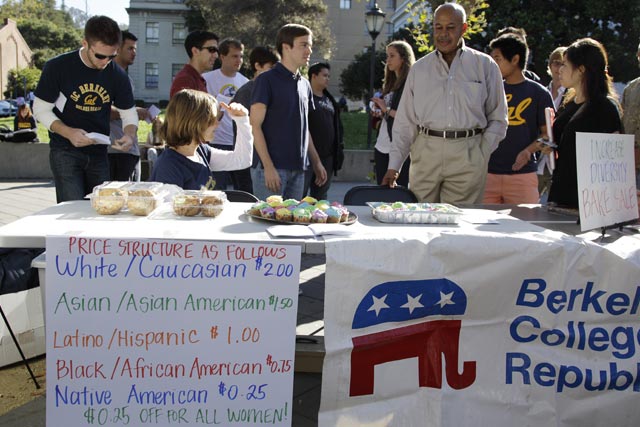
A controversy over cupcakes is heating up at UC Berkeley in California, where campus Republicans are planning to hold an affirmative action bake sale on Tuesday.
At the sale, white men will be charged $2 for a baked good, Asians will pay $1.50, Latinos $1, African-Americans 75 cents and 25 cents for Native Americans, KGO-TV reported.
Women will get a 25 cent discount.
“The pricing structure is there to bring attention, to cause people to get a little upset,” Campus Republican president Shawn Lewis told the TV station. “But it’s really there to cause people to think more critically about what this kind of policy would do in university admissions.”
The Campus Democrats immediately slammed the sale, which Lewis said is meant to take a stand against an affirmative action-like bill for the University of California system that is awaiting Gov. Jerry Brown’s signature.
On Friday, the student newspaper reported that the student government could vote to defund the Republican group over the bake sale. A hearing is scheduled for Sunday on the fiery issue.
So the response of the left is to censor the people who offend their feelings. But that’s not all.
Look at the emotional language from the opposition in this CNN article.
Excerpt:
ASUC President Vishalli Loomba said many students who attended a community meeting Monday night expressed disgust that the bake sale would take place.
“As a woman of color, when I first saw the event, I was appalled someone would post something like this on the Internet — not only a different pay structure, but also to rank the races,” she said. “It trivializes the struggles that people have been through and their histories.”
Now, for anyone who wants the research on affirmative action, and why it hurts minorities, I recommend two books by my favorite economist Thomas Sowell. (I also have to mention that he’s black, because otherwise the secular leftist commenters will cry racism, which is all they learn to do in four years of college). The first book is “Inside American Education” and the second book is “Affirmative Action Around the World: An Empirical Study“, published by Yale University Press. I only recommend the best to my readers. The first book is better for beginners, the second is more academic. Sowell’s conclusion? Affirmative action certainly doesn’t help minorities, and in many cases it actually hurts minorities. You can read a summary of Sowell’s findings here.
So on the one hand, you have the whiny secular left woman expressing real racism and sexism (“woman of color”), whining, blaming, and being disgusted and appalled. And on the other hand, you have Hoover Institute economist Thomas Sowell and the Yale University Press.
How Vanderbilt persecutes Christian groups on campus
Is Vanderbilt University flirting with the suppression of religion? Yes, according to Carol Swain, a professor at Vanderbilt’s Law School.
Specifically, Swain is referring to four Christian student groups being placed on “provisional status” after a university review found them to be in non-compliance with the school’s nondiscrimination policy.
Vanderbilt says the student organizations cannot require that leaders share the group’s beliefs, goals and values. Carried to its full extent, it means an atheist could lead a Christian group, a man a woman’s group, a Jew a Muslim group or vice versa.
If they remain in non-compliance, the student organizations risk being shut down.
So what’s behind this? Flashback to last fall. An openly gay undergrad at Vanderbilt complained he was kicked out of a Christian fraternity. The university wouldn’t identify the fraternity, but campus newspaper the “Hustler” reported it was Beta Upsilon Chi. As a result, the school took a look at the constitutions of some 300 student groups and found about a dozen, including five religious groups to be in non-compliance with Vanderbilt’s nondiscrimination policy. All were placed on provisional status.
Among the groups threatened with shut down is the Christian Legal Society. It ran afoul with this language from its constitution. “Each officer is expected to lead Bible studies, prayer and worship at chapter meetings.” CLS President Justin Gunter told me, “We come together to do things that Christians do together. Pray, and have Bible studies.”
[…]Vanderbilt officials refused to be interviewed, and instead released a statement saying in part “We are committed to making our campus a welcoming environment for all of our students.” In regard to the offending student organizations, officials said they “continue to work with them to achieve compliance.”
Some people who are Christians give money to Vanderbilt, and other universities. But they shouldn’t do that. The only two colleges worth giving money to are Hillsdale College and Grove City College.
In late May of this year Dr. Turek was hired to present at a meeting of your Global Business Management & Analysis Team within Global Wealth and Investment Management. The title of his presentation was called “Why Can’t You Be Normal Just Like Me?” The presentation helps participants adapt to diverse personalities to improve productivity and relationships—the essence of inclusion and diversity. The meeting was scheduled to take place at your Merrill Lynch facility in Pennington, New Jersey on June 17.
Three days before the event Dr. Turek was abruptly fired by an HR representative. Why? She explained that someone Googled his name and discovered that he had written Correct, Not Politically Correct: How Same-Sex Marriage Hurts Everyone. Marriage was not the topic of his presentation, nor has it ever been in all his years of working with the bank. Moreover, as his book reveals (although no one at the Bank is likely to have read it), Dr. Turek treats all people with respect, whether he agrees with them politically or not. Nevertheless, in the name of “inclusion” and “diversity,” he was immediately excluded for his political and religious viewpoint. Mr. Moynihan, please answer this question: Do you have to have certain political or religious views to work at Bank of America?
I know you cannot really believe that free speech and religion rights vanish when one works with Bank of America. I know that you cannot believe that all political conservatives, Jews, Christians, Mormons and Muslims should be fired for their deeply held beliefs. But that is how the Bank of America policy of “inclusion” was applied to Dr. Turek. He was fired because of his personal political and religious beliefs—beliefs that are undoubtedly shared by thousands of your very large and diverse workforce. Or is it really diverse?

 WINTERY KNIGHT