Tag Archives: Intelligent Design

Psychologist recommends Darwinian storytelling to suppress design intuitions

Amy Hall of Stand to Reason linked to this post by David Klinghoffer on Evolution News.

Excerpt:

The Wall Street Journal salutes the research of Boston University psychologist Deborah Kelemen. She has discovered that it’s possible with Darwinian storytelling to suppress common sense in children of the kind that leads them to recognize artifacts of intelligent design in nature.

The Journal notes that quite apart from religious instruction, kids are primed to see life as reflecting “intentional design.” It’s intuitive. The corrective is to catch them at an early age and train them to see things in a Darwinian light.

By elementary-school age, children start to invoke an ultimate God-like designer to explain the complexity of the world around them — even children brought up as atheists. Kids aged 6 to 10 have developed their own coherent “folk biological” theories. …

Dr. Kelemen and her colleagues thought that they might be able to get young children to understand the mechanism of natural selection before the alternative intentional-design theory had become too entrenched. They gave 5- to 8-year-olds 10-page picture books that illustrated an example of natural selection. The “pilosas,” for example, are fictional mammals who eat insects. Some of them had thick trunks, and some had thin ones. A sudden change in the climate drove the insects into narrow underground tunnels. The thin-trunked pilosas could still eat the insects, but the ones with thick trunks died. So the next generation all had thin trunks.

Before the children heard the story, the experimenters asked them to explain why a different group of fictional animals had a particular trait. Most of the children gave explanations based on intentional design. But after the children heard the story, they answered similar questions very differently: They had genuinely begun to understand evolution by natural selection. That understanding persisted when the experimenters went back three months later.

One picture book, of course, won’t solve all the problems of science education. But these results do suggest that simple story books like these could be powerful intellectual tools. The secret may be to reach children with the right theory before the wrong one is too firmly in place.

There are a number of interesting points here. First, that the example of natural selection is fictional. The mammalian order Pilosa (anteaters and sloths) is real, but “pilosas” are not. Second, it is decidedly in the micro-evolutionary realm — a kind of evolution that no one disputes, certainly not advocates of the theory of intelligent design. There’s no reason to think that the “pilosas” are on their way to true speciation, of the kind that evolutionary theory is really challenged to account for, any more than Darwin’s finches. The extrapolation from such a trivial thing into the origin of all species and all biological complexity by unguided natural processes is a cheat.

Most enlightening is that Dr. Kelemen and her colleagues would, to begin with, seek to talk children out of their intuitive response. Among ID researchers, the approach would be to test that intuition, objectively weighing the empirical evidence without preconceptions. Dr. Kelemen would “suppress” it: her own word!

The abstract of her research publication calls the Darwinian storytelling “interventions”. 

I do think it’s important for parents to counter what these educators are interested in doing to their children.

First, it’s important for parents to consider whether teachers are paid for their work (by parents who use privates schools) or whether their salary is coming from the government (parents are forced by law to pay taxes for government-run “public” schools), which has other purposes for children than parents have.  Second, it’s important for parents to decide how they intend to explain to their children the difference between macroevolution and microevolution, lest naturalistic educators use evidence for microevolution as a way of persuading children to accept macroevolution. Third, parents have to decide how to teach their children about the the standard cosmology, cosmic fine-tuning, the origin of life and the Cambrian explosion – each of which is lethal to naturalism, and each of which is more rooted in experimental science than clumsy storytelling. Unfortunately, the good evidence that modern science offers is largely unknown to most parents, who still trust teachers to teach children truth and practical skills.

I do think it’s important for parents to have some sort of plan for dealing with this, and money to fund their plan. The BU professor is obviously not capable of winning an argument about Darwinism with a grown-up with a good knowledge of the facts, but that’s not her purpose. She is a psychologist in Boston – it’s unlikely she is familiar with actual experimental science related to origins. She’s not interested in debating William Lane Craig or Stephen C. Meyer – she’s never even heard of them. She doesn’t want to talk about the details of experimental science with someone who has an awareness of it, she just wants to pass her own religion (naturalism) on to your children when they are too young to know how to resist her. And I’m sure that she’d like the assistance of a secular government to accomplish that. And believe me, there are powerful people who are very interested in helping her, and in making sure that no parent can stop her from indoctrinating their children.
520 million year old shrimp heart is more complex than those of today

First, the straight story on the scientific discovery, as reported in Bioscience Technology.

Excerpt:

520 million years ago, the first known animal heart was formed.

It was the heart of an ancient shrimp, and quite a heart it was. For it, and its vascular system, have been found to be more complex than that of modern shrimp, researchers reported in a recent Nature Communications. Its cardiovascular system was apparently one of evolution’s first templates for modern cardiovascular systems. Significant streamlining has occurred since.

The find comes on the heels of an equally important one by the same group: that of a stunningly intact nervous system from the same breed of primordial shrimp: Fuxianhuia protensa.

“This is only the second case of the description of a cardiovascular system in a Cambrian arthropod, the first one being that of the inch-long Marrella from Burgess Shale,” emailed Diego Garcia-Bellido of the University of Adelaide, who co-discovered that first arthropod while at the University of Cambridge. Garcia-Bellido was not involved in the new study. “This new finding of a cardiovascular system in a larger animal (Fuxianhuia is about two to three times as large, thus more detail), together with a fantastically preserved, and very complex, nervous system, unknown in Marrella, and the gut, make it probably the most complete arthropod internal anatomy known in the fossil record.”

The main conclusion drawn, said Garcia-Bellido: “The level of complexity of the Fuxianhuia was extremely high, considering that we are studying some of the oldest animals on Earth.”

Now, if you’re like me, you’re skeptical that soft tissues can be preserved in the fossil record, but:

Said the paleontologist via email: “As we know, most soft tissue of animals tends to decay away once the animals died, so often only the hard parts of animal body (bones, shells, teeth, etc.) are preserved in fossils. However, under very exceptional circumstances, soft tissue and anatomical organ system can also be preserved in fossils.”

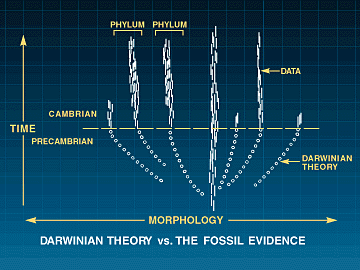
Keep in mind that 520 mya is right after the Cambrian explosion that intelligent design people like me love to talk about. I mean you are going from single-celled life to complex organ types in a few million years. Fine if you are an ID proponent, but devastating if you are a Darwinian naturalist.

Cambrian Explosion
The Cambrian Explosion: the origin of phyla

If you are a naturalist, then you need the fossil record to go from simple to complex. The trouble is that all the simple to complex in that image is pure speculation at this point – and not for lack of trying, either.

You know, I am writing this on Saturday night, and in a happier world, this discovery would be discussed tomorrow in every Christian church in the land. This is the kind of data that Christians should be familiar with to check the presupposition of naturalism which is lethal to rational thought. If only we were more focused on truth than on signing and feelings in church. If only we were not so scared of traditional dating of fossils. Maybe then we would be getting somewhere in the culture wars.

Theistic evolutionists and the two-platoon strategy

What should we make of theistic evolutionists telling us that you can believe in God, while still knowing that matter, law and chance explain the full development of all of life?

Consider this quotation from Phillip E. Johnson.

Quote:

The National Academy’s way of dealing with the religious implications of evolution is akin to the two-platoon system in American football. When the leading figures of evolutionary science feel free to say what they really believe, writers such as Edward O. Wilson, Richard Dawkins, Daniel Dennett, Carl Sagan, Steven Pinker, Stephen Jay Gould, Richard Lewontin and others state the “God is dead” thesis aggressively, invoking the authority of science to silence any theistic protest. That is the offensive platoon, and the National Academy never raises any objection to its promoting this worldview.

At other times, however, the scientific elite has to protect the teaching of the “fact of evolution” from objections by religious conservatives who know what the offensive platoon is saying and who argue that the science educators are insinuating a worldview that goes far beyond the data. When the objectors are too numerous or influential to be ignored, the defensive platoon takes the field. That is when we read those spin-doctored reassurances saying that many scientists are religious (in some sense), that science does not claim to have proved that God does not exist (but merely that he does not affect the natural world), and that science and religion are separate realms which should never be mixed (unless it is the materialists who are doing the mixing). Once the defensive platoon has done its job it leaves the field, and the offensive platoon goes right back to telling the public that science has shown that “God” is permanently out of business. (The Wedge of Truth, IVP 2000, pp. 88-89).

So what naturalistic scientists believe is that God didn’t do anything to create the diversity of life – that nature does all of its own creating. In fact, it doesn’t matter if the best naturalistic explanation is improbable or implausible – scientists must bitterly cling to materialistic explanations of natural phenomena.

The problem for these scientists is that they are taxpayer-funded, and religious people don’t like paying to have scientists shoehorn reality into a pre-supposed naturalistic framework. Sometimes, religious people get annoyed about being told that sparking gases can create functional proteins. And sometimes, religious people get annoyed about being told that the universe oscillates eternally despite observations that falsify that speculative theory. And sometimes, religious people get annoyed about being told that there are as yet undiscovered fossilized precusors to the Cambrian era fossils.

Naturalists think that opposition to these lame naturalistic theories only ever be religiously-motivated. They cannot accept that people might question their naturalistic just-so stories on scientific grounds. So what do the naturalists do when faced with scientifically-motivated dissent that they think is religiously motivated? Well, they trot out “religious” scientists. These “religious” scientists claim to have a deep personal faith in God, and a belief in miracles. But these religious scientists believe that what actually happened is that law, matter and chance did all the creating of life. This is the “second platoon”. They are sent out to mislead the public by talking about their personal faith, and what God could and couldn’t do, and how evolutionists can believe in God without any evidence of intelligent causes in the history of life. The one question they most want to avoid is whether science, done in the ordinary naturalistic way, can discover evidence of intelligent agency in the history of the development of life.

Now, take a look at this article by Jay Richards. He cites some theistic evolutionists.

Excerpt:

Biologist Ken Miller:

For his part, [Ken] Miller, a biologist, has no qualms about telling us what God would do: “And in Catholicism, he said, God wouldn’t micromanage that way. ‘Surely he can set things up without having to violate his own laws.'”

I am unaware of any tenet of Catholic theology that requires God not to micromanage. It is, however, a tenet of deism.

Got that? What really happened is that God didn’t do anything. How does he know that? From the science? No. Because he assumes naturalism. Oh, it’s true that he says that God is lurking somewhere behind the material processes that created life. But God’s agency is undetectable by the methods of science. And he is hoping that you will accept his subjective pious God-talk as proof that a fundamentally atheistic reality is somehow reconcilable with a robust conception of theism.

More from Richards:

Then we get Stephen Barr offering his private definition of “chance.”

It is possible to believe simultaneously in a world that is shaped by chance and one following a divine plan. “God is in charge and there’s a lot of accident,” said Barr, also a Catholic. “It’s all part of a plan. . . . God may have known where every molecule was going to move.”

What does Barr really believe? He believes that what science shows is that nature created life without any interference by an intelligent agent. Barr then offers believers his subjective pious God-talk to reassure them that evolution is compatible with religion. He has a personal belief – NOT BASED ON SCIENCE – that the material processes that created all of life are “all part of a plan”. He cannot demonstrate that from science – it’s his faith commitment. And more speculations: “God may have known…”. He can’t demonstrate that God did know anything from science. He is just offering a personal opinion about what God “could have” done. The purpose of these subjective opinions is to appease those who ask questions about what natural mechanisms can really create. Can natural causes really account for the development of functional proteins? Never mind that – look at my shiny spiritual-sounding testimony!

That’s theistic evolution. What really happened is that no intelligent causes are needed to explain life. What they say is “God could” and “God might” and “I believe” and “I attend this church” and “I received a Christian award” and “I believe in miracles too”. None of these religious opinions and speculations are scientifically knowable – they are just opinions, speculations and biographical trivia. Atheists and theistic evolutions agree on what science shows about the diversity of life – intelligent causes didn’t do anything.

The quickest way to disarm a theistic evolutionist is to refuse to talk about religion or God, and to ask them to show you the naturalistic explanation of the Big Bang. And the naturalistic explanation of the fine-tuning. And the naturalistic explanation of the origin of life. And the naturalistic explanation of the Cambrian explosion. And so on. Focus on the science – don’t let them turn the conversation to their personal beliefs, or to the Bible, or to religion, or to philosophy. Ask them what they can show in the lab. If naturalistic mechanisms can do all the creating they say it can do, let’s see the demonstration in the lab.