Tag Archives: Intelligent Design

New study: galactic habitable zone depends on fine-tuning of cosmological constant

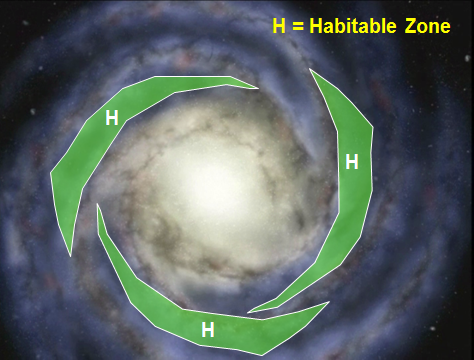
The galactic habitable zone (GHZ) is shown in green against a spiral galaxy
The galactic habitable zone (GHZ) is shown in green superimposed on a spiral galaxy

This is going to be old news to readers of this blog who are familiar with the Michael Strauss, Walter Bradley and Guillermo Gonzalez lectures on habitability and fine-tuning. But, it’s nice to see these ideas show up in one of the most prestigious peer-reviewed science journals in the world (if not the most prestigious).

Here’s the article from Science.

It says:

Scientists have known for several years now that stars, galaxies, and almost everything in the universe is moving away from us (and from everything else) at a faster and faster pace. Now, it turns out that the unknown forces behind the rate of this accelerating expansion—a mathematical value called the cosmological constant—may play a previously unexplored role in creating the right conditions for life.

That’s the conclusion of a group of physicists who studied the effects of massive cosmic explosions, called gamma ray bursts, on planets. They found that when it comes to growing life, it’s better to be far away from your neighbors—and the cosmological constant helps thin out the neighborhood.

“In dense environments, you have many explosions, and you’re too close to them,” says cosmologist and theoretical physicist Raul Jimenez of the University of Barcelona in Spain and an author on the new study. “It’s best to be in the outskirts, or in regions that have not been highly populated by small galaxies—and that’s exactly where the Milky Way is.”

Jimenez and his team had previously shown that gamma ray bursts could cause mass extinctions or make planets inhospitable to life by zapping them with radiation and destroying their ozone layer. The bursts channel the radiation into tight beams so powerful that one of them sweeping through a star system could wipe out planets in another galaxy. For their latest work, published this month in Physical Review Letters, they wanted to apply those findings on a broader scale and determine what type of universe would be most likely to support life.

The research is the latest investigation to touch on the so-called anthropic principle: the idea that in some sense the universe is tuned for the emergence of intelligent life. If the forces of nature were much stronger or weaker than physicists observe, proponents note, crucial building blocks of life—such fundamental particles, atoms, or the long-chain molecules needed for the chemistry of life—might not have formed, resulting in a sterile or even completely chaotic universe.

Basically, the best place for a galaxy that permits complex, embodied life to exist is one where you can pick up enough heavy elements from dying stars nearby, but not be in an area that is so crowded by stars that you will be murdered by intense gamma radiation when they die.

The cosmological constant has to be set just right that we spread out enough to make space between spiral arms for life-permitting solar systems, but no so spread out that we cannot pick up the heavy elements we need for a metal-rich star, a moon, and the bodies of the intelligent agents themselves.

More:

As it turns out, our universe seems to get it just about right. The existing cosmological constant means the rate of expansion is large enough that it minimizes planets’ exposure to gamma ray bursts, but small enough to form lots of hydrogen-burning stars around which life can exist. (A faster expansion rate would make it hard for gas clouds to collapse into stars.)

Jimenez says the expansion of the universe played a bigger role in creating habitable worlds than he expected. “It was surprising to me that you do need the cosmological constant to clear out the region and make it more suburbanlike,” he says.

Remember, this is only one of many characteristics that must obtain in order for a have a location in the universe that can support complex, embodied life of any conceivable kind.

Let’s review the big picture

Time for me to list out some of the things that are required for a galaxy, solar system and planet to support complex embodied life. Not just life as we know it, but life of any conceivable kind given these laws of physics.

  • a solar system with a single massive Sun than can serve as a long-lived, stable source of energy
  • a terrestrial planet (non-gaseous)
  • the planet must be the right distance from the sun in order to preserve liquid water at the surface – if it’s too close, the water is burnt off in a runaway greenhouse effect, if it’s too far, the water is permanently frozen in a runaway glaciation
  • the solar system must be placed at the right place in the galaxy – not too near dangerous radiation, but close enough to other stars to be able to absorb heavy elements after neighboring stars die
  • a moon of sufficient mass to stabilize the tilt of the planet’s rotation
  • plate tectonics
  • an oxygen-rich atmosphere
  • a sweeper planet to deflect comets, etc.
  • planetary neighbors must have non-eccentric orbits

It’s not easy to make a planet that supports life. For those who are interested in reaching out to God, he has left us an abundance of evidence for his existence – and his attention to detail.

And remember, these requirements for a habitable planet are downstream from the cosmic fine-tuning of constants and quantities that occurs at the Big Bang. No point in talking about the need for plate tectonics if you only have hydrogen in your universe. The habitability requirements are a further problem that comes after the fine-tuning problem.

Resources

The best book to read on this topic is “The Privileged Planet“, by Guillermo Gonzalez and Jay W. Richards. The latter is one of my absolute favorite Christian scholars, a real renaissance man. If the book is too much, there is a DVD by the same name that covers everything you need to know at a high level. Just FYI, Gonzalez made the cover of Scientific American in 2001, for his research on habitable zones. This is real evidence you can discuss with anyone, anywhere.

You can also watch the DVD for FREE on YouTube. Not sure how long that will be there. If you like it, buy the DVD, so you can show your friends.

Related posts

New “Science Uprising” video series seeks to counter naturalist dogma

The Circumstellar Habitable Zone, where liquid water could potentially exist

What is the nature of reality? Is the universe self-existing and eternal or did it coming into being? Can we attribute the the diversity of life to natural processes, or was their a designing agent involved? Whether people have thought deeply about these questions or not, they all live their lives as if one view or another were true. Is there any way to educate these busy people?

I found an article in CNS News about a new series of short videos that challenge the naturalistic view of origins that dominates society today.

Excerpt:

A new YouTube series, Science Uprising, challenges the notion that the smart money is on atheism.

I was part of the creative team behind the project. One of our aims was to reach Generation Z, “digital natives” who get much of their impression of the wider world from the internet, including streaming services like YouTube.

This generation tends to encounter well-articulated arguments for unbelief much earlier than their parents did, and they often encounter those arguments online. Science Uprising is among an increasingly rich body of online video material that pushes back against the flood of anti-theistic online propaganda.

The video series features researchers at the forefront of the intelligent design movement, including Lehigh University biochemist Michael Behe and Cambridge-trained philosopher of science Stephen Meyer. But it also feature some top researchers outside this circle, including renowned research psychiatrist Jeffrey Schwartz, leading synthetic organic chemist James Tour, and physicist Frank Tipler. For you physics/cosmology folks out there—yes, that Tipler.

Each Science Uprising video is 6-8 minutes long, fast-paced, and produced by filmmakers with extensive experience in the television industry. David Arabia, whose camera work can be seen on the popular History Channel series Mountain Men, headed up the project.

Each episode begins with a masked host who appears to hack into television and internet feeds around the country to offer a contrary perspective. One moment people in restaurants, classrooms, living rooms, Times Square, etc., are watching science popularizers like Bill Nye and Neal DeGrasse Tyson peddle a vision of man and nature as mere matter in motion. The next moment, the hacker host has replaced them onscreen to question their claims and introduce the episode topic.

In the first episode, released June 3, Carl Sagan famously intones that “the cosmos is all that is, or ever was, or ever will be,” then the masked host crackles onto the screen and asks, “How do they know the cosmos is all there is?”

In the second episode, released Monday, evolutionary biologist Jerry Coyne tells his audience that free will is an illusion since humans are essentially just “robots made out of meat.” The masked host then asks, “Are you and I really robots?”

The point of this hacker framing device isn’t that we live in an Orwellian police state. The United States enjoys tremendous press freedom—a freedom we are taking full advantage of through this video series. The idea, rather, is that if you passively absorb mainstream media and public education in the West, you will get a blinkered sense of what the latest scientific evidence suggests about the nature and origin of humankind and the cosmos.

Subsequent episodes will be released every Monday into July. They explore everything from DNA and genetic mutations to the curious way Earth and the laws of nature appear to be fine-tuned to allow for life. Each video includes one or more experts providing evidence that reality is more than matter, and that the world is charged with purpose and design.

Here is the first video:


And here is the second video:


And here is the third video:


And the fourth video:

If you want to share something on your wall to start a discussion, then these videos would be a good choice. Of course, to be able to debate these topics, you might need to read an article or a book about each topic. But that’s what I had to do, and it’s pretty fun to win arguments and beat up atheists.

New study: 90% of species on Earth today originated 100,000 to 200,000 years ago

Christianity and the progress of science

Well, it’s Friday, so I thought we would all benefit from reading about a brand new peer-reviewed study that should be the final nail in the coffin of naturalistic evolution. At least for those with an open mind who are not wedded to the philosophical assumption of naturalism.

Phys.org (which is committed dogmatically to fully naturalistic evolution) reports:

Mark Stoeckle from The Rockefeller University in New York and David Thaler at the University of Basel in Switzerland, who together published findings last week sure to jostle, if not overturn, more than one settled idea about how evolution unfolds.

It is textbook biology, for example, that species with large, far-flung populations—think ants, rats, humans—will become more genetically diverse over time.

But is that true?

“The answer is no,” said Stoeckle, lead author of the study, published in the journal Human Evolution.

For the planet’s 7.6 billion people, 500 million house sparrows, or 100,000 sandpipers, genetic diversity “is about the same,” he told AFP.

The study’s most startling result, perhaps, is that nine out of 10 species on Earth today, including humans, came into being 100,000 to 200,000 years ago.

“This conclusion is very surprising, and I fought against it as hard as I could,” Thaler told AFP.

That reaction is understandable: How does one explain the fact that 90 percent of animal life, genetically speaking, is roughly the same age?

Oh, oh. Pick me, pick me. I know the answer. The answer is that the biological information in living systems was put there by an intelligent agent. You know, the same way that information in books is put there by intelligent agents. And the same way that information in computer code is put there by intelligent agents. And the same way that information in blog posts is put there by intelligent agents. We know what introduces information from our own experience.

Well, what about mutation and selection? Couldn’t they create all this information in a couple hundred thousand years? Well, no. You see, mutation and selection have been tested in the lab to see how much information they can produce over generations and generations. And the conclusion is clear: it is impossible for blind forces to create the amount of information we see in living systems in the short time that is available. In fact, the whole history of the universe is not enough time for evolutionary mechanisms to create the information we have in front of us.

Before we leave the paper reported by Phys.org, here is something about whether we see the gradual emergence of complexity via lots of transitional forms in nature.

Not so much:

[…][A]nother unexpected finding from the study—species have very clear genetic boundaries, and there’s nothing much in between.

“If individuals are stars, then species are galaxies,” said Thaler. “They are compact clusters in the vastness of empty sequence space.”

The absence of “in-between” species is something that also perplexed Darwin, he said.

Indeed. So perplexing.

The evidence we gain from the progress of science is always perplexing to people who assume naturalism, and then try to shoehorn reality to match their religious assumptions. I have an idea. Why don’t we just make science the search for truth, no holds barred? Wouldn’t that be a much better way to do science? Let’s just do science honestly, and stop trying to make it prove things that are comfortable for us.

If the origin of the universe, the fine-tuning of the universe for intelligent life, the origin of the first living system, and the sudden origin of body plans in the Cambrian explosion are impossible to account for on naturalism, then maybe we need to jettison the philosophical assumption of naturalism, and just go where the evidence leads? What’s wrong with that?