Tag Archives: India

Is the accelerating universe compatible with Hinduism?

First, a news story – and then we’ll see how the accelerating universe relates to the existence of God.

Excerpt:

Three astrophysicists who discovered that the universe’s expansion is accelerating rather than decelerating, as had been expected, win the Nobel Prize in physics.

Adam Riess was sure he’d spotted a blatant error in his results. It was 1997, and the young post-doc’s measurements of distant, exploding stars implied that the universe was expanding at a faster and faster rate, instead of slowing down, as he had expected.

It wasn’t an error at all. Instead, what was at fault were some basic assumptions about the workings of the universe.

On Tuesday, the Johns Hopkins University astrophysicist received the Nobel Prize in physics for the revolutionary discovery and its implications, along with team leader Brian Schmidt of Australian National University and astrophysicist Saul Perlmutter of UC Berkeley and Lawrence Berkeley National Laboratory, who had reached the same conclusion independently.

At the time of their work, astrophysicists believed that the rate of expansion of the universe — set in motion by the Big Bang 13.7 billion years ago — would be slowing down as matter was pulled together by gravity. The goal at the time was to figure out how rapid the deceleration was.

What the two teams found instead was that the expansion of the universe was accelerating — an observation that could best be explained by the existence of a mysterious “dark energy” that pushes matter farther and farther apart.

Many scientists had thought that, just as the universe started with the Big Bang, it would end with a Big Crunch — with gravity pulling all the matter in the universe inward.

Does anyone remember that week that I wrote those posts about “Why I am not a… <insert some religion here>”? I explained why I was not all kinds of different religions and denominations, including Roman Catholicism, Calvinism, Hinduism, Judaism, Islam, etc. Everyone was offended and we fought about it. Ah, I remember it well.

Now let’s apply science to the Hindu religion and see if they go together, especially this new discovery about the expansion of the universe.

Why I am not a Hindu

  1. Hindu cosmology teaches that the universe cycles between creation and destruction, through infinite time.
  2. The closest cosmological model conforming to Hindu Scriptures is the eternally “oscillating” model of the universe.
  3. The “oscillating” model requires that the universe exist eternally into the past.
  4. But the evidence today shows the the universe, and time itself, had a beginning at the big bang.
  5. The “oscillating” model requires that the expansion of the universe reverse into a collapse, (= crunch).
  6. In 1998, the discovery of the year was that the universe would expand forever. There will be no crunch.
  7. Therefore, the oscillating model is disconfirmed by observations.
  8. The oscillating model also faces theoretical problems with the “bounce” mechanism.

So that’s one reason why I am not a Hindu. And now we have more scientific confirmation that there is no cycle of universes coming into being and going out of being.

The absolute origin of the universe out of nothing is also incompatible with Buddhism and Mormonism and maybe other religions. They also require an eternally existing universe.

And modern cosmology disagrees with atheism, too

I think it’s important for all of you to be familiar with the scientific evidence for the Big Bang. It will help you with your cosmological argument, and it will help you to refute many, many other religions that require eternal universes, including atheism.

I wrote about how the Big Bang theory falsifies atheism before.

Excerpt:

According to the Secular Humanist Manifesto, atheism is committed to an eternally existing universe, (See the first item: “Religious humanists regard the universe as self-existing and not created.”). If something non-material brought all existing matter into being, that would be a supernatural cause, and atheists deny that anything supernatural exists. The standard Big Bang theory requires that all the matter in the universe come into being out of nothing. The Big Bang has been confirmed by experimental evidence such as redshift measurements, light element abundances and the cosmic microwave background radiation. This falsifies eternal models of the universe, which are required by atheist Scriptures.

The experimental evidence that confirms the Big Bang creation out of nothing falsifies many worldviews. Those who care about evidence will have to choose some other religion that is compatible with what we know from science today.
A secular case against legalized abortion

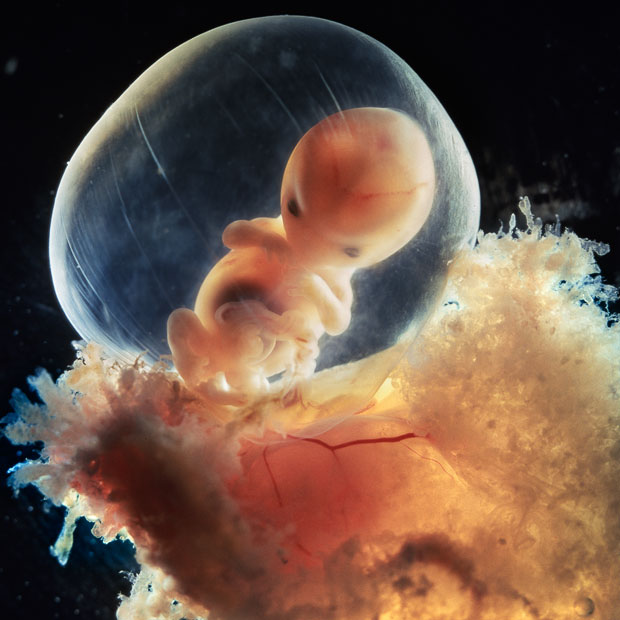
Unborn baby scheming about being only two months old

Note: this post has a twin! Its companion post on a secular case against gay marriage is here.

Now, you may think that the view that the unborn deserve protection during pregnancy is something that you either take on faith or not. But I want to explain how you can make a case for the right to life of the unborn, just by using reason and evidence.

To defend the pro-life position, I think you need to sustain 3 arguments:

  1. The unborn is a living being with human DNA, and is therefore human.
  2. There is no morally-relevant difference between an unborn baby, and one already born.
  3. None of the justifications given for terminating an unborn baby are morally adequate.

Now, the pro-abortion debater may object to point 1, perhaps by claiming that the unborn baby is either not living, or not human, or not distinct from the mother.

Defending point 1: Well, it is pretty obvious that the unborn child is not inanimate matter. It is definitely living and growing through all 9 months of pregnancy. (Click here for a video that shows what a baby looks like through all 9 months of pregnancy). Since it has human DNA, that makes it a human. And its DNA is different from either its mother or father, so it clearly not just a tissue growth of the father or the mother. More on this point at Christian Cadre, here. An unborn child cannot be the woman’s own body, because then the woman would have four arms, four legs, two heads, four eyes and two different DNA signatures. When you have two different human DNA signatures, you have two different humans.

Secondly, the pro-abortion debater may try to identify a characteristic of the unborn that is not yet present or developed while it is still in the womb, and then argue that because the unborn does not have that characteristic, it does not deserve the protection of the law.

Defending point 2: You need to show that the unborn are not different from the already-born in any meaningful way. The main differences between them are: size, level of development, environment and degree of dependence. Once these characteristics are identified, you can explain that none of these differences provide moral justification for terminating a life. For example, babies inside and outside the womb have the same value, because location does not change a human’s intrinsic value. More at Stand to Reason, here.

Additionally, the pro-abortion debater may try to identify a characteristic of the already-born that is not yet present or developed in the unborn, and then argue that because the unborn does not have that characteristic, that it does not deserve protection, (e.g. – sentience). Most of the these objections that you may encounter are refuted in this essay by Francis Beckwith. Usually these objections fall apart because they assume the thing they are trying to prove, namely, that the unborn deserves less protection than the already born.

Finally, the pro-abortion debater may conceded your points 1 and 2, and admit that the unborn is fully human. But they may then try to provide a moral justification for terminating the life of the unborn, regardless.

Defending point 3: I fully grant that it is sometimes justifiable to terminate an innocent human life, if there is a moral justification. Is there such a justification for abortion? One of the best known attempts to justify abortion is Judith Jarvis Thomson’s “violinist” argument. This argument is summarized by Paul Manata, one of the experts over at Triablogue:

Briefly, this argument goes like this: Say a world-famous violinist developed a fatal kidney ailment and the Society of Music Lovers found that only you had the right blood-type to help. So, they therefore have you kidnapped and then attach you to the violinist’s circulatory system so that your kidneys can be used to extract the poison from his. To unplug yourself from the violinist would be to kill him; therefore, pro-lifers would say a person has to stay attached against her will to the violinist for 9 months. Thompson says that it would be morally virtuous to stay plugged-in. But she asks, “Do you have to?” She appeals to our intuitions and answers, “No.”

Manata then goes on to defeat Thomson’s proposal here, with a short, memorable illustration, which I highly recommend that you check out. More info on how to respond to similar arguments is here.

The best book for beginners on the pro-life view is this book:

For those looking for advanced resources, Francis Beckwith, a professor at Baylor University, published the book Defending Life, with Cambridge University Press, 2007.

Learn about the pro-life case

And some posts motivating Christians and conservatives to take abortion seriously:

The blind men and the elephant: an argument for religious pluralism?

From Please Convince Me, a post by Aaron outlining 7 problems with the blind man and the elephant story.

Here’s the set up:

Maybe you’ve heard the parable of the six blind men and the elephant. In this parable, six blind men feel a different part of an elephant and come to different conclusions regarding what the elephant is actually like.

One blind man grabs the tusk and says, “An elephant is like a spear!” Another feels the trunk and concludes, “An elephant is like a snake!” The blind man hugging the leg thinks, “An elephant is like a tree!” The one holding the tail claims, “An elephant is like a rope!” Another feeling the ear believes, “An elephant is like a fan!” The last blind man leaning on the elephant’s side exclaims, “An elephant is like a wall!”

This parable is often used to illustrate a view known as religious pluralism. Like the blind men, no religion hasthe truth. Rather, all religions are true in that they accurately describe their personal experience and the spiritual reality they encounter, given various historical and cultural backgrounds.

There are various types of religious pluralism, but one way to define it is as follows: “the view that all religious roads – certainly all major or ethical ones – lead to God or to ultimate reality and salvation.”1 This idea is commonly reflected in such statements as “All religions basically teach the same thing” or “All roads lead to the top of the mountain.”

The elephant parable, while attractive to many, suffers from a number of problems.

And here’s one problem:

Problem #4: The parable commits the self-excepting fallacy.

The religious pluralist who tells this parable claims everyone is blind, except the religious pluralist himself! In other words, there is an objective perspective presented here. However, if all religious views are essentially blind, this would include the religious view of religious pluralism. But the religious pluralist conveniently exempts himself, having somehow escaped the spiritual blindness which has enveloped all other religious views and has come to see the truth of religious pluralism! In so doing, the religious pluralist claims to have the only objective perspective:

In fact, he wouldn’t know that the blind men were wrong unless he had an objective perspective of what was right! So if the person telling the parable can have an objective perspective, why can’t the blind men? They could – if the blind men suddenly could see, they too would realize that they were originally mistaken. That’s really an elephant in front of them and not a wall, fan, or rope. We too can see the truth in religion. Unfortunately, many of us who deny there’s truth in religion are not actually blind but only willfully blind. We may not want to admit that there’s truth in religion because that truth will convict us. But if we open our eyes and stop hiding behind the self-defeating nonsense that truth cannot be known, then we’ll be able to see the truth as well.5

5 Norman L. Geisler and Frank Turek, I Don’t Have Enough Faith to Be an Atheist (Wheaton: Crossway, 2004), 49.

Read the whole thing!

UPDATE: Greg West of The Poached Egg tweets an announcement of his post on the same topic.