
Tag Archives: Home Ownership

Can blacks and Hispanics blame their troubles on racism by whites?

Does government provide incentives for people to get married?
The success of children is due to their parents’ choices, not from outside racism

If the underperformance of blacks and Hispanics in America were caused by racism by whites, then it follows that Asian-Americans would be underperforming as well. But Asian-Americans are outperforming whites. Let’s look at three reasons why, and see if blacks and Hispanics can learn how to succeed by looking at the Asian example.

Here is the summary of this post:

  1. Asian Americans marry before they have children
  2. Asian Americans save more of what they earn
  3. Asian Americans monitor their children’s educational progress

Now let’s take a look at each of these in order.
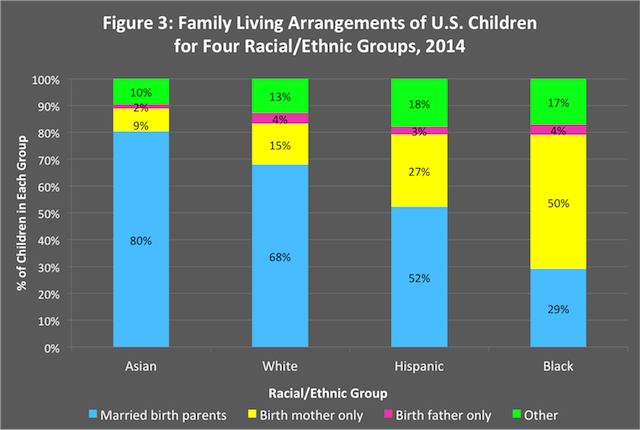
Asians marry before they have children, so the kids have two parents

1. Asian Americans marry before they have children

This article is from Family Studies.

It says:

Eight in ten Asian-American kids live with married birth parents, compared with about seven in ten European-American kids, five in ten Hispanic-American kids, and only about three in ten African-American kids. Half of black children live with their mothers only, compared to three in ten Hispanic children, less than two in ten white children and less than one in ten Asian children.

Naturally, children who have two parents to look after them do better, because one parent alone cannot work and do household chores and monitor the children as easily as two parents can. The decision about whether to have sex before marriage is entirely under the control of the grown-ups. It cannot be blamed on racism, poverty and other non-moral pre-occupations of the secular left. Marriage is a moral issue, and Asian-Americans do the moral thing, and marry before they have children.
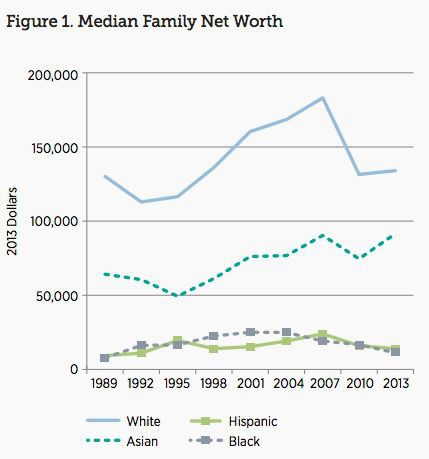
Asian household wealth set to surpass whites

2. Asian Americans save more of what they earn

This article from CNN Money explains:

Asians have had higher median incomes than their white counterparts, according to a new study by the Federal Reserve Bank of St. Louis. The typical Asian family has brought home more money for most of the past two decades.

[…][Asians] will surpass whites in net worth in the next decade or two, Fed researchers said.

[…]In 1989, the median Asian family had about half the net worth of its white peer. By 2013, they had more than two-thirds.

The gap between whites and blacks and Hispanics, meanwhile, remained little changed over that time period.

Asians have similar financial habits to whites, in terms of investing and borrowing. Both groups are more likely than blacks and Hispanics to invest in stocks and privately-owned businesses and to have more liquid assets, which serves as a buffer against financial shocks. And, on average, the former have about half as much debt as the later.

As a result, Asians and whites have more financial stability than blacks and Hispanics, which also allows the former to build more wealth.

Everyone has to earn and save money, but in some cultures, it becomes normal to not save part of what you earn. That needs to stop. But it has nothing to do with discrimination due to skin color. In Asian culture, there is no glorification of consumer spending on sparkles, bling and other ostentatious wealth. Asians don’t want to appear to be wealthy, they want to actually be wealthy – by saving money.
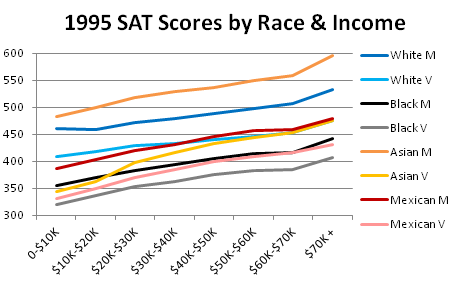
Composite SAT scores by race and income levels
Composite SAT scores by race and income levels: Asians outperform at every income level

3. Asian Americans monitor their children’s educational progress

This article from Investors Business Daily explains how Asian parents don’t just make demands on their kids to learn, they actively monitor their progress and talk to their kids’ teachers:

Asian-American parents tend to oversee their children’s homework, hold them accountable for grades and demand hard work as the ticket to a better life. And it pays off: Their children are soaring academically.

[…]As a group, Americans need to take a page from the Asian parents’ playbook. American teens rank a dismal 28th in math and science knowledge, compared with teens in other countries, even poor countries.

Singapore, Hong Kong, South Korea, Japan and Taiwan are at the top. We’ve slumped. For the first time in 25 years, U.S. scores on the main test for elementary and middle school education (NAEP) fell. And SAT scores for college-bound students dropped significantly.

[…]Many [Asian students]from poor or immigrant families, but they outscore all other students by large margins on both tests, and their lead keeps widening.

In New York City, where Asian-Americans make up 13% of overall students, they win more than 50% of the coveted places each year at the city’s eight selective public high schools, such as Bronx Science and Stuyvesant.

What’s at work here? It’s not a difference in IQ. It’s parenting. That’s confirmed by sociologists from City University of New York and the University of Michigan. Their study showed that parental oversight enabled Asian-American students to far outperform the others.

No wonder many successful charter schools require parents to sign a contract that they will supervise their children’s homework and inculcate a work ethic.

You can see an updated image with the latest scores here.

It’s not enough to just outsource the education of your children to a bunch of non-STEM education-degree-holding teachers. Teachers can be good, and some work very hard. But the Democrat teacher unions prevent the firing of teachers who underperform. This is especially true in non-right-to-work states (Democrat states). So, you cannot depend on teachers to educate your children, and Asian parents don’t. That’s why their kids learn. Performance of children in school is not affected by discrimination against skin color, it’s affected by the level of involvement of parents.

Conclusion

We have learned that the success of Asian-Americans in America is all earned. And this proves that there is no such thing as “racism” that holds back non-whites. If blacks and Hispanics imitated the behaviors of Asians (not whites, but Asians), then they would achieve just as well as Asians do. It’s not a race problem, it’s a behavior problem. It’s not a “racism” problem, it’s a behavior problem. It’s an us problem, it’s not a them problem.

Can blacks and Hispanics blame their troubles on racism by whites?

Does government provide incentives for people to get married?
The success of children is due to their parents’ choices, not from outside racism

If the underperformance of blacks and Hispanics in America were caused by racism by whites, then it follows that Asian-Americans would be underperforming as well. But Asian-Americans are outperforming whites. Let’s look at three reasons why, and see if blacks and Hispanics can learn how to succeed by looking at the Asian example.

Here is the summary of this post:

  1. Asian Americans marry before they have children
  2. Asian Americans save more of what they earn
  3. Asian Americans monitor their children’s educational progress

Now let’s take a look at each of these in order.

Asians marry before they have children, so the kids have two parents

1. Asian Americans marry before they have children

This article is from Family Studies.

It says:

Eight in ten Asian-American kids live with married birth parents, compared with about seven in ten European-American kids, five in ten Hispanic-American kids, and only about three in ten African-American kids. Half of black children live with their mothers only, compared to three in ten Hispanic children, less than two in ten white children and less than one in ten Asian children.

Naturally, children who have two parents to look after them do better, because one parent alone cannot work and do household chores and monitor the children as easily as two parents can. The decision about whether to have sex before marriage is entirely under the control of the grown-ups. It cannot be blamed on racism, poverty and other non-moral pre-occupations of the secular left. Marriage is a moral issue, and Asian-Americans do the moral thing, and marry before they have children.

Asian household wealth set to surpass whites

2. Asian Americans save more of what they earn

This article from CNN Money explains:

Asians have had higher median incomes than their white counterparts, according to a new study by the Federal Reserve Bank of St. Louis. The typical Asian family has brought home more money for most of the past two decades.

[…][Asians] will surpass whites in net worth in the next decade or two, Fed researchers said.

[…]In 1989, the median Asian family had about half the net worth of its white peer. By 2013, they had more than two-thirds.

The gap between whites and blacks and Hispanics, meanwhile, remained little changed over that time period.

Asians have similar financial habits to whites, in terms of investing and borrowing. Both groups are more likely than blacks and Hispanics to invest in stocks and privately-owned businesses and to have more liquid assets, which serves as a buffer against financial shocks. And, on average, the former have about half as much debt as the later.

As a result, Asians and whites have more financial stability than blacks and Hispanics, which also allows the former to build more wealth.

Everyone has to earn and save money, but in some cultures, it becomes normal to not save part of what you earn. That needs to stop. But it has nothing to do with discrimination due to skin color. In Asian culture, there is no glorification of consumer spending on sparkles, bling and other ostentatious wealth. Asians don’t want to appear to be wealthy, they want to actually be wealthy – by saving money.

Composite SAT scores by race and income levels
Composite SAT scores by race and income levels: Asians outperform at every income level

3. Asian Americans monitor their children’s educational progress

This article from Investors Business Daily explains how Asian parents don’t just make demands on their kids to learn, they actively monitor their progress and talk to their kids’ teachers:

Asian-American parents tend to oversee their children’s homework, hold them accountable for grades and demand hard work as the ticket to a better life. And it pays off: Their children are soaring academically.

[…]As a group, Americans need to take a page from the Asian parents’ playbook. American teens rank a dismal 28th in math and science knowledge, compared with teens in other countries, even poor countries.

Singapore, Hong Kong, South Korea, Japan and Taiwan are at the top. We’ve slumped. For the first time in 25 years, U.S. scores on the main test for elementary and middle school education (NAEP) fell. And SAT scores for college-bound students dropped significantly.

[…]Many [Asian students]from poor or immigrant families, but they outscore all other students by large margins on both tests, and their lead keeps widening.

In New York City, where Asian-Americans make up 13% of overall students, they win more than 50% of the coveted places each year at the city’s eight selective public high schools, such as Bronx Science and Stuyvesant.

What’s at work here? It’s not a difference in IQ. It’s parenting. That’s confirmed by sociologists from City University of New York and the University of Michigan. Their study showed that parental oversight enabled Asian-American students to far outperform the others.

No wonder many successful charter schools require parents to sign a contract that they will supervise their children’s homework and inculcate a work ethic.

You can see an updated image with the latest scores here.

It’s not enough to just outsource the education of your children to a bunch of non-STEM education-degree-holding teachers. Teachers can be good, and some work very hard. But the Democrat teacher unions prevent the firing of teachers who underperform. This is especially true in non-right-to-work states (Democrat states). So, you cannot depend on teachers to educate your children, and Asian parents don’t. That’s why their kids learn. Performance of children in school is not affected by discrimination against skin color, it’s affected by the level of involvement of parents.

Conclusion

We have learned that the success of Asian-Americans in America is all earned. And this proves that there is no such thing as “racism” that holds back non-whites. If blacks and Hispanics imitated the behaviors of Asians (not whites, but Asians), then they would achieve just as well as Asians do. It’s not a race problem, it’s a behavior problem. It’s not a “racism” problem, it’s a behavior problem. It’s an us problem, it’s not a them problem.

Obama administration pressuring banks to lower mortgage lending standards

Remember the housing bubble and the mortgage lending crisis of 2008? Well guess what – the Democrats want an encore.

Investors Business Daily explains.

Bankers warn the administration’s new “disparate impact” home-lending regulation will wreak havoc in credit markets, replacing merit standards with political correctness.

The Department of Housing and Urban Development issued the controversial new anti-discrimination rule earlier this year. Now enforced by every federal regulator dealing with banks, it has the effect of criminalizing credit standards used to qualify borrowers for home loans.

Last week, the Mortgage Bankers Association and Independent Community Bankers of America jointly filed a Supreme Court brief arguing that under the new HUD rule:

“Virtually every lender in the United States could be sued for using non-discriminatory credit standards simply because variations in economic and credit characteristics produce different credit outcomes among racial and ethnic groups.”

In their 33-page brief, filed in support of a landmark housing case pending before the court, they complain that HUD recently launched 22 separate investigations against lenders alleging that their policies of requiring minimum credit scores “had a disparate impact on minorities in violation of the Fair Housing Act.”

Dozens of similar actions have been brought against lenders by Attorney General Eric Holder. He is basing claims of bias on statistics showing differences in loan outcomes by race while ignoring racially neutral credit-risk factors that explain those differences.

Under disparate impact’s low standard of proof, the government doesn’t have to show lenders intentionally discriminated against borrowers.

For the first time in history, businesses are being ordered to justify the necessity of a certain level of return on investment given the racial impact resulting from the use of credit-score thresholds.

The mortgage trade groups argue the formalized disparate-impact rule also effectively criminalizes other legitimate business practices, including minimum down-payment requirements, sliding loan rates and the charging of brokers’ fees.

Banks today face increased litigation risk simply by complying with sensible lending standards for hedging against risk.

[…]The social engineers and race demagogues in this administration are trying to enforce a balance in financial outcomes that risks another collapse of the housing market. The Supreme Court must put an end to a scheme so reckless, unfair and unconstitutional.

Does that sound familiar? Yes. In the last recession, the government forced banks to make risky loans in order to increase home ownership. That is exactly what gave us the 2008 recession.

Excerpt:

[Democrat] Congressman [Barney] Frank, of course, blamed the financial crisis on the failure adequately to regulate the banks. In this, he is following the traditional Washington practice of blaming others for his own mistakes. For most of his career, Barney Frank was the principal advocate in Congress for using the government’s authority to force lower underwriting standards in the business of housing finance. Although he claims to have tried to reverse course as early as 2003, that was the year he made the oft-quoted remark, “I want to roll the dice a little bit more in this situation toward subsidized housing.” Rather than reversing course, he was pressing on when others were beginning to have doubts.

His most successful effort was to impose what were called “affordable housing” requirements on Fannie Mae and Freddie Mac in 1992. Before that time, these two government sponsored enterprises (GSEs) had been required to buy only mortgages that institutional investors would buy–in other words, prime mortgages–but Frank and others thought these standards made it too difficult for low income borrowers to buy homes. The affordable housing law required Fannie and Freddie to meet government quotas when they bought loans from banks and other mortgage originators.

At first, this quota was 30%; that is, of all the loans they bought, 30% had to be made to people at or below the median income in their communities. HUD, however, was given authority to administer these quotas, and between 1992 and 2007, the quotas were raised from 30% to 50% under Clinton in 2000 and to 55% under Bush in 2007.

[…]It is certainly possible to find prime mortgages among borrowers below the median income, but when half or more of the mortgages the GSEs bought had to be made to people below that income level, it was inevitable that underwriting standards had to decline. And they did. By 2000, Fannie was offering no-downpayment loans. By 2002, Fannie and Freddie had bought well over $1 trillion of subprime and other low quality loans. Fannie and Freddie were by far the largest part of this effort, but the FHA, Federal Home Loan Banks, Veterans Administration and other agencies–all under congressional and HUD pressure–followed suit. This continued through the 1990s and 2000s until the housing bubble–created by all this government-backed spending–collapsed in 2007. As a result, in 2008, before the mortgage meltdown that triggered the crisis, there were 27 million subprime and other low quality mortgages in the US financial system. That was half of all mortgages. Of these, over 70% (19.2 million) were on the books of government agencies like Fannie and Freddie, so there is no doubt that the government created the demand for these weak loans; less than 30% (7.8 million) were held or distributed by the banks, which profited from the opportunity created by the government. When these mortgages failed in unprecedented numbers in 2008, driving down housing prices throughout the U.S., they weakened all financial institutions and caused the financial crisis.

Reduced lending standards caused the last recession, and now the same party that pushed for reduced lending standards are pushing for reduced lending standards again. Hold onto your hats, there’s a storm coming.