Guillermo Gonzalez is an Associate Professor of Physics at Grove City College. He received his Ph.D. in Astronomy in 1993 from the University of Washington. He has done post-doctoral work at the University of Texas, Austin and at the University of Washington and has received fellowships, grants and awards from such institutions as NASA, the University of Washington, the Templeton Foundation, Sigma Xi (scientific research society) and the National Science Foundation.
Is the Earth’s suitability for hosting life rare in the universe?
Does the Earth have to be the center of the universe to be special?
How similar to the Earth does a planet have to be to support life?
What is the definition of life?
What are the three minimal requirements for life of any kind?
Requirement 1: A molecule that can store information (carbon)
Requirement 2: A medium in which chemicals can interact (liquid water)
Requirement 3: A diverse set of chemical elements
What is the best environment for life to exist?
Our place in the solar system: the circumstellar habitable zone
Our place in the galaxy: the galactic habitable zones
Our time in the universe’s history: the cosmic habitable age
Other habitability requirements (e.g. – metal-rich star, massive moon, etc.)
The orchestration needed to create a habitable planet
How different factors depend on one another through time
How tweaking one factor can adversely affect other factors
How many possible places are there in the universe where life could emerge?
Given these probabilistic resources, should we expect that there is life elsewhere?
How to calculate probabilities using the “Product Rule”
Can we infer that there is a Designer just because life is rare? Or do we need more?
The corelation between habitability and measurability.
Are the habitable places in the universe also the best places to do science?
Do the factors that make Earth habitable also make it good for doing science?
Some places and times in the history of the universe are more habitable than others
Those exact places and times also allow us to make scientific discoveries
Observing solar eclipses and structure of our star, the Sun
Observing stars and galaxies
Observing the cosmic microwave background radiation
Observing the acceleration of the universe caused by dark matter and energy
Observing the abundances of light elements like helium of hydrogen
These observations support the big bang and fine-tuning arguments for God’s existence
It is exactly like placing observatories on the tops of mountains
There are observers existing in the best places to observe things
This is EXACTLY how the universe has been designed for making scientific discoveries
This lecture was delivered by Guillermo Gonzalez in 2007 at the University of California at Davis.
What is intelligent design?
Dr. Stephen C. Meyer explains the concept of intelligent design in a lecture, with lots of visual aids.
He is also the author of “Signature in the Cell“, the best book on intelligent design. (A Times Literary Supplement Book of the Year selection)
Related DVDs
Illustra also made two other great DVDs on intelligent design. The first two DVDs “Unlocking the Mystery of Life” and “The Privileged Planet” are must-buys, but you can watch them on youtube if you want, for free.
Walter Bradley (B.S., Ph.D. University of Texas at Austin) is Distinguished Professor of Engineering at Baylor. He comes to Baylor from Texas A&M University where he helped develop a nationally recognized program in polymeric composite materials. At Texas A&M, he served as director of the Polymer Technology Center for 10 years and as Department Head of Mechanical Engineering, a department of 67 professors that was ranked as high as 12th nationally during his tenure. Bradley has authored over 150 refereed research publications including book chapters, articles in archival journals such as the Journal of Material Science, Journal of Reinforced Plastics and Composites, Mechanics of Time-Dependent Materials, Journal of Composites Technology and Research, Composite Science and Technology, Journal of Metals, Polymer Engineering and Science, and Journal of Materials Science, and refereed conference proceedings.
Dr. Bradley has secured over $5.0 million in research funding from NSF grants (15 yrs.), AFOSR (10 years), NASA grants (10 years), and DOE (3 years). He has also received research grants or contracts from many Fortune 500 companies, including Alcoa, Dow Chemical, DuPont, 3M, Shell, Exxon, Boeing, and Phillips.
He co-authored The Mystery of Life Origin: Reassessing Current Theories and has written 10 book chapters dealing with various faith science issues, a topic on which he speaks widely.
He has received 5 research awards at Texas A&M University and 1 national research award. He has also received two teaching awards. He is an Elected Fellow of the American Society for Materials and the American Scientific Affiliation (ASA), the largest organization of Christians in Science and Technology in the world. He is President elect of the ASA and will serve his term in 2008.
Below, I analyze a lecture entitled “Is There Scientific Evidence for an Intelligent Designer?”. Dr. Bradley explains how the progress of science has made the idea of a Creator and Designer of the universe more acceptable than ever before.
1. The correspondence of natural phenomena to mathematical law
All observations of physical phenomena in the universe, such as throwing a ball up in the air, are described by a few simple, elegant mathematical equations.
2. The fine-tuning of physical constants and rations between constants in order to provide a life-permitting universe
Life has certain minimal requirements; long-term stable source of energy, a large number of different chemical elements, an element that can serve as a hub for joining together other elements into compounds, etc.
In order to meet these minimal requirements, the physical constants, (such as the gravitational constant), and the ratios between physical constants, need to be withing a narrow range of values in order to support the minimal requirements for life of any kind.
Slight changes to any of the physical constants, or to the rations between the constants, will result in a universe inhospitable to life.
The range of possible ranges over 70 orders of magnitude.
Although each individual selection of constants and ratios is as unlikely as any other selection, the vast majority of these possibilities do not support the minimal requirements of life of any kind. (In the same way as any hand of 5 cards that is dealt is as likely as any other, but you are overwhelmingly likely NOT to get a royal flush. In our case, a royal flush is a life-permitting universe).
Examples of finely-tuned constants and ratios: (there are more examples in the lecture)
a) The strong force: (the force that binds nucleons (= protons and neutrons) together in nucleus, by means of meson exchange)
if the strong force constant were 2% stronger, there would be no stable hydrogen, no long-lived stars, no hydrogen containing compounds. This is because the single proton in hydrogen would want to stick to something else so badly that there would be no hydrogen left!
if the strong force constant were 5% weaker, there would be no stable stars, few (if any) elements besides hydrogen. This is because you would be able to build up the nuclei of the heavier elements, which contain more than 1 proton.
So, whether you adjust the strong force up or down, you lose stars than can serve as long-term sources of stable energy, or you lose chemical diversity, which is necessary to make beings that can perform the minimal requirements of living beings. (see below)
b) The conversion of beryllium to carbon, and carbon to oxygen
Life requires carbon in order to serve as the hub for complex molecules, but it also requires oxygen in order to create water.
Carbon is like the hub wheel in a tinker toy set: you can bind other elements together to more complicated molecules (e.g. – “carbon-based life), but the bonds are not so tight that they can’t be broken down again later to make something else.
The carbon resonance level is determined by two constants: the strong force and electromagnetic force.
If you mess with these forces even slightly, you either lose the carbon or the oxygen.
3. Fine-tuning to allow a habitable planet
A number of factors must be fine-tuned in order to have a planet that supports life
Initial estimates predicted abundant life in the universe, but revised estimates now predict that life is almost certainly unique in the galaxy, and probably unique in the universe.
Even though there are lots of stars in the universe, the odds are against any of them supporting complex life.
Here are just a few of the minimal requirements for habitability: must be a single star solar system, in order to support stable planetary orbits, the planet must be the right distance from the sun in order to have liquid water at the surface, the planet must sufficient mass in order to retain an atmosphere, etc.
The best non-theistic response to this argument is to postulate a multiverse, but that is very speculative and there is no experimental evidence that supports it.
Evidence #2: The origin of the universe
1. The progress of science has shown that the entire physical universe came into being out of nothing (= “the big bang”). It also shows that the cause of this creation event is non-physical and non-temporal. The cause is supernatural.
Atheism prefers an eternal universe, to get around the problem of a Creator having to create the universe.
Discovery #1: Observations of galaxies moving away from one another confirms that the universe expanded from a single point.
Discovery #2: Measurements of the cosmic background radiation confirms that the universe exploding into being.
Discovery #3: Predictions of elemental abundances prove that the universe is not eternal.
Discovery #4:The atheism-friendly steady-state model and oscillating model were both falsified by the evidence.
And there were other discoveries as well, mentioned in the lecture.
The best non-theistic response to this argument is to postulate a hyper-universe outside of ours, but that is very speculative and there is no experimental evidence that supports it.
Evidence #3: The origin of life
1. The progress of science has shown that the simplest living organism contains huge amounts of biological information, similar to the Java code I write all day at work. This is a problem for atheists, because the sequence of instructions in a living system has to come together all at once, it cannot have evolved by mutation and selection – because there was no replication in place prior to the formation of that first living system!
Living systems must support certain minimum life functions: processing energy, storing information, and replicating.
There needs to be a certain amount of complexity in the living system that can perform these minimum functions.
But on atheism, the living system needs to be simple enough to form by accident in a pre-biotic soup, and in a reasonable amount of time.
The minimal functionality in a living system is a achieved by DNA, RNA and enzymes. DNA and RNA are composed of sequences of proteins, which are in turn composed of sequences of amino acids.
Consider the problems of building a chain of 100 amino acids
The amino acids must be left-handed only, but left and right kinds are equally abundant in nature. How do you sort out the right-handed ones?
The amino acids must be bound together using peptide bonds. How do you prevent other types of bonds?
Each link of the amino acid chain needs to be carefully chosen such that the completed chain with fold up into a protein. How do you choose the correct amino acid for each link from the pool of 20 different kinds found in living systems?
In every case, a human or other intelligence could solve these problems by doing what intelligent agents do best: making choices.
But who is there to make the choices on atheism?
The best current non-theistic response to this is to speculate that aliens may have seeded the Earth with life at some point in the past.
The problem of the origin of life is not a problem of chemistry, it is a problem of engineering. Every part of car functionality can be understood and described using the laws of physics and chemistry. But an intelligence is still needed in order to assemble the components into a system that has the minimal requirements for a functioning vehicle.
Note: If you need a refresher on the habitability argument, click here.
Here’s an article entitled “Tidal heating shrinks the ‘goldilocks zone’: Overlooked factor suggests fewer habitable planets than thought”. It appeared in Nature, the most prestigious peer-reviewed science journal.
The gist of it is that tidal forces can alter orbits so that planets don’t spend all of their orbit in the habitable zone. If planets go outside the habitable zone, it damages their supply of liquid water, and any life chemistry going on in there is disrupted.
Excerpt:
A previously little-considered heating effect could shrink estimates of the habitable zone of the Milky Way’s most numerous class of stars — ‘M’ or red dwarfs — by up to one half, says Rory Barnes, an astrobiologist at the University of Washington in Seattle. That factor — gravitational heating via tides — suggests a menagerie of previously undreamt-of planets, on which tidal heating is a major source of internal heat. Barnes presented the work yesterday at a meeting of the American Astronomical Society’s Division on Dynamical Astronomy in Timberline Lodge, Oregon.
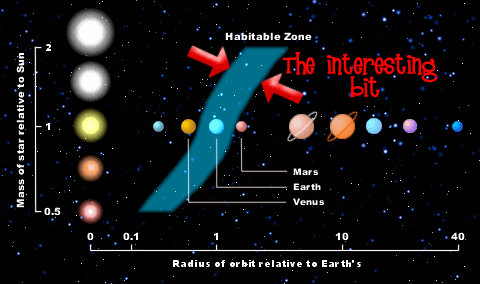
The habitable zone is the orbital region close enough to a star for a planet to have liquid water, but not so close that all of the water evaporates. For our Sun, the zone extends roughly from the inner edge of the orbit of Mars to the outer edge of that of Venus. For smaller, cooler stars, such as M-class dwarfs, the zone can be considerably closer to the star than Mercury is to the Sun. And because close-in planets are easier to spot than more distant ones, such stars have been a major target for planet hunters seeking Earth-like worlds.
There’s just one problem with finding habitable planets around such stars, says Barnes. Because tidal forces vary dramatically with the distance between a planet and its star, closer orbits also result in massively larger tidal forces.
Since planets do not have perfectly circular orbits, these tidal forces cause the planet to flex and unflex each time it moves closer to or further from its star; kneading its interior to produce massive quantities of frictional heat. Substantial heat can be produced, he added, with even slight deviations from a perfectly circular orbit. And, Barnes notes, other factors — such as the rate of the planet’s rotation and its axial tilt — can also influence heat production.
A similar tidal process makes Jupiter’s moon Io the most volcanic body in the Solar System. “I’m just scaling that Io–Jupiter system up by a factor of 1,000 in mass,” Barnes said at the meeting. “It’s the same process, on steroids.”
So, stars that are smaller and cooler will have a habitable zone that is closer to the star, exposing them to more tidal forces. More tidal forces makes their orbits less likely to stay circular – within the habitable zone around the star. These variations cause an increase in heat production on the planet. Too much heat means that the planet is unable to support liquid water on the surface, making it inhospitable for life. Therefore, solar systems with less massive stars can be ruled out as possible sites for life, because of these tidal forces.


 WINTERY KNIGHT