Tag Archives: God

Why would God want us to praise him?

From Amy K. Hall, staff apologist at Stand to Reason. (H/T The Poached Egg)

Excerpt:

I was recently asked why God would want us to praise and worship Him. This is a question I hear every so often since we immediately assume that a person who demands praise is a pompous big-head. I think there are many Christians out there who secretly wonder about this—afraid to ask the question (lest they be thought unspiritual), but bothered all the same.

God is completely self-sufficient and doesn’t need our praise and worship. However, He does deserve it. Would you agree that it is right and good to praise someone who is worthy of praise? We instinctively know this and praise people for all sorts of achievements. We praise the people we love and admire, and it’s not right or good for us to withhold praise from them.

We all understand the concept of praise being due certain people. Imagine that you crafted an incredibly beautiful sculpture and won a prestigious award for your creation; but when the time came for the award ceremony, they gave the prize for your sculpture to the wrong artist! That would not be just, right, or good. In the same way, God—as the only being perfect in goodness, justice, love, etc.—is worthy of our praise. We do, in fact, owe Him that praise. He wants us to praise Him because it is right and good for us to do so. Since God wants us to do right and good things, of course he wants us to praise and worship Him.

Beyond the praise being right and good (and because of its being right and good), worshiping God also brings us joy and enhances our relationship with Him. We see this in human relationships as well—think of a man with his wife. Doesn’t it bring him great joy to praise her?

I think it it’s interesting to note that very often, non-theists try to explain things like the creation of the universe and the fine-tuning of the universe and the origin of life as being the result of blind forces. That is the opposite of praise – that is speculating about nature to avoid giving credit to nature’s Creator and Designer. They are trying to escape the obligation to worship by attributing the great miracles of God to no one, so they can be accountable to no one. This is not the kind of thought life that God looks kindly on.

One important result of studying the world, including science, is to be able to understand what God has done in the world and to give him appropriate recognition for it. It is part of being in a relationship with him that we know him and respond appropriately to his real character. The refusal to acknowledge God is one of the symptoms of rebellion against him.

Matthew 10:32-33:

 32 “Whoever acknowledges me before others, I will also acknowledge before my Father in heaven.

33 But whoever disowns me before others, I will disown before my Father in heaven.

And this also appears in Luke 12:8-10:

8 “And I tell you, everyone who acknowledges me before men, the Son of Man also will acknowledge before the angels of God,

9 but the one who denies me before men will be denied before the angels of God.

10 And everyone who speaks a word against the Son of Man will be forgiven, but the one who blasphemes against the Holy Spirit will not be forgiven.

This passage is an early passage from Q, because it’s shared by Matthew and Luke, and Q is a source for those two early gospels. To get on the right side of this verse, it’s important to study what God has done, so you can give him the praise that he has earned. He wants to be acknowledged, and we want to hold up our end of the relationship and give him that acknowledgement. He did the deeds, and that means he should get the recognition for it.

One more thing I want to say about this. I see a lot of people singing songs about God in church, expressing praise for things they have no reason to believe that God has done. I think a good way to have authentic praise for God is to tone down the singing in groups and the emotional highs and the pretty buildings for a while, and focus on apologetics. Focus on learning the real stuff that God has actually done that we can know about – by studying science and history. In fact, it really scares me when I see young people singing and raising their hands and closing their eyes at church when I know good and well they have no intellectual grounding for these activities – it makes me feel like I am in some cult or something, surrounded by self-serving, fun-seeking weirdos.

You know that brings up an interesting question. What do you suppose would happen if I gathered together all the pastors and singing church people into a room and told them that we were going to do a scientific study of what God has done in nature, and a historical study of what God has done in history? My guess is that they would attack me, drive me out of the church, and go back to singing songs in groups with big musical bands and colorful lights in the ceiling. I think we need to guard against making Christianity about feelings and experiences and group gatherings, and make it more about knowledge. What has God really done that we can know about?

Let’s lay down a base of knowledge about God from nature and history, and then once we know he is real and he is good, we can talk about theology, and praising him for all of that. We don’t want what we do in church to be in anyway comparable to what non-Christians do in night clubs and concerts – gathering in groups and dancing around ecstatically. Blech! Christianity is about truth, not feelings.
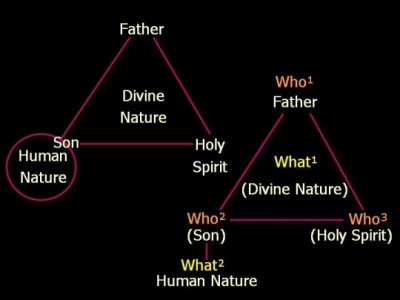
What is the Christian doctrine of the Trinity?

The Christian doctrine of the Trinity

I have a friend who is considering Christianity and he is stuck on the doctrine of the Trinity. Tom, this one’s for you.

Excerpt:

So, what exactly do we mean when we talk about the Trinity? Writing in the early third century, in hisAgainst Praxeas, Tertullian is credited with first employing the words “Trinity”, “person” and “substance” to convey the idea of the Father, Son and Spirit being “one in essence — but not one in person”. Indeed, Tertullian writes,

“Thus the connection of the Father in the Son, and of the Son in the Paraclete, produces three coherent Persons, who are yet distinct One from Another. These Three are, one essence, not one Person, as it is said, “I and my Father are One,” in respect of unity of substance not singularity of number.”

This concept was established as church orthodoxy at the famous Council of Nicaea in A.D. 325. The Nicene Creed speaks of Christ as “God of God, Light of Light, very God of very God, begotten not made, being of one substance with the Father.”

It is this definition that I am going to assume in the discussion that follows. Succinctly, then, the doctrine of the Trinity may be defined thusly: Within the one being or essence that is God, there exists three co-equal and co-divine distinct persons — namely the Father, Son and Holy Spirit — who share that essence fully and completely. This concept is not to be confused with polytheism, which maintains that there are multiple gods. While orthodox Christianity emphatically holds there to be only one God, we nonetheless understand God to be complex in his unity. The concept is also not to be confused with the ancient heresy of modalism, which maintains that God exists in three different modes. The Son has never been the Father and the Holy Spirit has never been the Son or the Father. Modalism is refuted by the picture given to us in all four gospels (Matthew 3:16-17; Mark 1:9-11; Luke 3:21-22; John 1:32-34) in which the Holy Spirit descends on Jesus in the form of a dove and a voice is heard from Heaven “This is my beloved Son. With him I am well pleased.” Similarly, it should be noted that the Father, Son and Spirit do not each make up merely a third of the Godhead. Rather, each of the three persons is God in the full and complete sense of the word.

Having shown that Scripture emphatically rejects the notion that the Father, Son and Spirit are synonymous persons, only five propositions remain to be demonstrated in order to provide Biblical substantiation for the concept of the Trinity. Those propositions are:

  1. There is only one eternal God.
  2. The Father is the eternal God.
  3. The Son is the eternal God.
  4. The Holy Spirit is the eternal God.
  5. Although the Father, Son and Holy Spirit are non-synonymous persons, the concept of the Trinity does not violate the law of non-contradiction.

Let’s take a look at each of these in turn.

He then takes a close look at what the Bible says about God with respect to those assertions. There can be no doubt that the Bible teaches that God is one divine substance, and three persons.

Physicist Michael Strauss discusses Christianity and science at Stanford university

This is one of my favorite lectures, by one of the people I admire the most for his scientific work and robust, evangelical Christian faith.

About Michael Strauss:

His full biography is here. (I removed his links from my excerpt text below)

Excerpt:

I had an interest in science and theology, so in 1977 I chose to go to Biola University where I could study both subjects in detail. I thoroughly enjoyed college and participated in intramural sports, was elected to student government, served as a resident assistant, competed in forensics, and studied a lot. As I neared college graduation my dual interest continued so I applied to seminary and to graduate school. After graduating summa cum laude from Biola, I decided to pursue a graduate degree in physics at UCLA.

During my first few years of graduate school, I developed an increased interest in quantum mechanics and subatomic physics and decided to do research in a field that dealt with these subjects. I joined a High Energy Physics experimental group doing research at the Stanford Linear Accelerator Center (SLAC) and moved to the San Francisco Bay Area to actively participate in research at SLAC. I graduated in 1988 with my Ph.D in High Energy Physics (a.k.a. Elementary Particle Physics). If you would like to know more about High Energy Physics, the Particle Data Group at Lawrence Berkeley Laboratory has a very nice interactive adventure that teaches you all about the subject. My research advisor was professor Charles Buchanan and my disertation was titled “A Study of Lambda Polarization and Phi Spin Alignment in Electron-Positron Annihilation at 29 GeV as a Probe of Color Field Behavior.”

After graduation, I accepted a post-doctoral research position with the University of Massachusetts at Amherst. I continued to do research at SLAC where I joined the SLD experiment. My research interests centered on the SLD silicon pixel vertex detector. I wrote most of the offline software for this device, and did physics analysis which used the vertex detector, including tagging b quark events for flavor specific QCD (Quantum Chromodynamics) analysis. In the seven years I was employed by UMASS, I only spent 3 days on the Amherst campus. The rest of the time was spent in California.

[…]In August 1995, I accepted a job as an Assistant Professor of Physics at the University of Oklahoma (OU) in Norman, Oklahoma. The University of Oklahoma has a vibrant high energy physics research group involved in experiments at the Fermi National Accelerator Center (Fermilab), and CERN. I joined the DØ experiment at Fermilab where I continue to do research in elementary particle physics. As a member of the DØ collaboration I have made contributions to the testing of silicon sensors for the upgraded vertex detector, to the track finding algorithms, to a measurement of the photon production cross section which probes the gluon content of protons, and to other QCD measurements. I am currently studying properties of B mesons that contain a b-quark, the production cross section of jets coming from quarks and gluons, and other QCD analyses. At CERN, I am a collaborator on the ATLAS detector.

I received tenure in 2001 and was promoted to the rank of Professor in the summer of 2010. Most of the time at OU I have taught introductory physics classes to physics majors, engineers, and life science majors. In these classes I have used a number of interactive techniques to facilitate student participation and learning. I have been privileged to win a few awards for my teaching. In 1999, the Associated Students selected me as the Outstanding Professor in the College of Arts and Science, and in 2000 I was awarded the BP AMOCO Foundation Good Teaching Award. In 2002, I was given the Regents Award for Superior Teaching. I received the Carlisle Mabrey and Lurine Mabrey Presidential Professorship in 2006 which is given to “faculty members who excel in all their professional activities and who relate those activities to the students they teach and mentor.”

He seems to have done a fine job of integrating his faith with a solid career in physics research. It would be nice if we were churning out more like him, but that would require the church to get serious about the integration between science and faith.

The lecture:

Dr. Strauss delivered this lecture at Stanford University in 1999. It is fairly easy to understand, and it even includes useful dating tips, one of which I was able to try out recently at IHOP, and it worked.

You can also listen to the audio here. (MP3)

Summary:

What does science tell us about God?
– the discoveries of Copernicus made humans less significant in the universe
– the discoveries of Darwin should that humans are an accident
– but this all pre-modern science
– what do the latest findings of science say about God?

Evidence #1: the origin of the universe
– the steady state model supports atheism, but was disproved by the latest discoveries
– the oscillating model supports atheism, but was disproved by the latest discoveries
– the big bang model supports theism, and it is supported by multiple recent discoveries
– the quantum gravity model supports atheism, but it pure theory and has never been tested or confirmed by experiment and observation

Evidence #2: the fine-tuning of physical constants for life
– there are over 100 examples of constants that must be selected within a narrow range in order for the universe to support the minimal requirements for life
– example: mass density
– example: strong nuclear force (what he studies)
– example: carbon formation

Evidence #3: the fine-tuning of our planet for habitability
– the type of galaxy and our location in it
– our solar system and our star
– our planet
– our moon

Positive arguments for Christian theism