Tag Archives: Gay Marriage

ADF offers advice on SCOTUS marriage redefinition ruling

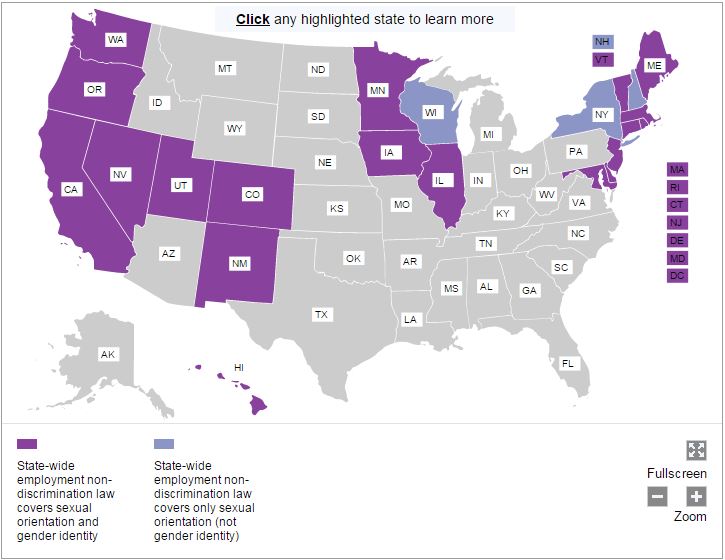
States with non-discrimination laws

(Source: ACLU)

Erik Stanley of the Alliance Defending Freedom offers advice to churches on how to respond to the Supreme Court’s decision to redefine marriage to remove the gender requirement.

He says:

[…][T]he greatest threat for churches lies in the application of the Court’s decision to believers who live in jurisdictions covered by so-called “non-discrimination” laws and ordinances. Everywhere that marriage has been redefined in the last several years has seen an awakening of non-discrimination laws that prohibit discrimination in employment, housing, or places of public accommodation on the basis of sexual orientation or gender identity. These laws are peppered throughout the states and local governments and are a linchpin of the sexual revolution’s broader legal and political strategy: to establish non-discrimination laws at all levels throughout the country and to to “ensure that religion is not used as an excuse to discriminate.”

In coming days, the threat from these non-discrimination laws will materialize in numerous ways as same-sex couples marry. But there are proactive steps your church can take to protect itself.

I put the map from the ACLU above. I think that’s what he is talking about when he says non-discrimination states. Keep in mind that the ACLU supported redefining marriage, and opposes religious liberty.

Erik’s article covers 3 areas:

  1. Church’s statement of faith
  2. Pastors officiating same-sex marriage ceremonies
  3. Church’s facility usage policy

Part 3) was the most interesting to me:

3. Churches should ensure their facilities usage policies are revised to allow only uses consistent with the church’s religious beliefs.

In the wake of the Supreme Court ruling, some churches may be approached by same-sex couples seeking to be married in the church facility. Churches should not feel as if they have to close their doors to the community just to prevent wedding ceremonies with which they disagree. Churches must continue to be a welcoming presence in the community and can do so through updating or revising their facility usage policy. The key point is to tie usage of the church’s facility to the statement of faith and religious beliefs of the church. And then to make clear that uses inconsistent with those religious beliefs will not be allowed. Alliance Defending Freedom has a sample facilities usage policy available in our Protecting Your Ministry manual.

So you update your statement of faith, and then tie usage of the the facility to that statement of faith. Simple.

I took a quick look at the booklet, and it also talked about tying employment within the church and church membership to the statement of faith.

Denny Burk summarizes those:

2. Religious Employment Criteria

Your church can best avail itself of the First Amendment’s protection in employee disputes if you create and faithfully enforce religious employment criteria for every employee. That requires churches to do at least two things: (1) require all employees and volunteers to sign a statement affirming the church’s statement of faith and standards of conduct, and (2) create written job descriptions for every employee and volunteer position.


4. Formal Membership Policy

If your church does not have a membership policy, you need to change that. Biblically, this should already be a priority for your church. You need to specify what the requirements for membership are, how one joins, how one resigns, and the procedures for church discipline. If all of this isn’t spelled out up front, your church could be exposed (see ADF guide pp. 17-18).

So what to make of this? Well, the ADF is an organization that I admire and trust. I cannot abide Christians who do not want to understand the details of what is happening with religious liberty in their country. The ADF has first class lawyers from the top law schools, and they defend religious liberty at every level of our justice system, up to and including the Supreme Court. If you want to help your church protect itself from prosecution, then you must point them to the ADF booklet linked above.

And this is especially true if you are in one of those states in the map above. In looking over the map, I noticed that much of the trouble we have been having with Christian businesses getting sued are in states that have these laws… Oregon, Washington, New Mexico, New York, and so on. Pay attention to that map and make decisions about where to live accordingly.

This woman’s husband left her for his business partner and took her kids

A striking story from the Public Discourse.

Excerpt:

In the fall of 2007, my husband of almost ten years told me that he was gay and that he wanted a divorce. In an instant, the world that I had known and loved—the life we had built together—was shattered.

I tried to convince him to stay, to stick it out and fight to save our marriage. But my voice, my desires, my needs—and those of our two young children—no longer mattered to him. We had become disposable, because he had embraced one tiny word that had become his entire identity. Being gay trumped commitment, vows, responsibility, faith, fatherhood, marriage, friendships, and community. All of this was thrown away for the sake of his new identity.

Try as I might to save our marriage, there was no stopping my husband. Our divorce was not settled in mediation or with lawyers. No, it went all the way to trial. My husband wanted primary custody of our children. His entire case can be summed up in one sentence: “I am gay, and I deserve my rights.” It worked: the judge gave him practically everything he wanted. At one point, he even told my husband, “If you had asked for more, I would have given it to you.”

I truly believe that judge was legislating from the bench, disregarding the facts of our particular case and simply using us—using our children— to help influence future cases. In our society, LGBT citizens are seen as marginalized victims who must be protected at all costs, even if it means stripping rights from others. By ignoring the injustice committed against me and my children, the judge seemed to think that he was correcting a larger injustice.

[…]At the time of the first ceremony, the marriage was not recognized by our state, our nation, or our church. And my ex-husband’s new marriage, like the majority of male-male relationships, is an “open,” non-exclusive relationship. This sends a clear message to our children: what you feel trumps all laws, promises, and higher authorities. You can do whatever you want, whenever you want—and it doesn’t matter who you hurt along the way.

[…]Our two young children were willfully and intentionally thrust into a world of strife and combative beliefs, lifestyles, and values, all in the name of “gay rights.” Their father moved into his new partner’s condo, which is in a complex inhabited by sixteen gay men. One of the men has a 19-year-old male prostitute who comes to service him. Another man, who functions as the father figure of this community, is in his late sixties and has a boyfriend in his twenties. My children are brought to gay parties where they are the only children and where only alcoholic beverages are served. They are taken to transgender baseball games, gay rights fundraisers, and LGBT film festivals.

Both of my children face identity issues, just like other children. Yet there are certain deep and unique problems that they will face as a direct result of my former husband’s actions. My son is now a maturing teen, and he is very interested in girls. But how will he learn how to deal with that interest when he is surrounded by men who seek sexual gratification from other men? How will he learn to treat girls with care and respect when his father has rejected them and devalues them? How will he embrace his developing masculinity without seeing his father live out authentic manhood by treating his wife and family with love, honoring his marriage vows even when it’s hard?

My daughter suffers too. She needs a dad who will encourage her to embrace her femininity and beauty, but these qualities are parodied and distorted in her father’s world. Her dad wears make-up and sex bondage straps for Halloween. She is often exposed to men dressing as women. The walls in his condo are adorned with large framed pictures of women in provocative positions. What is my little girl to believe about her own femininity and beauty? Her father should be protecting her sexuality. Instead, he is warping it.

Without the guidance of both their mother and their father, how can my children navigate their developing identities and sexuality? I ache to see my children struggle, desperately trying to make sense of their world.

When I was younger and considering marriage, I thought a lot about no-fault divorce and how I would feel about my wife leaving me because she wanted to find herself in Europe, or something. I thought about the feminist judge who would give her custody of our children, and force me to pay alimony and child support. Marriage did not seem like a good risk to me then. I guess part of me always thought that feminists would be the only bad guys in this sexual revolution, and men and children were the victims of feminist selfishness. But this woman’s story really makes me realize how women can be just as much the victims of judicial activism as any man was under no-fault divorce laws. That story she told about the activist judge just made my blood run cold. What must that have been like for her, to lose custody of her kids and have them put into the “gay lifestyle” Grindr-style environment? My heart goes out to her.

Previously, I blogged about Dawn Stefanowicz‘s story of growing up with a gay father.

Jennifer Roback Morse debates on marriage at Columbia University

Cloning her would solve the marriage problem
Dr. J makes marriage interesting and fun

Dr. Jennifer Roback Morse defends marriage at Columbia University in this short hour-long exchange. This is your chance to hear how anti-child advocates of same-sex marriage really are. And Dr. J links SSM to unilateral divorce at the end of the Q&A, too. Awesome! This debate really needed to go for twice the time, and I look forward to hearing MORE debates from Dr. J.

Details:

Columbia University’s Federalist Society hosts a debate between Dr J and Professor Katherine Franke based on the question “Is Marriage Equality Possible?”  About an hour of audio includes opening position (Dr J), arguments (Prof. Franke), and rebuttal (Dr J), as well as a brief question-and-answer period.

The MP3 file is here.

Dr. J’s opening speech (15 min.)

Two basic contentions:

  • 1) same-sex marriage is not the equivalent of traditional marriage
  • 2) if we legislate that they are equal, then we are really redefining marriage by changing the essential purpose of marriage

A case study from Ireland:

  • a known sperm donor for a lesbian couple was excluded from having a relationship with the child he conceived
  • after the child was born, the sperm donor wanted regular contact with the child, but the women opposed giving him access
  • same-sex marriage requires that courts are able to assign parental rights instead of having rights assigned biologically, as with traditional marriage
  • That is why SSM is different from TM

What is the purpose of marriage?

  • Marriage is about attaching mothers and fathers to children, and mothers and fathers to one another
  • Children are born helpless from two opposite-sex parents and they need parental guidance and care during development
  • In TM, there is no third party needed in order to have a child
  • In TM, the biological parents have rights and responsibilities for the child
  • TM is about providing the child with justice
  • Every child is entitled a relationship to both biological parents, and is entitled to care, protection and nourishment from both parents, and every child is entitled to a stable family environment
  • the problem is that children don’t have standing to sue for these rights in court
  • so the purpose of marriage is that we have a social construct to provide these rights to children naturally, without the state having to intervene

The purpose of marriage according to SSM?

  • In SSM, the essential child-centered  purpose marriage is replaced with new purposes like pooling resources and having same-sex couples recognized by society

SSM redefines marriage in four ways:

  • it diminishes the entitlement of children to a relationship with both biological parents
  • it diminishes the identification of parental roles with biology
  • it requires the state to determine parental relationships, instead of recognizing biological parents
  • it enshrines the idea that mothers and fathers are interchangeable, that children don’t really need mothers AND fathers

Dr. Franke’s opening speech (20 min.)

Hard cases make bad law 1: the presumption of paternity

  • consider the case where a mother is married and has an affair resulting in a child
  • the Supreme Court has ruled that the father of the child has no right of contact
  • this is a case where marriage gets in the way of biological parents having a relationship with the child
  • so it can be the case where marriage is in conflict with the relationships to biological parents

Hard cases make bad law 2: the purpose of marriage can be changed

  • marriages was used to keep peace between families and communities
  • marriage used to be about trading and trafficking of women
  • so the concern for offspring was not always the greatest concern

TM and SSM are both equally able to create stability for children:

  • same-sex unions are just as stable for children as TM marriages

Same-sex unions do provide justice for the child:

  • giving the adults in same-sex couples the social recognition that opposite sex married couples have is good for children

Children can sue in court

  • children can use guardians to sue their parents in court to get their rights

Opposing SSM is racism

  • opposing same-sex marriage is equivalent to racism
  • we could abolish marriage completely and let individuals form private contracts, then the state would really be neutral on marriage

Dr. J’s rebuttal speech (5 min.)

The state cannot be neutral on marriage

  • what the deinstutionalization of marriage means is that the private contracts are made by adults and children will have no consideration in those contracts

Regarding the adultery case

  • the presumption of paternity is there to protect the marriage
  • such borderline cases almost never happen with TM, whereas in SSM these third party problems occur in 100% of the cases

Children are not happy being separated from their biological parents

  • adults do not have a right to exclude a child’s biological parents from having a relationship with them, and children are often not happy being excluded from their biological parents