

The article that I am linking to in TODAY’s post is from the far-left Huffington Post. Please do not read the article if you are under 30. Huffington Post, like most radical feminism web sites, has dropped down to the level of 50 Shades of Gray. Reader discretion is advised. But I had to write about their article because it really shows you that radical feminists are not innocent little doves hoping for traditional marriage and children.
First, a little introduction. Radical feminism is a rejection of traditional sex roles for men and women, and the committed union of men and women in marriage.
Here is what radical feminists oppose:
- female sobriety when among the opposite sex
- male sobriety when among the opposite sex
- female chastity prior to marriage
- male chastity prior to marriage
- women preparing for the traditional roles of wife and mother
- men preparing for the traditional roles of protector, provider, moral leader and spiritual leader
- paying for their own condoms and birth control pills
- men who are pro-life and pro-natural-marriage
Radical feminism wants nothing to do with men who are sober and chaste. The only real way to decide whether a man is good or bad – for a radical feminist – is whether he is attractive looking and does not try to lead women or hold them accountable morally or spiritually. Men are just accessories designed to provide women with fun and thrills. They are not to be selected for their ability to perform “sexist” virtues like chivalry, providing or leadership.
Now, feminists have been very unhappy lately, because their plan for forming relationships (focus on career, choose hot guys, get drunk, have premarital sex, wait by the phone, claim that all men are evil when no one calls, repeat) doesn’t work. But radical feminists don’t see the problem with their promiscuity plan. They don’t think that marriage is a good thing, because it has unfair sex roles. And they don’t think that women or men should prepare for commitment by being sober, chaste and self-sacrificial. They think that they can choose pleasure right now, and at every moment following, and that this will somehow work out to provide them with lasting love, support and intimacy as they grow older. Somehow, after they tire of sexual revolutionisting with the hot guys, they will easily be able to find a man who is simultaneously hot and sober, faithful, committed, and a great father to whichever children she decided not to abort. And if this plan doesn’t “work out”, then it’s the fault of patriarchy and toxic masculinity.
The Huffington Post article explains why radical feminists think that their plan is failing:
[…][S]ome straight women have thrown their hands up in despair at the prospect of dealing with straight men. These men, who grope us and talk down to us and consistently fail to clean the bathroom ― we’re supposed to make lives with them? Let them touch us?
Women woke up one day to find that their husbands voted for Donald Trump and their sons have been ***posting on incel boards. Even before we heard the claims about Harvey Weinstein’s history of sexual harassment and assault and the ensuing avalanche of other horrifying Me Too allegations, we heard about our president grabbing women “by the pussy,” Bill Cosby feeding women roofies, and R. Kelly allegedly sexually exploiting young girls. So many straight men, we have been forced to accept, are bad to and for us. Why would we take the enormous risk of loving one of them?
All the bad boy leftist men they freely chose to have premarital sex with for money or career advancement failed to please them. And all men must be the same. After all, radical feminists rejected traditional male virtues and roles as “sexist”. Instead, they decided to have premarital sex with secular leftists like Bill Clinton, Anthony Weiner, Elliot Spitzer, etc. Those men are fun and thrilling, and might even help your career. If these relationships failed, then surely the relationships not chosen – the ones with the sober, chaste, responsible men – would have failed, too, right? You don’t expect a woman to have a relationship with someone who doesn’t support abortion and gay marriage, do you? How could a man who is pro-child and pro-marriage possibly be suitable for commitment and parenting? Just choose the hot ones who make you tingle, and then generalize about all men from those failed experiments.
More:
One seductive yet impossible fantasy might be the romantic attention of a man who lacks the exhausting baggage of male entitlement.
To find such a fantastical being, women ― in fiction, at least ― have turned to the sea.
Yes, the radical feminists are turning to the sea to find fictional mermen who meet their feminist ideals for relationships.
More:
Lucy, the protagonist of The Pisces, is newly single, running out of time to finish her dissertation, and spiraling out of control.
[…]Despite the therapy sessions, Lucy can’t stop searching for male attention to restore her sense of desirability and worth. Before each encounter with a prospect, she feels buoyant and eager, but again and again, she’s left sexually and emotionally unfulfilled, in part because the men don’t much care whether she’s enjoying herself.
One man she meets on an app ― a hot younger dude in an open relationship ― convinces her to have sex with him in the lobby bathroom of an upscale hotel. It’s quick and mediocre. She doesn’t come. Afterward, he leaves without telling her, stranding her alone at the hotel bar. Lucy thought the encounter would be something different, that it would make her feel deliriously sexy and desired. She tries not to let herself feel sad about how transparently he was using her to fulfill his fantasy while her own went entirely ignored. What she wants is for even this one-time fling to care desperately about making her come, for his world to narrow around her pleasure, even for just a few minutes.
Wow, the hot bad boys don’t care about the women who choose them for irresponsible recreational premarital sex? If only there were some way to keep a man committed? It can’t be marriage though, and acting like a wife. That’s “sexist”. I’m surprised that having recreational premarital sex with a hot, promiscuous pro-abortion pro-gay-marriage Democrat doesn’t lead to the woman enjoying herself in the long term.
It’s mermen to the rescue, though:
When she begins to fall for Theo, a tautly handsome swimmer she keeps seeing in the ocean near her sister’s beachside home, it seems like she may have found the something that couldn’t exist. Theo looks decades younger than her, but he is fascinated by her. He seeks her out, pulling up by the rocks at the edge of the beach to talk with her night after night. He wants to kiss her, then give her oral sex for hours under the stars. Soon, she learns that there’s a reason he initially stayed submerged from the waist down during their encounters: He’s what we might call a merman, and instead of legs he has a scaly tail.
Like the creature in “The Shape of Water,” Theo seems to be an exception to the rule of toxic straight maleness. Where other men hurt, threaten and betray, these unhuman beings pleasure, console and conspire with women.
[…]Her ex toys with her emotions; the men she dates are sexually selfish and reckless with her health. But Theo is different, both because he has a scaly tail instead of legs, and because he proclaims to be devoted to her and her pleasure.
After some discussion about the wonders of the merman’s equipment, (so important to a radical feminist!), we read this:
….there’s also an unmistakable queerness to these mythical, human-like creatures. They transgress the boundaries of what society traditionally demands from a male body. Lucy even notes a feminine quality to Theo…
[…]This story is a seductive one, especially to straight women who yearn to get outside of the oppressive structures and expectations of their dating realm. What if we found men who were different? Who were in touch with their emotions, called themselves “feminist allies” for reasons other than wanting to center themselves in the movement, enjoyed giving us orgasms, texted right after the first date?
Wow, she will get treated so well, and without having to marry him (sexist!), or commit to care for his needs (patriarchy!), or fulfill loving obligations for him in a restrictive long-term commitment (slavery!).
She can have sex with a hot sexy effeminate fish who is DECADES younger than she is, who doesn’t have a job or savings, and who isn’t able to be a father to children in any normal sense. But who cares! As long as he wants to give her orgasms, and he’s young and hot, and doesn’t try to tell her to get a real degree, or to get a real job, or to grow up and get married and have children who can take care of her in her old age. The merman provides all that’s important to radical feminists.
And I’m sure that this plan is sustainable, too. He will love her just as much when she is old and wrinkly, because giving a merman premarital sex always makes him commit self-sacrificially for life. That’s the power of recreational premarital sex – it turns irresponsible young hot mermen into pleasure-giving slaves for life.
Radical feminism changes men’s perceptions of women in the workplace

Lately, we’ve seen an outburst of radical feminism as more women have been equating actual rape and sexual assault with sexist comments or clumsy passes. How does this change how women are perceived in the workplace?
Here’s an article from Medium (H/T Tracy) by an anonymous male feminist.
The first point is about how women handle disagreement, compared to men:
When James Damore was asked for feedback from his supervisor and internally circulated his google memo, it got leaked, he got fired and women stayed at home the next Day because “for emotional reasons”
A ten page summary of data and analysis from Damore was enough to “emotional distress” the women at the company.
This lack of resilience and self-control disrupts the workplace, and results in lost productivity. If it turns into a lawsuit, the costs are even higher. This is in addition to women having fewer STEM degrees than men, working fewer hours than men, and taking months leave for pregnancy. Not to mention affirmative action hiring and promoting in order to meet quotas of women.
Second point, is increased hostility to men.
Look at this tweet from a writer at Teen Vogue:
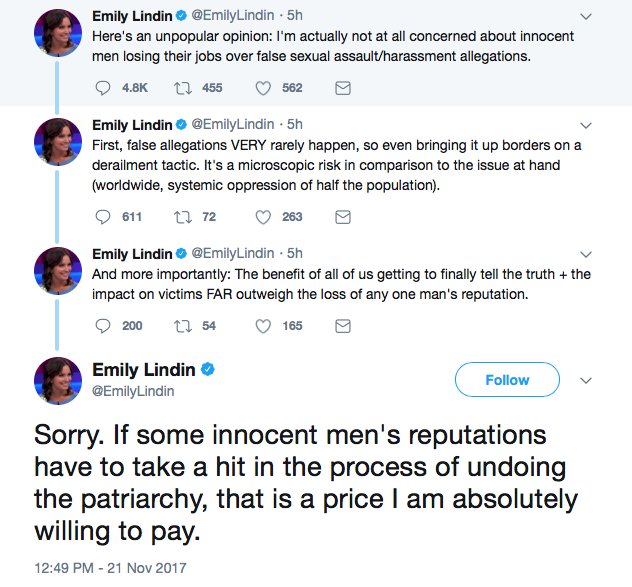
She has 23,000 followers on Twitter – this woman is mainstream. I looked into her background a bit. No mention of a father at home, and a self-confessed “slutty” lifestyle from her early teens onward. Her entire writing career seems to be to attack everyone who disagrees with her promiscuity.
Feminism, as an ideology, does not allow women to prefer men who exhibit traditional masculine characteristics: providing, protecting, moral and spiritual leadership, chastity, fidelity. That’s “sexist”. So what’s left? Get drunk and have sex with the hot bad boys, since evaluating a man’s character is “sexist”. Then promote false accusations and misandry to get revenge against the hot bad boys you freely chose. This will only get worse as more radical feminists waste their 20s on hot bad boys, and raise more fatherless girls when they become single mothers by choice, in their 30s.
Do men want to work with women who hate men and make false accusations with people they disagree with? I’m a conservative, Christian, pro-life virgin. I disagree with all premarital sex. If this woman worked with me and found out my views, she would almost certainly get me fired.
Another article from Medium (H/T Wes) makes a third point about how conservatives are treated by liberal women in the workplace. The article is written by a female senior software engineer, who promotes STEM to women and the elderly. She is a self-described “moderate conservative”.
Excerpt:
On September 27, 2017, I decided to attend the Atlanta Google Women Techmakers’ event “Idea Jam Session,” which was hosted at TechSquare Labs in Atlanta. At that time, I was still an active member of Women Who Code, the Atlanta GDG, and Google Women Techmakers and, perhaps naively, I just assumed that I had every right to attend the event like any other member of the group because I had not been banned.
Upon arriving at the event, Maggie immediately asked me to leave the room. At the door, she informed me that she would be extremely uncomfortable if I remained a member of the community because some of the views that I had expressed on Twitter are “very harmful to gender equality”. She then asked Daniel Sabeo, the event coordinator at TechSquare Labs, to escort me from the facility. I was deeply upset at being publicly humiliated, but left willingly without causing any disruption.
Two days later, I got an email from TechSquare Labs. Daniel had discussed the incident with Allen Nance, Paul Judge, and Rodney Sampson, the owners of the facility, and he informed me that they had collectively decided to ban me and my company from using their venue or attending any of their events because they were concerned about the “safety” of their members. I later learned from a fellow developer that Maggie had, in fact, told various people that I’d been stalking her.
[…]The following week, Martin Omander, GDG program manager for North America, formally banned me from the Google Developer Group and Google Women Techmakers and, again, declined to provide me with any details of the complaints against me or the rules that I’d allegedly violated.
How many women are likely to attack conservatives in the workplace?
Young, unmarried women voted 78% to 22% for Obama in 2008, according to exit polls.
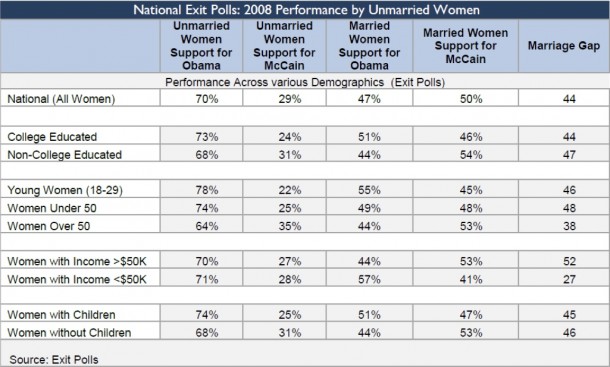
Obama was a radical feminist president who voted against banning infanticide multiple times as a state senator in Illinois. 78% of young, unmarried women voted for him anyway. Women who graduate from college in non-STEM fields are especially progressive. In my experience, young, unmarried women typically form their views by adapting to the dominant views of their community, which is overwhelmingly liberal on campus. In my experience, men are more likely to construct a worldview through reasoning and evaluating evidence.
I’ve personally never met a young, unmarried woman who could answer basic political questions, like naming prior terrorist attacks against the United States, US allies, or US assets abroad, or telling me the amount of the national debt. In my experience, young unmarried women are not concerned with the plight of women in Iran, Pakistan or Afghanistan. They’re not concerned with spending money today that will be paid back by generations of taxpayers not yet born.
Instead, I usually hear that they are progressive because they want taxpayer-funded abortions, taxpayer-funded contraception, no-fault divorce, single mother welfare, student-loan forgiveness, etc. They want taxpayer-funded bailouts for problems caused by their own free choices. They feel that if society is paying for something, then it’s “normal” and they don’t have feel guilty about making poor choices. Their primary concern about politics is being able to do what they feel like without anyone disapproving. Everything bad that happens is “unexpected”, and so society should have to pay for it. It wasn’t their fault that their “follow-your-heart” plan didn’t work out.
I don’t even speak to young, unmarried women about religion and politics in the workplace. It doesn’t matter if we have the same views or not. Feeling offended and going full totalitarian is just too widespread. The rational choice for men is to disengage. I can have conversations safely about religion and politics with men, even if they disagree with me.
Christian case maker warns Christians to trust the evidence, not their feelings

Alisa Childers posted a review of a recent dialog between Dr. Sean McDowell and former-Christian Bart Campolo, son of far-left progressive fake Christian Tony Campolo. The dialog occurred on the Unbelievable radio show.
Here’s an exerpt from Alisa’s review:
Recently, the two came together to have a discussion on Premier Christian Radio entitled, “Why Bart Lost His Faith, Why Sean Kept His.” It was a fascinating discussion, and the thing that most struck me was the reason they each gave for having become a Christian in the first place. Campolo described how he converted to Christianity after finding a youth group he connected with and attending one of their retreats:
There’s hundreds of kids there. It’s Saturday night, there’s candlelight and firelight and everybody’s singing “Our God is an Awesome God,” and “We Love You Lord.” And in the midst of that kind of environment I had what I guess you would call a transcendent moment…I felt something. It felt like there was something happening in that room that was bigger than the group. I felt like I was connecting to something. And in that moment ….that was God.
I heard something. It was real to me. People that don’t believe in transcendent experiences—I always think like, “You haven’t been to the right concert… You haven’t used the right drugs. You haven’t fallen in love with the right partner.”
These experiences are real, and I think whatever narrative you’re in when you have one, it confirms that narrative. If I would have had that same transcendent moment with my friends in a mosque in Afghanistan, it would have confirmed Islam to me. But I was in the Christian world, so from that point on, Jesus was real to me.
In Campolo’s own words, he became a Christian because of a transcendent experience….a feeling that resonated deeply in his heart.
He had a feeling, and he took that feeling as a reason for believing propositional claims about the external world. God’s existence? He had a feeling. Christ’s resurrection? He had a feeling. The reliability of the Bible? He had a feeling. Instead of focusing on truth, he spent his early life pursuing social justice. He didn’t look at evidence, he just tried to have experiences. He tried to chase feelings by having little Christian ministry adventures. Missions trips. Volunteer work. Community. Charismatic speaking to crowds about things he knew literally nothing about.
Further on in the dialog, he explains that his standard for allegiance is not truth, it’s literally “what works”. And he clarifies “what causes [people] to thrive, what causes [people] to flourish”. His emphasis (in his ministry) was always on feeling good by being nice to people, because they liked him. This perspective is rampant in the evangelical church, especially among progressive young people. The idea of testing the Christian worldview against science and history to see if it is true is absolutely out. Instead, it’s all about feeling good and making people like you by being nice to them.
Experiences made him an atheist. He worked with poor people, and he decided that God didn’t exist because he wasn’t making these people happy. He had gay roommates in college, so he decided that the Bible’s rules around sexual morality had to be wrong. Never any investigation of economics to understand poverty, no investigation of homosexuality in the peer-reviewed literature, etc. It was feelings all the way. A bit later, Campolo extols the virtue of blind faith, and blasts apologetics as ineffective at changing minds. And then later, he has a bicycle crash, and he becomes convinced from that accident that “this life is all we have”. So he disproved substance dualism, which is consistent with the Bible and supported by multiple lines of philosophical argumentation and experimental evidence… by having feelings about a bicycle crash.
Now, on this blog, we despise feelings and experiences. We discuss scientific evidence for a Creator and a Designer all the time. The origin of the universe, the fine-tuning, the origin of life, the Cambrian explosion, the habitality requirements, etc. For Campolo, Christianity was never about truth, and so he never conducted an investigation about whether it was true. The only God he would accept was a god who “worked for him” – who made him feel good, and who made people (including non-Christians) like him. It was all about him, never about adjusting himself to an objective reality that might have involved obedience to God, having some bad feelings, and being disliked by non-Christians.
The more emphasis that a person places on feelings, intuitions, travel, adventure, and social justice, the farther away they tend to be from analytical philosophy, historical investigation, scientific evidence, etc. You cannot establish the truth of a worldview by going on a missions trip to Haiti, or by holding orphans in Bolivia. The truth of Christianity is known through study of reality, using logic, science and historical analysis. Making feelings the foundation for a worldview is just a disaster waiting to happen.
Alisa has some words of caution to young Christians and their parents about experience as the root of a Christian worldview:
- You can be talked out of an experience.
- Your heart and feelings lie.
- You can fall back on evidence in times of doubt or suffering.
Here is number 2:
The prophet Jeremiah described the human heart as “deceitful above all things and desperately sick.” Proverbs 3:5-7 tells us not to “lean on our own understanding.” Jesus described the human heart as being filled with thoughts like murder, adultery, sexual immorality, theft, false testimony, and slander. Proverbs 28:26 tells us that whoever trusts his own mind is a fool.
In other words, do not, under any circumstances, follow your heart.
This, of course, stands in stark contrast to the themes we are constantly encountering in entertainment and on social media. However, when it comes to spiritual beliefs, trusting our hearts and following our feelings can lead to all sorts of aberrant theology, sinful choices, and a distortion of true Christian faith.
See that?
“In other words, do not, under any circumstances, follow your heart.”
We need more Christians saying this in the church. Especially Christian women – it’s better when women put evidence at the center of the Christian life, and push feelings out to the edges.
By the way, she mentions a quotation from J. Warner Wallace about not being a Christian because “it works for me“. I wrote a whole post about this.
If you want to read another deconversion story that shows how a focus on feelings and experiences leads to atheism, check out the story of Dan Barker. I know so many people who were raised in the church by pastors who were anxious to “protect” Christian truth claims from being proved or disproved by evidence. They thought that their approach was more pious – how dare we let science and history stand in judgment over the Bible? When I look at Dan Barker and Bart Campolo, I can see where that fideism ended up. Piety is a cheap way of gaining respect without having done any work. We need to demand better from pastors. They ought to be able to show their work. They ought to be able to demonstrate what reasoning and evidence led them to their convictions. Not their feelings and experiences, but actual reasoning and evidence.
The sooner we get to the point where Christianity is true because of reason and evidence, regardless of individual feelings, the better off we will be at being authentic followers of Jesus.
Finally, if you liked the Unbelievable show dialog between McDowell and Campolo, there is a 3-hour discussion on the same topic, which was held at the Faith Beyond Belief conference in Calgary, Alberta, Canada last week. The video has been posted on YouTube.
Positive arguments for Christian theism
- The kalam cosmological argument and the Big Bang theory
- The fine-tuning argument from cosmological constants and quantities
- The origin of life, part 1 of 2: the building blocks of life
- The origin of life, part 2 of 2: biological information
- The sudden origin of phyla in the Cambrian explosion
- Galactic habitable zones and circumstellar habitable zones
- Irreducible complexity in molecular machines
- The creative limits of natural selection and random mutation
- Angus Menuge’s ontological argument from reason
- Alvin Plantinga’s epistemological argument from reason
- William Lane Craig’s moral argument
- The unexpected applicability of mathematics to nature
- Six reasons why you should believe in non-physical minds
- William Lane Craig’s case for the resurrection of Jesus
 WINTERY KNIGHT